
Fortinet FortiSwitch FS-124F in Uganda
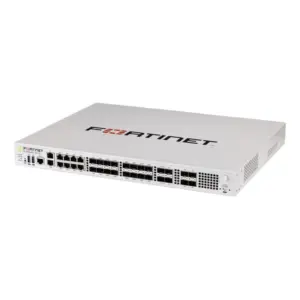
A 24-port Gigabit Ethernet access switch with four 10 Gigabit SFP+ uplinks for structured office, branch and campus-edge networks.
The FS-124F is built for organisations that need a practical wired access layer with strong uplink headroom, centralized management options and a quiet fanless chassis. It is the non-PoE member of the 124F family, so device-power requirements must be checked before purchase.
A compact access-layer switch for business LAN design
The FS-124F is part of Fortinet’s 100F Series of secure access switches. Its role is straightforward: connect wired endpoints at Gigabit Ethernet speed while providing four SFP+ uplink interfaces capable of 10 Gigabit Ethernet. For many small and medium business networks, branch offices and edge closets, that combination creates a useful balance between endpoint density and upstream bandwidth. Twenty-four copper ports can serve desktops, printers, servers, appliances and other Ethernet devices, while the faster uplinks can connect toward a FortiGate, aggregation switch, server or another appropriate upstream device.
Fortinet publishes a switching capacity of 128 Gbps and forwarding performance of 190 million packets per second for the FS-124F. The unit supports up to 4,000 VLANs, 32,000 MAC addresses, link aggregation groups and common access-layer switching capabilities. Those figures matter because an access switch should not become an avoidable bottleneck simply because multiple users and devices are active at the same time. The four 10GE uplinks also give designers more flexibility than a switch restricted to 1GbE uplinks.
The physical design is particularly relevant in quiet workspaces. The non-PoE FS-124F is fanless and fits a 1RU rack form factor. Its published dimensions are 44 × 230 × 330 mm, and average power consumption is approximately 24.8 W, with a maximum of 26.3 W under Fortinet’s stated test basis. That makes it easier to deploy in a small equipment rack or communications room where noise, depth and power draw are practical concerns.
Selection still requires care. The most common error is assuming that every 124F model supplies Power over Ethernet. It does not. The FS-124F is the non-PoE version, while FS-124F-POE provides PoE on 12 ports with a published 185 W budget and FS-124F-FPOE extends PoE to 24 ports with a 370 W budget. Buyers planning wireless access points, VoIP phones or IP cameras should identify their powered-device count and wattage before finalising the model.
Management architecture also affects how the switch fits. FortiSwitch can be operated within Fortinet’s Security Fabric architecture and, in FortiGate-managed environments, FortiLink can bring switch visibility and policy control into a consolidated network-security workflow. Organisations using another operational model should confirm the intended FortiSwitchOS management method, software compatibility and support approach for the deployed version. FourTeck can review these inputs with Uganda customers before quotation so the chosen hardware aligns with the intended network design rather than simply matching a port count.
Why the FS-124F works well at the access layer
Useful endpoint density without an oversized chassis
Twenty-four Gigabit RJ45 ports suit many branch offices, departmental floors and small server-room deployments. The density is enough to consolidate a meaningful group of wired users and devices while keeping the hardware within a single rack unit.
Four 10GbE uplinks reduce upstream constraints
The four SFP+ interfaces allow higher-speed connections toward the network core, aggregation layer, firewall or servers. That creates more design headroom than relying on a single 1GbE uplink and can support link aggregation where appropriate.
Fanless operation suits noise-sensitive environments
Because the base FS-124F is fanless, it can be easier to place near occupied work areas than a switch whose cooling system contributes constant fan noise. Thermal and rack ventilation requirements still need normal planning.
Fortinet-aligned management can simplify operations
In an environment built around FortiGate and FortiLink, switching can be incorporated into a broader security-driven networking model. That can reduce the operational separation between access switching and network security, especially for teams already standardized on Fortinet.
Segmentation capacity supports structured LAN design
Support for thousands of VLANs gives administrators room to separate users, servers, voice, management, guest systems and other traffic classes according to the wider network policy. The actual design should remain as simple as operational needs allow.
Low published power draw helps edge deployment planning
With average consumption around 24.8 W for the non-PoE model, the switch places a modest load on the electrical and UPS design compared with PoE versions. Actual site power planning should include every rack device and UPS efficiency rather than looking at the switch in isolation.
The differentiator is not one headline feature; it is the combination of 24-port access, four 10GbE uplinks, quiet operation and Fortinet integration.
24× Gigabit Ethernet RJ45 ports: connects standard wired endpoints at the access layer without requiring a larger 48-port switch when density does not justify it.
4× 10GE SFP+ uplinks: supports higher-speed fibre or DAC-based upstream connections, subject to transceiver and cable compatibility.
128 Gbps switching capacity and 190 Mpps forwarding: provides the performance envelope published by Fortinet for the entire 124F hardware family.
Fanless 1RU chassis: helps in space- and noise-sensitive closets while remaining rack mountable.
FortiSwitchOS and Fortinet Security Fabric alignment: enables organizations to use the switch as part of a broader Fortinet network architecture, with feature availability dependent on software version and management mode.
Clear family choices: the base switch has no PoE, so procurement teams can avoid paying for a PoE power subsystem when every attached device already has independent power.
| Model | FortiSwitch FS-124F |
| Network interfaces | 24× GE RJ45 + 4× 10GE SFP+ |
| Console | 1× RJ45 serial console port |
| PoE | None on FS-124F |
| Switching capacity | 128 Gbps duplex |
| Packet forwarding | 190 Mpps duplex |
| Network latency | Less than 1 µs |
| MAC address storage | 32K |
| VLAN support | 4K |
| Link aggregation | Up to 8 members per group; 16 total groups |
| Packet buffer | 2 MB |
| Memory / flash | 512 MB DDR3 / 64 MB flash |
| ACL | 640 |
| Spanning Tree instances | 32 |
| Form factor | 1RU rack mount |
| Dimensions | 44 × 230 × 330 mm |
| Weight | 2.03 kg |
| Input power | 100–240 V AC, 50–60 Hz; built-in AC power supply |
| Redundant power | No |
| Power consumption | 24.8 W average / 26.3 W maximum |
| Cooling / acoustics | Fanless |
| Operating temperature | 0°C to 45°C |
| Humidity | 10% to 90%, non-condensing |
| Published hardware warranty | Fortinet limited lifetime warranty; terms and regional applicability should be confirmed for the purchase |
Which specifications most affect the buying decision?
The port mix is the first filter. If 24 copper Gigabit ports are enough and the network needs 10GbE uplinks, the model aligns naturally. If the deployment already needs more than 24 endpoints, choosing a 48-port platform may produce a cleaner design than installing two switches immediately. The second filter is PoE: FS-124F provides none. Powered endpoints therefore require injectors, separate power supplies or a PoE-enabled switch model.
Uplink media is another practical decision. SFP+ ports require suitable modules or direct-attach cables, and the correct choice depends on distance, fibre type, connector standard and the interface on the peer device. Management architecture should also be defined before installation. A FortiGate-managed FortiLink design can be attractive for Fortinet-centered networks, while other modes may be appropriate in different environments. Finally, check rack depth, ambient temperature, UPS sizing and future port growth. A switch is usually kept for several years, so spare ports and uplink capacity can be more important than the first-day endpoint count.
Five questions to answer before requesting a quote
01 — What workload and endpoint types will use the switch?
List desktops, printers, servers, firewall links, building systems and any other wired endpoints. This reveals whether 24 access ports are sufficient and whether traffic patterns justify particular uplink choices. It also exposes power needs: a basic workstation does not require PoE from the switch, while an IP phone or wireless access point often does.
02 — What is the present and expected port scale?
Count active ports, reserved ports, uplinks and a sensible allowance for growth. Buying exactly the current port count can lead to an early second-switch purchase. If near-term demand approaches the limit, a 48-port model may provide a simpler expansion path.
03 — What must the switch connect to?
Document the FortiGate model, core or aggregation switch, server interfaces, fibre type and transceiver requirements. The four SFP+ slots are valuable only when the selected optics or DAC cables are compatible with the peer devices and intended link distances.
04 — How will the network grow and be managed?
Clarify whether the switch will be FortiGate-managed through FortiLink, operated under another supported Fortinet management approach, or integrated into a broader network standard. Also note anticipated VLAN growth, new branches and whether higher redundancy features are required. Fortinet specifically positions the 100F Series as access switches and notes that MCLAG is not supported.
05 — What installation, warranty, delivery and support expectations apply?
Identify rack location, UPS capacity, patching needs, transceivers, project schedule, support coverage and quantity. Published warranty terms should be reviewed against the actual supply channel and local requirements rather than assumed from a generic listing.
Where this switch makes operational sense
Branch office wired access
A branch with approximately a dozen to two dozen wired endpoints can use the switch as a structured access layer while reserving faster SFP+ links for the firewall, server or upstream switching. This is especially practical when endpoints have their own power sources. The design should still reserve spare ports and confirm whether any planned phones or access points create a PoE requirement.
Education administration and lab networks
Schools and training organizations often need reliable wired connectivity for computer labs, office PCs, printers and local servers. Twenty-four Gigabit ports can align with a room or departmental access requirement, while 10GbE uplinks help aggregate traffic toward a central network. If classroom wireless or IP telephony must be powered from the same switch, the non-PoE model should be replaced by the appropriate PoE variant.
Quiet office communications racks
The fanless design is useful where equipment is installed close to staff and acoustic noise matters. A compact 1RU chassis and modest published power consumption simplify small-rack deployment. The room still needs suitable ventilation and operating temperature, and the rack should accommodate patch panels, fibre management and upstream equipment cleanly.
Fortinet-centered secure branch architecture
Organizations already using FortiGate can consider FortiSwitch for a more integrated LAN edge. FortiLink-based management can extend visibility and control from the firewall into the access network. The exact topology, software release and supported features should be confirmed during design, particularly where advanced redundancy or multi-chassis attachment is expected.
10GbE uplinks: the feature that changes the network shape
Access switches do most of their work at the edge, but user experience can still be constrained by the link that connects them upstream. The FS-124F provides four SFP+ ports that support 10 Gigabit Ethernet. For a 24-port access platform, that is a significant design advantage because it gives the network architect several ways to connect the switch without forcing every aggregate flow through a single 1GbE interface.
A typical branch might use one 10GbE uplink to a FortiGate or aggregation switch and reserve additional SFP+ ports for resilience, link aggregation or local server connectivity where the topology supports it. Another installation may use two uplinks as a logical aggregate to the same upstream destination. The correct design depends on peer capabilities, spanning-tree design, link aggregation support and the wider redundancy model. Fortinet’s own access-layer guidance says the 100F Series can be dual-homed to top-of-rack or aggregation switches and supports multiple links aggregated toward the same destination, but it does not support MCLAG. This means the platform should remain within the access-layer role for which it is designed.
Media selection deserves equal attention. SFP+ is a slot, not a complete cable solution. Fibre modules must match fibre type, wavelength, connector and distance, while direct-attach copper cables have different reach and interoperability considerations. A procurement request that only says “four fibre ports” is therefore incomplete. FourTeck can use the required distance and peer-device model to narrow the optics or DAC choice before quotation.
Fortinet management and access-layer control
FortiSwitch is designed to operate as part of Fortinet’s broader networking ecosystem. In FortiGate-managed deployments, FortiLink can help administrators bring switching into an integrated management model where the firewall participates in visibility and policy control at the LAN edge. This can be particularly useful for small IT teams that prefer a coordinated Fortinet operational workflow rather than managing the firewall and access switching as completely separate domains.
The management benefit should not be confused with a requirement that every network must use exactly the same architecture. Supported capabilities depend on FortiSwitchOS release, management method and the surrounding Fortinet components. Buyers should therefore document the FortiGate model, firmware strategy and feature needs. A switch that is technically compatible at the Ethernet level can still be a poor operational fit if the desired management feature is not supported in the chosen software combination.
FortiSwitchOS supports the F-series, including FS-124F.
FortiGate-managed FortiLink deployments can consolidate switch visibility and policy workflows.
Feature support is software- and topology-dependent, so version planning matters.
Fanless hardware, power planning and physical deployment
The FS-124F differs physically from its PoE siblings in ways that directly affect installation. At 330 mm wide and 230 mm deep, the base model is relatively shallow for rack equipment, weighs about 2.03 kg and uses a built-in AC power supply. It has no redundant power option. Fortinet specifies 100–240 V AC at 50–60 Hz, 24.8 W average consumption and 26.3 W maximum consumption. Because no PoE power budget is present, the switch’s electrical requirement is much lower than the PoE variants under powered-device load.
Fanless operation is valuable but should not be treated as permission to ignore thermal design. Fortinet specifies an operating range of 0°C to 45°C and 10% to 90% non-condensing humidity. In Kampala or other warm environments, the communications room, enclosure and rack airflow should keep equipment inside its rated limits. Dust control, rack spacing and UPS quality are also practical considerations for long service life.
Buyer decision checklist
□ Is a fanless switch preferred because the rack is near staff?
□ Does the rack provide enough depth for the chassis plus cable bend radius?
□ Is the UPS sized for the switch, firewall, optics and other rack equipment?
□ Is the room expected to remain within the published operating temperature?
□ Is redundant power required? If yes, the FS-124F is not the right hardware platform.
□ Are all endpoint power needs independent of the switch?
What buyers should check before purchase
| Risk | What to confirm | Why it matters | What to share with FourTeck |
|---|---|---|---|
| Wrong 124F variant | Whether endpoints need PoE and the required wattage. | FS-124F has no PoE; POE and FPOE models are separate SKUs. | Powered-device count and models. |
| Uplink mismatch | SFP+ module or DAC compatibility, fibre type and distance. | Incorrect optics can prevent links from operating as intended. | Peer device, distance and cable medium. |
| Topology limitation | Whether MCLAG or dual-attached endpoint design is required. | The 100F Series does not support MCLAG. | Network diagram and redundancy goal. |
| Insufficient growth room | Expected ports over the next project phase. | A 48-port model may be cleaner if 24 ports will be exceeded soon. | Current and forecast endpoint count. |
Other checks include rack mounting, patch panels, power protection, software version, support coverage and the organization’s warranty expectations. For project supply, provide the desired deployment window and quantity early so availability can be checked against the required configuration. If the current model is not appropriate for the topology or lifecycle requirement, FourTeck can help identify a more suitable FortiSwitch family rather than forcing the FS-124F into a design it was not intended to serve.
Planning an FS-124F purchase in Uganda
FourTeck supports business customers in Uganda with product selection, quotation and deployment planning for Fortinet networking requirements. Availability can change by supply cycle, quantity and support configuration, so the most useful starting point is a requirement-based quote rather than an assumption of stock. For Kampala projects, buyers can share the number of switches required, their existing FortiGate or upstream switch, SFP+ link requirements and whether PoE is needed.
Configuration review is particularly important for the 124F family because the three similarly named versions differ substantially in PoE capability and physical power consumption. FourTeck can help distinguish the base FS-124F from the POE and FPOE versions, identify compatible connectivity items and structure a bill of materials around the actual deployment. Where support coverage, warranty expectations or project phasing matter, those requirements should be included in the quotation request so they can be addressed explicitly.
Delivery coordination within Uganda is handled according to the confirmed order, destination and supply conditions. Buyers planning multiple locations or staged rollouts should provide a site list and preferred sequencing. No delivery interval or stock position should be assumed until confirmed for the specific quotation.
One coordinated approach for multi-site requirements
Organizations sourcing for Kampala, Entebbe, Jinja, Mbarara and Gulu can consolidate their switch requirements into one structured request. FourTeck can review quantities by site, network-role differences and the accessories needed at each location. A head office may need 10GbE fibre uplinks to an aggregation layer, while a smaller branch may use a different uplink medium or fewer active ports. Capturing those differences prevents a single generic bill of materials from being applied to every site without technical justification.
Support for regional procurement planning
For organisations coordinating projects beyond Uganda, FourTeck can also discuss requirements involving Kenya and selected East Africa or Africa markets where commercial and delivery arrangements can be supported. Regional procurement often benefits from standardising the chosen switch family, software approach, optics and documentation while still allowing site-specific differences in port count, PoE and uplink distance.
For broader enquiries, buyers can review FourTeck Kenya, FourTeck Africa, FourTeck UAE and FourTeck Kuwait. Actual product availability, delivery arrangements and warranty handling should be confirmed for each destination rather than inferred from another market.
Nearby choices in the FortiSwitch buying path
A credible alternative path is to move to a newer or higher FortiSwitch series when the project needs multi-gigabit access, higher PoE capability, different uplink density, redundant power, or advanced redundancy features not provided by the 100F Series. The correct choice should follow topology and lifecycle needs rather than model familiarity.
Practical assistance before a purchase order is raised
01 — Product selection guidance. FourTeck can compare port count, PoE requirement, uplink type and intended topology before the quote is prepared. This is important where FS-124F, FS-124F-POE and FS-124F-FPOE could easily be confused by name.
02 — Configuration review. SFP+ optics, DACs, rack requirements, power protection and management dependencies can be reviewed as part of the proposed bill of materials.
03 — Quote assistance. Business customers can request pricing based on required quantity, destination and support needs rather than relying on a generic online figure that may not reflect Uganda supply conditions.
04 — Business IT context. The switch is considered as part of the wider network: firewall, wireless, servers, VLAN plan, uplink architecture and growth expectations.
05 — Delivery and project coordination. Multi-site and quantity orders can be planned around the confirmed project requirements, with destination and sequencing included in the commercial discussion.
06 — Alternative matching. If the base FS-124F does not meet PoE, redundancy, port-density or lifecycle needs, a more appropriate FortiSwitch model can be proposed rather than forcing a poor technical fit.
Questions buyers ask about the FS-124F
01. What is the FortiSwitch FS-124F mainly used for?
It is primarily an access-layer managed Ethernet switch for connecting wired business devices. The hardware provides 24 Gigabit RJ45 ports and four 10GbE SFP+ uplinks. That makes it useful for branch offices, departments, labs and other locations that need around two dozen copper access ports with faster upstream connectivity. It is not a PoE switch, so powered endpoints must use another power source or a PoE-enabled 124F variant.
02. Does the FS-124F provide Power over Ethernet?
No. The exact FS-124F SKU has no PoE ports and no PoE power budget. Fortinet offers FS-124F-POE with PoE on 12 ports and FS-124F-FPOE with PoE on all 24 access ports. If the project includes wireless access points, IP phones or cameras, list their models and required wattage before choosing the switch so the PoE variant and budget can be sized correctly.
03. How many 10 Gigabit uplinks does it have?
The switch provides four 10GE SFP+ interfaces. These can be used for suitable fibre transceivers or direct-attach connectivity depending on the peer equipment and link distance. The ports are valuable for high-speed upstream links, but the modules or cables must be selected separately and matched to the network design. Share the upstream switch or FortiGate model and distance with FourTeck when requesting a quote.
04. Can the FS-124F be managed with a FortiGate?
FortiSwitch is designed to support Fortinet’s integrated networking architecture, including FortiGate-managed deployments using FortiLink. The exact feature set depends on FortiSwitchOS, FortiOS, the selected management mode and the surrounding topology. Before deployment, check the software compatibility and the management features your network team expects. This is especially important when standardizing multiple sites on one operational workflow.
05. Is the switch suitable for a quiet office?
The non-PoE FS-124F uses a fanless design, which removes the continuous fan noise associated with many rack switches. That can make it suitable for small communications rooms located close to office users. The unit still needs appropriate ventilation and must remain within Fortinet’s published operating range of 0°C to 45°C. Rack airflow, dust, UPS quality and ambient temperature should all be considered during installation.
06. Does the FS-124F support MCLAG?
Fortinet’s switching reference architecture guidance states that the 100F Series does not support MCLAG. The family is positioned as an access-switch platform for single-attached end devices. It can support multiple links and appropriate dual-homed upstream designs, but if the project requires an endpoint to be dual-attached across two access switches through MCLAG, a different FortiSwitch series should be selected.
07. What should I include in a Uganda quote request?
Provide the number of switches, current and future wired endpoint count, whether any device needs PoE, the FortiGate or upstream switch model, expected 10GbE uplink distance, fibre or copper preference, rack location and desired support coverage. For multi-site projects, list quantities per location and any different topology requirements. These details allow the quotation to reflect the complete deployment rather than only the base switch.
08. What is the difference between FS-124F and FS-148F?
The most obvious difference is access-port density. FS-124F has 24 Gigabit RJ45 ports, while FS-148F provides 48 Gigabit RJ45 ports. Both families include four 10GbE SFP+ uplinks in the published 100F Series specifications. A site that expects to exceed roughly two dozen wired endpoints soon may find the 48-port model operationally cleaner than installing a second 24-port switch.
09. What warranty should buyers expect?
Fortinet’s Secure Access Series datasheet lists a limited lifetime warranty for the relevant models. Warranty terms, eligibility, support entitlements and regional handling should still be confirmed for the actual purchase and supply channel. Buyers with formal response-time, replacement or on-site service requirements should state those needs during quotation so any appropriate FortiCare or related service option can be considered separately.
10. Is the FS-124F the right choice for every 24-port Fortinet deployment?
No. Port count alone is not enough. The base model is a good fit when Gigabit access, four 10GbE uplinks and non-PoE operation align with the design. Choose a PoE variant when powered devices are present, a larger model when port growth is high, or another FortiSwitch series when multi-gigabit access, redundant power or advanced multi-chassis redundancy is required. FourTeck can help map those requirements before ordering.
Build the quote around the network, not only the switch SKU.
Send FourTeck the required quantity, endpoint count, PoE requirement, upstream device, SFP+ link distance, rack environment and support expectations. Those inputs help confirm whether FS-124F is the correct fit and identify any transceivers, cables or alternative model choices required for the project.
Reviews
There are no reviews yet.