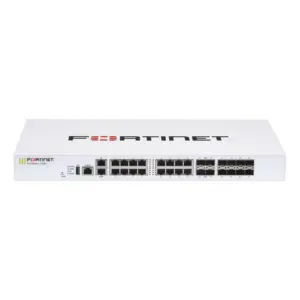
FortiSwitch FS-248E-FPOE in Uganda
A 48-port Gigabit managed access switch with PoE+ on every copper port, four GE SFP uplinks and a 740 W PoE power budget.
Designed for dense wired and powered-edge deployments, the FS-248E-FPOE helps business networks connect and power access points, voice endpoints, cameras and other compatible devices from a single 1RU switching platform. FourTeck can help Uganda buyers review power requirements, uplink optics, management mode and project quantities before quotation.
Fortinet
FS-248E-FPOE
Managed PoE+ access switch
48 × GE RJ45
740 W
1RU rack mount
Dense edge connectivity with power delivered where devices live
The FS-248E-FPOE is a Fortinet FortiSwitch 200 Series access-layer switch intended for organizations that need many Gigabit Ethernet edge connections and substantial Power over Ethernet capacity in a single rack unit. Its most obvious differentiator is density: all 48 GE RJ45 access ports support IEEE 802.3af/802.3at PoE, with a platform power budget of 740 W. Four additional GE SFP interfaces provide fiber or compatible transceiver-based uplink options.
This combination is useful where the access layer must support a broad mix of powered and non-powered endpoints. A business floor may have desk phones, wireless access points, security cameras, badge readers, thin clients or ordinary PCs connected to the same wiring system. Instead of placing local power adapters near every powered device, a PoE switch centralizes power distribution at the rack. That can simplify cable planning, UPS design and device moves, but it also makes switch power planning more important.
Fortinet lists 104 Gbps switching capacity, 155 Mpps packet forwarding performance, 16K MAC address storage, support for 4K VLANs and network latency below 1 microsecond for this model. Those characteristics position it as a capable access switch rather than a small unmanaged edge device. The platform also supports features associated with managed enterprise switching, including link aggregation, access control lists, spanning tree instances and Layer 3 host or route entries within the limits published for the platform.
Selection still depends on the architecture around it. A buyer should decide whether the switch will operate in a FortiGate-integrated environment using FortiLink management or as a standalone FortiSwitch. They should also determine whether the four GE SFP uplinks match the speed and media requirements of the distribution layer, because the model does not provide the 10GbE uplinks seen on newer product generations. That uplink decision can be more important than the raw access-port count when the network is expected to carry heavy east-west traffic, video streams or dense wireless traffic.
What the switch changes in a real deployment
Power 48 edge devices from the wiring closet
With PoE+ support on all 48 copper ports and a 740 W aggregate budget, the switch can reduce dependence on local AC adapters for compatible powered devices. For procurement teams, this creates a cleaner bill of materials because network and power delivery can be designed together rather than device by device.
Consolidate high-density access in 1RU
Forty-eight access ports in a 1RU chassis can reduce rack space compared with multiple smaller switches. This is valuable for branch racks, floor telecom rooms and project environments where rack units, patch-panel positioning and power distribution need to stay compact.
Build a segmented wired edge
Support for thousands of VLANs, ACL resources and enterprise switching functions lets network teams separate voice, wireless, user, guest and device traffic according to policy. Segmentation is especially useful when the physical ports serve endpoints with different trust levels.
Manage the access layer in a Fortinet architecture
The FortiSwitch family supports integrated management with FortiGate through FortiLink as well as standalone operation. Organizations already standardizing on Fortinet can therefore incorporate switch configuration and visibility into a broader security-led network architecture.
Use fiber where copper is not appropriate
Four GE SFP ports provide options for fiber uplinks or suitable SFP connectivity. Buyers should select optics according to distance, fiber type and the interfaces on the upstream switch or router rather than assuming one transceiver suits every link.
Plan resilience beyond the internal supply
Fortinet lists the optional FRPS-740 redundant power system for the PoE variants. In projects where switch-powered endpoints are operationally important, the power architecture should include rack UPS capacity, upstream resilience and a decision on whether optional redundant power is required.
The value is the combination of full-port PoE+ density, enterprise switching and Fortinet-managed edge control.
Rather than treating the access switch as a simple port multiplier, this model is better evaluated as the power and policy boundary for a dense set of edge devices. Its 740 W PoE budget, 48 powered access ports and managed switching capabilities make capacity planning more deliberate: endpoint power, traffic segmentation, uplinks and management need to be designed as one system.
48 × GE RJ45 PoE+: enables one switch to serve a full rack-panel-sized group of compatible wired and powered devices.
740 W PoE budget: provides substantial aggregate power, although actual endpoint allocation must be checked against each device’s requirement.
4 × GE SFP: gives fiber or transceiver uplink flexibility; optic type and upstream compatibility are project-specific.
104 Gbps switching / 155 Mpps: published platform performance supports busy access-layer switching workloads.
FortiGate integration or standalone operation: supports different operational models depending on the wider Fortinet architecture.
FortiSwitch FS-248E-FPOE specification ledger
| Specification | Published detail |
|---|---|
| Network interfaces | 48 × GE RJ45 + 4 × GE SFP |
| PoE ports | 48 ports, IEEE 802.3af / 802.3at |
| PoE power budget | 740 W |
| Switching capacity | 104 Gbps duplex |
| Packet forwarding | 155 Mpps duplex |
| MAC address storage | 16K |
| Network latency | Below 1 µs |
| VLANs supported | 4K |
| Link aggregation group size | 8 |
| Packet buffer | 1.5 MB |
| Memory | 512 MB DDR3 |
| Flash | 128 MB |
| ACL | 512 |
| Spanning Tree instances | 32 |
| Route entries | 64 IPv4 / 64 IPv6 |
| Host entries | 512 IPv4 / 512 IPv6 |
| Dedicated management port | 1 × 10/100 |
| Console | 1 × RJ45 serial console |
| Form factor | 1RU rack mount |
| Dimensions | 44 × 410 × 440 mm |
| Weight | 6.1 kg |
| Power input | 100–240 V AC, 50/60 Hz |
| Power supply | Built-in AC supply |
| Redundant power option | Optional FRPS-740 |
| Average / maximum consumption | 842 W / 855.02 W as published for the platform |
| Operating temperature | 0°C to 50°C |
| Humidity | 10% to 90% non-condensing |
| Airflow | Side-to-back |
For purchasing, three specifications deserve particular attention. First is the 740 W PoE budget. A 48-port PoE+ label does not mean every connected device will automatically receive the maximum possible PoE+ wattage at the same time; the endpoint mix must fit within the total power budget and port-level capabilities. Second is the uplink design. The four SFP interfaces are Gigabit Ethernet, so buyers should confirm that GE uplinks provide enough aggregate capacity for the site. Third is power and cooling. Maximum platform consumption rises significantly when PoE is heavily used, which affects UPS sizing, PDU capacity, rack circuit planning and room cooling. These are design inputs rather than small installation details.
The published memory, forwarding, VLAN and table capacities are appropriate for many access-layer environments, but the surrounding network still determines suitability. If the switch will be integrated with FortiGate, verify the supported FortiOS/FortiSwitchOS combination for the intended architecture. If standalone, confirm the operational features and firmware release required. FourTeck can review these factors alongside quantity, optics and endpoint power before preparing a Uganda project quote.
Five questions to answer before the switch is quoted
- Workload or operational requirement. Identify whether the switch is primarily serving office users, Wi-Fi access points, IP telephony, cameras, building systems or a mixed edge. Traffic pattern and endpoint criticality influence uplink design, VLAN policy and resilience.
- Device, power and performance scale. Count copper endpoints and list the power draw of every powered-device type. The FS-248E-FPOE provides 48 PoE+ ports, but the total 740 W budget must cover the expected simultaneous load with appropriate design margin.
- Compatibility with existing systems. Confirm upstream switch/router interfaces, SFP type, fiber media, FortiGate model if FortiLink will be used, rack depth, available AC circuits and current firmware architecture. Compatibility errors often appear outside the switch itself.
- Growth and upgrade needs. Decide whether 1GbE uplinks remain adequate for the expected service life. A site expecting multi-gigabit wireless, large camera estates or sustained high-volume east-west traffic may benefit from evaluating newer models with faster uplinks.
- Installation, support and delivery expectations. Define quantity, site count, target deployment window, desired vendor support coverage, redundant power requirements and whether optics, patch leads or rack accessories need to be included in one procurement package.
Where a full-power 48-port access switch makes practical sense
Office and campus floor switching
A business floor with dozens of desktops, phones and wireless access points can use one switch as a dense access layer. PoE reduces local power adapters, while VLANs and managed switching support separation of voice, user and infrastructure traffic. The key design check is whether the four GE SFP uplinks provide enough aggregate throughput for the floor and whether redundancy is needed.
Education and training facilities
Schools, universities and training centers often have many wired rooms plus ceiling access points and security devices. Forty-eight PoE+ ports can serve a substantial classroom or building segment from one rack. Before purchase, the integrator should calculate AP power requirements and confirm how many switches feed each distribution point.
IP surveillance access networks
For compatible PoE cameras, the switch can combine network transport and centralized power at the rack. This can simplify protected power design because the switch and recording/network infrastructure can share UPS planning. Camera bitrate, retention architecture and uplink utilization should still be modeled; a high camera count can make upstream bandwidth the limiting factor.
Hospitality and multi-service edge
Hotels and similar properties may combine access points, phones, terminals and operational devices on a common access platform. The ability to allocate PoE across many ports supports that device mix, while segmentation can separate guest, staff and infrastructure networks. Uplink topology, redundancy and remote management policy should be finalized before deployment.
PoE capacity is an electrical design decision as much as a networking feature
The defining capability of this model is full-port PoE+. Every one of the 48 GE RJ45 access ports can supply power to compatible IEEE 802.3af or 802.3at powered devices, while the switch provides an aggregate 740 W PoE budget. That level of power is useful for dense access-point, voice or surveillance deployments, but procurement should begin with an endpoint power schedule rather than the assumption that port availability equals power availability.
Consider a mixed floor with wireless access points, IP phones and cameras. Each endpoint class can have a different maximum and typical draw. Some devices may remain near a steady baseline while others increase consumption when radios, infrared illumination or other functions are active. A sound design totals the expected draw, checks per-port compatibility and leaves operational margin. It also prioritizes which devices must remain powered if the installation ever operates under constrained conditions.
The upstream electrical environment matters too. Fortinet publishes average and maximum platform power consumption figures of 842 W and 855.02 W for the full-PoE model. A UPS or rack PDU selected only for the switch’s non-PoE electronics could therefore be undersized once the powered-device load is included. Heat, branch-circuit capacity and runtime targets also need consideration.
Fortinet documents per-port PoE controls in FortiSwitchOS, including enable/disable behavior, 802.3af or 802.3at mode and port priorities. Exact available commands depend on software release, so configuration policy should be verified against the deployed FortiSwitchOS version. For buyers, the operational outcome is control: powered endpoints can be part of a managed access-layer policy instead of an unmanaged collection of wall adapters.
Fortinet-managed access can join switching and security operations
FortiSwitch platforms can be deployed under FortiGate management through FortiLink, giving organizations already using Fortinet security infrastructure a way to manage the access layer in the same architectural context. That can reduce the number of disconnected management workflows and give administrators a clearer relationship between users, ports, VLANs and policy. The value is strongest when the switching design is planned together with the FortiGate rather than added as an isolated afterthought.
Standalone operation remains another path. This matters for sites that need FortiSwitch features without placing the switch under a FortiGate controller. The correct operating mode should be defined before rollout because it influences how administrators provision ports, apply policies, monitor devices and handle firmware lifecycle.
Capability line 1 — FortiLink integration: suitable for FortiGate-centered LAN architectures where switching is managed as part of a broader secure access design.
Capability line 2 — Standalone FortiSwitchOS: supports independent switch administration where FortiGate integration is not the chosen model.
Capability line 3 — Managed edge controls: VLANs, ACL resources, link aggregation, spanning tree and PoE policies support structured enterprise access rather than unmanaged connectivity.
For procurement, the important step is to confirm the management architecture and software support matrix before purchase. A FortiSwitch model that is technically capable may still be a poor choice if it does not align with the organization’s target FortiOS/FortiSwitchOS lifecycle or desired centralized management design.
Uplink capacity can decide whether this is the right generation for your network
The access side of the FS-248E-FPOE is dense: 48 Gigabit copper interfaces can produce substantial aggregate traffic. The uplink side consists of four GE SFP interfaces. In many conventional office, voice, branch and moderate wireless environments, that can be entirely workable when traffic is distributed sensibly and link aggregation is used where appropriate. In other environments, it is the factor that should trigger a closer comparison with newer FortiSwitch generations.
A modern access point can serve many users, and multiple cameras can produce continuous video traffic. If dozens of such devices share a switch, the aggregate upstream requirement may exceed what a single 1GbE uplink can comfortably carry. Using multiple SFP links in an appropriate aggregated design can increase available capacity and resilience, but it still needs compatible configuration on the upstream device and careful topology planning.
Buyer decision checklist
□ Confirm expected average and peak upstream traffic.
□ Check whether the distribution switch supports compatible GE SFP links and aggregation.
□ Select optics by fiber type, distance and connector requirement.
□ Decide whether uplink redundancy is required.
□ Evaluate a newer switch with faster uplinks if traffic growth is likely to make 1GbE a bottleneck.
For a replacement project, do not assume the newer model should match the old switch port-for-port. Use the refresh as an opportunity to examine uplink headroom, wireless growth, surveillance bandwidth and core/distribution speed. FourTeck can include this architecture review when preparing an alternative or current-generation recommendation.
What buyers should check before purchase
| Risk | What to confirm | Why it matters | What to share with FourTeck |
|---|---|---|---|
| Wrong PoE assumption | Endpoint standards and total wattage | 48 PoE+ ports still share a 740 W budget | Device models and quantities |
| Uplink bottleneck | Required upstream capacity | The uplinks are GE SFP, not 10GbE SFP+ | Traffic estimate and upstream switch |
| Optic mismatch | SFP, fiber type, distance and connector | Incorrect optics can prevent the link from operating | Fiber path and remote interface details |
| Power or rack shortfall | PDU, UPS, AC circuit, depth and cooling | Full PoE load changes electrical and thermal requirements | Rack and UPS data |
| Lifecycle mismatch | Supported software and replacement roadmap | Older platforms may not match a long refresh horizon | Target service life and Fortinet environment |
| Incomplete quote | Support, optics, redundant power and quantities | The switch alone may not complete the installation | Full bill-of-material requirements |
The most common purchasing mistake with a high-density PoE switch is focusing on the model number while leaving the surrounding infrastructure unspecified. The correct switch is only one part of a working access layer. Power availability, optical uplinks, compatible upstream interfaces, software architecture, rack readiness and endpoint requirements all influence whether the deployment succeeds. For project quantities, confirming these items before ordering also reduces the risk of repeatedly sourcing accessories after the main hardware arrives.
Plan supply around the exact configuration and project quantity
FourTeck supports Uganda customers who need business networking hardware, configuration review and quotation assistance. Availability for a specific Fortinet model can vary by sourcing cycle, quantity and lifecycle status, so the FS-248E-FPOE should be confirmed at quotation stage rather than assumed to be locally stocked. For Kampala projects, FourTeck can review the requested quantity, delivery destination, PoE endpoint requirements, uplink media and any related accessories before preparing a commercial response.
For larger rollouts, it helps to provide a site schedule rather than only a total switch count. A multi-floor or multi-site deployment may need different numbers of optics, rack accessories, redundant power components and support coverage by location. FourTeck can assist with quote structuring and delivery coordination based on the information supplied by the customer. Warranty handling depends on the product supply terms and applicable Fortinet support or warranty arrangements, so buyers should request those details as part of the quotation rather than relying on an assumed coverage period.
If the exact model is no longer the preferred option for the project, FourTeck can also help identify a current FortiSwitch alternative with comparable port density and PoE capability while taking uplink speed and lifecycle into account.
Uganda location coverage
Business and project inquiries can be coordinated for Kampala as well as deployments in Entebbe, Jinja, Mbarara and Gulu. The useful starting point is the same for every location: specify switch quantity, endpoint count, PoE requirements, uplink type and delivery destination. FourTeck can then review the request and advise on suitable sourcing and quotation steps without relying on generic city-by-city stock assumptions.
East Africa and regional project coordination
Organizations managing multi-country infrastructure can use FourTeck’s regional web presence to coordinate related requests beyond Uganda. Procurement teams with projects in Kenya or selected East Africa markets can review requirements through FourTeck Kenya and FourTeck Africa. For organizations that also source through the Gulf, FourTeck UAE and FourTeck Kuwait provide regional contact points.
Regional availability should still be confirmed for each destination because product lifecycle, import channels, quantity and support requirements can differ by market. A cross-border project benefits from one technical bill of materials that clearly identifies the switch model, optics, support expectation, powered-device profile and site quantities. That makes it easier to assess whether the same hardware should be standardized across all sites or whether a current-generation replacement is more appropriate in some locations.
Build the request around the network, not one SKU
Best for buyers comparing port density, PoE and uplink generations.
For designs that do not require PoE on all 48 access ports; verify current availability and lifecycle.
For buyers who need faster uplinks or a longer technology refresh horizon.
Best for organizations planning FortiLink-managed switching within a Fortinet security architecture.
Select transceivers by fiber type, distance and upstream interface.
For multi-switch, multi-site or phased deployments.
Useful assistance before a networking order becomes a deployment problem
01 — Product selection guidance. FourTeck can help determine whether the FS-248E-FPOE’s 48-port density, PoE budget and GE uplinks match the intended site or whether another FortiSwitch is a better fit.
02 — Configuration review. The quote can account for optics, endpoint power, FortiGate integration, redundant power considerations and rack requirements instead of treating the switch as an isolated line item.
03 — Quote assistance. Business buyers can submit quantity, delivery location and technical requirements so the commercial offer reflects the actual project rather than a generic single-unit request.
04 — Uganda delivery coordination. Project requirements can be reviewed for Kampala and other Uganda locations, with supply timing confirmed during quotation.
05 — Warranty and support guidance. Buyers can request clarification on the applicable Fortinet coverage, support services and supply terms for the quoted hardware.
06 — Alternative product matching. Where lifecycle, uplink speed or availability makes the original model less suitable, FourTeck can propose a current alternative based on the same deployment brief.
Buyer questions about the FS-248E-FPOE
01. What is the FortiSwitch FS-248E-FPOE mainly used for?
It is a managed 48-port Gigabit access switch designed for business networks that need PoE+ across all copper access ports. Typical deployments include office floors, Wi-Fi access networks, IP telephony and surveillance access. Its 740 W PoE budget is a major selection factor, while the four GE SFP uplinks should be checked against the site’s upstream bandwidth needs.
02. Does every RJ45 port support PoE+?
Yes. Fortinet lists 48 PoE ports supporting IEEE 802.3af and 802.3at, so every GE RJ45 access port is PoE-capable. However, the total platform PoE budget is 740 W. The endpoint mix must therefore be calculated so that simultaneous device demand remains within the available budget and each powered device is compatible with the supported standards.
03. What uplinks does the switch provide?
The published hardware specification lists four Gigabit Ethernet SFP interfaces. Buyers should choose SFP transceivers according to fiber type, distance and the interface on the upstream device. Because these are GE SFP rather than 10GbE SFP+ uplinks, organizations with heavy wireless, video or aggregate traffic should verify that the uplink design has enough capacity.
04. Can the switch be managed through FortiGate?
FortiSwitch products support FortiGate-integrated management through FortiLink, and the platform can also be operated standalone. The exact design depends on the FortiGate model, FortiOS release, FortiSwitchOS release and intended topology. Before deployment, verify the current compatibility matrix and management architecture rather than assuming any firmware combination will provide the same features.
05. Do I need extra SFP modules?
If you plan to use the SFP uplink ports, compatible SFP transceivers are normally separate procurement items. The correct optic depends on the network medium and link distance. Provide FourTeck with the upstream device model, fiber type, connector information and approximate distance so the quotation can include suitable transceivers rather than generic optics.
06. Is redundant power available?
Fortinet’s Secure Access Series datasheet lists the optional FRPS-740 redundant power system for the FS-248E-FPOE. Whether it is required depends on the importance of the powered endpoints and the site’s resilience design. A serious availability plan should also examine UPS runtime, branch-circuit redundancy, upstream network resilience and whether a second switch is needed for path diversity.
07. Is the FS-248E-FPOE suitable for surveillance cameras?
It can be suitable for compatible PoE or PoE+ IP cameras because all 48 copper ports can supply supported PoE and the switch provides a 740 W budget. Camera model, per-port power requirement and total video throughput must still be checked. A large surveillance estate can be limited by uplink bandwidth even when PoE capacity remains sufficient.
08. How should I size UPS capacity for this switch?
Do not size a UPS using only the switch electronics. Fortinet publishes up to 855.02 W maximum platform consumption for the full-PoE model, reflecting the effect of PoE load. UPS selection should consider real endpoint demand, desired runtime, power factor, other rack equipment and design margin. An electrical or infrastructure professional should validate the final load for critical installations.
09. Is the switch currently available in Uganda?
Availability can vary by quantity, sourcing cycle and product lifecycle, so it should be confirmed at quotation stage rather than assumed. FourTeck can review the required quantity and delivery destination, then provide current sourcing guidance. If the model is not the best current option, a comparable FortiSwitch alternative can be proposed based on port, PoE and uplink requirements.
10. What information should I send for a quote?
Share the quantity, delivery location, expected endpoint count, powered-device models or wattage, uplink media and distance, FortiGate integration requirement, SFP needs, rack power environment and support expectations. For multi-site projects, include a per-site quantity schedule. These details let FourTeck prepare a more useful bill of materials and reduce the risk of missing optics or power-related components.
Send the deployment details, not just the switch model
For a more accurate Uganda quotation, provide your required quantity, powered-device list, estimated PoE demand, uplink type, fiber distance, FortiGate environment, delivery destination and any support or project timing requirements. FourTeck can use that information to review the switch, optics and related components as one practical access-layer package.
- Switch quantity and site count
- PoE endpoint models and quantities
- Uplink media, speed and distance
- FortiGate or standalone management plan
- Delivery location and project schedule