
Fortinet FortiVoice FVE-2000F Enterprise IP Phone System Uganda
FortiVoice FVE-2000F is a high-capacity enterprise phone-system appliance for organizations that want to consolidate business calling, extension management, SIP connectivity, automated attendants, conferencing and call-center operations on a purpose-built platform. It is positioned for environments where a small-office PBX no longer provides enough extension scale, concurrent-call capacity or centralized operational control. Fortinet specifies capacity for up to 2,000 extensions, 200 VoIP trunks, 300 concurrent calls, 200 auto attendants, 50 conference bridges and as many as 225 call-center agents. These capacities make the appliance relevant to large headquarters, campuses and multi-site organizations planning a standardized communications architecture.
For a Uganda procurement, the appliance should be treated as the core of a complete voice solution rather than as an isolated rack device. A successful bill of materials may include compatible IP phones, SIP services, FortiVoice gateways for analog or PRI connectivity, switching, PoE capacity, UPS protection, support coverage and implementation services. FourTeck can help buyers translate user counts, branch topology, legacy line requirements and continuity objectives into a practical configuration before commercial ordering.
Procurement Fact Rail
FVE-2000F
Large enterprise / multi-site
Up to 2,000
Up to 300
Up to 200
Quote-based procurement
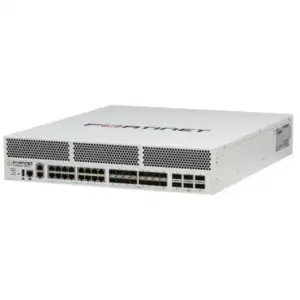
The FVE-2000F uses a 1U-class chassis measuring approximately 44 × 432 × 270 mm and weighing about 7.3 kg. Its compact rack footprint is useful in data-center and communications-room deployments, but rack planning should still account for airflow, cable bend radius, service access, UPS capacity and adjacent network equipment. Procurement teams should confirm the current regional power accessories, support entitlement and complete ordered configuration on the formal quotation.
Operational Architecture and Enterprise Overview
Enterprise telephony becomes difficult to operate when organizations accumulate independent PBXs, unmanaged analog gateways, inconsistent dial plans and branch-specific carrier arrangements. FortiVoice FVE-2000F provides a centralized control point intended to reduce that fragmentation. Administrators can build extension plans, calling rules, attendants, conferencing resources and call-center functions around one enterprise communications system while using gateways where legacy or carrier-facing interfaces remain necessary.
The 2,000-extension ceiling is especially important when sizing. Extension count is not the same as simultaneous call demand: a company can have thousands of registered users while only a fraction are active on calls at the same moment. The FVE-2000F supports up to 300 concurrent calls, so sizing should examine busy-hour behavior rather than simply employee headcount. Contact centers, reservations teams, customer-service desks and outbound sales operations can produce a much higher concurrency ratio than administrative offices. Buyers should therefore document current peak sessions, expected growth, conferencing patterns and any call recording or queue requirements before finalizing a design.
Distributed organizations can also use managed FortiVoice gateways to extend centralized administration. Fortinet documentation indicates that the FVE-2000F can manage up to 80 FortiVoice gateways. This can simplify environments that need analog, FXS, FXO or PRI connectivity at different sites while retaining centralized administration. FortiVoice local-survivability capabilities are designed for multi-site resiliency, helping organizations plan branch continuity when connectivity to the central system is disrupted. The precise topology, gateway model and survivability configuration should be validated against the deployed firmware and branch requirements.
Enterprise Business Outcomes
Key Hardware and Software Highlights
| Capability | FVE-2000F | Operational Relevance |
|---|---|---|
| Extensions | 2,000 | Supports large enterprise user populations. |
| VoIP trunks | 200 | Provides substantial SIP trunk planning capacity. |
| Concurrent calls | 300 | Defines busy-hour simultaneous session ceiling. |
| Auto attendants | 200 | Supports structured inbound routing for departments and sites. |
| Conference bridges | 50 | Supports internal and external collaboration workflows. |
| Attendees per bridge | 20 | Useful for team and departmental conference planning. |
| Call-center agents | 225 | Supports substantial service-desk and customer-contact teams. |
| Managed gateways | Up to 80 | Supports distributed gateway administration. |
| Audio codecs | G.711 μ-law/A-law, G.729a, G.722, Opus | Offers codec choices for voice quality and bandwidth planning. |
| Video codecs | H.263, H.264 | Provides supported video codec compatibility where applicable. |
| Dimensions | 44 × 432 × 270 mm | Compact rack-mount footprint. |
| Weight | 7.3 kg | Relevant for rack and shipping planning. |
Configuration and Sizing Worksheet
1. Establish the user and device population
Count current employees, shared-area phones, reception positions, meeting rooms, security desks, warehouses and expected near-term additions. Separate registered extensions from actual human users because common-area and functional devices can materially increase the extension count. Keep headroom beneath the 2,000-extension platform limit rather than designing directly to the ceiling.
2. Calculate busy-hour call concurrency
Review carrier records or existing PBX statistics to determine the maximum number of simultaneous inbound, outbound and internal calls. Contact-center organizations should model shift peaks and campaigns. Compare the resulting figure with the 300 concurrent-call capacity and preserve sensible growth margin.
3. Map carrier and legacy interfaces
Document SIP trunks, PRI circuits, analog PSTN lines, fax devices, door phones, paging equipment and other special endpoints. Where physical interfaces are needed, select compatible FortiVoice gateways and determine whether local survivability is required at each remote site.
4. Validate rack, network and power design
Reserve appropriate rack space and confirm Ethernet switching, VLAN design, QoS, PoE budgets for phones, structured cabling, UPS runtime and grounding. Voice quality depends on the complete LAN/WAN path, so appliance procurement should be coordinated with the network design.
5. Prepare the quote package
Provide FourTeck with the extension count, expected concurrency, branch list, gateway requirements, handset quantities, carrier interface types, contact-center agent count, support term and desired deployment services. This reduces revisions and helps the quotation reflect the actual project.
Deployment Scenarios
Large Enterprise and Multi-Site Networks
A headquarters can host the FVE-2000F as the central call-control platform while branches connect across appropriately engineered WAN links. Compatible gateways can be positioned where analog or carrier interfaces are required. This design can standardize numbering, routing and administration across many locations while still allowing site-specific operational rules. Branch resiliency should be designed according to business criticality and available local carrier options.
Financial and Banking Institutions
Banks and financial organizations commonly need predictable branch calling, centralized administrative control, service-desk workflows and resilient communications. The FVE-2000F capacity profile can support substantial extension populations and call-center teams. Deployment design should additionally address change control, access privileges, network segmentation, secure administration, recording policies where applicable and continuity procedures.
Education and Campus Networks
Universities, colleges and large schools can use centralized telephony to serve faculties, administration, security, libraries, residences and support departments. The 2,000-extension scale can accommodate a broad campus population, while attendants and structured call routing can direct callers to departments. Campus switching, PoE, emergency procedures and legacy analog devices should be included in the design.
Government and Public-Sector Procurement
Government deployments often require formal bills of materials, documented support coverage, predictable lifecycle planning and multi-location administration. Procurement teams should validate exact firmware, accessories, support terms, delivery documentation and implementation scope on the quotation. Where continuity requirements are strict, gateway placement and survivability design should be explicitly documented before approval.
Technical Deep Dive: Voice Processing and Capacity Architecture
The practical value of the FVE-2000F is its defined enterprise capacity envelope. Voice platforms must process signaling, maintain active sessions, apply dial-plan logic, operate attendants and queues, and coordinate endpoint registrations continuously. The 300-concurrent-call rating therefore matters more to many architects than the headline extension count. A well-designed deployment models the ratio between registered extensions and simultaneous sessions, then reserves capacity for busy periods. Codec selection also influences network bandwidth. G.711 generally consumes more bandwidth than compressed codecs, while G.722 and Opus can support wideband audio scenarios. WAN engineering must consider codec payload, protocol overhead, call volume, latency, jitter and packet loss.
Technical Deep Dive: Software Ecosystem and Operational Control
FortiVoice provides centralized administration for enterprise phone-system functions and supports management of compatible FortiVoice gateways. Fortinet documentation for current FortiVoice releases lists FVE-2000F as a supported appliance platform. Administrators should follow validated upgrade paths and review release notes before firmware changes. Production upgrades should be scheduled with backups, maintenance windows and rollback planning appropriate to the organization. Endpoint and gateway firmware should likewise be managed deliberately so interoperability remains predictable.
Technical Deep Dive: High Availability and Disaster Recovery Planning
Communications continuity is broader than appliance uptime. A resilient design examines WAN circuits, carrier trunks, switches, PoE, electrical supply, UPS runtime, gateway placement and administrative recovery procedures. FortiVoice local-survivability functionality is intended for centralized multi-site deployments, allowing architects to consider how branches continue operating during loss of central connectivity. The correct approach varies by site: a small branch may need basic local calling, while a customer-service or financial location may justify stronger carrier and network redundancy. Document recovery objectives before choosing hardware and services.
Pre-Purchase Buyer Gap Checklist
Licensing and support: Do not assume that the chassis price represents the entire deployment. Confirm the exact support package, optional capabilities, phone requirements, gateway hardware and implementation services in the quote. Lifecycle: verify the current supported FortiVoice release and planned support term for the purchased appliance. Rack clearance: the chassis dimensions are compact, but leave room for ventilation and service access. Power: confirm the supplied power configuration and local requirements on the commercial offer rather than relying on generic assumptions. Carrier compatibility: provide details of the SIP provider or legacy circuit so the proposed design can include appropriate gateways and configuration work. Existing phones: third-party SIP interoperability can depend on feature expectations and provisioning method; validate the exact endpoint models before committing to reuse. Call center: the platform supports up to 225 call-center agents, but workflows, queues, reporting expectations and integrations should be reviewed as a solution rather than judged only by the agent number. Growth: keep capacity headroom for new branches and employees. Network readiness: assess VLANs, QoS, WAN stability and PoE before cutover. Migration: prepare a numbering plan, porting schedule, pilot group, fallback plan and user communications before moving production calling.
Uganda Procurement, Delivery and Technical Preparation
FourTeck supports quote-based enterprise procurement for Uganda projects. A complete request should identify the FortiVoice FVE-2000F, quantity, delivery location, extension population, handset requirements, gateway interfaces, support expectations and any implementation scope. Where a project includes multiple branches, provide a site schedule so the bill of materials can distinguish central equipment from branch components. Commercial lead time and availability can vary with stock position, import scheduling and the exact accessory bundle, so delivery commitments should be taken from the issued quotation.
Pre-configuration can be planned where the project scope calls for staging before shipment. Typical preparation may include bill-of-materials verification, firmware review, configuration planning, addressing information and deployment documentation. Final service scope should be agreed commercially. Buyers in Kampala, Entebbe, Jinja, Mbarara and Gulu can use the same structured procurement process, with delivery arrangements determined by destination and order terms.
Local Coverage Matrix
Cross-Border and Regional Supply
Organizations operating across several countries can coordinate related requirements through FourTeck regional sites. Visit FourTeck Uganda for Uganda projects, FourTeck Kenya for Kenya requirements, FourTeck Africa for broader African supply, FourTeck UAE for UAE procurement and FourTeck Kuwait for Kuwait projects. Multi-country projects should standardize model numbers, support terms, gateway requirements and endpoint specifications while allowing for local carrier interfaces, electrical requirements and import processes.
Related Solution Components
A complete FortiVoice project normally extends beyond the FVE-2000F chassis. Review enterprise communications solutions for complementary infrastructure. Depending on the topology, the bill of materials may include FortiFone IP handsets, FortiVoice analog or PRI gateways, managed PoE switching, UPS systems, structured cabling and rack accessories. Multi-site deployments should also assess WAN resilience and local-survivability requirements. For exact related model URLs and current accessory compatibility, request a validated bill of materials rather than selecting components only by connector type or headline capacity.
FourTeck Technical Service Capabilities
FourTeck can support the procurement process with engineering validation and bill-of-materials review so the ordered system better reflects actual extension, gateway and endpoint requirements. Staging requirements can be discussed before shipment, including firmware review and agreed pre-configuration activities. This is particularly useful for distributed projects where branch equipment must arrive with a consistent deployment plan. Post-sales support scope can also be aligned to the project, including configuration assistance, troubleshooting coordination and warranty-processing guidance where applicable. Buyers should define responsibilities clearly: carrier provisioning, LAN changes, number porting, endpoint installation, user training and cutover support may involve different parties. A written scope reduces ambiguity during implementation.
FortiVoice FVE-2000F Technical FAQ
How many extensions does the FVE-2000F support?
Fortinet lists the FVE-2000F for up to 2,000 extensions. This figure should be treated as a platform capacity boundary, not a target that every project should fill completely. A practical design leaves headroom for new staff, shared phones, meeting rooms, service accounts and future branches. Procurement teams should create an extension inventory and forecast growth over the intended service life before deciding that the FVE-2000F is the correct model.
How many simultaneous calls can it handle?
The published capacity is up to 300 concurrent calls. This number is distinct from extension count. A 1,500-user organization might remain comfortably below 300 simultaneous calls, while a smaller contact-center operation could create high concurrency during peak periods. Use existing call records where possible and account for inbound queues, outbound campaigns, conferences and seasonal peaks. Sizing based on busy-hour traffic provides a stronger basis than employee count alone.
Can the FVE-2000F be used for a call center?
Yes. Fortinet publishes a maximum of 225 call-center agents for this model. The suitability of the system still depends on workflow requirements such as queue structure, reporting, agent profiles, IVR design and operational integrations. Organizations should document the number of simultaneously active agents, supervisors, departments, expected queue volume and reporting needs. A technical review before ordering can confirm whether the proposed configuration and software capabilities match the intended customer-service operation.
Does it support multi-branch deployments?
The FVE-2000F is well suited to centralized multi-site designs. Fortinet documentation indicates support for managing up to 80 FortiVoice gateways, and FortiVoice offers local-survivability capabilities for distributed deployments. The network design remains critical: branch WAN quality, routing, QoS, carrier availability and power resilience all affect the calling experience. Each branch should be classified by business criticality so the architecture can provide an appropriate continuity level.
Which codecs are supported?
Fortinet lists G.711 μ-law/A-law, G.729a, G.722 and Opus for audio, with H.263 and H.264 listed for video. Codec choice influences bandwidth consumption, voice quality and interoperability. The selected carrier, endpoints and WAN design should all be considered. Network engineers should calculate aggregate busy-hour voice traffic with protocol overhead rather than relying only on nominal codec bit rates.
Do I need separate gateways for analog or PRI connections?
Where the deployment requires FXS, FXO or PRI interfaces, compatible FortiVoice gateways can provide those physical connections and can be managed from the FortiVoice system. The correct gateway depends on the number and type of circuits or analog devices. Provide a port inventory covering PSTN lines, analog phones, fax machines, paging systems and PRI services so the quotation includes the correct gateway quantities and interfaces.
What should be checked before migrating from an existing PBX?
Start with extension numbering, direct inward dial numbers, carrier contracts, hunt groups, attendants, queues, analog devices and special routing rules. Then document the network and PoE environment, identify endpoint models and create a cutover sequence. Number porting and SIP activation should be coordinated with carriers. A pilot group can expose dial-plan, audio and provisioning issues before the full migration. Backout procedures and stakeholder communications should be prepared for the production cutover window.
How is warranty or hardware replacement handled?
Warranty and replacement arrangements depend on the purchased support entitlement, regional terms and the commercial order. Buyers should ensure serial-number records, invoices and support details are retained. When a hardware fault occurs, troubleshooting information may be required before replacement authorization. For mission-critical deployments, organizations should also consider whether their continuity design can maintain essential calling while hardware service is being coordinated rather than relying solely on replacement speed.
Can FourTeck help with configuration and staging?
Configuration and staging support can be discussed as part of the project scope. Useful pre-deployment work can include bill-of-materials verification, firmware review, addressing and VLAN planning, extension and dial-plan preparation, gateway mapping and documentation. The exact activities should be agreed before ordering so both the customer and implementation team understand which tasks will be completed before shipment and which will occur on site during commissioning.
What information is needed for an accurate Uganda quotation?
Provide the FVE-2000F quantity, delivery city, number of extensions, peak concurrent-call estimate, SIP trunk or legacy carrier interfaces, handset quantities, branch count, gateway needs, call-center agent count, support term and requested implementation services. Also identify any project deadline or tender documentation requirements. A structured request helps avoid an incomplete chassis-only quotation and allows the proposed bill of materials to reflect the complete operational environment.
Request a FortiVoice FVE-2000F Uganda Procurement Quote
Plan the appliance, phones, gateways, support and deployment requirements as one enterprise communications solution. Send FourTeck your user count, branch topology, carrier interfaces and service requirements for configuration review and commercial quotation. This approach helps procurement teams compare a complete solution rather than a bare appliance price and reduces the risk of discovering missing interfaces or accessories during implementation.
Reviews
There are no reviews yet.