
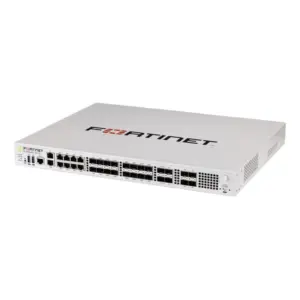
Fortinet FortiVoice FVE-50G2 Enterprise Business Phone System Uganda
The Fortinet FortiVoice FVE-50G2 is a compact unified communications appliance built for small and growing offices that require a controlled, professionally managed business telephony environment. Its role is straightforward: centralize extensions, inbound and outbound calling, analog line connectivity, voice services and administration in a purpose-built platform that can be deployed as a local PBX or used as a survivability branch within a larger supported FortiVoice architecture. The platform supports up to 50 extensions, 8 VoIP trunks, 2 FXO interfaces and 2 FXS interfaces. This combination makes the appliance especially practical where an organization is migrating toward IP telephony but still needs selected legacy telephone lines, fax equipment or analog endpoints.
For procurement teams in Uganda, choosing a phone system is rarely only about the extension count. The proposed platform must match the carrier service, expected simultaneous calls, endpoint type, branch topology, power conditions, LAN design, voice VLAN strategy and future growth plan. The FVE-50G2 addresses a focused office tier where administrators want centralized controls and integrated communications without deploying a larger chassis. FortiVoice also provides integrated voice, conferencing and fax capabilities within the wider product family, with centralized management intended to simplify configuration and monitoring.
FourTeck supports organizations evaluating the FVE-50G2 for new offices, replacement PBX projects, branch modernization and multi-site communication designs. Before procurement, the recommended approach is to confirm the number of users, expected concurrent calls, SIP trunk availability, existing analog lines, handset requirements and whether branch survivability is required. This avoids purchasing an appliance based solely on user count while overlooking call concurrency or carrier-interface requirements.
Instant Specifications & Procurement Fact Rail
FortiVoice FVE-50G2
Compact office / branch PBX
Up to 50
8
2 FXO + 2 FXS
2 RJ45 Ethernet interfaces
Desktop appliance
Contact FourTeck for current supply and commercial terms
The fact rail should be read as a sizing starting point rather than a complete deployment design. Fifty registered extensions do not automatically mean that every user can conduct an external call at the same time. Published specifications indicate a concurrent-call capacity of 15, so organizations with call-intensive teams should estimate busy-hour call demand before selecting the appliance. Similarly, the two FXO ports are useful when conventional telephone lines must be connected, while the two FXS ports provide analog extension connectivity for compatible analog devices. Where the site is primarily SIP-based, the eight VoIP trunks become an important sizing consideration. Warranty and support terms should be confirmed on the quotation because commercial coverage can vary according to supplied service package, project scope and regional channel terms.
Operational Product Architecture & Overview
The FVE-50G2 brings multiple communications functions into a compact appliance rather than forcing an organization to maintain separate systems for extension registration, basic call routing and selected analog connectivity. In a typical office deployment, IP phones communicate across the organization’s LAN, while the FortiVoice system acts as the central PBX control point. External calling can be presented through supported VoIP services, while the FXO interfaces offer a path for conventional telephone lines. The FXS interfaces are designed for analog endpoints such as compatible telephones or fax devices. Fortinet documentation specifically identifies the FVE-50G2 as having two analog ports for analog phones and fax machines.
The appliance can be assigned a PBX role for a standalone office. In this mode, the organization manages extensions and calling functions locally. Fortinet also documents a Survivability Branch deployment mode for the FVE-50G2. That role matters in a centralized multi-site environment because a branch can be designed to retain appropriate local communication capabilities when connectivity to the central system is interrupted, subject to the supported FortiVoice topology and configuration. This makes the model useful not only as a compact standalone system but also as an infrastructure component in selected distributed deployments.
Operationally, procurement pain points tend to arise at the interfaces between systems rather than from the PBX alone. A company may already own SIP phones from a previous deployment, maintain analog fax devices, use PSTN lines from a local carrier, or have a data network that was never designed for voice traffic. A successful FVE-50G2 project therefore begins with discovery. Confirm endpoint compatibility, VLAN requirements, DHCP strategy, QoS policy, upstream firewall rules, carrier handoff, dial plan and emergency-call routing. Voice quality depends on the network path as well as the PBX, so packet loss, jitter and latency should be considered during design.
FortiVoice includes centralized administration capabilities intended to simplify deployment, configuration and real-time monitoring. For an IT team, centralized control is valuable because extension changes, routing policies and operational visibility can be handled from a consistent management environment. Role-based administration and scheduled backup capabilities further support controlled operations. The platform also supports security-related voice technologies such as SRTP according to published feature information, helping organizations design protected voice sessions where compatible endpoints and services are used.
Storage is another architectural consideration. The FVE-50G2 is specified with 8 GB of storage. Buyers should not assume that a compact appliance is intended for unlimited recording retention or data-intensive workloads. If call recording, extensive logs, or other storage-dependent features form part of the project, the exact feature entitlement, storage behavior and retention target should be validated during solution design. The right question is not merely whether a feature exists in the wider FortiVoice ecosystem, but whether it is supported and appropriately sized on this specific appliance and software release.
Enterprise Business Outcomes & Value Analysis
Key Hardware & Software Highlights
The FVE-50G2 combines a focused set of physical interfaces with FortiVoice software services. Its two Ethernet interfaces connect the PBX to the data network according to the selected topology. Two FXO ports accommodate traditional telephone-line inputs, while two FXS ports provide analog extension connectivity. The desktop form factor is useful in offices without a full rack environment, but installation should still provide ventilation, protected power and secure physical placement. The external power supply should be incorporated into UPS planning because voice availability depends on the PBX, network switches, routers, carrier equipment and endpoints remaining powered.
On the software side, FortiVoice provides unified communications functions including voice, conferencing and fax across the product family. The FVE-50G2 supports common voice codecs including G.711, G.729a, G.722 and Opus, with video codec support including H.263 and H.264 in published specifications. Codec selection affects bandwidth consumption and interoperability, so SIP carrier and handset capabilities should be verified. Network functions such as voice QoS, VLAN support and SNMP can help integrate the appliance into a structured enterprise LAN and monitoring practice.
Management features are equally important. CLI access, role-based management, password-policy controls and scheduled backup capabilities give administrators tools for controlled operations. Before deployment, establish named administrative roles, backup schedules, firmware-management procedures and configuration-change records. These practices reduce recovery time and make troubleshooting more predictable.
Technical Specifications Ledger
| Product | Fortinet FortiVoice FVE-50G2 |
| Maximum Extensions | 50 |
| VoIP Trunks | 8 |
| Concurrent Calls | 15 |
| FXO | 2 traditional telephone-line interfaces |
| FXS | 2 analog extension interfaces |
| Network Interfaces | 2 × RJ45 10/100 Ethernet |
| Storage | 8 GB |
| Form Factor | Desktop |
| Power Supply | External |
| Dimensions | Approx. 29 × 116 × 172 mm |
| Weight | Approx. 0.61 kg |
| Auto Attendants | 5 |
| Conference Bridges | 2 |
| Attendees per Bridge | 5 |
| Audio Codecs | G.711 μ-law/A-law, G.729a, G.722, Opus |
| Video Codecs | H.263, H.264 |
| Deployment Modes | PBX and supported Survivability Branch role |
Specifications should be validated against the Fortinet documentation and the software release proposed for the project. Feature availability can depend on platform, firmware, licensing, endpoint support and deployment mode. Procurement documents should therefore separate fixed hardware capacity from optional software functions and project-specific integrations. Where a tender requires environmental tolerances, regulatory certifications or precise power consumption figures, request the current manufacturer hardware documentation and compliance records for the exact supplied unit rather than substituting assumptions from another FortiVoice model.
Configuration & Sizing Worksheet
1. Workload and scale estimation
List every required extension, including reception phones, meeting-room devices, shared-area phones and analog devices. Then calculate peak simultaneous calling. A 30-person office may fit comfortably when only a few users make external calls at once, while a 20-person outbound-focused team may require more call capacity. Compare the busiest expected period with the appliance’s published concurrent-call and trunk limits.
2. Carrier and analog service mapping
Document each SIP trunk, PSTN line, fax device and analog phone. Identify which services must remain after migration. The two FXO and two FXS interfaces are finite resources, so any requirement beyond these counts may need a FortiVoice gateway, a different appliance or a revised service design.
3. LAN, power and placement
Confirm switch ports, VLANs, DHCP scope, QoS policy, firewall rules and IP addressing. Place the PBX and supporting network equipment on protected power. A UPS strategy should include the appliance, switches powering IP phones, router, firewall and any carrier termination equipment; protecting only the PBX does not maintain communications if the rest of the path loses power.
4. Licensing and software services
Identify any optional services required beyond the base system, such as softclient usage or call-trunk services. Confirm entitlements on the quotation rather than assuming that every capability shown in the broader FortiVoice portfolio is included with this appliance. Also confirm the proposed FortiVoice software version and support coverage.
5. Quote preparation checklist
Provide FourTeck with user count, expected concurrent calls, number and type of external lines, existing handset models, required new phones, branch count, network topology, preferred deployment date, delivery city and any integration requirements. If the system will replace an existing PBX, include current extension numbering and call-routing requirements. For multi-site designs, specify whether centralized management and branch survivability are expected. This information allows the bill of materials to be reviewed before commercial submission.
Deployment Scenarios & Industry Use Cases
Corporate and Multi-Site Offices
A headquarters or branch office with fewer than 50 required extensions can use the FVE-50G2 as a compact local PBX when the call profile fits its trunk and concurrency limits. In a supported centralized architecture, the appliance can also be considered for a survivability branch role. This is valuable for organizations that want centralized communications governance while planning for WAN disruption at selected branches. The topology should be validated against the central FortiVoice model because only supported larger systems can manage survivability branches.
Financial and Professional Services
Banks, microfinance offices, insurance branches, legal firms and accounting practices often need controlled extension plans, predictable call routing and disciplined administrative access. The FVE-50G2 can provide a focused platform for a branch or office while the surrounding network implements segmentation, firewall policy and monitoring. Where recording, retention or compliance controls are mandatory, those requirements must be reviewed separately because storage, licensing and regulatory policy may determine whether the compact appliance is appropriate.
Education and Campus Departments
Schools, training centers and individual university departments can use a compact PBX to connect administration, reception, finance, security and selected teaching offices. Analog interfaces can help retain a fax machine or conventional line during transition. A campus-wide project, however, should be sized as a multi-building communications architecture rather than assuming one 50-extension appliance can serve every department.
Government and Public-Sector Offices
Government offices commonly require formal bills of materials, support documentation, clear warranty terms and controlled configuration. The FVE-50G2 can suit smaller administrative locations where its published capacity aligns with the requirement. Procurement teams should specify endpoint quantities, line types, installation locations, support expectations and documentation deliverables in the request for quotation. Projects with specialized security classifications or defense requirements require additional validation beyond standard commercial deployment guidance.
Technical Deep Dive: Processing, Media and Call Architecture
Business telephony is a real-time workload. Unlike email or ordinary web traffic, voice conversations become noticeably degraded when packets arrive late, out of sequence or with excessive loss. The FVE-50G2 provides the call-control platform, but overall voice quality depends on the complete path between endpoints and external services. A professional deployment therefore combines PBX sizing with network engineering. Voice VLANs can separate endpoint traffic logically, QoS policies can prioritize latency-sensitive flows, and switches should be sized for the required phones and uplinks. Codec selection also changes bandwidth requirements. G.711 generally consumes more bandwidth than compressed alternatives, while codec compatibility must match phones and service providers.
The published capacity of 15 concurrent calls is a key engineering boundary. Organizations should model internal and external call patterns, conferencing needs and busy-hour peaks. If the workload regularly approaches the ceiling, selecting a larger platform can provide operational headroom. Capacity planning should include growth because PBX replacements are typically expected to remain in service for years.
Technical Deep Dive: Software Ecosystem, Firmware Security & Control
Fortinet continues to list the FVE-50G2 among supported FortiVoice platforms in current 7.4 documentation. Maintaining an approved firmware lifecycle is important because phone systems are network-connected infrastructure and should not be treated as isolated appliances. Administrators should review release notes, supported upgrade paths, configuration backups and compatibility requirements before applying changes. Production upgrades should be scheduled with a rollback and recovery plan.
Administrative controls should follow least-privilege principles. Use role-based accounts rather than sharing a single administrator credential. Restrict management access to trusted networks, enforce appropriate password policies and retain configuration backups. SNMP and other monitoring integrations should be configured according to the organization’s security standard. SIP trunks and remote endpoints should also be protected through appropriate firewall and access policies.
Technical Deep Dive: Resilience and Disaster Recovery
Resilience begins by identifying failure domains. A PBX may be operational while calling remains unavailable because the ISP, SIP carrier, switch, firewall or electrical supply has failed. The FVE-50G2’s documented Survivability Branch capability provides an additional design option in supported centralized deployments, but it does not eliminate the need for resilient LAN, WAN and power planning. Determine which calls must continue during a WAN outage and what local carrier resources are available.
Configuration backup is a fundamental recovery control. Maintain scheduled backups and document restoration procedures. Where business continuity requirements are strict, test recovery rather than relying solely on written procedures. UPS runtime, spare handset availability, replacement hardware procedures, carrier escalation contacts and configuration copies should be included in the continuity plan. For a standalone deployment, assess whether the organization can tolerate appliance failure for the time required to obtain replacement hardware and restore configuration. Where that risk is unacceptable, consider a larger architecture or operational spare strategy appropriate to the business impact.
Pre-Purchase Buyer Gap Checklist
Are all features included? Do not assume that every FortiVoice portfolio capability is bundled with every appliance. Confirm optional services, support coverage and subscriptions on the quotation. Will existing phones work? Provide exact handset makes, models and firmware versions for compatibility review. SIP is a standard, but vendor-specific provisioning and feature behavior can vary. Can it use existing telephone lines? The FVE-50G2 includes two FXO interfaces for traditional lines, but the carrier handoff and line characteristics should be checked. Can analog devices remain? Two FXS interfaces support compatible analog endpoints, including use cases such as analog phones and fax devices.
Is 50 extensions enough? Count all devices and leave growth margin. More importantly, verify 15 concurrent calls and 8 VoIP trunks against busy-hour demand. Does it need a rack? The appliance is a compact desktop unit, so it does not require a full rack position, although secure mounting, ventilation and cable management remain important. How should power be protected? Include the external power supply and the surrounding voice network in the UPS design. Can it be a resilient branch? Fortinet documents the FVE-50G2 as a supported local survivable gateway model. The central managing FortiVoice platform and software topology must also be supported.
What about lifecycle? Confirm the current manufacturer support status, software release and commercial support term at the time of order. Fortinet’s current documentation lists the FVE-50G2 as a supported platform. What about cross-vendor SIP services? Compatibility should be validated with the specific provider. Collect SIP registration details, authentication method, codecs, DTMF method, DID ranges and required firewall behavior before cutover. Can the unit store extensive recordings? Do not plan large recording-retention requirements around the 8 GB local storage figure without validating the exact feature and retention design. What should be included in the BOM? Consider the appliance, FortiFone or compatible endpoints, any required gateway, support or subscriptions, switching, PoE capacity, UPS, patching, carrier services and installation effort.
Uganda Procurement & Delivery Logistics
FourTeck can prepare a project quotation for the FortiVoice FVE-50G2 based on the required appliance, endpoint count, accessories, support services and implementation scope. A useful request includes the delivery location, company details, required quantity, expected deployment date and technical requirements. Where the customer is replacing an existing telephone system, supplying a simple inventory of extensions, trunks and phones helps reduce ambiguity.
Order processing and delivery timing depend on confirmed stock position, sourcing route, project quantity and commercial approval at the time of purchase. For this reason, buyers should request current lead-time information rather than relying on a fixed generic delivery promise. Pre-configuration can be scoped for projects that need extension planning, baseline network settings, firmware review or other staging work before dispatch. Final site configuration may still depend on live carrier credentials and the customer’s network environment.
For tender and corporate procurement, FourTeck can assist with bill-of-materials review so that the PBX is considered together with phones, gateways, support and infrastructure dependencies. Warranty processing should follow the commercial and manufacturer coverage supplied with the order. Serial numbers, purchase documentation and fault information should be retained to streamline any support case.
Uganda Coverage Matrix
Corporate offices, financial institutions, NGOs and multi-site headquarters.
Hospitality, aviation-related offices, services and branch communications.
Industrial, education, commercial and regional office deployments.
Regional enterprises, healthcare, education and branch-office projects.
Public sector, NGOs, education and distributed organizational sites.
Projects outside these hubs can also be quoted subject to delivery and implementation scope. For remote sites, early validation of ISP service, SIP carrier availability, electrical conditions and local network readiness is particularly useful. Where engineers are not continuously present on site, staging and documented configuration can reduce commissioning effort.
Cross-Border & Regional Supply Chains
Organizations operating across East Africa, the Gulf and wider African markets may require consistent communications equipment across several legal entities or offices. FourTeck regional resources include Uganda, Kenya, Africa, UAE and Kuwait. Cross-border projects should standardize model numbers, firmware baselines, handset families and extension conventions while separately validating telecommunications regulations and carrier compatibility in each destination.
Fortinet notes that FortiVoice products are subject to regional telecommunications regulations and that availability varies by country. This makes destination validation important before international shipment or standardized rollout. Commercial lead time, import requirements, warranty routing and local telecom approvals should be checked for each country rather than assuming a configuration approved in one market automatically applies everywhere.
Related FortiVoice Products & Project Components
A complete business communications project often requires more than the PBX appliance. Buyers can review Fortinet solutions in Uganda for related infrastructure and request suitable FortiFone handsets, voice gateways, switching and security components. Offices that expect to exceed 50 extensions should ask about larger FortiVoice appliances such as the FVE-100F or higher-capacity models. Projects that require additional analog interfaces can be evaluated with FortiVoice gateway options rather than forcing the compact appliance beyond its physical port count.
For branch resilience, the FVE-50G2 may be paired conceptually with a supported larger central FortiVoice platform capable of managing survivability branches. For LAN modernization, suitable FortiSwitch infrastructure can provide structured switching and PoE for compatible IP phones, while FortiGate platforms can form part of the perimeter and inter-site security design. Exact compatibility and sizing should be validated as a system rather than selecting components independently. Contact FourTeck Uganda for a consolidated bill of materials.
FourTeck Technical Service Capabilities
FourTeck’s project role can extend beyond hardware supply. Engineering validation begins by checking whether the proposed FVE-50G2 capacity matches users, trunks, call concurrency and analog requirements. Bill-of-materials verification can identify missing phones, gateways, support services, switching capacity or power protection before an order is placed. For multi-site deployments, the topology can be reviewed to determine whether the branch and central FortiVoice roles align with supported architecture.
Staging services can include baseline configuration preparation, firmware review and pre-shipment checks where included in the project scope. This is useful when equipment is destined for a remote branch or when an organization wants standardized configuration across several offices. Pre-shipment firmware work should follow supported upgrade paths and customer change-control requirements. Post-sales support can assist with deployment questions, configuration troubleshooting and warranty escalation according to the purchased service arrangement. Customers should retain configuration backups, serial numbers and project documentation to accelerate support.
FortiVoice FVE-50G2 Technical FAQ
How many extensions does the FVE-50G2 support?
The FortiVoice FVE-50G2 is specified for up to 50 extensions. This figure is an endpoint capacity and should not be confused with simultaneous external-call capacity. Published specifications identify 15 concurrent calls and 8 VoIP trunks. A procurement team should therefore size the system using both user count and busy-hour call behavior. Include reception, shared spaces, meeting rooms and analog devices in the extension inventory, then add sensible growth margin. If the organization expects to approach the platform limit during the planned service life, evaluating the next FortiVoice capacity tier may provide a cleaner expansion path.
Does the FVE-50G2 support traditional telephone lines?
Yes. The appliance includes two FXO interfaces intended for traditional telephone-line connectivity. This can be useful for offices retaining PSTN lines during an IP migration, maintaining selected local lines, or implementing a mixed carrier design. The physical presence of FXO ports does not remove the need to verify the local carrier service. Confirm line presentation, signaling requirements and the desired inbound and outbound routing plan. If more than two analog telephone lines are required, discuss a suitable FortiVoice gateway or alternative appliance rather than assuming additional lines can be connected directly.
Can analog phones or fax machines connect to the FVE-50G2?
The FVE-50G2 includes two FXS interfaces, and Fortinet documentation identifies its analog ports for use with analog phones and fax machines. This is useful when an organization has a small number of devices that cannot immediately be migrated to IP. Fax performance can depend on the complete network and carrier path, particularly when VoIP is involved, so business-critical fax requirements should be tested. Count each required analog endpoint during design because the two integrated FXS ports are a fixed physical capacity. Additional analog requirements may call for a compatible external gateway.
Can the FVE-50G2 operate as a survivability branch?
Yes. Fortinet documentation lists the FVE-50G2 among supported Local Survivable Gateway models and documents a Survivability Branch deployment mode. In this role, the appliance participates in a centralized multi-site FortiVoice design intended to provide branch resilience. The central FortiVoice system must itself be a supported model and configured appropriately. Survivability should be designed around actual outage scenarios, including WAN loss, local carrier availability and power failure. It is not a substitute for resilient switching, routing, UPS protection or documented recovery procedures, but it can be an important component of a broader branch-continuity architecture.
What network preparation is recommended before installation?
Prepare IP addressing, switch ports, voice VLANs, DHCP behavior, DNS, routing, firewall policies and QoS before commissioning. Confirm that switches have enough ports and, where IP phones require it, sufficient PoE capacity. Voice is sensitive to latency, jitter and packet loss, so the WAN and LAN should be evaluated if existing users experience unstable connectivity. SIP trunk deployments also require coordination with the service provider for server addresses, authentication, codecs, DTMF and firewall behavior. A documented network plan makes installation faster and reduces troubleshooting caused by unclear ownership between PBX, network and carrier teams.
Does every FortiVoice feature come included with this model?
Buyers should not assume that every capability available across the FortiVoice family is included or supported identically on the FVE-50G2. Some services or add-ons may require separate entitlement, and higher-tier functions can be model-specific. The safest procurement method is to list required outcomes—such as softclient use, specific trunk services, recording, integrations or advanced workflows—and have each one validated against the exact model, software version and quotation. This prevents a project from being approved based on a generic family feature list that may not describe the commercial or technical entitlement of the selected appliance.
What should be considered for power continuity?
The FVE-50G2 uses an external power supply, but maintaining voice service requires more than protecting the PBX itself. Put the appliance, LAN switches, firewall or router, ISP equipment and any carrier gateway on an appropriately sized UPS. If IP phones rely on PoE switches, those switches must remain powered as well. Estimate runtime according to the organization’s continuity objective and local power conditions. Critical sites may also require generator support. Test the complete voice path during a controlled power event because a PBX that stays online is not useful if the network or carrier termination equipment loses power.
How should warranty and replacement planning be handled?
Warranty and support coverage should be confirmed on the commercial quotation because terms can depend on the supplied service and channel arrangement. Keep proof of purchase, serial numbers, support details and configuration backups in an accessible asset record. If hardware replacement is required, a recent configuration backup can substantially reduce recovery effort. Organizations with very low tolerance for telephony downtime should also discuss replacement lead time and whether an operational spare or more resilient architecture is justified. Business continuity planning should reflect the actual impact of losing voice service rather than relying only on standard warranty replacement processes.
Is the FVE-50G2 suitable for a growing company?
It can be a strong fit when the growth forecast remains within its 50-extension, 15-concurrent-call and 8-VoIP-trunk boundaries. The important step is to forecast the organization at the end of the intended deployment period, not only on installation day. A company with 35 users that expects modest growth may have comfortable room, while a 45-user company adding a new department soon may be better served by a larger model. Growth can also increase call concurrency faster than headcount, especially when sales, support or appointment teams are added. FourTeck can compare the expected workload against larger FortiVoice options before procurement.
What information should I provide when requesting a Uganda quotation?
Provide the required quantity, delivery city, number of extensions, estimated simultaneous calls, existing or desired telephone lines, SIP trunk details if known, analog phone or fax requirements, and the number of new IP phones required. Mention whether the system is standalone or part of a multi-site deployment and whether survivability is required. If replacing an existing PBX, include the current extension list and carrier information. Also identify installation, staging, support and warranty expectations. This information helps FourTeck prepare a more accurate bill of materials and reduces the chance of missing gateways, endpoints, licenses, power protection or network components.
Request a FortiVoice FVE-50G2 Uganda Procurement Quote
For a properly scoped quotation, send your expected user count, peak concurrent calls, external line requirements, existing handset details, branch locations and delivery destination. FourTeck can review the FVE-50G2 against the required communications workload and help identify related phones, gateways, switching, support and deployment services. This validation is particularly important when the project combines SIP services with analog lines or when the appliance will be used as a survivability branch. A clear bill of materials at the procurement stage reduces last-minute compatibility changes during installation and helps the organization budget for the complete communications solution rather than the PBX appliance alone.
Reviews
There are no reviews yet.