
FortiSwitch FS-2048F in Uganda
A dense 1RU Layer 2/3 switch built for 25GbE aggregation, 100GbE uplinks, campus core roles, and modern data-center fabrics.
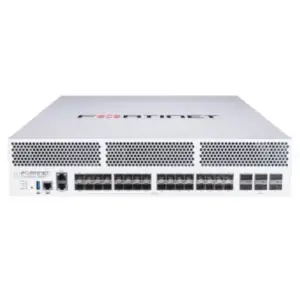
The FS-2048F is aimed at organizations that need far more than conventional access switching. Its 48 SFP28 interfaces and eight QSFP28 interfaces allow network architects to consolidate large numbers of high-speed server, distribution, and aggregation links while preserving room for resilient 100GbE connectivity. FourTeck can assist with model confirmation, optics, airflow, management architecture, power planning, and quotation for Uganda projects.
Where a 25GbE aggregation switch fits in a modern network
The FS-2048F sits above ordinary edge switching. Fortinet positions the platform for campus core and data-center roles, where large volumes of traffic need to move between access layers, servers, security systems, storage platforms, virtualization clusters, and upstream core devices. Its defining characteristic is density: forty-eight ports can operate at 25GbE using SFP28 interfaces, while eight QSFP28 ports provide 100GbE connectivity for high-capacity uplinks, inter-switch links, or resilient paths toward a higher-speed core.
That port combination makes the model particularly relevant when an organization is moving from 1GbE or 10GbE server connectivity toward 25GbE without wanting to consume a large amount of rack space. A 1RU footprint allows significant throughput to be concentrated in a compact physical format. Fortinet lists a 4Tbps switching capacity and packet forwarding performance appropriate to this class, so the design emphasis is not merely the number of ports but the ability to aggregate them at high speed.
The product can be used as a Layer 2/3 switch and can participate in Fortinet-managed architectures. It is compatible with FortiGate switch-controller deployments through FortiLink, while Fortinet also supports standalone and other centralized management approaches across the FortiSwitch family. This matters for organizations that already operate FortiGate because network and security teams can design switching with a common operational model rather than treating the aggregation layer as an isolated platform.
Selection still requires careful engineering. The switch uses fiber-oriented SFP28 and QSFP28 interfaces rather than a bank of standard copper access ports. Buyers therefore need to identify required optics, cable lengths, fiber type, transceiver reach, breakout requirements where applicable, and the port speeds on neighboring devices. Airflow direction is another material consideration because Fortinet offers both standard and back-to-front airflow variants. Choosing the wrong direction can conflict with established hot-aisle/cold-aisle rack design.
For Uganda buyers, FourTeck can help translate the intended topology into a bill of materials. That review can cover switch quantity, redundancy, optics, rack position, compatible FortiGate design, support services, spare power requirements, and delivery planning. For a device in this performance class, the safest buying approach is to confirm the architecture before the purchase order rather than treat the switch as a standalone line item.
Business outcomes created by dense high-speed switching
Consolidate 25GbE server and aggregation links
Forty-eight SFP28 ports provide a practical concentration point for 25GbE connections from server racks, lower-tier switches, virtualization hosts, or other high-bandwidth infrastructure. Consolidation can reduce the need to spread equivalent connectivity across several smaller devices, simplifying rack planning and cable organization.
Build resilient 100GbE upstream paths
Eight QSFP28 interfaces provide enough high-speed ports to design multiple links toward core switches and to support resilient inter-switch connectivity. Fortinet reference architectures use this type of layout to reduce dependence on a single uplink and to preserve high bandwidth between aggregation and core tiers.
Increase bandwidth without consuming excessive rack space
The 1RU form factor concentrates substantial switching capacity into a single rack unit. For colocation sites, enterprise server rooms, and data centers where cabinet space has a direct operational cost, density can simplify expansion planning and free rack capacity for servers, storage, or security appliances.
Align switching operations with Fortinet security infrastructure
In FortiGate-controlled designs, FortiLink allows switching to be integrated into the broader Fortinet environment. This can reduce operational separation between security policy and LAN infrastructure, giving teams a more consistent way to provision, monitor, and troubleshoot the network.
Support Layer 3 aggregation rather than pure Layer 2 concentration
The switch is a Layer 2/3 platform, allowing network architects to place routing functions where they make architectural sense. This can be valuable in data-center and campus designs that need routed aggregation, segmented networks, resilient uplinks, or distribution of routing roles.
Plan for service continuity with redundant power
Dual AC power supplies are part of the model description, helping buyers design around separate power feeds where the facility supports them. Redundant power does not replace an end-to-end continuity plan, but it removes one common single-device power risk from the switch itself.
The most important benefit is architectural flexibility at high link speeds. Buyers can use the platform as an aggregation point today while preserving 100GbE capacity for core connectivity and future growth. The value is strongest when port utilization, optics, link redundancy, and neighboring equipment are designed together.
A compact platform designed around 25GbE access to a 100GbE fabric
The model stands out because it combines a large block of 25GbE ports with a meaningful number of 100GbE interfaces in a 1RU platform. That relationship is useful for aggregation: many downstream devices can connect at high speed while multiple upstream links can be reserved for a resilient core. The architecture is also compatible with Fortinet’s integrated management approach, making it relevant to organizations that want switching and security operations to work together.
High-density server or aggregation connectivity. Link operation depends on selected transceivers and neighboring devices.
High-capacity uplinks, inter-switch links, or core-facing connections.
Designed for demanding campus-core and data-center traffic volumes.
Supports resilient power design when separate feeds and appropriate facility power are available.
High port density with limited rack-space consumption.
Can participate in FortiLink-managed architectures where the chosen FortiGate and software versions are compatible.
FortiSwitch FS-2048F specification ledger
| Specification | Confirmed detail | Buyer relevance |
|---|---|---|
| Product type | Layer 2/3 FortiGate switch-controller compatible switch | Suitable for aggregation, core, and data-center roles. |
| 25GbE interfaces | 48 x 25G/10G/1G SFP28/SFP+/SFP ports | Check optics, link partner speed, fiber type, and reach. |
| 100GbE interfaces | 8 x 100G/40G QSFP28/QSFP+ ports | Useful for core uplinks and resilient high-capacity interconnects. |
| Additional high-speed ports | 2 x 10G/1G SFP+/SFP | Provides additional service or management-design flexibility. |
| Service port | 1 x 10/100/1000 service port | Supports out-of-band or service access depending on deployment. |
| Console | 1 x RJ-45 serial console | Useful for local administration and commissioning. |
| Switching capacity | 4000 Gbps duplex | Indicates suitability for heavy aggregate traffic. |
| Packet forwarding | 4000 Mpps at 64-byte packets | Relevant to high packet-rate workloads and dense fabrics. |
| MAC address storage | 96K | Important in large Layer 2 environments and virtualized networks. |
| Network latency | Less than 1 microsecond | Supports latency-sensitive data-center traffic designs. |
| VLANs | Up to 4K | Provides segmentation capacity for complex enterprise environments. |
| IPv4/IPv6 routing | Supported | Allows routed aggregation and modern dual-stack designs. |
| Link aggregation | Groups up to 48 links; total groups up to number of ports | Useful for redundancy and higher logical link capacity. |
| Form factor | 1RU rack mount | Plan rack position, cable routing, and airflow accordingly. |
| Power | Dual AC power supplies | Supports redundant-feed designs where facility power allows. |
| Airflow | Standard FS-2048F and separate FS-2048F-B2F back-to-front variant | Confirm hot-aisle/cold-aisle orientation before ordering. |
| Management | Standalone or integrated Fortinet management options; configuration dependent | Confirm FortiGate, FortiManager, FortiEdge Cloud, and software-version compatibility for the intended architecture. |
The purchase-driving specifications are port type, uplink count, switching capacity, airflow, and management architecture. The 48 SFP28 ports are valuable only when the project includes compatible 25GbE optics or direct-attach connectivity and neighboring devices that support the planned speeds. Likewise, the eight QSFP28 ports provide substantial 100GbE capacity, but the required transceivers, fiber reach, and redundancy design should be calculated before finalizing quantities.
Airflow deserves equal attention. Data-center racks are normally engineered around a defined front-to-back cooling path. Ordering the wrong airflow variant may create a thermal design conflict even though the electrical and logical specifications appear correct. Management is another architectural decision: a FortiGate-controlled deployment can centralize switch operations, while standalone or cloud-oriented options may fit a different operating model. Software compatibility should be checked whenever FortiGate and FortiSwitch firmware are upgraded together.
Five questions that shape the correct FS-2048F deployment
01. What workload or operational requirement is driving 25GbE?
Start with the traffic source rather than the switch. Virtualization hosts, storage systems, data-center leaf switches, high-performance compute nodes, and aggregation layers generate very different traffic patterns. If many servers only require 10GbE, the value of a 25GbE-dense switch may be future growth rather than immediate utilization. If hosts already have 25GbE adapters, then transceiver and fiber compatibility become the next purchasing priority.
02. What scale must the switch aggregate?
Count active ports, redundant links, spare ports, and expected growth. A design that needs 38 server-facing links today should not assume all 48 ports remain available if several interfaces are reserved for inter-switch connections or special services. At the same time, the eight 100GbE ports should be allocated deliberately between core uplinks, MCLAG or inter-chassis connectivity, and expansion.
03. What existing systems must interoperate?
Document switch models above and below the FS-2048F, FortiGate controller models if used, NIC speeds, optics already installed, fiber type, connector standards, and operating software. Compatibility problems usually appear at the boundaries: unsupported transceivers, mismatched speed capabilities, firmware combinations, or a cabling plant that cannot support the intended reach.
04. What growth, routing, or management features will be needed?
Future requirements can change whether the switch is deployed as a simple aggregation point or as part of a routed and centrally controlled fabric. Buyers should consider VLAN scale, Layer 3 routing needs, link aggregation, resilience, automation, cloud management, and whether the network will later extend into an EVPN/VXLAN or more sophisticated data-center architecture.
05. What installation, support, and delivery expectations apply?
Confirm rack units, power feeds, airflow direction, power cords, transceiver quantities, spare power strategy, support term, commissioning responsibility, and delivery destination. Uganda project lead times can vary by exact configuration and quantity, so procurement dates should be planned around a reviewed bill of materials rather than the switch chassis alone.
Where the FS-2048F delivers the strongest architectural fit
Enterprise data-center aggregation
A data center with multiple racks of virtualization hosts or top-of-rack switches may need a dense aggregation layer between 10/25GbE server connectivity and a 100GbE core. The FS-2048F provides the port ratio for that job. The design should reserve adequate 100GbE interfaces for redundant upstream paths and confirm optical reach between aggregation and core racks.
Large campus core or distribution
Universities, government estates, hospitals, corporate campuses, and multi-building facilities can use high-speed fiber aggregation to concentrate traffic from distribution switches. The switch’s Layer 2/3 capabilities and FortiGate-controller compatibility can support a consolidated operating model. Exact suitability depends on topology, port count, routing design, and the capabilities of downstream campus switches.
Virtualization and private-cloud clusters
Dense hypervisor hosts increasingly use 25GbE adapters to reduce network bottlenecks and consolidate traffic. A 48-port SFP28 platform can connect a substantial server population while maintaining 100GbE northbound capacity. Buyers should map redundancy at the host NIC, switch, and core levels rather than relying on a single path.
High-throughput storage networks
Where Ethernet-based storage platforms use 10GbE or 25GbE, the FS-2048F can provide a high-capacity transport layer. Storage traffic is sensitive to congestion and design quality, so queueing, link utilization, redundancy, and end-to-end NIC and transceiver compatibility should be reviewed alongside raw switch capacity.
These use cases share a common characteristic: they aggregate high-bandwidth infrastructure rather than ordinary user endpoints. Fortinet’s own switching reference architecture places the FS-2048F in an aggregation role and specifically advises against treating that tier as a conventional endpoint-access layer. That distinction helps buyers avoid spending on 25GbE density where a standard access switch would be more appropriate.
Why 48 x 25GbE ports change aggregation planning
Twenty-five Gigabit Ethernet occupies an important middle ground between 10GbE and 40/100GbE. For server connections, it delivers 2.5 times the bandwidth of 10GbE while continuing to use a single-lane architecture that fits common data-center deployment patterns. In practical procurement terms, that makes the FS-2048F attractive when server or lower-tier switch interfaces have already moved to 25GbE and the network needs a compact concentration point.
Port density matters because aggregation designs rarely consume ports one-for-one with physical devices. Redundant hosts may use two network links. Lower-tier switches may be dual-homed. Some ports may be reserved for migration, maintenance, or growth. A project that expects forty connected devices can therefore exceed forty physical links quickly. The 48-port block gives planners room to build a meaningful 25GbE domain without immediately adding another aggregation chassis.
The same density introduces a cabling discipline requirement. SFP28 links depend on the correct optical module or direct-attach cable, and the link partner must support a compatible speed. Buyers should distinguish short intra-rack direct-attach connections from longer fiber runs and should verify multimode versus single-mode requirements. A technically correct switch can still fail to deliver the intended result if the transceiver bill of materials is incomplete.
From a business perspective, the value is a cleaner upgrade path. Rather than replacing an entire core simply because server links outgrow 10GbE, an organization can introduce a 25GbE aggregation tier and use 100GbE upstream connectivity toward the core. This allows bandwidth growth to be staged around actual workload demand.
Eight 100GbE interfaces give the uplink plan room to breathe
Aggregation switches can become bottlenecks when their uplink capacity is too small relative to the number of downstream links. The FS-2048F addresses that risk with eight QSFP28 ports capable of 100GbE. This does not eliminate the need for oversubscription planning, but it gives architects enough high-speed interfaces to build multiple core-facing paths and still retain ports for switch interconnection or future expansion.
The key buying question is therefore not simply whether eight 100GbE ports are enough. It is how those eight ports will be allocated. A diagram showing core A, core B, peer aggregation switches, and any special high-bandwidth appliances often reveals the correct optics count and redundancy strategy more clearly than a spreadsheet of port totals.
Integrated management is an architecture decision, not a checkbox
Fortinet supports FortiSwitch as part of an integrated secure-networking environment. When a compatible FortiGate is used as the switch controller through FortiLink, switching can be managed within the Fortinet operating model. This can help teams coordinate network access, segmentation, device visibility, and policy workflows. The FS-2048F can also operate within other supported management approaches, so the choice should reflect operational responsibility, scale, resilience, and the rest of the infrastructure.
Version compatibility deserves special attention. Fortinet documentation and technical notes show that topology behavior and switch-controller integration can depend on specific FortiOS and FortiSwitch releases. An upgrade plan should therefore treat FortiGate and FortiSwitch software as a coordinated system. Before procurement or a major refresh, record the current FortiGate model, firmware release, intended FortiSwitch release, and any planned FortiManager or cloud-management components.
Buyer decision checklist
- Will the switch be managed by FortiGate, standalone, through FortiManager, or through an eligible cloud-management service?
- Is the selected FortiGate model appropriate for the number and class of FortiSwitch devices in the design?
- Have firmware compatibility and supported topology features been checked?
- Does the operating team need centralized policy visibility or independent switching administration?
- Will the design use Layer 3 routing, MCLAG, dynamic routing, or more advanced data-center features?
- Is the required management subscription or support service included in the bill of materials where applicable?
What buyers should check before purchase
Other purchasing checks include power-cord requirements, support-term expectations, rack mounting, spare power supplies, expected growth, project quantity, and whether a different FortiSwitch model would be more appropriate for 10GbE-dominant or 100GbE-dominant designs. FourTeck can use this information to build a configuration-oriented quotation rather than a chassis-only quote that leaves critical accessories unspecified.
Configuration-led sourcing for Uganda projects
FortiSwitch FS-2048F availability in Uganda can vary with required quantity, airflow variant, transceivers, support coverage, and project timing. FourTeck can prepare a quotation after reviewing the required bill of materials, rather than assuming that every deployment needs the same accessories. This is particularly important for 25GbE and 100GbE projects because optics and fiber reach can materially change the final configuration.
For Kampala deployments, FourTeck can coordinate quotation, configuration review, delivery planning, and warranty guidance based on the selected Fortinet support option. Project buyers should provide the intended deployment date, site details, quantity, and any requirement for phased delivery. For enterprise refreshes, it is useful to include the existing switch and firewall models so that compatibility and migration questions can be identified before procurement.
FourTeck does not need a final engineering drawing to begin. A simple link-count worksheet, rack location, and list of neighboring devices is usually enough to identify the main questions. Once those details are reviewed, the quotation can distinguish the switch chassis, optics, optional spare power items, support services, and any compatible Fortinet components required by the architecture.
Uganda location coverage
FourTeck can coordinate business IT supply for customers in Kampala and for projects serving Entebbe, Jinja, Mbarara, and Gulu. The practical requirement is to confirm site destination, project quantity, delivery expectations, and whether configuration work is centralized or split across multiple locations. For multi-site projects, buyers should identify which site will host the core or data-center equipment and which sites require downstream access or distribution switches, because the FS-2048F is generally an aggregation or core platform rather than a branch-access device.
Planning a Fortinet switching standard across East Africa
Organizations with infrastructure in more than one country often need consistent switch models, optics, support terms, and documentation. FourTeck can support quotation discussions for Uganda and may coordinate related requirements through its regional web presence for Kenya, selected East Africa and Africa markets, the UAE, and Kuwait where relevant. Regional project planning should still be handled location by location because import conditions, delivery routes, support requirements, and exact configurations can differ.
For a multi-country data-center or campus standard, create one technical baseline first: switch model, airflow, supported firmware, optics families, rack power arrangement, support level, naming convention, and redundancy pattern. Then identify any site-specific deviations. This prevents each location from building a separate design while still allowing local needs to be respected.
Useful regional starting points include FourTeck Kenya, FourTeck Africa, FourTeck UAE, and FourTeck Kuwait. These links are useful for regional coordination; they do not imply identical local stock, pricing, delivery time, or warranty handling in every market.
Related Fortinet switching options to discuss
Practical assistance around the switching hardware
01 — Product selection guidance. FourTeck can help determine whether a 25GbE-dense FS-2048F is the right tier for the network or whether a 10GbE- or 100GbE-focused model better matches the topology.
02 — Configuration review. The quote can be built around airflow, optics, fiber reach, support term, power, and management design instead of treating the switch chassis as a complete solution by itself.
03 — Quote assistance. Business buyers can provide quantities, desired link speeds, delivery site, and target timing so procurement can receive a structured bill of materials.
04 — Uganda delivery coordination. Project supply can be planned around destination, site schedule, and quantity without making unverified claims about immediate stock or delivery times.
05 — Warranty and support guidance. Fortinet support options vary by product and term. FourTeck can include the requested support level and explain what has been quoted so buyers can align procurement with operational expectations.
06 — Alternative product matching. If the required links are predominantly 10GbE or the core needs much more 100GbE density, the conversation can shift to another FortiSwitch model rather than forcing the FS-2048F into the wrong role.
FortiSwitch FS-2048F buying questions
01. What is the FortiSwitch FS-2048F mainly used for?
It is designed for high-capacity campus core and data-center switching, especially aggregation environments that need many 25GbE links and multiple 100GbE uplinks. Fortinet reference architecture places it in the aggregation tier rather than as a conventional endpoint-access switch. It is therefore best evaluated against server, distribution, and core-link requirements instead of desktop port counts.
02. How many 25GbE and 100GbE ports does it provide?
The platform provides 48 SFP28 interfaces that support 25GbE and lower compatible optical speeds, plus eight QSFP28 interfaces supporting 100GbE and 40GbE operation. It also includes two 10GbE/1GbE SFP+/SFP ports. Actual link speed depends on the transceiver, cabling, and capabilities of the connected device.
03. Can the FS-2048F be managed by FortiGate?
Yes. Fortinet describes the model as FortiGate switch-controller compatible, allowing it to participate in FortiLink-managed deployments. The exact FortiGate model, FortiOS release, FortiSwitch firmware, topology, and feature requirements should be checked together. This is particularly important during upgrades or when using advanced switching features in a production environment.
04. Does it include redundant power?
The FS-2048F is specified with dual AC power supplies. In facilities with separate power feeds, this can support a more resilient power arrangement. Buyers should still confirm power cords, voltage environment, PDU capacity, UPS design, and whether spare power supplies are required as part of the project bill of materials.
05. What is the difference between FS-2048F and FS-2048F-B2F?
The primary published distinction is airflow direction. The B2F variant is specified for back-to-front airflow. This is a critical mechanical choice in data-center racks, because the switch should follow the intended hot-aisle/cold-aisle cooling pattern. Tell FourTeck the rack airflow direction so the appropriate variant can be quoted.
06. Are SFP28 and QSFP28 transceivers included?
Transceiver requirements should be treated as a separate configuration item unless the specific quotation states otherwise. Buyers need to define link speed, cable distance, fiber type, and neighboring interface. FourTeck can use those details to build an optics list for 25GbE and 100GbE links rather than assuming one module suits every connection.
07. Is the FS-2048F suitable for user access ports?
It is generally not the first choice for ordinary endpoint access. Fortinet’s aggregation guidance notes that devices such as access points, cameras, phones, and laptops should normally connect at a lower access tier. The FS-2048F is better used to aggregate those lower-tier switches, servers, or other high-bandwidth infrastructure.
08. What details should I send for a Uganda quotation?
Send the switch quantity, required 25GbE and 100GbE link counts, approximate fiber distances, fiber type if known, connected-device models, FortiGate model if used, airflow requirement, support term, delivery city, and target project date. This allows FourTeck to quote a more complete and technically aligned bill of materials.
09. Can the switch be used in a redundant pair?
Yes, redundant architectures can be designed using multiple switches and high-speed interconnections. The exact method depends on the topology and supported features, such as link aggregation or MCLAG in the chosen software release. Redundancy should be planned across switches, uplinks, power feeds, and core devices rather than assumed from a pair of chassis alone.
10. How do I know whether another FortiSwitch model would be better?
Compare the real link mix. If most downstream connections are 10GbE, a 10GbE-dense model may be more economical. If the network is predominantly 100GbE, a higher-density 100GbE core platform may be preferable. The FS-2048F is strongest when many 25GbE connections need to aggregate into several 100GbE uplinks.
Build the switch, optics, airflow, and support quote as one project
For a high-capacity aggregation switch, a complete quotation should reflect the whole deployment rather than the chassis alone. Share the required switch quantity, 25GbE and 100GbE link counts, fiber distances, connected-device models, preferred airflow direction, FortiGate management requirement, support term, delivery destination, and project timing. FourTeck can use this information to prepare an Uganda-focused quote and identify any configuration questions before procurement.
- Required quantity and rack location
- 25GbE / 100GbE optics and distance
- Airflow direction and power arrangement
- FortiGate or standalone management plan
- Support term and target deployment date
Reviews
There are no reviews yet.