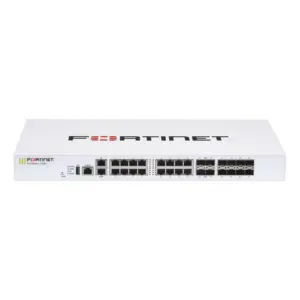
FortiSwitch FS-624F-FPOE in Uganda
A 24-port multi-gigabit PoE++ enterprise switch built for high-density campus access, powerful edge devices and 10/25GbE uplinks.
The FS-624F-FPOE combines 1/2.5/5GbE copper access with a large PoE budget and four SFP28 uplink ports, giving IT teams a practical platform for modern wireless, security and converged campus networks. FourTeck supports Uganda buyers with configuration review, quotation, accessory planning and deployment-oriented product selection.
A campus access switch for faster edge devices
The FortiSwitch 624F-FPOE is positioned for organisations that need more than traditional 1GbE access at the network edge. Its copper interfaces can operate at 1GbE, 2.5GbE or 5GbE, so a business can connect current-generation endpoints without immediately moving every horizontal link to fibre. That is particularly relevant when wireless access points, high-resolution surveillance endpoints, specialist workstations or other devices can use more bandwidth than a conventional gigabit access layer provides.
The second major part of the platform is power delivery. Fortinet specifies 24 PoE-capable ports supporting IEEE 802.3af, 802.3at and 802.3bt Type 4, with a 1440 W total PoE budget. This gives network designers substantial flexibility, but it also makes pre-purchase planning more important. A simple port count is not enough. IT teams should map the expected wattage of every powered endpoint, identify which devices require higher PoE classes, and reserve capacity for future expansion rather than treating the published budget as an abstract maximum.
Four 10/25GbE SFP28 interfaces provide the higher-speed paths needed to aggregate access traffic toward distribution, core or security infrastructure. These ports can also be relevant to stacking designs supported by current FortiSwitch software. Fibre type, transceiver model, distance, redundancy and upstream switch capability all affect the final bill of materials, so optics should be selected as part of the design rather than added at the last minute.
For Uganda buyers, the best fit is usually an enterprise, education, hospitality, healthcare, government or multi-floor commercial network where high-performance wireless and powered devices must share a manageable access platform. FourTeck can review the intended endpoint mix, uplink design, FortiGate integration, rack environment and support requirements before a quotation is finalised.
What the architecture changes for an IT team
More headroom at the access edge
Multi-gigabit RJ45 ports allow compatible endpoints to move beyond 1GbE while continuing to use familiar copper cabling where the installed cable plant and distance support the target speed. This helps organisations modernise incrementally rather than forcing a complete media change for every connection.
High-power endpoint support
A 1440 W PoE budget gives the switch room to serve demanding powered devices. The business benefit is cleaner edge deployment with fewer separate power injectors, provided the endpoint power profile is validated and the rack electrical design is sized appropriately.
Faster aggregation paths
Four SFP28 ports supporting 10GbE and 25GbE help prevent the uplink from becoming an immediate bottleneck when several multi-gig access devices are active. Designers can choose the uplink speed that matches the upstream environment and growth plan.
Operational alignment with Fortinet environments
The model is designed for the Fortinet switching ecosystem and can be managed in FortiGate-integrated deployments using FortiLink. For organisations already standardised on Fortinet security, this can simplify policy-driven access operations and reduce the number of disconnected management workflows.
Resilient power design
Fortinet specifies dual hot-swappable AC power supplies on the FPOE model. In a correctly designed rack, this supports a more resilient switching layer and allows power-supply servicing with less disruption than a fixed single-supply design.
Room for segmented enterprise networks
Published support for up to 4K VLANs, large MAC address storage and substantial Layer 3 route capacity gives architects useful flexibility for segmented campus designs. The exact topology should still be matched to software version, upstream routing strategy and security policy.
High-density power delivery meets multi-gig campus access.
The distinguishing point is not one headline specification in isolation. It is the combination of multi-gig copper, a substantial PoE++ budget, 25GbE-capable uplinks, Fortinet management options and enterprise rack design in a 1RU chassis. That combination targets campus access blocks where wireless and powered edge devices are becoming faster and more demanding.
24 × 1/2.5/5GbE RJ45: supports mixed-speed access devices without requiring identical port speeds across the floor.
4 × 10/25GbE SFP28: provides scalable fibre uplink choices; optics and upstream compatibility remain configuration items.
802.3af/at/bt Type 4: broadens the range of powered endpoints that can be served directly from the switch.
1440 W PoE budget: supports dense powered deployments when rack power and endpoint draw are planned correctly.
440 Gbps switching capacity: gives the platform internal switching headroom suitable for its multi-gig access role.
Dual hot-swappable AC supplies: supports resilient power architecture and serviceability.
FortiSwitch FS-624F-FPOE specification ledger
| Specification | Published detail |
|---|---|
| Network interfaces | 24 × 1GE/2.5GE/5GE RJ45 + 4 × 10GE/25GE SFP+/SFP28 |
| Dedicated management | 1 × 10/100/1000 management port |
| Console | 1 × RJ45 serial console port |
| PoE ports | 24, IEEE 802.3af/at/bt Type 4 |
| PoE power budget | 1440 W |
| Switching capacity | 440 Gbps duplex |
| Packet forwarding | 654 Mpps duplex |
| MAC address storage | 64K |
| Network latency | <1 µs |
| VLANs | 4K |
| Packet buffer | 8 MB |
| Memory / storage | 4 GB DDR4, 32 MB flash, 32 GB SSD |
| IPv4 / IPv6 routes | 330K / 112K route entries |
| Form factor | 1RU rack mount |
| Dimensions | 44 × 442 × 440 mm |
| Weight | 7.407 kg |
| Input power | 100–240 V AC, 50/60 Hz |
| Maximum power consumption | 1680 W |
| Power supplies | 2 × 1200 W, dual hot-swappable AC |
| Operating temperature | 0°C to 45°C |
| Humidity | 5% to 95% RH, non-condensing |
| Airflow | Front to back |
For procurement, four specifications deserve special attention. First, the 1440 W PoE budget is a chassis-wide resource, so a device inventory should be built from actual endpoint wattage rather than simply multiplying the number of ports by a maximum class. Second, the 10/25GbE uplinks require compatible transceivers, fibre and upstream interfaces. Third, the maximum 1680 W system consumption affects rack power distribution, UPS sizing and heat planning. Fourth, the 1RU footprint is compact, but dense PoE switching still needs appropriate airflow and rack clearance. A quote should therefore include not only the switch but also the optics, patching, support and power assumptions that make the design workable.
Five questions to answer before requesting a quote
01 — What must the access layer carry?
List the devices that will connect to the switch and the throughput they actually need. If the deployment is dominated by ordinary 1GbE endpoints, the business case for multi-gig access may be limited. If the switch will serve Wi-Fi access points, high-bandwidth cameras, specialist compute endpoints or aggregation links that can use 2.5GbE or 5GbE, the model becomes more relevant. This workload view also helps determine whether all 24 ports need to be active immediately or whether some capacity can be reserved for growth.
02 — How much PoE power is required?
Create a port-by-port power schedule. Record the expected PoE standard and maximum draw of every powered device, then include design margin. The switch supports 802.3af, 802.3at and 802.3bt Type 4, but not every endpoint consumes the same amount of power. The correct question is whether the total deployment fits comfortably within the published 1440 W budget under realistic operation.
03 — What does the upstream network support?
The four SFP28 ports can operate at 10GbE or 25GbE, but the final selection depends on the upstream switch, router or FortiGate, as well as fibre type and distance. Confirm whether links will be single-mode or multimode, whether redundancy is required, and whether link aggregation or supported stacking will be used. This determines the transceivers and patch leads that belong on the quote.
04 — How will the switch be managed and expanded?
Decide whether the design is FortiGate-managed through FortiLink, locally managed, cloud-managed where applicable, or part of a broader Fortinet campus architecture. Software version and topology affect available features. Growth planning should also include VLAN scale, routing requirements, additional access switches and whether a higher-density model would reduce future rack and uplink complexity.
05 — What are the installation and support expectations?
Confirm rack depth, rack unit availability, PDU capacity, UPS sizing, airflow direction, ambient conditions, support preference, delivery destination and project quantity. These details change the completeness of the bill of materials even when the core switch model stays the same.
Where the 624F-FPOE makes practical sense
High-density enterprise wireless
Modern access points can require multi-gigabit Ethernet and higher PoE classes. A 24-port switch with 5GbE-capable copper and PoE++ gives a campus team a focused way to serve a wireless-heavy floor or building zone. The design still needs a power map and 10/25GbE uplinks sized for aggregate traffic. For a large wireless rollout, architects should also assess whether multiple 24-port blocks or a higher-port-count model provides cleaner capacity planning.
Converged smart-building networks
Commercial buildings increasingly combine access points, cameras, phones, sensors and other powered devices on the same structured cabling plant. The large PoE budget can reduce the need for independent injectors, while VLAN and management capabilities support segmentation. The buyer should verify the power requirement of each device type and ensure the physical cabling supports the intended data rate, especially when older copper runs are being reused.
Education and institutional campuses
Schools, universities and public institutions often need reliable powered access across classrooms, offices, laboratories and common spaces. The switch can anchor a building-level access layer where Wi-Fi and IP endpoints dominate. Procurement teams should document the quantity of powered devices, expected peak usage, resilience requirements and central management approach before standardising on a design for multiple buildings.
Hospitality and large commercial properties
Hotels, conference facilities and large office properties may need dense wireless coverage plus surveillance and voice endpoints. Multi-gig access helps accommodate newer wireless infrastructure, while 25GbE uplinks can move aggregate traffic toward distribution. A good design separates guest, staff, operational and security traffic logically and gives the rack enough power and cooling margin for sustained PoE use.
Multi-gig access without abandoning copper at the edge
The practical value of 1/2.5/5GbE RJ45 connectivity is migration flexibility. Many organisations already have substantial investments in structured copper cabling, but the devices attached to that cabling are becoming faster. Wireless access points are a common example: an access point can offer aggregate radio capacity beyond the useful limit of a single 1GbE Ethernet link. A switch port capable of negotiating higher speeds lets the access layer keep pace when the cabling category, distance and endpoint support the selected data rate.
This does not mean every copper run will automatically deliver 5GbE. Cable quality, termination, length, interference and endpoint capability all matter. A procurement exercise should therefore include basic cabling validation for the parts of the network expected to operate above 1GbE. This is especially important in older buildings where cable labels may not tell the full story of installation quality.
The four 10/25GbE fibre interfaces then provide the higher-capacity path out of the access switch. Their role should be determined from expected aggregate traffic rather than simply choosing the highest available speed. A smaller branch of a campus may work well with redundant 10GbE uplinks, while a denser wireless zone or an architecture designed for growth may justify 25GbE. By aligning port speed with real application demand, the organisation can spend on capacity where it produces an operational benefit instead of treating every interface as an isolated specification.
PoE++ capacity becomes a design resource, not just a port feature
Power over Ethernet is often discussed as a yes-or-no capability, but high-density enterprise deployments require a more disciplined approach. The FS-624F-FPOE supports 24 powered ports and multiple PoE generations through 802.3bt Type 4. Fortinet publishes a 1440 W total PoE budget for the platform. That is a large pool of power, but the engineering question is how that pool is allocated across the connected devices during normal and peak operation.
Capability 01 — Broad endpoint classes: support for af, at and bt allows the access layer to accommodate devices with very different power requirements.
Capability 02 — High chassis budget: 1440 W provides room for dense powered access, but the total remains finite and should include design margin.
Capability 03 — Redundant hot-swappable supplies: dual AC supplies support resilient rack design, provided they are connected to appropriately planned power sources.
For a buyer, the right method is to create an endpoint schedule before ordering. Record each access point, camera, phone or other device, its required PoE class, its typical draw and its maximum draw. Add future devices and account for any policy that requires reserve capacity. Then compare that plan with the switch budget and the available rack power. A high PoE switch can shift electrical demand from remote outlets into the network cabinet, so UPS and PDU sizing must be reviewed at the same time. This is particularly relevant in Uganda projects where the network may rely heavily on centralised backup power. The switch should be designed as part of the rack electrical system, not treated as a low-power data-only appliance.
Management, stacking and upstream design
The value of an enterprise switch depends on how it operates inside the wider network. The 624F-FPOE can be used in Fortinet environments where FortiGate and FortiLink centralise switch management, and Fortinet documentation also identifies ports 25–28 as supported stack ports for the current FortiSwitch stacking feature set. These capabilities can help architects build a more coordinated access layer, but topology and software support should be checked against the exact FortiSwitchOS and FortiOS versions planned for deployment.
Management choice affects licensing, operational workflow and troubleshooting. An organisation already using FortiGate may prefer integrated management so switching policy and security operations sit closer together. A standalone or cloud-managed environment has different planning considerations. Before purchase, define who will operate the switch, where configuration backups will reside, how software updates will be controlled and how remote support will access the environment if required.
Buyer decision checklist
- Confirm the intended FortiGate or upstream switch model.
- Confirm FortiOS and FortiSwitchOS version compatibility for required features.
- Decide whether the four SFP28 interfaces are used for uplinks, stacking or a combination supported by the design.
- Select optics only after fibre type, distance and speed are known.
- Document redundancy requirements for both data paths and electrical feeds.
- Confirm operational ownership, monitoring and support expectations.
These decisions prevent a common procurement problem: buying the correct switch chassis but an incomplete surrounding solution. FourTeck can use the answers to prepare a more accurate bill of materials instead of quoting hardware in isolation.
What buyers should check before purchase
| Risk | What to confirm | Why it matters | What to share with FourTeck |
|---|---|---|---|
| Wrong density or variant | 24 ports, FPOE requirement and expected growth | A non-PoE or higher-density model may fit some projects better. | Current and three-year port count. |
| PoE budget mismatch | Endpoint classes and peak wattage | Port count alone does not prove that every powered device can be supported simultaneously. | Device models and quantities. |
| Uplink incompatibility | 10/25GbE speed, optics, fibre and upstream ports | Incorrect transceivers or fibre assumptions can delay commissioning. | Distance, fibre type and upstream model. |
| Rack and power shortfall | PDU, UPS, cooling, airflow and rack depth | A high-PoE switch can place significant load on the cabinet electrical environment. | Rack power source, UPS plan and site conditions. |
Additional checks should include the required FortiCare or cloud-management options, support term, software compatibility, spare optics strategy, patch-cord type and delivery quantity. Warranty expectations should be matched to the applicable Fortinet policy and the support package selected rather than assumed from a generic switch purchase. For multi-site projects, document whether every site uses the same uplink media and power design; standardising the switch while ignoring site differences can create avoidable installation exceptions.
Planning supply for Uganda projects
Availability of enterprise switching hardware can vary with quantity, support package, optics and project timing, so FourTeck treats the product quotation as a configuration exercise rather than a promise of fixed stock. Uganda customers can request assistance with model confirmation, accessory selection, project quantities, delivery coordination and warranty guidance based on the final supply route and support choice.
For projects centred in Kampala, it is useful to provide the installation schedule and site-readiness information with the quote request. That helps separate the hardware requirement from later commissioning dependencies such as rack power, fibre completion or upstream firewall readiness. FourTeck can also help identify when the non-PoE FS-624F or a higher-density FortiSwitch model is a better technical fit, avoiding unnecessary cost or redesign.
The quotation should list the core switch, any required transceivers, support or management options, and relevant accessories as separate decision items. This makes it easier for procurement teams to compare the bill of materials with the network design and approve only what the project actually needs.
Coordinating deployments beyond one site
FourTeck can support quotation and delivery coordination for business IT projects across Uganda. A customer operating from Kampala may be planning a single headquarters upgrade, while organisations with branches or facilities in Entebbe, Jinja, Mbarara or Gulu may need the same switch architecture repeated across several locations. In those cases, the most useful approach is to create one standard design and then document site-specific differences in port count, PoE load, fibre distance and rack power.
This avoids assuming that every location has identical infrastructure. One site may have multimode fibre and another single-mode; one may need a full PoE load while another primarily serves non-powered endpoints. FourTeck can use a site schedule to separate common equipment from location-specific accessories and prepare a clearer project quotation.
Regional sourcing for multi-country IT standards
Organisations that standardise Fortinet networking across more than one country can also discuss regional sourcing with FourTeck. A Uganda project may form part of a wider East Africa rollout that includes Kenya or other selected markets, or it may be linked to procurement teams in the UAE or Kuwait. The useful objective is consistency: the same switch model, approved software baseline, optics policy, support approach and documentation can simplify operations across multiple sites.
Regional availability, delivery arrangements and warranty handling should always be confirmed for the actual destination and supply path. FourTeck does not assume that stock or service conditions are identical across countries. Buyers can review the FourTeck Uganda technology catalogue, FourTeck Kenya, FourTeck Africa, FourTeck UAE or FourTeck Kuwait when the project scope includes those markets.
Related paths to review before standardising
Practical assistance around the hardware decision
01. Model selection guidance. FourTeck can help determine whether the 24-port FPOE model, the non-PoE variant or a higher-density switch better matches the planned access block.
02. Configuration review. Port speed, PoE budget, uplink media, optics, stacking, management and support can be reviewed as one design instead of separate line items.
03. Quote preparation. A structured quotation makes it easier for procurement teams to see which components are essential, optional or dependent on final site conditions.
04. Uganda delivery coordination. Project quantities and delivery requirements can be discussed against the actual destination and deployment schedule rather than relying on generic availability wording.
05. Warranty and support guidance. Buyers can align Fortinet support choices and applicable warranty expectations with the intended operating model.
06. Alternative matching. If the final port count, PoE load or uplink requirement changes, FourTeck can compare suitable FortiSwitch options instead of forcing the original model into an unsuitable design.
FortiSwitch 624F-FPOE buyer questions
01. What is the main use of the FortiSwitch 624F-FPOE?
It is designed as a secure campus access switch for environments that need multi-gigabit copper connectivity, high-capacity Power over Ethernet and fast fibre uplinks. Its 24 RJ45 ports can run at 1GbE, 2.5GbE or 5GbE, while four SFP28 interfaces support 10GbE or 25GbE uplinks. It is particularly relevant to wireless-heavy and converged enterprise networks.
02. How much PoE power does the switch provide?
Fortinet publishes a 1440 W PoE power budget for the FPOE model, with all 24 copper ports supporting 802.3af, 802.3at and 802.3bt Type 4. The correct deployment still depends on the actual power draw and class of each connected endpoint. Buyers should prepare a device-by-device power schedule and leave margin for growth and operating variation.
03. Can the uplinks operate at 25GbE?
Yes. The switch has four SFP28 uplink interfaces that support 10GbE and 25GbE operation. The final link speed depends on the upstream equipment and compatible optics. Fibre type, distance, redundancy, transceiver selection and the upstream port capability should all be confirmed before the bill of materials is approved.
04. Is it suitable for FortiGate-managed networks?
Yes, the model is designed for Fortinet switching environments and can be used with FortiGate through FortiLink where the planned FortiGate and software versions support the required architecture. Before deployment, confirm the management model, FortiOS and FortiSwitchOS versions, uplink topology and any operational requirements such as centralised policy, monitoring and configuration backup.
05. Does it support stacking?
Current Fortinet FortiSwitch stacking documentation lists the FS-624F-FPOE as a supported model and identifies ports 25–28 as stack ports. Stacking feature support and limitations can depend on the FortiSwitchOS release, so the planned software version and topology should be reviewed before the design is finalised.
06. What rack power should be planned?
Fortinet specifies 100–240 V AC input and a maximum power consumption of 1680 W for the FPOE model, with two 1200 W hot-swappable AC power supplies. Rack PDU capacity, UPS sizing, electrical redundancy and cooling should be designed around the actual deployment. A high PoE load can shift substantial electrical demand into the network cabinet.
07. Are transceivers included with the switch?
Optics should be treated as configuration-dependent accessories unless the quoted bundle explicitly states otherwise. The correct SFP+ or SFP28 transceiver depends on whether the uplink runs at 10GbE or 25GbE, the fibre medium, distance and upstream device. Share those details with FourTeck so the quotation can include compatible optical components where required.
08. Is the FS-624F-FPOE available in Uganda?
Supply can vary with quantity, timing, support package and accessory requirements. FourTeck can prepare a current Uganda quotation and coordinate the supply requirement after confirming the configuration. The quote request should state the required quantity, destination, target deployment schedule and whether optics, support or related Fortinet equipment are part of the project.
09. What information should I provide for a quotation?
Provide the number and type of connected devices, required copper speeds, PoE classes or wattages, desired uplink speed, fibre type and distance, upstream switch or FortiGate model, management preference, support term, project quantity and delivery location. Rack power and UPS details are also useful when the design will use a large share of the available PoE budget.
10. When should I consider another FortiSwitch model?
Consider another model when the project does not need PoE, when 24 access ports are insufficient, when the desired uplink count differs materially, or when the edge devices do not justify multi-gig speeds. The FS-624F is the natural non-PoE comparison, while the FS-648F-FPOE is worth reviewing for higher-density powered campus access.
Build the quote around your endpoint and uplink plan
For the most useful quotation, send FourTeck the planned device count, PoE requirements, preferred uplink speed, fibre distance, upstream Fortinet equipment, rack power environment, support preference and quantity. The team can then review whether the selected 624F-FPOE configuration is appropriate and identify the accessories needed for a complete deployment.
- Access-port and endpoint count
- PoE classes or maximum endpoint wattage
- 10GbE or 25GbE uplink requirement
- Fibre type and distance
- FortiGate or upstream switch model
- Project quantity and delivery location