
FortiSwitch FS-M426E-FPOE in Uganda
A 1U managed Layer 2/3 access switch combining Gigabit, multi-gigabit and 10GbE connectivity for Fortinet-based campus and branch networks.
The M426E-FPOE is built for business networks that need more than uniform 1GbE access. It brings 16 Gigabit copper ports, eight 2.5GbE copper ports, two 5GbE copper ports and four 10GbE SFP+ uplinks into a compact rack platform, while providing a 420W PoE budget. It can be managed as part of a FortiGate-controlled LAN environment, giving IT teams a practical route to consolidate access switching and security-oriented management.
Fortinet
FS-M426E-FPOE
Managed Layer 2/3 switch
1GbE / 2.5GbE / 5GbE
4 × 10GbE SFP+
420W published
A multi-gigabit access platform for mixed-speed campus networks
The FortiSwitch FS-M426E-FPOE is designed for organisations whose wired access layer is no longer adequately served by a row of identical 1GbE ports. Many current business networks have a mixed endpoint profile: ordinary workstations, printers and phones may remain comfortable at Gigabit speed, while newer wireless access points, high-throughput workstations, local servers or specialist devices can justify 2.5GbE or 5GbE connectivity. Rather than forcing every endpoint onto the same port class, this switch gives IT planners a structured mix of copper speeds and four 10GbE SFP+ interfaces for aggregation or uplink duties.
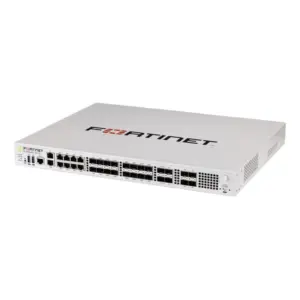
The physical interface layout is one of the model’s main reasons to consider it. Fortinet specifies 16 GE RJ45 ports, eight 2.5 GE RJ45 ports, two 5 GE RJ45 ports and four 10 GE SFP+ ports. The SFP+ interfaces are also documented as compatible with 1 GE SFP modules, which can help during staged upgrades when an organisation is not yet ready to move every uplink immediately to 10GbE. The switch is a 1U rack-mount appliance with a dedicated 10/100 management port and an RJ45 serial console connection for administration and recovery workflows.
For a business buyer, the important issue is not only port count but port assignment. A site with twenty-four powered endpoints can appear to fit a 24-port PoE switch on paper, but the actual requirement may depend on how many devices need 1GbE, how many need multi-gigabit throughput, how much aggregate PoE draw is expected and how much traffic must move northbound through the uplinks. The M426E-FPOE is therefore best treated as a design component rather than a generic replacement switch.
Fortinet positions the model within its secure campus switching portfolio and supports direct management from FortiGate. This matters for organisations already standardising on the Fortinet Security Fabric because switch configuration, visibility and access policies can be coordinated from the FortiGate environment rather than being treated as a completely separate management island. The best fit is normally an organisation that values the combination of multi-gigabit access and Fortinet-integrated control rather than one seeking only the largest possible number of ordinary Gigabit ports.
Uganda buyers should also review lifecycle, support and accessory requirements as part of the quote. Transceivers for SFP+ links, fibre patching, rack power, compatible FortiGate capacity and any FortiCare or cloud-management services should be considered separately from the switch hardware. FourTeck can use the device count, endpoint types, current firewall platform and expected growth plan to help define a more accurate bill of materials before a project is priced.
What the port mix can change for a real network
Allocate bandwidth where it is actually needed
The eight 2.5GbE and two 5GbE copper ports let a network designer reserve higher access speeds for devices that can use them while leaving the 16 Gigabit ports available for conventional endpoints. That can reduce unnecessary over-specification and allows a more purposeful migration from older access switching.
Support multi-gigabit wireless uplinks without a full access-layer redesign
Modern access points can generate more than 1Gbps of aggregate traffic under busy conditions. Multi-gigabit copper can preserve existing structured cabling where suitable while avoiding a 1GbE bottleneck between the access point and switch. The endpoint’s actual Ethernet and power specifications still need to be checked before deployment.
Create higher-capacity aggregation paths
Four 10GbE SFP+ interfaces give the design several options for uplinks, redundant paths or connections to aggregation devices. Link aggregation and topology should be planned around the actual traffic profile, resilience target and upstream equipment rather than simply filling all four ports.
Consolidate access control with FortiGate
Fortinet documents FortiSwitch models as directly manageable from FortiGate. For organisations already using FortiGate as the network security platform, this can bring switching visibility and policy administration into a familiar operational model. The relevant FortiOS and FortiSwitchOS compatibility should be checked for the installed environment.
Power common network endpoints from the access layer
The published 420W PoE budget can simplify deployment of compatible powered devices such as phones, cameras and access points by reducing separate local power adapters. The total budget and each endpoint’s IEEE power class both matter; the switch should not be selected from the aggregate wattage alone.
Keep upgrade choices visible
A mixed-speed platform makes it easier to document which endpoints are on standard Gigabit access and which ones justify higher link rates. This supports phased infrastructure planning, especially when older cabling, endpoint refresh cycles and wireless upgrades do not happen at the same time.
The defining advantage is not a single speed; it is a deliberately mixed access profile.
The M426E-FPOE occupies a useful design position between conventional Gigabit-only access switches and newer platforms where every port is multi-gigabit. It gives IT teams enough high-speed copper ports for bandwidth-sensitive endpoints while preserving a larger set of standard GE interfaces for ordinary access devices.
16 × GE RJ45
Primary wired access for conventional Gigabit endpoints. Exact PoE allocation depends on connected devices and total budget.
8 × 2.5GbE + 2 × 5GbE
Higher-speed copper for access points or other clients whose interface and workload can exceed 1GbE.
4 × 10GbE SFP+
Flexible fibre or DAC uplink options, with 1GE SFP compatibility documented for the SFP+ interfaces.
172Gbps switching capacity
Fortinet’s published duplex switching capacity, paired with 255Mpps packet forwarding for the model.
FortiSwitch M426E-FPOE specification ledger
| Specification | Published detail / buying note |
|---|---|
| Product type | Managed Layer 2/3 FortiSwitch campus access switch |
| Copper access ports | 16 × GE RJ45, 8 × 2.5GE RJ45, 2 × 5GE RJ45 |
| Uplink ports | 4 × 10GE SFP+; Fortinet documentation notes compatibility with 1GE SFP |
| Dedicated management | 1 × 10/100 management port |
| Console | 1 × RJ45 serial console port |
| PoE ports | Fortinet’s 2025 technical clarification states hardware supports IEEE 802.3af/at; do not assume 802.3bt support from older literature |
| PoE budget | 420W published maximum budget |
| Switching capacity | 172Gbps duplex |
| Packet forwarding | 255Mpps duplex |
| MAC address storage | 16K |
| VLANs | 4K supported |
| Network latency | <1µs published |
| Link aggregation group size | 8 |
| Memory / flash | 1GB DDR4 / 256MB flash |
| Packet buffer | 2MB |
| Route entries | IPv4 1K / IPv6 1K |
| Host entries | IPv4 5K / IPv6 2.4K |
| Form factor | 1RU rack mount |
| Dimensions | 44 × 410 × 440mm (H × D × W) |
| Weight | 5.9kg |
| Input power | 100–240V AC, 50/60Hz |
| Power supply | Built-in AC; redundant AC documented |
| Average / maximum consumption | 441W / 442W in published specification; PoE usage strongly affects actual load |
| Operating temperature | 0°C to 50°C |
| Airflow | Side-to-back |
| Management | FortiGate-integrated management supported; standalone/cloud options depend on selected management approach and service |
The specifications that most often change a purchase decision are not the headline switching figures. First, map endpoint speed to the correct copper port group. A deployment that needs twelve 2.5GbE access points does not fit simply because the switch has more than twenty copper interfaces; only eight are 2.5GbE. Second, map endpoint power. The published 420W aggregate budget can look generous, but Fortinet’s later hardware clarification means devices that specifically require 802.3bt power from a single port should not be assumed compatible. Third, define the uplink medium and distance. The four SFP+ slots require appropriate optics or direct-attach cabling based on the connected equipment and physical path.
Power and cooling also deserve planning. A fully loaded PoE access switch can draw far more power than a non-PoE unit, so UPS sizing, rack PDUs, circuit capacity and cabinet ventilation should be reviewed against the intended endpoint load rather than the empty-switch condition. Finally, verify the management model. A FortiGate-controlled design can be operationally attractive for an existing Fortinet environment, but software compatibility, controller sizing and the organisation’s intended support coverage should be checked before a quote is finalised.
Five questions that should be answered before quotation
01 — What workload or operational requirement is driving the switch change?
If the project is being triggered by new Wi-Fi access points, VoIP growth, surveillance, office expansion or a firewall refresh, say so clearly. The reason matters because each workload creates a different balance of bandwidth, PoE and uplink demand. A switch bought only from a port-count spreadsheet can become the wrong model once real endpoint behaviour is considered.
02 — How many devices actually need 1GbE, 2.5GbE and 5GbE?
Count by required interface speed, not by total endpoints. The model has three distinct copper groups. Reserve higher-speed ports for equipment that can use them and allow spare capacity for growth. This question is especially important for wireless designs because the number of multi-gigabit access points may expand faster than the number of ordinary wired clients.
03 — What must the switch interoperate with?
Identify the FortiGate model, software versions, existing switch stack or topology, transceiver types, fibre standard and cabling category. Also identify powered endpoints and their IEEE PoE requirements. Compatibility is not only a vendor question; it includes link rate, optics, cable reach, power class and the intended management architecture.
04 — What growth or expansion is expected?
Estimate the next refresh cycle rather than only today’s endpoint count. If a site is moving steadily toward Wi-Fi 6E or Wi-Fi 7 class access points, a newer switch with a larger multi-gigabit port population or confirmed 802.3bt capability may be more suitable. If the higher-speed requirement is limited to a small number of devices, the M426E-FPOE’s mixed profile can remain efficient.
05 — What are the installation, support and delivery expectations?
Confirm rack space, redundant power approach, UPS availability, fibre patching, installation responsibility, required support term and project schedule. Hardware supply and service entitlements should be quoted separately where appropriate so procurement teams can see what is included, what is optional and what may depend on current distribution availability.
Where the mixed-speed design earns its place
Corporate floor with a small high-speed wireless zone
A company may have ordinary desktops, phones and printers across most desks while only conference areas and collaborative spaces use access points that benefit from multi-gigabit Ethernet. The M426E-FPOE can place conventional clients on GE ports and reserve 2.5GbE access for the wireless layer. The buyer should verify each access point’s power specification, because an AP requiring true 802.3bt from one port is not an appropriate assumption for this model.
In this environment, the 10GbE SFP+ links can provide upstream capacity to the distribution layer or a FortiGate-connected design. A traffic estimate still matters: if multiple high-throughput APs are expected to be busy at the same time, uplink oversubscription should be checked rather than judged from port speed alone.
Campus building refreshing from 1GbE in phases
Education, professional-services and institutional networks often upgrade in stages because cabling, access points and endpoint devices have different replacement cycles. A mixed-port switch can support that transition without forcing every access port to be multi-gigabit from day one. The organisation can document which endpoints justify 2.5GbE or 5GbE and keep remaining clients on standard Gigabit interfaces.
The key design question is future density. If the next project phase will quickly exceed eight 2.5GbE endpoints, a newer high-density multi-gigabit platform may provide a cleaner long-term path. FourTeck can compare the current bill of materials with the next planned phase before the first order is placed.
Fortinet-managed branch or regional office
A branch already using FortiGate can benefit from FortiSwitch integration when the IT team wants access-layer visibility and management aligned with the security platform. The M426E-FPOE is particularly relevant if the site also needs a handful of multi-gigabit edge connections rather than only standard Gigabit switching.
Management compatibility should be checked against the deployed FortiOS and FortiSwitchOS versions, and the branch WAN design should be considered separately from LAN switching. Where support or cloud-based lifecycle management is required, the service entitlement should be specified in the quote rather than assumed to be included with hardware.
IP endpoint aggregation with selective bandwidth upgrades
Some environments combine cameras, phones, control devices and a small number of higher-bandwidth clients in the same rack. The available PoE budget can reduce dependence on local adapters for compatible devices, while the speed mix avoids dedicating premium ports to endpoints that cannot use them. The design should include a PoE worksheet showing each device’s maximum draw and power standard.
This is particularly important for surveillance or wireless refreshes where the endpoint model may change during procurement. A switch that works with the originally selected device can become unsuitable if the replacement endpoint has a different power class or interface speed.
Multi-gigabit access is valuable only when it is mapped to the right endpoints
Multi-gigabit switching is often discussed as if every user needs the fastest available port. In practice, the business value comes from matching link capacity to devices that can generate enough traffic to justify it. The M426E-FPOE’s eight 2.5GbE ports and two 5GbE ports make that mapping explicit. A laptop dock or office printer may remain perfectly suited to 1GbE, while a high-density wireless access point can benefit from a faster wired uplink because traffic from many wireless clients is aggregated onto one Ethernet link.
The cabling path has to be part of the review. Multi-gigabit Ethernet was designed to make higher speeds possible over installed copper in many environments, but actual performance still depends on cable category, length, termination quality and interference. A procurement list that specifies only switch and access point models leaves a significant implementation question unanswered. For a new deployment, record the cable standard and test results where available. For an existing site, identify any runs that have a history of link negotiation or error problems before expecting them to carry higher rates.
There is also a capacity-planning point. Eight 2.5GbE ports do not mean every future AP can be accommodated indefinitely. If the site expects rapid wireless expansion, the switch may be a transitional fit rather than the final access architecture. That is not necessarily a disadvantage; a mixed-speed model can be cost-effective when the high-speed endpoint count is known and stable. What matters is making that assumption visible before ordering.
PoE planning requires a standards check, not just a wattage calculation
Fortinet’s published materials for this model have not always been consistent. Older datasheets and current product-family tables have referenced UPOE or 802.3bt Class 6 capability on eight ports, while Fortinet issued a technical clarification in March 2025 stating that the FS-M426E-FPOE hardware does not support the 802.3bt standard and that its available PoE port modes are IEEE 802.3af and IEEE 802.3at. For procurement, the later clarification is the safer basis for endpoint compatibility.
420W aggregate budget
The overall budget remains an important sizing figure, especially when many PoE+ devices are connected simultaneously.
802.3af/at hardware clarification
Treat endpoints that require 802.3bt from a single port as a compatibility risk and select a confirmed-capable switch where necessary.
Dual-link workarounds are design choices
Fortinet documents dual-port aggregation as a workaround for specific FortiAP scenarios, but that should be engineered deliberately rather than assumed in a general switch quote.
For an IT manager, this distinction can be the difference between an access point powering at full capability and an endpoint that starts in a reduced-power state or fails to operate as intended. Build a PoE matrix using the exact endpoint model, required standard and maximum draw. If the endpoint specification says 802.3bt is mandatory for full function, do not rely on the switch’s historical marketing description. FourTeck can use that matrix to identify whether this model still fits or whether a current FortiSwitch with confirmed 802.3bt support is the better procurement path.
10GbE uplinks and FortiGate management shape the upstream design
The four SFP+ interfaces give the switch a useful set of upstream options, but the correct topology depends on what sits above the access layer. A simple branch might use one or two uplinks toward a FortiGate or aggregation switch. A campus design may use link aggregation or redundant paths. The hardware supports a link aggregation group size of eight, but the network architecture should be aligned with resilience, spanning-tree or multi-chassis design decisions elsewhere in the infrastructure.
Transceiver selection is a separate procurement task. SFP+ is a slot type, not a guarantee that any optical module will be suitable. Fibre type, connector, distance, wavelength and the supported module list all matter. For short rack-to-rack links, direct-attach cabling may be appropriate in some designs. For building or campus fibre, the optic must match the installed plant and the interface at the far end. Fortinet also notes that these SFP+ ports can operate with 1GE SFP modules, which can ease migration where the upstream platform is still Gigabit.
Management is similarly architectural. Fortinet documents direct FortiGate management across the FortiSwitch range, making the switch a logical option where the organisation already uses FortiGate and wants coordinated visibility and policy. In a standalone or cloud-managed model, the required service and operational workflow differ. Buyers should decide who will administer the switch, where configuration will live, how firmware will be maintained and what support entitlement is expected before purchase.
Buyer decision checklist
- Confirm the upstream port speed and media at both ends of every link.
- Specify required SFP/SFP+ optics or DACs separately from the chassis.
- Check FortiOS and FortiSwitchOS compatibility for the intended FortiGate-managed design.
- Decide whether link aggregation or physical redundancy is required.
- Include support and cloud-management subscriptions only when they match the chosen operating model.
What buyers should check before purchase
A good network-switch purchase is a compatibility exercise before it is a price exercise. The most important risk on this particular model is the inconsistency between older specifications and Fortinet’s later PoE clarification. Buyers should treat that clarification as a reason to validate every high-power endpoint rather than as a minor documentation issue. A second risk is assuming that a 26-copper-port design provides 26 identical interfaces; it does not. The differentiated speed groups are the product’s strength, but only when the endpoint map fits them.
Procurement should also separate hardware from services. FortiCare support, cloud-management licensing and transceivers can be line items rather than inherent parts of the switch. If a replacement or alternative model is being considered due to lifecycle or availability, compare the same dimensions: copper speed mix, PoE standard, budget, uplink capacity, management compatibility and physical power requirements.
Availability, configuration and project coordination
FourTeck can assist Uganda organisations with product selection, current quotation, compatibility review and delivery coordination for the FS-M426E-FPOE. Availability can vary by supply cycle, quantity and support requirement, so project buyers should request a current quote rather than assume local stock or a fixed lead time.
For Kampala deployments, provide the intended rack location, endpoint schedule, PoE load and uplink plan so the quote can include relevant accessories such as optics where required. For multi-site or phased projects, quantities and preferred rollout sequence should be supplied early because an older campus-switch model may have different sourcing conditions from current-generation equivalents. FourTeck can also discuss warranty guidance and applicable support options without assuming that every project needs the same service term.
Where the design is still being finalised, a short bill-of-material review can help identify omissions before procurement approval. Common gaps include SFP+ modules, fibre patch leads, rack power, UPS capacity, FortiGate compatibility, support SKUs and the power standard of new wireless access points.
Planning supply across Uganda
FourTeck can coordinate enquiries for business and project customers in Kampala as well as requirements serving Entebbe, Jinja, Mbarara and Gulu. The most useful way to plan a multi-location switch project is to supply the quantity per site, required accessories, support expectation and preferred deployment sequence in one request. That gives the procurement team a clearer basis for comparing site needs without duplicating technical assumptions for every location. Delivery arrangements and availability should be confirmed against the final quotation because product sourcing, project volume and destination can affect the practical supply plan.
Regional procurement for distributed organisations
Organisations operating across East Africa may need a common switching standard while purchasing by country or project phase. FourTeck can support enquiries originating in Uganda and can also coordinate product discussions through its regional web properties for Kenya and selected Africa markets. Customers with wider procurement programmes can reference FourTeck resources in the UAE and Kuwait where relevant.
Regional standardisation should still allow for local deployment conditions. Rack power, optics, upstream firewall models, cabling, endpoint power demands and software versions may differ from one site to another. A single model should therefore be standardised only after the highest-demand location has been checked. FourTeck does not need to assume identical stock, warranty handling or delivery time in every market; those commercial points can be confirmed per quotation while the technical bill of materials remains controlled centrally.
FortiSwitch paths to compare before final selection
View 424E-FPOE options
Compare 48-port FortiSwitch choices
Explore newer multi-gigabit switching
Review high-density campus options
Browse FortiSwitch enquiries on FourTeck Uganda
Practical help around the product, not only the chassis
01
Selection guidance
FourTeck can compare the project’s port-speed, PoE and uplink requirements against the specific model so that procurement does not reduce the decision to a total port count.
02
Configuration review
Endpoint models, FortiGate compatibility, optics, fibre, rack power and UPS capacity can be reviewed before the bill of materials is finalised.
03
Quote assistance
A current quotation can separate switch hardware, support and accessories so procurement teams can see exactly what is being requested and what may be optional.
04
Project quantity planning
Multi-site orders can be structured by location, rollout phase and quantity, with technical assumptions checked once and exceptions documented by site.
05
Alternative product matching
If current requirements exceed the M426E-FPOE’s multi-gigabit count or need confirmed 802.3bt, FourTeck can discuss a more suitable current-generation path instead of forcing the original model into the design.
06
Warranty and support guidance
Published manufacturer warranty terms and available FortiCare options can be reviewed against the buyer’s operational expectation. Exact coverage should be confirmed on the selected quote and support SKU.
Questions procurement teams ask about this model
01. What is the FortiSwitch FS-M426E-FPOE mainly used for?
It is a managed Layer 2/3 campus access switch for networks that need a mixture of standard Gigabit and multi-gigabit copper ports with 10GbE SFP+ uplinks. It is especially relevant where selected wireless or high-throughput endpoints need more than 1GbE while many other devices remain Gigabit. It also fits Fortinet environments where switch management through FortiGate is part of the design.
02. How many multi-gigabit ports does the M426E-FPOE provide?
Fortinet specifies eight 2.5GbE RJ45 ports and two 5GbE RJ45 ports, in addition to 16 Gigabit RJ45 interfaces. This matters when planning access points or other devices above 1GbE: the total copper port count should not be treated as if every port supports the same maximum speed. Prepare a port schedule before ordering if multi-gigabit capacity is a key requirement.
03. Does this switch support 802.3bt PoE?
Fortinet issued a technical clarification in 2025 stating that the FS-M426E-FPOE hardware does not support the 802.3bt standard and offers IEEE 802.3af and 802.3at PoE modes. This clarification is important because older Fortinet material referenced UPOE or 802.3bt capability. If your endpoint requires true 802.3bt from one port, specify a different switch with confirmed support.
04. What is the PoE power budget?
The published PoE budget is 420W. That figure is the aggregate budget, not a substitute for checking each device’s required power standard and maximum draw. Build the PoE plan by endpoint model, then total the load with appropriate engineering margin. Devices that demand 802.3bt power should be treated as incompatible with the model’s clarified hardware capability even if the total wattage appears sufficient.
05. Can the switch be managed from FortiGate?
Yes. Fortinet documents FortiSwitch models as manageable directly from FortiGate, supporting integrated visibility and control in a Fortinet LAN design. Before deployment, confirm that the specific FortiGate model, FortiOS version and intended FortiSwitchOS release are compatible and appropriately sized. If the organisation intends standalone or cloud-based management instead, identify the required management service and support model separately.
06. Are SFP+ transceivers included with the switch?
Do not assume that the required SFP or SFP+ optics are included unless the quotation explicitly lists them. The four 10GbE SFP+ slots need modules or suitable direct-attach cables matched to the link design. Buyers should provide fibre type, connector, distance and the upstream device model so the optics can be selected correctly. Fortinet also documents 1GE SFP compatibility on these SFP+ interfaces.
07. Is the FS-M426E-FPOE suitable for newer high-power wireless access points?
It can be suitable where the access point’s Ethernet speed and power requirements fit the switch’s available interfaces and IEEE 802.3af/at capability. It should not be selected for an AP that requires 802.3bt power from a single port to operate fully. For modern wireless refresh projects, share the exact AP model with FourTeck so both data rate and power requirements are checked before quotation.
08. What information should I provide for a Uganda quotation?
Provide the required quantity, delivery location, FortiGate model, endpoint count by 1GbE/2.5GbE/5GbE speed, PoE device models, uplink media and distance, required SFP+ optics, support term and any installation constraints. This gives FourTeck enough context to quote the correct hardware and accessories and to flag a different FortiSwitch model if the current design needs more multi-gigabit ports or stronger PoE capability.
09. Is this model appropriate for a large campus expansion?
That depends on the number of endpoints and future speed requirements. The model can fit a building or access block where the mixed port profile aligns well with actual devices. If a large campus expects many more 2.5GbE or 5GbE access points, a newer higher-density platform may reduce future replacement pressure. Capacity planning should include the next expansion phase, not only the first rack being purchased.
10. What alternatives should be considered if this model is not the right fit?
Within the FortiSwitch family, compare models according to the reason this switch falls short. A standard 1GbE design may suit a 424E-FPOE or 448E-FPOE type profile, while a modern high-density multi-gigabit and confirmed 802.3bt requirement points toward newer 600-series FPOE options such as the 624F-FPOE or 648F-FPOE. FourTeck can match the alternative to the actual port and power worksheet.
Send the port, power and uplink plan before you request the final switch quote
The fastest way to validate this purchase is to share the exact endpoint list rather than only the required quantity. FourTeck can use that information to review whether the M426E-FPOE has enough multi-gigabit ports, whether each PoE endpoint fits the clarified 802.3af/at hardware capability, and which uplink optics or support items need to be included.
- Quantity and Uganda delivery location
- FortiGate model and management approach
- Endpoint count by link speed
- Powered-device models and IEEE power requirements
- Uplink fibre or DAC details
- Support term and project schedule
Reviews
There are no reviews yet.