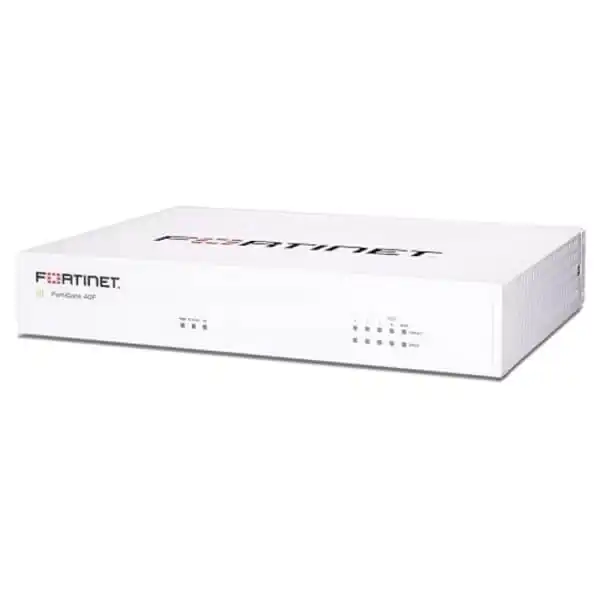
FortiWiFi 40F-3G4G Uganda
A compact next-generation firewall that brings wired security, integrated Wi-Fi and CAT-12 LTE connectivity into one desktop platform for small and distributed business sites.
For branch offices, shops, professional offices and project locations where network resilience matters, this model gives IT teams a practical way to combine fixed WAN access with cellular connectivity while keeping policy, SD-WAN and security control inside the FortiOS environment. The final order should match the required FortiGuard services, support term, mobile operator, antenna plan and site design.
A branch-security appliance built for sites where the WAN cannot be taken for granted
The Fortinet 40F-3G4G platform is designed for distributed locations that need a compact security gateway but also benefit from cellular connectivity at the edge. Instead of treating the firewall, basic local wireless service and LTE modem as three unrelated boxes, the appliance brings these functions into one FortiOS-managed device. That can simplify branch topology, reduce the number of powered components and give administrators a consistent policy point for internet access, segmentation and secure connectivity.
Its strongest fit is not simply “small business.” It is a small or light branch with a real dependency on internet service: a retail point that must keep cloud applications reachable, a professional office that needs secure remote connectivity, a temporary project location where wired service may be delayed, or a distributed organisation seeking a standard appliance for modest sites. In these scenarios, integrated cellular capability can be planned as a secondary link or, where technically appropriate, as part of a primary access strategy.
The model includes hardware-accelerated Gigabit Ethernet interfaces, a FortiLink-capable port, integrated Wi-Fi and a CAT-12 LTE modem. Fortinet specifies two nano-SIM slots in an active/passive arrangement and broad LTE-band coverage. That does not mean every SIM or every operator will perform equally at every location. Uganda buyers should confirm signal conditions, band compatibility, data-plan terms and antenna placement for the intended site. The same diligence applies to security subscriptions: FortiOS provides the platform, while FortiGuard service selection and FortiCare coverage depend on the purchased bundle or licences.
FourTeck can help translate these variables into an orderable configuration by reviewing site count, current ISP links, expected user load, VPN requirements, security-service scope and deployment timeline. The result should be a bill of materials based on the actual operating environment rather than a generic appliance-only quote.
Why the integrated design matters operationally
Fewer branch-edge components to coordinate
Combining firewalling, integrated wireless and an embedded LTE modem reduces the need to design three separate edge devices for a light branch. The business value is a more coherent topology, fewer power adapters and a single FortiOS policy point. This does not remove the need for external switching or access points when port count, PoE or wireless coverage requires them.
Cellular resilience can be designed into the branch
CAT-12 LTE and dual nano-SIM slots give network teams a practical cellular option at the firewall itself. With suitable operator service and coverage, the cellular path can support continuity planning or sites awaiting a fixed circuit. The value is not the existence of LTE alone; it is the ability to include that link in an intentional WAN and SD-WAN policy.
Consistent security policy across distributed sites
Because the appliance runs FortiOS, organisations already using FortiGate can apply familiar routing, security and SD-WAN concepts at smaller locations. Standardisation can reduce configuration drift and make branch troubleshooting easier, especially when a rollout includes multiple geographically separated offices.
Fanless desktop operation suits office environments
Fortinet lists the platform as fanless at 0 dBA and desktop form factor. For small offices without a dedicated network room, silent operation can simplify placement. Buyers still need adequate ventilation, safe power and suitable physical security for the appliance and its antennas.
Hardware acceleration supports a security-first branch design
The 40F family uses Fortinet’s purpose-built security processing architecture to accelerate networking and security functions. For buyers, this means appliance sizing can focus on the actual security profile and workload instead of assuming basic firewall throughput is the only meaningful number.
A structured route to broader Fortinet integration
The appliance can form part of the Fortinet Security Fabric and can use FortiLink for managed switching designs. This is useful for customers building a repeatable branch architecture. Compatibility, management licensing and the exact FortiSwitch or FortiAP design should be confirmed for the intended FortiOS version and site requirements.
Its distinction is the convergence of a compact NGFW, branch Wi-Fi and embedded cellular WAN—not a single headline throughput figure.
The buying case becomes clearer when the hardware is evaluated as a branch design rather than as a standalone firewall. The verified capabilities below show what the appliance contributes and where configuration still matters.
CAT-12 modem, two nano-SIM slots and broad supported LTE bands. Operator service, coverage and SIM policy remain deployment choices.
Single-radio 2.4/5 GHz 802.11 a/b/g/n/ac-W2 with 3×3 MU-MIMO. Coverage capacity should be validated for the site.
One hardware-accelerated GE WAN, three GE internal ports and one GE FortiLink port provide compact branch connectivity.
Firewall, secure networking and SD-WAN functions are administered within FortiOS, with security services based on the selected licences.
Confirmed hardware details that influence deployment
| Field | FortiWiFi 40F-3G4G | Buyer relevance |
|---|---|---|
| WAN interface | 1 × hardware-accelerated GE RJ45 WAN | Connects primary fixed WAN service. |
| Internal interfaces | 3 × hardware-accelerated GE RJ45 internal | External switching may be required for larger port counts or PoE. |
| FortiLink | 1 × hardware-accelerated GE RJ45 FortiLink | Relevant to FortiSwitch-managed branch designs. |
| Cellular modem | 3G/4G LTE, Sierra Wireless EM7565, CAT-12 | Confirm operator bands, signal strength and data plan. |
| SIM slots | 2 × nano SIM, active/passive | Supports a dual-SIM design subject to configuration and operator policy. |
| Wireless | Single radio 2.4/5 GHz, 802.11 a/b/g/n/ac-W2, 3×3 MU-MIMO | Assess client density and coverage before relying on integrated Wi-Fi alone. |
| Maximum Wi-Fi rates | 1300 Mbps at 5 GHz; 450 Mbps at 2.4 GHz | Theoretical radio rates are not the same as end-user application throughput. |
| Antenna ports | 6 × SMA | Plan antenna installation and physical clearance. |
| USB / console | 1 × USB, 1 × RJ45 console | Useful for administration and supported peripheral/service workflows. |
| Dimensions | 40.5 × 216 × 160 mm | Compact desktop placement; mounting accessories may be separate. |
| Weight | 1 kg | Relevant for shelf, enclosure and transport planning. |
| Power input | 12 V DC, 3 A; external adapter, 100–240 V AC 50/60 Hz | Confirm protected power source and UPS strategy. |
| Power consumption | 18.6 W average / 19.8 W maximum | Useful for UPS runtime and branch power budgeting. |
| Acoustics | Fanless, 0 dBA | Suitable for office-adjacent placement when environmental requirements are met. |
| Operating environment | 0–40°C; 10–90% non-condensing humidity | Ensure adequate ventilation and suitable room conditions. |
How to read this ledger. Port count, cellular design and wireless coverage are likely to affect a purchase more than the chassis dimensions. A branch with only a handful of wired devices may use the integrated interfaces directly; a site with IP phones, cameras, multiple access points or PoE requirements will normally need a suitable switch. Likewise, the integrated radio can serve an appropriately sized office, but walls, client density, roaming needs and floor area may make managed FortiAP access points the better architecture.
The embedded LTE modem is valuable only when the selected mobile service works well where the appliance and antennas will be installed. Before rollout, conduct a signal and operator assessment, identify whether LTE is backup or primary, and define what traffic is allowed over cellular. Finally, size the security subscription to the required protections and confirm the software/support term. Hardware capability and security-service entitlement are related but not identical procurement items.
Five questions to answer before requesting the final configuration
01 — What must remain available when the primary link fails?
List the applications that are business critical: payment processing, cloud ERP, email, VoIP, remote desktop, VPN access, inventory platforms or customer-facing services. This determines whether LTE is merely emergency management access or a true continuity path for users. It also informs SD-WAN rules, data-plan sizing and traffic restrictions.
02 — How large is the site in users, traffic and wireless demand?
User count alone is not enough. Note internet circuit speed, typical simultaneous sessions, encrypted application use, VPN traffic and local wireless density. A quiet eight-person office and an eight-person media branch can have very different traffic patterns. The answer determines whether the 40F-class appliance and integrated Wi-Fi are appropriately sized or whether a larger platform or separate access points are justified.
03 — What must integrate with the existing environment?
Record VLANs, switches, access points, authentication services, VPN peers, cloud management tools and any existing Fortinet products. If FortiLink, FortiSwitch or FortiAP management is planned, confirm model and FortiOS compatibility. For LTE, identify the operator, SIM form factor, APN requirements and intended bands.
04 — What will change over the next three to five years?
Include additional sites, faster WAN circuits, more users, new security services and anticipated cloud dependence. A device that is comfortable for today’s branch should still support the planned operational profile. Growth expectations may change the recommended model, subscription term or external switching and wireless design.
05 — What installation and support expectations apply?
Clarify whether the appliance will sit on a desk, shelf or enclosure, whether UPS protection is available, who will configure it, how changes will be managed and what FortiCare term is required. Also state required delivery location and project quantity. These practical details affect the bill of materials and rollout plan.
Deployment stories where the feature mix makes practical sense
Retail branch dependent on cloud applications
A shop or service outlet may have modest bandwidth but high sensitivity to internet interruption because point-of-sale, inventory or cloud communications are central to daily work. The appliance can secure the fixed WAN and keep an LTE path available for a defined continuity policy. The design should identify which applications are permitted on cellular, how much data they consume and whether local Wi-Fi coverage is adequate. If the branch also has many PoE devices, a managed switch becomes part of the project.
Professional office with limited network space
A small legal, accounting, engineering or consulting office may need firewalling, VPN connectivity and local wireless but have no dedicated server room. The compact fanless chassis reduces acoustic and physical impact while FortiOS provides the security and networking platform. LTE can act as backup connectivity. Buyers should check encrypted traffic volume, remote-access requirements and whether a single integrated radio can cover the workspace without compromising user experience.
Project or temporary location awaiting fixed broadband
Construction, field, event and temporary project offices sometimes become operational before a permanent circuit is delivered. Integrated LTE can provide a practical early-stage WAN path where mobile coverage and data plans are suitable. When fixed service arrives, the branch can retain LTE as an alternate link. The procurement team should verify signal quality at the exact location, antenna placement, power protection and the expected duration and volume of cellular use.
Distributed enterprise standardising light branches
An organisation operating many smaller sites can benefit from a repeatable edge design. A common FortiOS platform can make configuration templates, secure SD-WAN policy and branch troubleshooting more consistent. The integrated cellular option provides another design tool for difficult or high-risk links. Before standardisation, test the complete template: throughput under required security services, Wi-Fi coverage, SIM behaviour, remote management, FortiSwitch/FortiAP integration and recovery procedures.
Cellular resilience is most valuable when traffic policy is designed before an outage
The embedded CAT-12 modem is a defining feature of this model, but a cellular interface should not be treated as a magic failover button. A sound branch design first identifies the role of LTE. Is it only for firewall management and critical transactions? Should all office users fail over automatically? Can voice traffic use it? What happens to large operating-system updates, cloud backups or video meetings when the fixed circuit is unavailable? These questions convert a hardware feature into an operational continuity plan.
Fortinet specifies two nano-SIM slots in an active/passive arrangement. That provides flexibility for a deployment that may use more than one mobile service, but operator terms, coverage and configuration must be validated. Radio signal quality is site-specific; building materials, equipment placement and antenna position can materially affect performance. The broad band support of the modem helps compatibility, yet the final answer still comes from the selected Uganda mobile network and the conditions at the actual branch.
For SD-WAN use, administrators can establish health checks and link-selection rules so that business traffic follows the intended path. The practical benefit is control: the network does not have to treat every link as equivalent. A project can prefer fixed broadband for normal operations, reserve LTE for selected applications or invoke it according to performance conditions. Security policy should remain consistent across the paths, and cellular data consumption should be monitored.
Integrated wireless is convenient, but coverage engineering still matters
The Wi-Fi capability uses a single radio supporting 2.4 GHz and 5 GHz 802.11 a/b/g/n/ac-W2 with 3×3 MU-MIMO. Fortinet lists maximum radio rates of 450 Mbps at 2.4 GHz and 1300 Mbps at 5 GHz. Those figures describe the radio capability, not a guarantee of application throughput. Real wireless performance depends on channel conditions, distance, interference, client capability, walls and the number of simultaneous devices.
Integrated dual-band Wi-Fi can serve appropriately sized branch environments without requiring a separate access point for every deployment.
3×3 MU-MIMO supports multiple-user wireless operation, while the single-radio architecture still requires realistic capacity planning.
For larger spaces, higher client density or roaming requirements, external FortiAP access points may be the more suitable design.
The buying decision should therefore start with a floor plan and client profile, not just a feature checkbox. If the branch has concrete walls, multiple rooms, a warehouse area or a high density of phones and laptops, discuss separate managed wireless. The built-in radio is an advantage when it matches the site; it should not be forced to cover an environment beyond its practical design.
Security services and support terms belong in the original bill of materials
A common procurement error is to evaluate a next-generation firewall as hardware only and postpone the subscription decision. The appliance runs FortiOS and can provide secure networking and SD-WAN capabilities, but the exact FortiGuard security services and FortiCare support entitlement depend on what is purchased. The correct bundle should reflect the organisation’s security policy, compliance obligations, operational capability and intended ownership period.
For example, teams expecting intrusion prevention, web filtering, malware protection or other FortiGuard functions should confirm the chosen security package and term. Likewise, support expectations should be matched to the FortiCare offering in the quote. A one-year project and a standardised multi-year branch rollout may call for different commercial structures even when the hardware is the same.
Buyer decision checklist
- Which FortiGuard protections are required by policy?
- What subscription duration matches the budget and deployment lifecycle?
- What FortiCare support level is expected by the IT operations team?
- Will the appliance be centrally managed, and what platform is already in use?
- Who owns firmware planning, configuration backup and policy change control?
- Does the quote include the required antennas, power adapter and any mounting or switching accessories?
The benefit of deciding these items at purchase is predictability. IT receives an appliance with the intended capabilities and support path, while procurement can compare like-for-like quotations instead of confusing hardware-only offers with bundled security solutions.
A four-part risk register for avoiding the wrong branch configuration
| Risk | What to confirm | Why it matters | What to share with FourTeck |
|---|---|---|---|
| Undersized branch design | WAN speed, users, VPN, security inspection and growth | A model selected only by current user count may not suit real traffic or future circuits. | Circuit speed, user/device count, workloads and expected growth. |
| LTE works poorly at the site | Operator, bands, APN, signal strength, antenna placement and data plan | Cellular capability is useful only when radio and commercial conditions are suitable. | Preferred operator, site location, signal observations and continuity objective. |
| Wireless coverage is overestimated | Floor area, walls, client count, roaming and interference | An integrated radio may be enough for one site but not another. | Floor plan, device density and coverage expectations. |
| Incomplete subscription or accessory scope | FortiGuard bundle, FortiCare term, switching, mounting, power protection and cabling | Missing service or accessory items can delay deployment or leave required features unavailable. | Security requirements, support term, current switch/AP design and installation constraints. |
Also confirm the exact regional hardware suffix or part number used in the quotation. Fortinet hardware variants can differ by regulatory or radio region, and product lifecycle status can change over time. Buyers planning a multi-site standard should ask for current orderability and, when appropriate, replacement-model guidance rather than assuming an older bill of materials will remain valid indefinitely. For bulk projects, provide site quantities and delivery phases so the quotation can be aligned with rollout planning.
Plan the quote around the exact site and service bundle
Availability in Uganda can vary by hardware region, lifecycle position, subscription bundle and project quantity. FourTeck can assist with current quotation, configuration review, delivery coordination and guidance on the support options included in the proposed bill of materials.
For a Kampala deployment, provide the number of appliances, expected WAN type, LTE operator preference, Wi-Fi requirement and security term. For multi-branch projects, add the rollout sequence and whether configurations should be standardised across locations. Warranty and support coverage should be read from the quoted FortiCare terms rather than assumed.
Uganda location coverage
FourTeck can coordinate business technology quotations and project supply discussions for organisations in Kampala and for deployments extending to Entebbe, Jinja, Mbarara and Gulu. Coverage planning should be based on the actual delivery address, rollout quantity and technical requirements. For cellular deployments in particular, network performance must be assessed locally because signal and operator conditions can differ substantially between sites even within the same region.
Regional procurement can use the same technical brief while commercial terms remain market specific
Organisations with branches beyond Uganda may want a consistent firewall and SD-WAN standard across several operating markets. The technical requirements—site size, circuits, LTE strategy, wireless coverage and security subscription—can be documented centrally, while each regional quotation reflects local supply and delivery conditions. FourTeck’s regional web presence can support enquiry routing for Kenya, wider selected Africa markets, the UAE and Kuwait.
Regional planning should not assume identical stock positions, delivery times, radio regulations or service terms. Cellular variants are especially sensitive to regional hardware and operator compatibility. For a cross-border rollout, prepare one common technical standard and then validate the exact part number, subscriptions, SIM strategy and logistics for each market. This reduces the chance that superficially similar appliances arrive with different service entitlements or unsuitable radio variants.
Build the branch bill of materials around the required scale
The useful part of procurement is turning a model number into a deployable branch standard
01. Selection guidance: FourTeck can compare the intended branch workload with the appliance class so buyers do not choose solely on name or price.
02. Configuration review: WAN, LTE, Wi-Fi, FortiGuard and FortiCare requirements can be reviewed as one solution rather than disconnected line items.
03. Quote assistance: A structured requirement allows the quotation to identify hardware, subscription terms and relevant accessories clearly.
04. Project and quantity planning: Multi-site customers can provide rollout quantities and phases so supply discussions reflect the deployment plan.
05. Delivery coordination: Uganda destination details can be incorporated into the commercial discussion without implying unverified stock or delivery times.
06. Alternative matching: If lifecycle, throughput or coverage requirements point elsewhere, FourTeck can help identify a more suitable branch path instead of forcing the original model into the project.
Practical questions from branch-network buyers
01. What is the main use of the FortiWiFi 40F-3G4G?
It is intended for small or light branch environments that need a next-generation firewall and benefit from integrated Wi-Fi plus cellular WAN capability. Typical projects include retail branches, professional offices, distributed enterprise sites and temporary locations. The embedded LTE modem can support continuity or access designs, while FortiOS provides the networking, firewall and SD-WAN platform. The exact security services depend on the licences or bundle purchased.
02. Does the appliance support two SIM cards?
Yes. Fortinet specifies two nano-SIM slots using an active/passive arrangement for the integrated Sierra Wireless EM7565 CAT-12 modem. A dual-SIM design can provide operator flexibility, but the actual behaviour, APN details, data plans and network coverage must be validated for the chosen mobile services. Buyers should confirm the regional hardware part number and operator compatibility before ordering a large quantity.
03. Can LTE replace the fixed internet connection?
It can be used as an internet path where mobile coverage, data allowance and performance are suitable, but whether it should replace fixed broadband is a site-specific design decision. Many organisations use cellular as secondary connectivity and keep the fixed circuit preferred. Define the applications that must remain active during failover, expected data use, acceptable latency and the local signal conditions before choosing the policy.
04. Is the built-in Wi-Fi enough for an entire office?
Sometimes, but not universally. The integrated radio supports 2.4 and 5 GHz 802.11ac-class wireless with 3×3 MU-MIMO. Coverage depends on office size, construction materials, interference, client count and roaming requirements. A small open office may be a good match, while multi-floor, high-density or heavily partitioned environments may need FortiAP access points. Share a floor plan when wireless coverage is important to the project.
05. Are FortiGuard security services included automatically?
No assumption should be made from the hardware model alone. FortiGuard services and FortiCare support depend on the bundle or licence term included in the quotation. Decide which protections and support level your security policy requires, then request a matching bundle. This makes quotations easier to compare and avoids discovering after installation that a required service was not part of the hardware-only order.
06. How many wired devices can connect directly?
The appliance provides three hardware-accelerated GE RJ45 internal ports plus a GE FortiLink port, alongside the dedicated GE WAN interface. A branch with more wired endpoints, PoE phones, cameras or several access points will normally need a suitable Ethernet switch. FortiLink can be relevant when the project uses compatible FortiSwitch equipment. Port and PoE requirements should therefore be counted before the final quote.
07. What information should I send for a Uganda quotation?
Provide site location, quantity, internet circuit type and speed, approximate user and device count, preferred LTE operator, Wi-Fi coverage requirement, VPN needs and the security-service term you expect. For multiple branches, include rollout phases and whether configurations should be standardised. FourTeck can then structure the quotation around hardware, subscriptions and relevant accessories instead of returning a generic appliance-only price.
08. Does the device need a UPS?
The firewall uses an external 12 V DC power adapter and has modest power consumption, but branch continuity depends on more than the network link. If the appliance, ISP equipment or switch loses power, LTE failover cannot preserve service. A correctly sized UPS is therefore worth considering for sites where uptime matters. UPS runtime should account for the whole critical network stack rather than the firewall by itself.
09. What should I consider if this model is being standardised across many branches?
Test the complete branch template before broad rollout. Validate security throughput for the intended profile, firmware policy, VPN design, SD-WAN rules, LTE behaviour, operator coverage, wireless capacity, switch integration and remote-management procedures. Also confirm current product lifecycle and orderability. A technically consistent template is valuable, but the cellular and physical environment still needs local validation at each site.
Send the branch requirements, not just the model number
For a useful quote, tell FourTeck how the branch will connect, what must stay online if the fixed WAN fails, how many users and devices are expected, whether the integrated Wi-Fi will serve the site, and which FortiGuard/FortiCare term is required. Include the Uganda delivery location and project quantity so the commercial response can match the deployment plan.
Share: WAN speed • LTE operator • user/device count • VPN needs • Wi-Fi coverage • security bundle • support term • quantity.

Reviews
There are no reviews yet.