
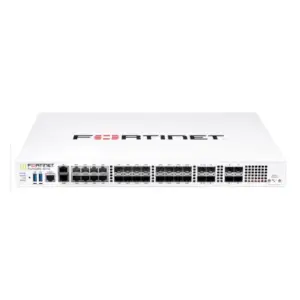
FortiWiFi 81F-2R in Uganda
A compact next-generation firewall, secure SD-WAN and dual-radio wireless platform with 128GB onboard SSD storage for distributed business sites.
The Fortinet FortiWiFi 81F-2R combines wired edge security, WAN connectivity and integrated Wi-Fi in a desktop-class appliance. It is suited to organizations that want one FortiOS-managed platform at a branch, professional office, retail site, education facility or remote operational location without separating the firewall and wireless edge into unrelated systems. Configuration, security-service subscriptions and accessories should be checked against the intended deployment before purchase.
Fortinet
FortiWiFi 81F-2R
NGFW + Secure SD-WAN + Wi-Fi
128GB onboard SSD
FortiOS
A branch security platform that reduces edge complexity
The FortiWiFi 81F-2R belongs to Fortinet’s 80F family of converged security appliances. Fortinet positions the family for secure networking at distributed enterprise sites, where firewalling, software-defined WAN and threat protection need to work together rather than as isolated functions. The 81F-2R version adds integrated dual-radio wireless connectivity and 128GB of onboard SSD storage to the wired interfaces of the platform.
For a business buyer, the practical value is consolidation. A smaller office can use one managed edge appliance for internet-facing security policies, VPN connectivity, SD-WAN decisions and wireless access rather than building an unnecessarily fragmented stack. That does not remove the need for careful design: wireless coverage, internet bandwidth, user count, application mix and security-service requirements still determine whether this model is the correct fit.
The appliance provides eight Gigabit Ethernet RJ45 ports and two shared RJ45/SFP media WAN ports. The shared-media design matters during procurement because an SFP-based uplink may require the appropriate transceiver and fiber specification. Buyers should also distinguish this model from PoE variants in the family; the standard 81F-2R is not the same as the 81F-2R-POE, so powering access points, cameras or phones may still require a suitable PoE switch or injector elsewhere in the design.
FortiOS provides the common operating environment for networking and security functions, while FortiGuard security services can extend protection depending on the license bundle selected. This means the order should be considered as a complete deployment package rather than simply a hardware SKU. FourTeck can help Uganda buyers review the expected WAN design, desired service term, interface requirements, mounting approach and project quantity before a quotation is prepared.
Business outcomes shaped by an integrated edge
01
Consolidated branch operations
Firewalling, SD-WAN and wireless functions can be administered within the Fortinet environment, reducing the number of disconnected edge platforms an IT team must learn, update and troubleshoot. For distributed organizations, that can improve consistency between sites and simplify policy administration.
02
Secure WAN flexibility
Two shared RJ45/SFP WAN interfaces allow the network design to accommodate suitable copper or SFP-based links. Combined with secure SD-WAN capabilities, the platform supports organizations that want application-aware WAN control and resilience strategies from the security edge.
03
Integrated wireless at smaller sites
Dual-radio Wi-Fi is built into this FortiWiFi variant, which can be useful at locations where a separate access-point architecture is unnecessary or where local integrated coverage is desirable. Radio placement and physical coverage still need to be validated for the actual premises.
04
Local storage capacity
The 81F-2R includes 128GB onboard SSD storage, differentiating it from the 80F-2R model. Local storage can support platform functions that benefit from onboard disk capacity, subject to FortiOS features and deployment configuration.
05
Security services aligned to risk
Organizations can select FortiGuard and FortiCare service bundles according to the security functions and support term they require. The important procurement decision is to define those needs before comparing quotations, because a base appliance and a multi-year security bundle are materially different purchases.
06
Compact deployment options
The platform supports desktop, wall and rack-tray deployment options. That flexibility helps buyers fit the appliance into a branch office, communications cabinet or standardized rack environment without assuming that every site requires a full rackmount chassis.
The distinguishing point is not one isolated feature; it is the convergence of security, WAN control, wireless and onboard storage in a compact branch platform.
Fortinet’s 80F family is designed around the convergence of networking and security in FortiOS. For the 81F-2R buyer, the evidence is concrete: the unit brings eight GE RJ45 ports, two shared RJ45/SFP WAN interfaces, dual Wi-Fi radios and a 128GB SSD into one appliance. Those capabilities make it possible to design a complete branch edge around one central policy platform, while still leaving room for external switching, dedicated access points or fiber transceivers when the site requires them.
FortiWiFi 81F-2R specification ledger
| Specification | Confirmed detail |
|---|---|
| Product type | Next-generation firewall / secure SD-WAN appliance with integrated Wi-Fi |
| Ethernet ports | 8 x GE RJ45 |
| WAN interfaces | 2 x shared RJ45/SFP media WAN ports |
| Wireless | Dual Wi-Fi radio |
| Onboard storage | 128GB SSD |
| Dimensions | 60 x 216 x 178 mm |
| Weight | 1.5 kg |
| Form factor | Desktop / wall mount / rack tray |
| Power input | 12V DC, 5A; optional dual power redundancy |
| External AC input | 100–240V AC, 50/60Hz through external DC adapter arrangement; one adapter included according to vendor datasheet |
| Average / maximum power | 24.79W / 30.29W |
| Operating temperature | 0°C to 40°C |
| Operating system | FortiOS |
| Security services | Based on selected FortiGuard / FortiCare license bundle and term |
| Regional code | Configuration dependent; confirm appropriate regional SKU when quoting |
The specifications that most affect a purchase decision are the interface mix, integrated radio requirement, onboard SSD, service bundle and physical deployment method. Eight GE RJ45 ports may be sufficient for a compact site, but larger branch networks normally pair the firewall with access switching. The two shared RJ45/SFP WAN ports should be planned around the actual service-provider handoff; choosing fiber means confirming the correct SFP transceiver and optical specification. The standard 81F-2R should also not be confused with the 81F-2R-POE variant. If downstream devices require power over Ethernet, the network design needs a suitable PoE switch, injector or the appropriate PoE firewall model. Finally, advanced security coverage depends on the FortiGuard package and term selected, so quotations should be compared on equivalent licensing rather than hardware price alone.
Five questions to answer before requesting a configuration
01. What workloads and applications will cross the firewall?
Document internet access, cloud applications, site-to-site VPN traffic, remote-access requirements, voice, business-critical SaaS and any workloads that require tighter inspection. Security performance depends on enabled features, so a meaningful sizing exercise considers the services in use rather than relying on a single headline throughput number.
02. How many users, devices and WAN links will the site support?
A small branch with a modest number of endpoints has a different traffic pattern from a busy customer-facing office. Include wired devices, wireless clients, guest access, printers, phones, cameras and IoT equipment when estimating the site scale. The standard model does not provide PoE on its eight LAN ports, which matters where endpoints require powered Ethernet.
03. What must integrate with the existing network?
Confirm switch uplinks, VLAN structure, ISP handoffs, SFP requirements, authentication services, existing Fortinet management tools and any site-to-site VPN standards. Compatibility planning prevents an otherwise suitable appliance from arriving without the transceiver, cable, switch capability or service setting required for deployment.
04. What growth or subscription horizon should be planned?
Consider expected user growth, additional branch connectivity, future bandwidth, security inspection requirements and the desired FortiCare or FortiGuard term. A multi-year project should compare the total service term and renewal path, not just the initial appliance purchase.
05. What installation, delivery and support expectations apply?
State whether the appliance will be desktop mounted, wall mounted or placed in a rack tray; whether redundant external power is required; and whether the project needs staged delivery or multiple units. FourTeck can use those details to prepare a more accurate Uganda quotation.
Where the 81F-2R can make operational sense
Distributed professional branch
A professional services firm may need secure internet access, encrypted links to head office, controlled guest wireless and consistent firewall policy at a compact branch. The integrated wireless radios can reduce hardware count, while the shared WAN interfaces leave options for compatible copper or SFP handoffs. Site survey and service sizing still matter if the premises are large or densely occupied.
Retail or service location
A retail or service site can benefit from separating corporate, payment, guest and operational traffic with policy controls while using secure SD-WAN for WAN management. The appliance can act as the security edge, but PoE-powered cameras, phones or access points normally require separate PoE switching unless the PoE model is selected.
Education or training office
A smaller education administration office or training center may require controlled browsing, wireless connectivity and VPN access to central systems. FortiGuard services can be chosen according to the desired threat and content controls. Capacity planning should reflect concurrent student devices and any high-bandwidth learning applications.
Remote project office
A temporary or remote business office can use the platform to standardize security and connectivity with the organization’s wider Fortinet environment. Compact dimensions help where rack space is limited. Buyers should still confirm local ISP presentation, electrical resilience, environmental conditions and whether separate access switching is required.
Converged networking and security is the architectural advantage
Fortinet describes the 80F family as a converged next-generation firewall and SD-WAN platform. In practice, convergence matters because many branch problems cross traditional product boundaries. Internet-path selection affects application quality; VPN configuration affects connectivity; segmentation affects both security and operations; and threat controls can change the performance profile of inspected traffic. When these functions share a common operating environment, administrators can apply policies with a more unified view of the edge.
For the 81F-2R, this convergence extends to integrated Wi-Fi. A smaller branch can place the wireless function under the same Fortinet platform rather than treating wireless access as a separate, unmanaged element. This does not mean an integrated radio is the right answer for every building. Larger premises, multiple floors, high user density or difficult radio conditions may justify dedicated access points instead. The buyer decision should therefore start with coverage and capacity rather than the mere presence of Wi-Fi hardware.
Secure SD-WAN is similarly valuable when a site has multiple internet connections or wants application-aware link selection, but implementation depends on the WAN design and policy objectives. A branch with one simple broadband circuit may use only part of the available capability today while keeping a path for future WAN resilience.
Interfaces determine how cleanly the appliance fits your site
The FortiWiFi 81F-2R exposes eight Gigabit Ethernet RJ45 ports and two shared RJ45/SFP media WAN ports. That combination supports compact wired deployments and gives WAN designers flexibility when the service-provider handoff is copper or when a compatible SFP module is preferable. “Shared” is the important word: the copper and SFP media choices correspond to the same logical WAN interface resources, so they should not be counted as four independent WAN ports.
Useful for direct local connectivity or uplinks into a wider switching design.
Supports compatible copper or optical media choices according to the WAN handoff.
Powered endpoints require separate PoE infrastructure or evaluation of the PoE variant.
This is why a port-count comparison alone is not enough. A buyer should map every physical connection before ordering: primary WAN, backup WAN, switch uplink, management, local servers or appliances, and any devices expected to connect directly. If fiber is used, the optical module, wavelength, distance and connector requirements should be matched to the network. FourTeck can incorporate these choices into the quote so the appliance is not procured without necessary interface accessories.
Licensing is part of the security design, not an afterthought
The hardware establishes the Fortinet platform, but the security outcomes available to the organization depend partly on the FortiGuard and FortiCare services chosen. Commercial bundles can combine the appliance with support and threat-protection services over different terms. A buyer comparing one quotation for bare hardware with another quotation that includes multi-year security services is not comparing like for like.
Before requesting pricing, define the controls that matter to the organization. These may include intrusion prevention, malware protection, application control, web or DNS filtering and other FortiGuard capabilities according to the selected bundle. The correct package depends on risk profile, regulatory expectations, IT operating model and renewal preference. FortiCare support level and service duration should also be captured in the procurement record so future renewal planning is predictable.
Buyer decision checklist
- Confirm whether the quote is hardware-only or includes FortiGuard and FortiCare.
- Compare service bundles on equivalent features and contract duration.
- Record the required regional SKU and support entitlement.
- Confirm whether any migration, centralized management or logging requirements create additional license needs.
- Plan renewal responsibility and budget before the initial subscription expires.
What buyers should check before purchase
| Risk | What to confirm | Why it matters | What to share with FourTeck |
|---|---|---|---|
| Wrong family variant | 81F-2R versus 80F-2R or PoE versions | Storage and PoE characteristics differ | Need for SSD, PoE and exact SKU |
| Incomplete license comparison | Bundle, service features and term | Security capability and total cost change by package | Desired FortiGuard/FortiCare scope and duration |
| WAN media mismatch | RJ45 or SFP handoff and optics | Incorrect media prevents clean installation | ISP handoff, fiber type and transceiver requirement |
| Under-planned site design | Users, devices, Wi-Fi coverage, switching and growth | The appliance must fit both present traffic and future operating needs | Device count, layout, bandwidth, project quantity and expected growth |
Additional checks should cover mounting, power redundancy, cabling, environmental limits and replacement planning. If the appliance will be installed in a communications rack, include the appropriate rack tray requirement rather than assuming rack ears are native to the desktop chassis. If a wall installation is preferred, confirm the compatible wall-mount accessory. For projects with multiple sites, standardizing the bundle and interface accessories can simplify rollout and support documentation.
Quote and deployment planning for Uganda organizations
FourTeck can assist organizations sourcing the Fortinet appliance in Uganda with configuration review, quote preparation, accessory matching and delivery coordination. Availability can vary according to the regional code, selected security bundle, support term and distributor supply position, so procurement should be based on a current quotation rather than an assumption of immediate stock.
For Kampala projects, the most useful starting point is a concise deployment brief: required quantity, number and type of WAN links, user/device scale, desired FortiGuard coverage, support duration, mounting requirement and any SFP optics. FourTeck can use this information to help reduce model or bundle mismatches before the order is finalized. Warranty and support guidance should be tied to the actual FortiCare entitlement and commercial terms included in the selected quote.
Organizations purchasing for multiple locations should identify whether every branch needs the same configuration. A standardized model can simplify operations, but a smaller satellite office and a larger high-traffic site may justify different edge designs. Project quantity planning can therefore combine common policy requirements with site-specific sizing rather than forcing a single configuration everywhere.
One procurement conversation across key Uganda locations
FourTeck can coordinate product enquiries for organizations operating in Kampala and planning deployments that extend to Entebbe, Jinja, Mbarara or Gulu. The purpose of a combined approach is to keep model selection, license term, accessories and rollout documentation consistent while still accounting for differences in ISP handoff, office size, radio coverage and local installation conditions. Delivery arrangements and product availability should be confirmed at quotation stage for each project.
Support for regional procurement planning
Organizations with operations beyond Uganda may also need aligned procurement across Kenya or selected East Africa and wider Africa markets. FourTeck’s regional websites can support product discovery and contact routing, while UAE and Kuwait channels may be relevant to organizations with Gulf procurement operations. Product codes, commercial terms, service entitlements and logistics can differ by market, so a regional project should not assume that one country’s SKU or availability applies everywhere.
For cross-border rollouts, maintain a master bill of materials that records the exact FortiWiFi model, regional code, FortiGuard/FortiCare bundle, transceivers, mounting hardware and quantity by site. This makes it easier to compare quotations and reduces the chance of mixing appliance-only and bundled service offers. See FourTeck Uganda, FourTeck Kenya, FourTeck Africa, FourTeck UAE or FourTeck Kuwait for the relevant market contact route.
Related Fortinet purchasing paths
Practical assistance before the purchase order
01 / Product selection guidance. Review whether the 81F-2R, another 80F-family variant or a different capacity tier better fits the site.
02 / Configuration review. Match WAN media, switching, Wi-Fi expectations, mounting and power requirements to the physical deployment.
03 / Quote assistance. Build a quotation around the required quantity and FortiGuard/FortiCare term rather than leaving licensing ambiguous.
04 / Business IT context. Consider how the firewall fits alongside access switching, wireless coverage, VPN architecture and branch operations.
05 / Uganda delivery coordination. Confirm practical supply and delivery details at the time of quotation without assuming fixed stock status.
06 / Alternative matching. When the requested configuration is not the best technical fit, compare a suitable Fortinet family alternative based on the actual site requirement.
FortiWiFi 81F-2R buyer questions
01. What is the FortiWiFi 81F-2R primarily used for?
It is designed as a compact security edge for distributed business sites, combining next-generation firewall functions, secure SD-WAN and integrated dual-radio Wi-Fi. The model is well suited to branch environments where an organization wants FortiOS-managed networking and security in one appliance. Exact fit depends on traffic levels, enabled security services, wireless coverage requirements and the number of connected users and devices.
02. How is the 81F-2R different from the 80F-2R?
The key confirmed distinction is onboard storage: the FortiWiFi 81F-2R includes a 128GB SSD, while the FortiWiFi 80F-2R ordering description does not list that onboard SSD. Both are part of the same 80F family and offer dual-radio wireless capability. Buyers should still check the exact SKU, regional code and service bundle before ordering.
03. Does the standard 81F-2R provide PoE?
The standard 81F-2R is listed with eight GE RJ45 ports and should not be treated as the PoE variant. Fortinet separately lists an 81F-2R-POE model. If the branch must power access points, IP phones, cameras or other PoE endpoints, plan for a suitable PoE switch or evaluate the dedicated PoE version of the appliance.
04. Can it connect to a fiber WAN service?
The appliance has two shared RJ45/SFP media WAN interfaces, allowing compatible SFP connectivity where appropriate. A fiber deployment still requires the correct transceiver for the service-provider handoff and optical characteristics. Confirm connector type, wavelength, distance and supported Fortinet transceiver before finalizing the bill of materials.
05. Are FortiGuard services included with every unit?
Do not assume that every appliance quote contains the same security services. Fortinet hardware can be sold in different bundles and support terms. The required FortiGuard and FortiCare coverage should be written into the request for quotation so hardware-only and bundled offers are not compared as if they were equivalent.
06. Is the integrated Wi-Fi enough for an entire office?
That depends on floor plan, construction materials, user density, interference and coverage expectations. The dual-radio capability can be useful for a compact office, but larger or more complex premises may need dedicated Fortinet access points and a proper wireless design. A site survey or coverage assessment is the safer approach when wireless service is business critical.
07. Can the appliance be rack mounted?
Fortinet lists the 81F-2R for desktop, wall-mount or rack-tray use. A rack deployment therefore requires the compatible rack tray rather than assuming a full-width rack chassis. Share the intended mounting method during quotation so the necessary accessory can be included or identified.
08. What information should I provide for a Uganda quote?
Provide the number of appliances, approximate users and devices, internet link type and bandwidth, VPN requirements, desired FortiGuard/FortiCare term, mounting preference and any SFP needs. Also note whether the site already has PoE switching and whether the integrated Wi-Fi will be used. These details help FourTeck review the configuration before pricing.
09. Is availability guaranteed in Uganda?
No fixed availability should be assumed. Supply can vary by regional SKU, security bundle, quantity and distributor position. FourTeck can confirm current quotation and delivery information for the requested configuration. For project deployments, it is useful to submit quantities and required dates together so procurement options can be reviewed consistently.
Prepare a cleaner Fortinet branch-security quote
Send FourTeck the site quantity, WAN handoff, user/device estimate, preferred FortiGuard and FortiCare term, mounting choice and any transceiver or PoE requirements. The team can use those details to review the requested Fortinet configuration and coordinate a Uganda quotation.
- Number of units and deployment locations
- WAN media and approximate bandwidth
- User/device count and VPN needs
- Security-service and support term
- Mounting, SFP and switching requirements
Reviews
There are no reviews yet.