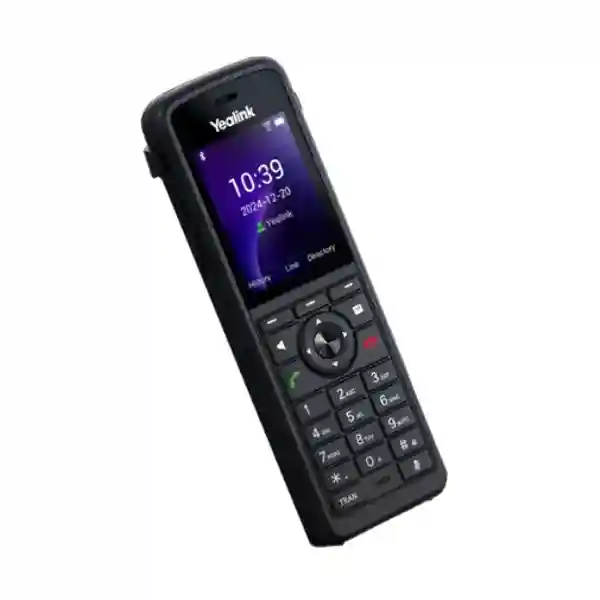
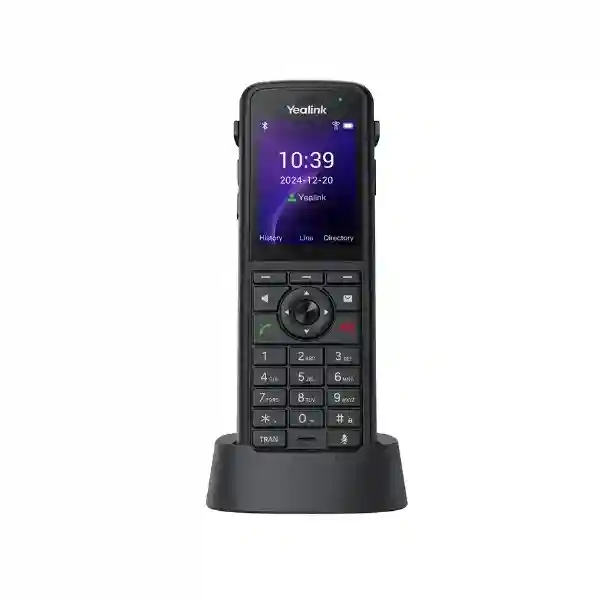
Yealink AX86R Rugged Wi-Fi IP Phone for Mobile Enterprise Communications
The Yealink AX86R is a ruggedized SIP handset built for organizations that need business voice to move with employees rather than remain fixed to a desk. Instead of relying on a cellular voice subscription for every worker or installing desk phones throughout operational areas, the AX86R uses the organization’s Wi-Fi infrastructure for SIP communications. It is especially relevant where users move through warehouses, production floors, healthcare facilities, campuses, hospitality operations, retail sites, logistics zones and service environments where ordinary office handsets may be exposed to dust, splashes, frequent handling or accidental drops.
Its core design combines dual-band Wi-Fi 6, 802.11k/r/v roaming, four SIP accounts, Bluetooth 5.0, a 2.4-inch 240 × 320 TFT colour display, a 3100mAh rechargeable battery and IP67-rated protection. Yealink specifies drop resistance up to 1.8 metres and laboratory battery figures of up to 13 hours of talk time and 300 hours of standby. Operational features include a dedicated alarm key, push-to-talk key, vibration, keypad backlight, proximity sensor, full-duplex speakerphone, Acoustic Shield, smart noise filtering and support for secure enterprise wireless environments.
For Uganda deployments, the important procurement question is not simply whether the handset can make a SIP call. A successful project requires alignment between Wi-Fi coverage, roaming design, authentication policy, call-server compatibility, charging practice, user roles, emergency procedures and device management. FourTeck can help procurement and technical teams turn those requirements into a practical bill of materials and deployment plan.
Instant Specifications & Procurement Fact Rail
Yealink AX86R ruggedized Wi-Fi handset
2.4/5 GHz Wi-Fi 6, 802.11a/b/g/n/ac/ax
IEEE 802.11k/r/v
IP67; safe drop height 1.8 m
4 SIP accounts; local 5-way conference
3100mAh, 3.7V, 11.47Wh rechargeable Li-ion
The AX86R is positioned for enterprise mobility rather than fixed desktop use. It has no requirement for an Ethernet cable at the point of use; voice and management traffic traverse the wireless LAN. Charging is handled through the supplied charger cradle or compatible Type-C charging arrangement. For procurement, confirm the exact regional package, power-adapter requirement, accessory quantities, headset strategy and warranty terms on the quotation. Stock status, lead time and commercial warranty handling can vary by order and should therefore be confirmed at quotation stage rather than assumed from a generic catalogue listing.
Operational Product Architecture & Overview
AX86R architecture is centered on wireless SIP mobility. The handset associates to an enterprise WLAN and registers with a compatible SIP service, allowing the user to place and receive calls while moving within designed coverage. Dual-band operation gives network teams flexibility to use 2.4 GHz where reach is valuable and 5 GHz where channel capacity and reduced congestion are priorities. Support for IEEE 802.11k, 802.11r and 802.11v is significant in voice deployments because real-time calls are less tolerant of roaming delay than ordinary data sessions. The handset and WLAN still need to be configured as a system: roaming performance depends on access-point placement, RF conditions, security settings, channel planning and controller behavior.
On the call-control side, four VoIP accounts allow the device to support multiple identities or service contexts where the chosen PBX design permits it. SIP v1 and v2 support, IPv4/IPv6, static or DHCP addressing, STUN mode, proxy and peer-to-peer SIP link modes, call-server redundancy support and standard enterprise provisioning methods make the handset suitable for integration into many established voice environments. The practical advantage for procurement teams is that the AX86R can fit into an existing SIP strategy without introducing a completely separate mobility voice architecture, subject to interoperability validation with the target platform.
Audio design matters in operational environments. Yealink specifies HD handset and speaker audio, full-duplex hands-free operation with acoustic echo cancellation, Acoustic Shield, smart noise cancellation, and codecs including G.722, G.711 variants, G.729 family, G.726, G.723.1 and iLBC. These capabilities help maintain intelligibility, but no handset can compensate for poor WLAN design or extreme ambient noise in every scenario. A site pilot remains the best way to validate user experience in loading bays, production lines, stairwells, plant rooms and other acoustically or radio-challenging areas.
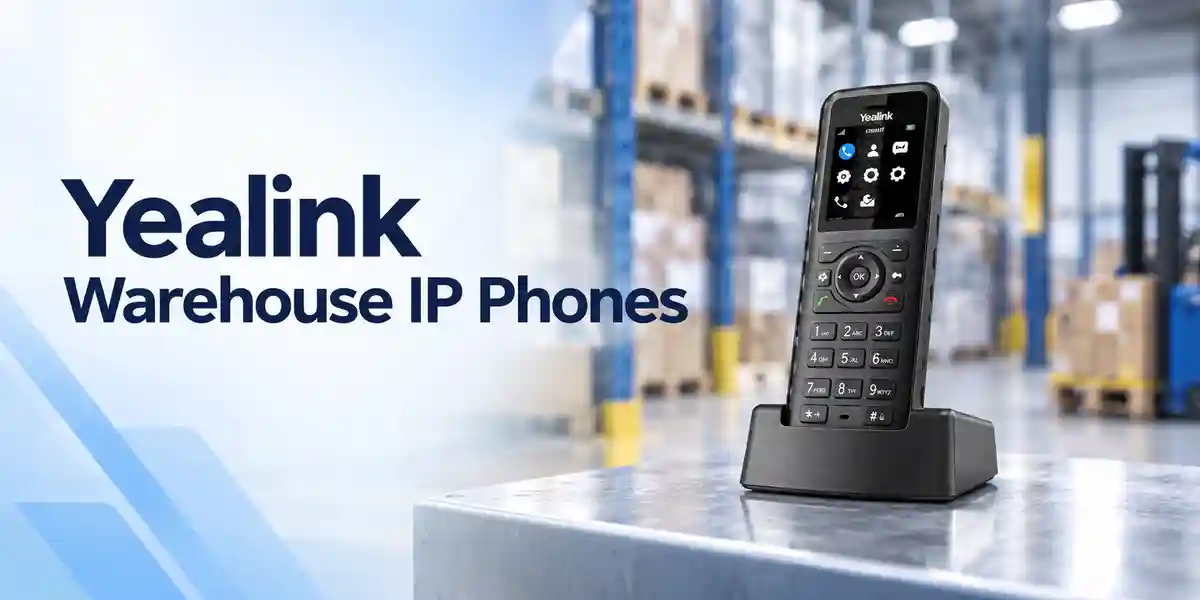
Physical resilience is another architectural layer. IP67 protection addresses dust and water ingress, while the stated 1.8-metre safe drop height is useful for staff who carry the phone throughout a shift. The casing is described as chemical-cleaning resistant and antibacterial in Yealink documentation, supporting environments with regular device-cleaning procedures. These characteristics reduce, but do not eliminate, damage risk; organizations should still define handling, cleaning, charging and replacement procedures appropriate to their workplace.
Enterprise Business Outcomes & Value Analysis
Key Hardware & Software Highlights
The AX86R combines a compact handheld form factor with features chosen for continuous movement. The 2.4-inch colour screen keeps menus, directories and call information visible without making the handset unnecessarily large. A physical keypad, three soft keys, navigation controls, dedicated function keys, alarm key and push-to-talk key support operation where tactile control is preferable to a large touch interface. Vibration and call/message indication are useful in active environments, while the proximity sensor supports normal handset behavior during calls.
Connectivity includes dual-band Wi-Fi 6, Bluetooth 5.0, one 3.5 mm headset jack and one Type-C port. Bluetooth headset support gives users a cable-free option, while the wired headset interface remains useful for organizations that standardize on simple accessories. The handset supports common call features such as hold, transfer, waiting, forwarding, DND, auto answer, hotline, call park and pickup, intercom, multicast paging, message-waiting indication and direct IP calling. Feature availability can depend on the PBX or service platform.
For fleet operations, auto provisioning over FTP, TFTP, HTTP or HTTPS, PnP provisioning, web configuration, system logs, tracing export and device-management support reduce repetitive manual setup. Procurement teams planning tens or hundreds of units should define configuration templates before arrival so that SSIDs, security profiles, SIP accounts, time settings, dial plans and policy controls can be applied consistently.
Technical Specifications Ledger
| Wireless LAN | Dual-band 2.4/5 GHz IEEE 802.11a/b/g/n/ac/ax; Wi-Fi 6 |
| Roaming | IEEE 802.11k/r/v |
| Bluetooth | Bluetooth 5.0; Bluetooth headset connectivity |
| Display | 2.4-inch 240 × 320 TFT colour screen |
| SIP | 4 VoIP accounts; SIP v1/v2; local five-way conferencing |
| Audio | HD handset/speaker, full duplex, AEC, Acoustic Shield, smart noise cancellation, HAC support |
| Codecs | G.722, PCMU, PCMA, G.729 family, G.726, G.723.1, iLBC |
| Security | SRTP, TLS 1.3, HTTPS certificate manager, AES256 configuration encryption, OpenVPN, IEEE 802.1X, WPA/WPA2/WPA3, secure boot |
| Interfaces | 1 × 3.5 mm headset jack; 1 × Type-C port |
| Battery | 3100mAh rechargeable Li-ion, 3.7V, 11.47Wh; up to 13h talk / 300h standby laboratory data |
| Power adapter | AC 100–240V input; DC 5V/2A output |
| Protection | IP67; safe drop height 1.8 m; chemical-cleaning resistant; antibacterial design |
| Operating environment | 0–40°C; 10–95% operating humidity; storage -30–70°C |
| Dimensions / weight | 160.1 × 55.3 × 25.85 mm; 218 g |
| Package | AX86R phone, charger cradle, rechargeable battery, belt clip, quick-start guide and power adapter |
Specifications above are based on Yealink published material. Firmware, package composition, regional certifications and supported platform behavior can change over a product lifecycle. For a controlled enterprise purchase, validate the current datasheet and quotation against the required deployment standard before issuing a purchase order.
Configuration & Sizing Worksheet
1. Estimate users and concurrent calls
Start with the number of people who need a handset, then separate that from simultaneous call demand. A warehouse may issue 80 handsets while only a portion are in active calls at once. Concurrent call estimates affect WLAN airtime, upstream bandwidth, session-border capacity and PBX licensing. Include shift overlap and peak operational periods rather than using a daily average.
2. Map the RF environment
Document work zones, access-point locations, ceiling heights, shelving, machinery, cold rooms, outdoor transitions and known interference. Voice roaming needs continuous usable coverage. A data network that feels acceptable for handheld scanning or email may still reveal gaps during a live voice call. Survey and pilot the routes employees actually walk.
3. Confirm charging and shift design
Determine whether each user receives an individual cradle, whether charging is centralized, and whether spare devices are required for long or overlapping shifts. Laboratory battery figures are useful for comparison but real runtime changes with signal conditions, call activity, screen use, Bluetooth, alarms and configuration.
4. Validate call platform and security
Record the PBX or hosted SIP platform, registrar addresses, transport and encryption requirements, extension format, codec policy, certificate approach, VLAN or SSID design, 802.1X method and WPA policy. Confirm any platform-specific features before mass purchase. Microsoft SIP Gateway support is listed by Yealink, but organizations should verify their intended service workflow and current platform requirements.
5. Prepare the quotation checklist
Provide handset quantity, delivery city, PBX platform, Wi-Fi vendor, security method, required headsets, charger quantities, spare-device ratio, desired staging, firmware policy, labeling needs and target rollout date. This information makes it easier to identify omissions before the order is placed.
Deployment Scenarios & Industry Use Cases
Large enterprise and multi-site operations
In a multi-building enterprise, AX86R handsets can provide a common mobile SIP endpoint for facilities, operations, security and technical staff. The design should standardize SSIDs, authentication and provisioning while allowing site-specific extension assignments. Central device management can reduce the administrative effort of keeping firmware and templates consistent.
Financial and banking institutions
Banks may use rugged Wi-Fi handsets for facilities, security, branch support and back-office operational teams where mobile voice is required. Security architecture should be reviewed carefully, including WPA3 or enterprise authentication policy, certificate management, SRTP/TLS use, segmentation, logging and call-server controls. The handset’s security features provide building blocks; organizational policy determines how they are assembled.
Education and campus networks
Universities, schools and training campuses can use Wi-Fi handsets for maintenance, security, residence operations and event teams. Campus deployments benefit from existing managed WLAN coverage but should test roaming across building entrances, staircases, courtyards and high-density zones. Multicast paging, intercom and push-to-talk capabilities may be useful where supported by the communications design.
Government and public-sector procurement
Public-sector buyers often need traceable specifications, standardized configuration, controlled firmware and clear replacement procedures. The AX86R can be evaluated against those requirements using the manufacturer datasheet, security documentation and a site pilot. Where procurement frameworks require specific certifications, warranty terms or support SLAs, those items should be explicitly written into the commercial request.
Technical Deep Dive: Wireless Processing & Voice Mobility
A Wi-Fi voice endpoint behaves differently from a wired desk phone because radio conditions become part of the voice path. AX86R support for 802.11ax brings the handset into modern Wi-Fi 6 infrastructure, while backward compatibility with earlier listed standards supports mixed estates. The important engineering objective is predictable airtime and roaming. Voice packets are small and continuous, so latency, jitter and packet loss are often more important than headline throughput. QoS support including Layer 3 DSCP and 802.11e/WMM allows the network to classify and prioritize voice when the WLAN and upstream switches are configured consistently.
The 802.11k/r/v feature set can improve handoff behavior by helping clients discover neighboring access points, accelerate transitions and respond to network steering. These standards do not remove the need for RF engineering. Transmit power, minimum data rates, channel reuse, band steering, authentication latency and coverage overlap all influence real-world performance. For that reason, a procurement project should pair handset selection with a voice-focused wireless assessment.
Technical Deep Dive: Firmware Security & Operational Control
AX86R includes security controls spanning the wireless connection, SIP media, management plane and boot process. WPA3 support addresses modern WLAN security, IEEE 802.1X supports enterprise access-control designs, SRTP protects compatible voice media, TLS 1.3 supports secure signaling and management use cases, and AES256 configuration-file encryption helps protect provisioned settings. Secure boot adds a device-integrity layer. These capabilities are most effective when administrators maintain certificate lifecycles, restrict management access, use supported firmware and remove unnecessary services.
For operational control, the phone supports local and remote configuration plus mass auto provisioning. Large deployments should avoid ad-hoc per-device settings. A controlled template should define WLAN profiles, SIP servers, codecs, time services, directory behavior, feature keys and update policy. Changes can then be tested on a small ring of devices before wider release.
Technical Deep Dive: Availability, Redundancy & Recovery
Handset availability is only one part of service availability. Yealink lists call-server redundancy support, but an enterprise design should also consider redundant WLAN controllers or cloud management, resilient switching, UPS-backed access points, redundant PBX or SBC services and alternate communications for major incidents. A rugged handset cannot maintain service if the WLAN or call platform is unavailable.
Recovery planning should include spare charged handsets, documented reprovisioning, configuration backups, firmware rollback procedures where supported, and a defined replacement path. For safety-oriented users, test the red alarm button and automatic alarm behavior as part of commissioning and after significant configuration changes. Organizational emergency procedures must remain authoritative.
Pre-Purchase Buyer Gap Checklist
Is a separate cellular plan required? No cellular subscription is inherent to the AX86R voice design; it is a Wi-Fi SIP handset. A compatible WLAN and SIP call service are required.
Will it roam without dropping calls? The handset supports 802.11k/r/v, but successful roaming depends on the WLAN design and configuration. Validate on the actual access-point platform and walking routes.
Are there hidden licenses? The handset itself supports SIP functions, but PBX extensions, hosted calling, device-management services or platform-specific capabilities may carry separate licensing. Confirm these items in the project bill of materials.
Does IP67 mean indestructible? No. IP67 describes ingress protection under defined test conditions. Yealink also specifies a 1.8-metre safe drop height. Neither specification removes the need for appropriate handling.
Can existing Bluetooth headsets be reused? Bluetooth 5.0 headset support is provided, but model-specific interoperability and call-control behavior should be tested. The phone also provides a 3.5 mm headset jack.
What affects battery runtime? Talk time, WLAN signal strength, roaming, screen activity, Bluetooth, alarms, temperature and configuration can all change runtime. Use the manufacturer figures as laboratory benchmarks and validate shift coverage in the intended environment.
Can it work with any PBX? It uses standards-based SIP, but feature compatibility varies. Validate registration, transfer, hold, conferencing, directories, voicemail, paging and any proprietary PBX functions that matter to users.
What should be piloted? Test voice quality, roaming, authentication, battery endurance, headset behavior, emergency functions, charging workflow, cleaning procedure and device-management operations with representative users before a large rollout.
Uganda Procurement & Delivery Logistics
FourTeck Uganda can prepare an AX86R quotation around project quantity and deployment requirements. A useful request includes the number of handsets, destination, target delivery date, SIP platform, Wi-Fi platform, required accessories and any staging expectations. This helps distinguish a simple handset purchase from a managed rollout that may need configuration validation, firmware preparation, labeling or accessory planning.
After commercial confirmation, order processing should align product quantity, package contents and accessories with the approved bill of materials. Delivery timing depends on stock position, inbound supply and project size, so procurement teams should request a written lead-time indication for the specific order. For phased projects, quantities can be planned by site or rollout wave to support controlled acceptance testing.
Pre-configuration can reduce installation effort when requirements are defined in advance. Typical preparation may include firmware alignment, provisioning template review and basic configuration validation. Customer credentials and production security material should be handled according to the agreed deployment process.
Local Coverage Matrix
Kampala: suitable for corporate headquarters, hospitals, hotels, retail operations, warehouses and multi-floor offices. Entebbe: relevant to hospitality, logistics, airport-related operations and distributed service teams. Jinja: useful for industrial, manufacturing, education and commercial environments requiring mobile SIP communications. Mbarara: supports regional enterprise, healthcare, education, hospitality and distribution deployments. Gulu: provides a procurement path for northern Uganda organizations planning standardized Wi-Fi voice devices. For every location, lead time and delivery arrangement should be confirmed against the actual order.
Cross-Border & Regional Supply
Organizations operating across East Africa, the Gulf and wider African markets may need consistent models and configuration standards across countries. FourTeck regional sites include Uganda, Kenya, Africa, UAE and Kuwait. Cross-border projects should standardize the technical baseline while separately confirming regional power accessories, commercial terms, import requirements, warranty routing and delivery schedules.
Related Yealink Solutions
AX86R projects often sit within a broader unified communications environment. Buyers can explore Yealink business communications solutions in Uganda for desk phones, conferencing and accessories. A mixed estate may use rugged AX86R units for warehouse or field-operational staff while deploying conventional SIP desk phones at reception, management and office workstations. Bluetooth or wired headsets may be selected for hands-free roles, while charging cradles and spare devices can support shift-based operations. The correct combination depends on user mobility rather than applying one endpoint type to every employee.
FourTeck Technical Service Capabilities
A business handset rollout benefits from validation before boxes reach users. FourTeck can support bill-of-materials review, requirement clarification, accessory checks and deployment preparation. For larger projects, engineering validation can focus on the intended SIP environment, WLAN assumptions, security requirements and provisioning method. Pre-shipment firmware alignment and staging can help reduce first-day configuration effort where agreed for the project.
Post-sales support should begin with a documented baseline: handset model and firmware, WLAN platform, PBX platform, provisioning template and symptom description. This makes troubleshooting more systematic when investigating registration, roaming, audio, authentication or accessory behavior. Warranty processing and replacement procedures should follow the commercial terms supplied with the order.
Extended Technical FAQ
Does the Yealink AX86R require a wired Ethernet connection?
No. The AX86R is designed as a Wi-Fi SIP handset and uses dual-band wireless LAN connectivity rather than an Ethernet cable at the user position. That makes it appropriate for staff who move around a facility. The wireless network becomes part of the voice infrastructure, however, so access-point coverage, roaming, QoS, authentication and upstream connectivity need to be engineered for real-time communications. Charging still requires the supplied charging arrangement or an appropriate Type-C charging method. Before a large purchase, test the phone across the actual work routes and confirm stable registration and voice quality.
What makes the AX86R suitable for rugged environments?
Yealink specifies IP67 protection against dust and water ingress and a safe drop height of 1.8 metres. The published specifications also describe chemical-cleaning resistance and an antibacterial design. These features make the handset more suitable than a typical office phone for warehouses, production facilities, healthcare operations and other active workplaces. Ruggedized does not mean damage-proof. Organizations should still define approved cleaning products, storage locations, charging practices and handling procedures, and should assess whether any site has environmental conditions beyond the manufacturer’s operating specifications.
How does Wi-Fi roaming work on the AX86R?
The handset supports IEEE 802.11k, 802.11r and 802.11v roaming-related mechanisms. In a properly designed enterprise WLAN, these features can help the handset discover neighboring access points and transition more efficiently as the user moves. Actual call continuity depends on the entire network: access-point placement, signal overlap, channel plan, transmit power, security authentication, controller behavior and RF interference all matter. A site survey and live-call walk test are recommended before a large deployment, particularly in warehouses with tall shelving, manufacturing sites with machinery or campuses with transitions between indoor and outdoor zones.
Can AX86R connect to an existing SIP PBX?
AX86R supports SIP v1 and v2 and provides four VoIP accounts, so it is designed for standards-based SIP communications. It also includes common calling functions such as hold, transfer, waiting, forwarding, DND, intercom, paging and five-way local conferencing. Compatibility should nevertheless be validated with the exact PBX or hosted service because vendors can implement advanced functions differently. For procurement, identify the call-control platform and the must-have user features, then test registration, codecs, voicemail indication, directories, transfer behavior, conferencing and any platform-specific functions before scaling the rollout.
What security features are available?
Published AX86R specifications include WPA, WPA2 and WPA3, IEEE 802.1X, SRTP for voice, TLS 1.3, HTTPS certificate management, AES256 encryption for configuration files, OpenVPN and secure boot. These controls allow the handset to participate in structured enterprise security designs. Security is still an end-to-end responsibility: administrators should choose appropriate authentication methods, manage certificates, isolate voice services where required, protect provisioning servers, restrict management access and maintain supported firmware. Security requirements should be agreed with the organization’s network and security teams before mass provisioning.
How long does the battery last?
The handset uses a 3100mAh rechargeable lithium-ion battery rated at 3.7V and 11.47Wh. Yealink publishes laboratory figures of up to 13 hours of talk time and up to 300 hours of standby. These are reference figures rather than guaranteed shift duration in every environment. Runtime can change with call volume, WLAN signal conditions, roaming frequency, screen use, Bluetooth accessories, temperature and configuration. Organizations with long shifts should conduct a representative pilot and decide whether charging breaks, spare handsets or other continuity measures are needed.
Does it support headsets and hands-free calling?
Yes. AX86R includes Bluetooth 5.0 support for Bluetooth headsets and a 3.5 mm headset jack for compatible wired accessories. It also supports a full-duplex hands-free speakerphone with acoustic echo cancellation. The best headset choice depends on noise level, hygiene policy, user movement and required call-control behavior. Bluetooth interoperability can vary between headset models, particularly for enhanced controls such as synchronized hold or volume functions. For operational teams, test the chosen headset with the handset and the real workplace before standardizing it across a large fleet.
Can the phones be centrally provisioned?
Yes. Yealink lists configuration through the phone, browser and auto-provisioning, including FTP, TFTP, HTTP and HTTPS methods, PnP provisioning and TR-069. The AX86R also supports Yealink device-management platforms. Centralized provisioning is particularly valuable when deploying many devices because it reduces manual configuration differences. A project should define a master template covering WLAN, SIP, security, codecs, time, directories, feature behavior and firmware policy. Test the template on a small group before applying it broadly, and maintain change control so future updates can be traced.
What should be included in a Uganda quotation request?
Include the required AX86R quantity, delivery location, target date, SIP or PBX platform, WLAN vendor, wireless security method, headset requirement, charger expectations and whether staging or pre-configuration is needed. If the deployment covers multiple branches, provide quantities by site and identify whether extensions and configuration differ between locations. For safety-oriented use, describe the expected alarm or push-to-talk workflow so compatibility can be discussed. A complete requirement set helps procurement compare the correct bill of materials rather than comparing handset unit price alone.
How should warranty and replacement planning be handled?
Warranty terms and processing should be confirmed on the commercial quotation for the specific regional supply. For operationally critical fleets, procurement should also define how failed or damaged handsets are replaced during the support process. Keeping a small controlled spare pool may reduce downtime where immediate continuity is important. Record serial numbers, firmware versions and assigned users or locations to simplify support. When reporting a fault, include the symptom, network context, firmware version and troubleshooting already completed so the technical team can distinguish device faults from WLAN, PBX, provisioning or accessory issues.
Plan Your Yealink AX86R Deployment in Uganda
A reliable rugged Wi-Fi voice project starts with the handset, but it succeeds through correct sizing, wireless design, SIP compatibility, security policy and deployment preparation. Send FourTeck your quantity, location, call platform, Wi-Fi environment and accessory requirements. The team can use those details to prepare a commercial quotation and help identify the technical items that should be validated before rollout. For multi-site requirements, include the expected number of users per location and any common configuration standard you want maintained across the estate.

Reviews
There are no reviews yet.