Yealink CS10 Network Ceiling Speaker for Professional Meeting Rooms
The Yealink CS10 is a PoE+ active network ceiling loudspeaker built for modern conference rooms where intelligible speech, even room coverage and a clean architectural finish matter. Instead of treating loudspeakers as an afterthought, the CS10 places amplification, digital-to-analogue conversion and network connectivity into a purpose-built ceiling unit. This helps project teams reduce visible equipment, simplify cable planning and create repeatable audio designs across meeting spaces. Its two-way coaxial architecture combines a 145 mm low-frequency woofer and 28 mm high-frequency tweeter, with a 100 Hz to 20 kHz response and 120-degree nominal coverage. Yealink specifies 99 dB continuous maximum SPL at 20 W measured at one metre and 88 dB sensitivity at one metre with one watt. The acoustic profile is tuned for speech, making the product especially relevant to video meetings, presentations and collaboration rooms where vocal clarity takes priority over entertainment-style bass output.
For Uganda deployments, the important purchasing question is not simply whether the speaker fits a ceiling opening. The complete design should account for ceiling height, participant area, required sound pressure, network topology, PoE+ capacity, conferencing platform, associated microphones and room processor, mounting method, plenum requirements and future service access. FourTeck can validate these elements before quotation and help prepare a bill of materials for single rooms or multi-site standards.
Instant Specifications & Procurement Fact Rail
Yealink CS10
2-way coaxial network ceiling loudspeaker
PoE+, IEEE 802.3at Class 4
1 × RJ-45
20 W / 24 W
120° nominal
The CS10 is intended for indoor professional AV deployments. The quoted configuration should be checked against room geometry and the available PoE budget rather than selected solely by speaker count. Warranty terms, stock position and project lead time should be confirmed on the formal FourTeck quotation because these may vary by supply batch and project scope.
Operational Product Architecture
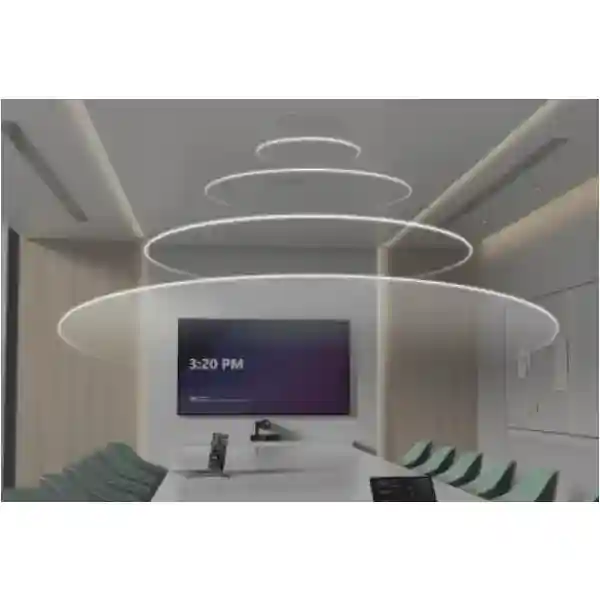
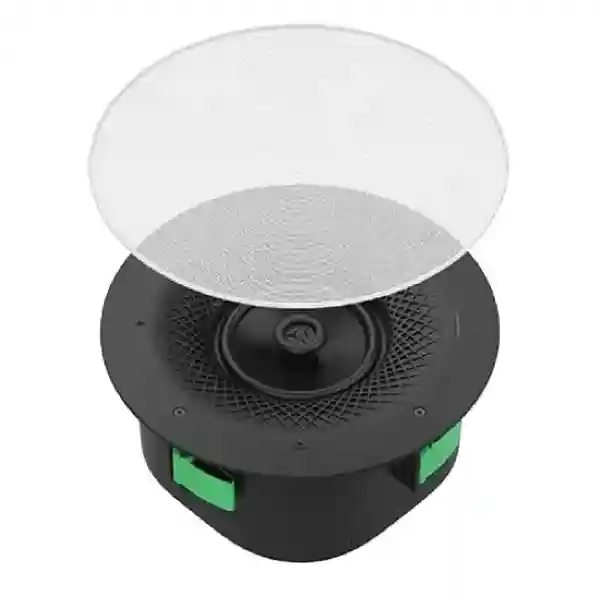
At the acoustic layer, the CS10 uses a coaxial driver arrangement. Placing the high-frequency element on the same acoustic axis as the low-frequency driver supports consistent dispersion from a compact ceiling aperture. This is useful in meeting rooms because listeners sit at different positions relative to each speaker. The broad 120-degree nominal coverage helps designers create overlapping listening zones without relying on a narrow projection pattern. The 100 Hz–20 kHz specified response is well aligned with conferencing, presentations and general programme audio, while the mid-range emphasis described by Yealink is intended to improve human voice reproduction.
At the infrastructure layer, the CS10 receives power through PoE+ and connects through one RJ-45 interface. This architecture can simplify installation by avoiding a separate local AC outlet at each speaker position. It also moves power planning upstream to the network design: integrators must verify that the selected PoE switch or conferencing connectivity device can provide the required IEEE 802.3at Class 4 power and that aggregate power remains within the switch budget. Structured cabling routes, patch panels, switch ports and service access should therefore be included in the room bill of materials.
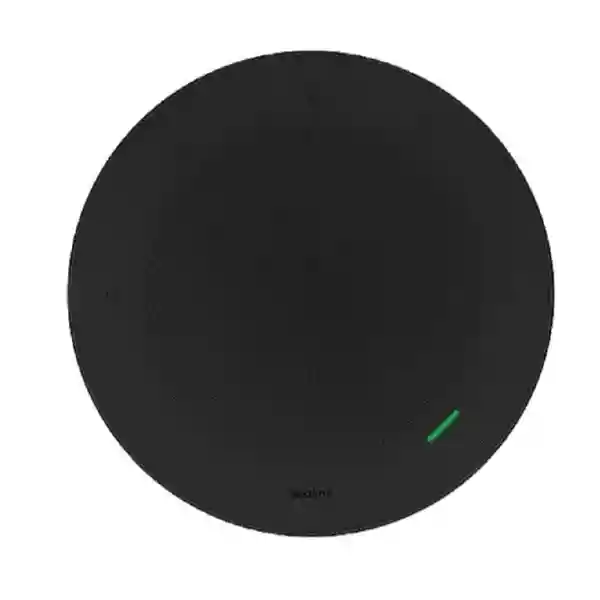
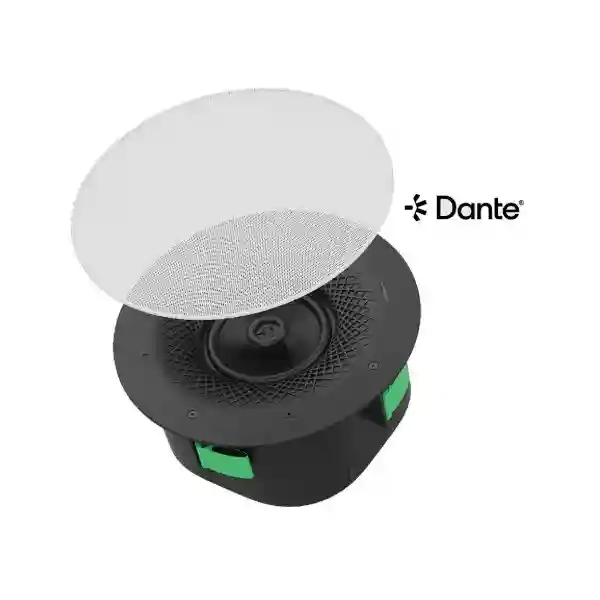
The enclosure is engineered for ceiling integration. Yealink lists a diameter of 294 mm and height of 125.8 mm with the mesh cover installed, while the main body without the mesh measures 287.2 mm in diameter and 125 mm high. The speaker body weighs 2,808 g without the cover mesh, and the mesh itself is listed at 207 g. The product is available in white or black, and the magnetic grille can be selected to suit interior design. UL 2043 plenum rating is an important architectural consideration for installations in air-handling spaces, although local building and fire requirements must still be reviewed by the project consultant or contractor.
Procurement teams commonly encounter three practical issues: underestimating ceiling coordination, assuming any PoE port is sufficient, and ordering speakers before the overall room audio topology is confirmed. A successful design starts with reflected ceiling plans, ceiling type, room dimensions, ceiling height, participant seating, conferencing platform and associated Yealink components. These inputs allow the integrator to estimate coverage, speaker quantity and cable routes before equipment reaches site.
Enterprise Business Outcomes & Value Analysis
Wide 120° nominal dispersion supports balanced listening across meeting-room seating. Correct spacing reduces hot spots near a loudspeaker and weak zones at table edges.
PoE+ combines network connectivity and power delivery over structured cabling, reducing the need for dedicated mains power at each ceiling speaker location.
A network-based ceiling design can be documented and repeated across multiple rooms and offices, helping IT and AV teams maintain consistent meeting-room standards.
The low-profile round form, magnetic grille and white/black finish options help the audio layer blend into commercial interiors rather than dominate the room aesthetic.
Network-centric deployment aligns speaker infrastructure with managed meeting-room ecosystems, making cabling, power and device mapping easier to document.
Central PoE power can simplify maintenance and reduce distributed electrical work. Proper upfront sizing also helps avoid costly post-installation speaker additions.
Key Hardware & Software Highlights
The CS10 combines a 5.7-inch woofer and 1.1-inch tweeter in a coaxial assembly, a configuration selected to provide full-range speech and presentation reproduction from a compact ceiling footprint. Its continuous maximum SPL is specified at 99 dB at 20 W and one metre. Sensitivity is 88 dB at one watt and one metre, and total harmonic distortion is specified below one percent. The integrated active architecture means external speaker amplifiers are not the primary power model for this unit; instead, PoE+ supplies the device. This can make system drawings cleaner, but the network power budget becomes a critical engineering input.
The physical construction includes a PC/ABS and welded SPCC cover mesh, polyamide main shell with 15 percent glass fibre, aluminium-alloy bottom shell and PC/ABS plus SGCC cover plate. These details matter for commercial procurement because ceiling devices must balance rigidity, weight, heat management and architectural appearance. The included package is specified with the CS10 speaker, white mesh cover, quick-start guide, assembly fixing bracket, dust cover, deployment instruction template, bracing bridge and six dust-cover screws. A black mesh cover is optional.
Technical Specifications Ledger
| Parameter | Specification |
|---|---|
| Frequency response | 100 Hz–20 kHz (-6 dB) |
| Maximum SPL | 99 dB continuous @ 20 W, 1 m |
| Sensitivity | 88 dB @ 1 m, 1 W |
| LF driver | 5.7 in / 145 mm woofer |
| HF driver | 1.1 in / 28 mm tweeter |
| Nominal impedance | 8 Ω |
| Coverage angle | 120° nominal |
| THD | <1% |
| Power | 24 W rated; 20 W typical |
| Power supply | PoE+ IEEE 802.3at Class 4 |
| Interface | 1 × RJ-45 |
| Dimensions with mesh | Ø294 × H125.8 mm |
| Dimensions without mesh | Ø287.2 × H125 mm |
| Operating temperature | 0–50°C |
| Operating humidity | 5%–90% |
| Plenum | UL 2043 rated |
Configuration & Sizing Worksheet
1. Define the room. Record room length, width, finished ceiling height, ceiling construction, table layout and expected occupancy. Speaker spacing should be planned around the listening plane and the 120° nominal coverage rather than simply placing one unit at the geometric centre.
2. Establish the audio objective. Identify whether the room is used mainly for video meetings, presentations, divisible-room events or mixed collaboration. A boardroom with seated speech has different coverage expectations from a training room where participants are spread across rows.
3. Validate PoE. Confirm IEEE 802.3at Class 4 support and calculate aggregate PoE demand for all CS10 speakers and other powered AV endpoints. Allow design margin in the switch budget and consider UPS-backed network power where meeting continuity is important.
4. Coordinate the ceiling. Check cut-out requirements, plenum depth, structural support, bracing, HVAC routes, lighting, sprinklers and access panels. The 125.8 mm overall height is only one part of clearance planning; cable bend radius and installer access also matter.
5. Confirm ecosystem compatibility. Document the room processor, conferencing platform, microphones, cameras and network devices. Yealink positions CS10 within its professional meeting-room ecosystem, including solutions used with ceiling microphones and room AV components. Compatibility should be confirmed for the exact proposed topology and firmware baseline.
6. Prepare the quote. Send FourTeck the room drawings, quantities, site city, desired delivery date, ceiling details, conferencing platform and any installation or staging requirement. This allows accessories, cabling, network power and associated Yealink devices to be considered together.
Deployment Scenarios & Industry Use Cases
Large enterprise and multi-site networks: Standardized CS10 room designs can help enterprises deploy consistent ceiling audio across headquarters, branch offices and collaboration suites. IT teams can document port assignments, PoE budgets and room bills of materials as part of a repeatable workplace standard. For divisible rooms, the audio design should account for both combined and separated operating modes so each partition receives suitable coverage.
Financial and banking institutions: Executive meeting rooms, training spaces and operations centres often need discreet equipment, clear speech and controlled infrastructure. Ceiling loudspeakers keep tables free of speaker hardware while PoE-based connectivity can align with centrally managed network and UPS practices. Network segmentation and access policies remain the responsibility of the customer’s security architecture.
Education and campus networks: Universities and training institutions can use the CS10 in collaboration rooms, lecture-support spaces and hybrid teaching environments where spoken content must remain intelligible across a distributed seating plan. Ceiling height and room reverberation should be assessed carefully, particularly in larger classrooms.
Government and regulated procurement: Public-sector projects benefit from clearly documented model numbers, technical specifications, accessories and installation assumptions. FourTeck can assist with bill-of-material validation and quotation documentation. Any mandatory compliance, origin, security, warranty or tender clauses should be provided before order placement so the supplied configuration can be checked against the procurement requirement.
Three Technical Deep Dives
1. Acoustic Processing and Driver Architecture
The CS10’s two-way coaxial architecture separates low/mid-frequency reproduction from high-frequency reproduction while keeping the drivers concentrically aligned. For conference audio this supports a coherent source and broad room dispersion. Yealink’s published response of 100 Hz–20 kHz and speech-focused tuning indicate a design prioritizing vocal intelligibility while retaining enough bandwidth for presentation media. The 99 dB continuous maximum SPL specification should be interpreted in the context of listening distance and room acoustics; SPL falls with distance, and reflective or absorptive surfaces can change perceived clarity. Speaker quantity and placement should therefore be calculated from the actual room rather than from the one-metre laboratory figure alone.
2. Network Power and Operational Control
PoE+ changes how ceiling audio is engineered. Power originates from compatible network infrastructure, so the AV design and LAN design must agree on port capacity, switch power budget, VLAN policy where applicable, cable length and UPS strategy. A speaker may physically connect to an RJ-45 port yet still be unsuitable if the source cannot supply the required power class or if the wider room topology is incompatible. Before procurement, identify every powered endpoint and calculate worst-case aggregate demand. This avoids late-stage surprises when cameras, microphones, touch panels and speakers compete for a limited PoE budget.
3. Availability, Redundancy and Recovery Planning
Meeting-room resilience depends on more than the speaker itself. Consider UPS-backed switching, spare switch capacity, documented patching, accessible ceiling routes and standardized replacement procedures. In critical rooms, retain configuration records and room diagrams so support teams can isolate whether a fault originates at the endpoint, cabling, PoE source, processor or conferencing host. Multi-room estates can also benefit from holding strategic spares where downtime carries a high operational cost. FourTeck can help identify practical spare quantities based on installed estate size and service expectations.
Pre-Purchase Buyer Gap Checklist
Before approving a purchase order, verify the exact model is CS10 rather than CS10-D because related variants may differ in supported audio networking. Confirm the room design calls for PoE+ IEEE 802.3at Class 4 and that every intended switch port can supply the required power. Check the total switch power budget, not only per-port capability. Confirm ceiling depth, support method, service access and whether the project’s fire or mechanical consultant accepts the proposed plenum installation. Verify grille colour, because white is standard in the package description while black is optional.
Ask whether the quote includes only speakers or also associated mounting items, network switching, patching, room processors, microphones, cameras and installation. Confirm whether firmware staging or pre-shipment checks are required. If the project spans several sites, define a single approved room standard and list permitted substitutions. For lifecycle planning, record purchase date, serial numbers, installed room, switch port and warranty terms. These simple records materially reduce troubleshooting time later.
Licensing and platform subscriptions should be evaluated at the room-system level rather than assumed to be part of the ceiling speaker. The CS10 is an audio endpoint within a wider conferencing solution; Microsoft Teams Rooms, Zoom Rooms or other platform entitlements may be associated with the room system rather than this loudspeaker. Ask for a complete bill of materials if the requirement is a working meeting room, not merely a replacement speaker.
Uganda Procurement, Delivery & Local Coverage
FourTeck Uganda supports project quotation for Yealink CS10 deployments in Kampala, Entebbe, Jinja, Mbarara, Gulu and other locations nationwide. A useful request for quotation should state quantity, delivery city, room dimensions, ceiling height, preferred grille colour, required deployment date and whether the request is supply-only or includes engineering validation. For multi-room projects, attach a room schedule so quantities and room types can be checked systematically.
Order processing and delivery timing depend on confirmed stock, project quantity and supply route. The formal quotation should be treated as the source for lead time, warranty baseline, commercial validity and included accessories. For projects requiring pre-configuration or coordinated delivery, identify those requirements before order confirmation. This allows staging, labelling and bill-of-material checks to be incorporated into the project workflow rather than handled after equipment arrives on site.
Kampala: suitable for corporate headquarters, hotels, financial institutions and government meeting environments. Entebbe: supports hospitality, aviation-linked and institutional collaboration spaces. Jinja: relevant to industrial, education and regional office deployments. Mbarara: supports western-region enterprise, healthcare and education projects. Gulu: enables northern-region institutional and business deployments. Site-specific installation scope and travel requirements should be confirmed during quotation.
Cross-Border Supply & Related Solutions
Regional organizations can coordinate requirements across Uganda, Kenya, broader African markets, UAE and Kuwait. Cross-border projects should standardize model numbers, room bills of materials, acceptable accessories, firmware expectations and documentation before shipment. Customs, tax, warranty and lead-time conditions can vary by destination and should be confirmed on the relevant quotation.
Related Yealink room components may include the CM20 ceiling microphone, RCH40 PoE connectivity device, AVHub for advanced room designs, Yealink room cameras and complete Microsoft Teams Rooms or Zoom Rooms systems. Accessory selection should follow the target room topology. For CS10 specifically, Yealink also identifies a detachable black cover and pendant-mount enclosure among related options. Request the complete room requirement from FourTeck rather than assuming every accessory is universal across every ceiling type.
FourTeck Technical Service Capabilities
FourTeck can support engineering validation before supply by reviewing room schedules, model selection, PoE requirements and accessory assumptions. Bill-of-material verification is especially valuable when several Yealink devices must operate as one room solution. Project staging can include equipment identification and pre-shipment checks where agreed in the quotation. Firmware requirements should be stated early when a customer has a controlled baseline or change-management policy.
Post-sales troubleshooting is more effective when installation records are maintained. Keep serial numbers, room names, switch ports, cable test results and photos of ceiling locations. When reporting a fault, provide symptoms, affected rooms, power state and recent changes. This gives technical teams a clearer starting point and helps distinguish endpoint issues from network power, cabling or upstream room-system problems.
Extended Technical FAQ
Is the Yealink CS10 powered from a normal electrical socket?
The CS10 is specified for PoE+ power using IEEE 802.3at Class 4 through its RJ-45 connection. That means the deployment normally relies on compatible network power rather than a separate AC outlet beside the ceiling speaker. The design team must verify both per-port PoE capability and the aggregate power budget of the selected switch or connectivity device. If several speakers and other AV endpoints share the same PoE source, calculate the combined requirement with appropriate design margin.
How many CS10 speakers are required in a meeting room?
There is no universal speaker count because room length, width, ceiling height, seating geometry, target SPL and acoustic conditions all affect coverage. The CS10 has a 120° nominal coverage angle and Yealink publishes 99 dB continuous maximum SPL at 20 W and one metre, but these figures should be applied through room design rather than used as a simple quantity rule. Send room dimensions and ceiling height with your quotation request so placement and quantity can be reviewed.
What are the main acoustic specifications?
Yealink specifies a 100 Hz–20 kHz frequency response at -6 dB, 88 dB sensitivity at one watt and one metre, and continuous maximum SPL of 99 dB at 20 W and one metre. The two-way coaxial driver system uses a 145 mm low-frequency woofer and 28 mm high-frequency tweeter. The product is tuned with conference speech in mind, which makes it appropriate for meeting-room voice reproduction and presentation audio.
Can the CS10 be installed in an air-handling ceiling space?
Yealink lists the CS10 as UL 2043 plenum rated, which is relevant to equipment installed in air-handling spaces. However, project acceptance depends on the applicable local building, fire and mechanical requirements. The consultant or authority responsible for the project should confirm the installation method. Ceiling coordination must also consider structural support, cable routes, HVAC equipment, sprinklers, lighting and adequate access for future maintenance.
What is included with the CS10?
Yealink’s published package list includes the CS10 speaker, white mesh cover, quick-start guide, assembly fixing bracket, dust cover, deployment instruction template, bracing bridge and six dust-cover screws. A black mesh cover is described as optional. Project quotes should still be checked line by line because additional accessories, cabling, PoE switching, room processors, microphones or installation services are separate design items unless expressly included.
Does the CS10 require conferencing software licensing?
The speaker itself should be considered one component of the wider room audio architecture. Conferencing subscriptions such as Microsoft Teams Rooms or Zoom Rooms, where required, are generally associated with the room platform rather than assumed to be bundled with a ceiling loudspeaker. Licensing requirements depend on the complete room system selected. For a new meeting-room deployment, request a full bill of materials and platform review rather than purchasing the speaker in isolation.
What ceiling clearance is needed?
The published speaker dimensions are Ø294 × H125.8 mm with the cover mesh and Ø287.2 × H125 mm without it. The real installation clearance should exceed the bare product height because installers need room for the network cable, bend radius, support hardware and safe access. Obstructions above the ceiling, including ducts, cable trays and lighting, should be checked on site or against coordinated drawings before cutting the ceiling.
Is the CS10 suitable for multi-site corporate standards?
Yes, it can be a strong candidate where an organization wants a repeatable ceiling-audio approach across standardized meeting rooms. The best results come from defining room archetypes—such as small, medium, large and divisible spaces—and documenting speaker count, placement, PoE source, associated microphones, processor, camera and platform for each archetype. This makes procurement, deployment and support more consistent and helps avoid site-by-site improvisation.
How should warranty and replacement planning be handled?
Warranty terms should be confirmed on the FourTeck quotation for the specific supply. For larger estates, maintain an asset register linking each serial number to its room and purchase record. Organizations with strict uptime requirements may choose to hold strategic spares, especially when many rooms use the same standardized model. A replacement process should also document switch port, cable path and room configuration so a failed endpoint can be exchanged without unnecessary redesign.
Can FourTeck help validate the design before purchase?
Yes. Provide room dimensions, ceiling height, room drawings where available, conferencing platform, expected participant count, existing network equipment and desired delivery location. FourTeck can use these inputs to review the proposed bill of materials, PoE assumptions, accessory requirements and deployment scope before quotation. This is particularly useful for multi-room projects where a small design error repeated across many spaces can create significant rework.
Request a Yealink CS10 Procurement Quote
For a precise Uganda quotation, send the required quantity, delivery location, room dimensions, ceiling height, conferencing platform and any installation or staging requirement. FourTeck can help validate the speaker count, PoE+ infrastructure, accessories and related Yealink room components before order placement. For multi-site deployments, include a room schedule and target rollout dates so procurement can be structured around the project plan.

Reviews
There are no reviews yet.