Enterprise Cordless Coverage Extension • Uganda
Yealink RT30 DECT Repeater – Business Cordless Coverage Extension
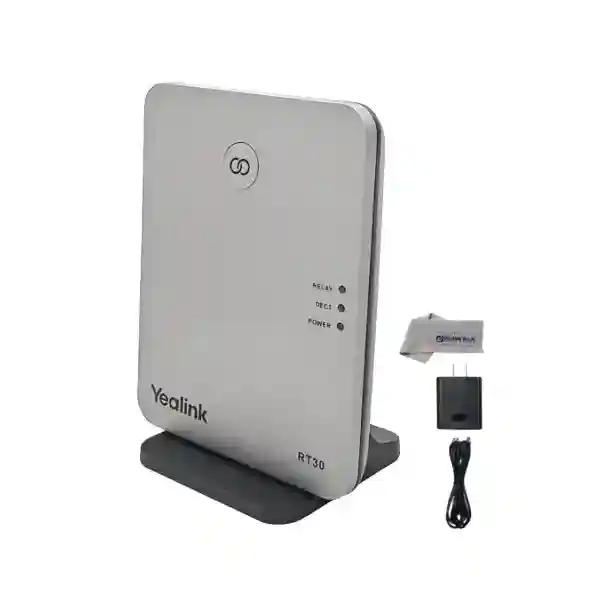
The Yealink RT30 is a dedicated DECT radio repeater built to extend the usable cordless voice coverage of compatible Yealink DECT base stations. It is intended for organizations where staff need to move between rooms, corridors, work areas or operational zones while remaining connected to business calls. Rather than adding another independent telephone system, the RT30 relays the DECT radio connection from a supported base, allowing correctly positioned handsets to continue operating across a larger planned radio footprint.
For procurement teams, the central question is usually not whether a repeater can make a signal travel farther, but whether it can do so predictably in the actual building. Walls, reinforced concrete, metal shelving, lift shafts, machinery, glazing and floor separation can materially affect radio propagation. The RT30 therefore works best as part of a measured coverage plan. Yealink specifies an ideal-condition indoor range of up to 50 metres and an unobstructed outdoor range of up to 300 metres, but real installations should be designed around overlap, obstruction and call-density requirements rather than maximum theoretical distance.
The unit supports automatic association, status LEDs, desktop or wall mounting and automatic handover between properly deployed RT30 coverage areas. Up to six repeaters can be associated with one compatible base in a star topology. With supported W60B or W70B deployments, up to two RT30 units can be placed in cascade to extend coverage farther in a particular direction. A repeater can carry up to four simultaneous calls when the applicable firmware requirements are satisfied, making capacity planning just as important as range planning.
FourTeck supplies the Yealink RT30 for Uganda business deployments and can assist with model validation, quantity planning, accessory checks, firmware considerations and deployment preparation. Buyers should provide the existing base-station model, handset family, approximate floor layout, weak-signal locations and expected concurrent call load when requesting a quotation.
RT30 Procurement Fact Rail
Yealink RT30
DECT coverage extension
Up to 6 repeaters per compatible base
Up to 4 simultaneous calls per repeater*
100–240 V AC adapter; 5 V/600 mA output
Contact FourTeck for current supply and lead time
The RT30 belongs in the access layer of a business voice deployment: it extends the DECT radio footprint but does not replace the SIP platform, PBX, base station or handset. This distinction matters when preparing a bill of materials. A buyer expanding an existing Yealink W60B or W70B environment may need only one or more repeaters and power points, while a new cordless voice project also requires a compatible base station, handsets, network connectivity for the base, SIP service and any PBX licensing. Warranty terms, regional frequency version and current availability should be confirmed on the formal quotation. *Four-call operation depends on supported firmware levels and link quality.
Operational Architecture and Coverage Planning
The RT30 operates as a radio relay within a compatible Yealink DECT environment. Its purpose is to receive a usable DECT signal from the base station or, in supported cascade designs, another repeater, and retransmit that signal into an adjacent coverage zone. This architecture addresses a common limitation in cordless deployments: the Ethernet-connected base station may be ideally positioned for network access but not ideally positioned for radio coverage throughout the premises. A repeater creates flexibility by extending radio reach without requiring Ethernet cabling to every extension point.
The repeater contains two internal QWL omnidirectional antennas and uses GFSK modulation. Regional radio variants operate in the frequency band appropriate to the market, so procurement teams should avoid mixing units sourced for incompatible regulatory regions. The published receiver sensitivity is typically -91 dBm and average transmission power is 10 mW. These radio characteristics should be interpreted alongside the building environment. A long open corridor may permit excellent propagation, while a much shorter path through dense reinforced walls or metal storage can produce a weaker link.
The deployment principle is coverage overlap. The repeater must itself be placed where it receives a sufficiently strong link from the base or upstream repeater. Installing it directly inside the dead zone usually fails because there is no strong source signal to relay. A practical survey starts at the base and moves toward the weak area while observing handset behavior and, where available, installation diagnostics. The RT30’s clear LEDs provide immediate indication for power, DECT link and active relay state, simplifying installation verification.
In a star design, multiple RT30 units extend coverage in different directions from one base. This is useful for offices with wings, clinic corridors, hotel service areas, schools or warehouse zones. Yealink supports up to six repeaters per compatible base station. In a directional extension, supported W60B/W70B deployments can use up to two RT30 repeaters in cascade. Cascading is particularly useful when a coverage target lies beyond the direct reach of the base but should not be treated as unlimited daisy chaining. The two-repeater cascade limit is a design boundary that must be respected.
Call capacity is another architectural constraint. Each RT30 supports up to four simultaneous calls under the applicable firmware and radio-link conditions. A location may therefore have sufficient signal coverage yet still require capacity analysis if many cordless users make calls concurrently in the same repeated zone. High-density environments should compare the expected busy-hour concurrency with the capabilities of the base and repeater design. For very large estates, multi-cell DECT architecture may be more appropriate than attempting to solve every requirement with repeaters.
Enterprise Business Outcomes and Value Analysis
1. Coverage Continuity
The principal value of the RT30 is the ability to expand cordless coverage into areas where a compatible base alone cannot provide dependable radio service. This can reduce dropped calls and the need for employees to remain close to a single base location. In operational environments, improved mobility can be valuable for supervisors, technicians, nurses, warehouse teams, front-of-house personnel and managers who move while communicating.
2. Reliable Handover
When repeaters are positioned with adequate overlap, the system supports automatic handover of calls between RT30 coverage areas. Users do not manually reconnect as they move. The operational outcome depends heavily on radio planning, because a repeater placed at the edge of an unreliable source signal cannot create a stable downstream zone.
3. Scalable Single-Base Expansion
Support for up to six repeaters per compatible base gives smaller and medium deployments a structured way to extend coverage in several directions. This can be more economical than introducing a larger multi-cell platform when the user count is modest and the primary problem is geography rather than call density.
4. Controlled Voice Infrastructure
The RT30 does not create a separate IP endpoint or require a network switch port at each repeater location. This simplifies the network-access footprint. Security policy remains concentrated around the base station, PBX and SIP infrastructure, while the repeater focuses on DECT radio extension. Physical placement and power security still require attention.
5. Operational Simplicity
Automatic association, clear LEDs and plug-and-play design reduce the complexity of routine installation. The product can be desktop or wall mounted, giving installers flexibility in locating the repeater where radio conditions are favorable rather than where furniture happens to be positioned.
6. Cost and Energy Discipline
A repeater can solve localized coverage gaps without requiring another full network-connected base system. Its external adapter provides 5 V/600 mA output, reflecting the relatively light electrical requirement of the device. Procurement should nevertheless account for available sockets, UPS strategy where required, mounting and any protected power arrangements.
7. Deployment Flexibility
Star and supported cascade layouts allow designers to address different floor shapes. Star arrangements suit branches or multiple surrounding zones; cascade arrangements suit directional corridors or extended paths. Neither topology substitutes for a site survey where construction materials materially attenuate DECT signals.
8. Investment Protection
For organizations already using supported Yealink single-cell DECT bases, the RT30 can extend the useful footprint of existing infrastructure. Compatibility and firmware should be verified before purchase, especially in mixed-generation environments, so the repeater is integrated into a supported configuration.
Key Hardware and Software Highlights
The RT30 is deliberately specialized. It is not a general-purpose wireless access point and it has no requirement to carry Ethernet traffic. Its hardware is centered on DECT radio relay, internal omnidirectional antennas, local status indication and low-voltage power. This specialization helps keep deployment straightforward: select the correct regional unit, associate it with the supported base, identify a location with a good upstream radio link, supply power and validate handset movement through the expanded zone.
| Feature | Technical Role | Operational Outcome |
|---|---|---|
| 2 internal QWL omnidirectional antennas | DECT radio reception and relay | Broad surrounding coverage when placement is suitable |
| Three status LEDs | Power, DECT link and relay indication | Faster visual installation checks |
| Automatic association | Simplifies repeater registration | Reduced setup overhead |
| Base Link Reset | Clears existing base relationship | Useful for controlled reassignment or troubleshooting |
| Desktop/wall mounting | Flexible physical installation | Placement can prioritize radio quality |
Technical Specifications Ledger
| Product | Yealink RT30 DECT Repeater |
|---|---|
| Purpose | Extends DECT radio coverage for compatible Yealink base stations |
| Compatible bases | Yealink W60B, W70B and W52 base family subject to supported firmware; current Yealink product information also lists compatible W-series systems |
| Repeaters per base | Up to 6 in star connection |
| Cascade | Up to 2 RT30 repeaters in cascade with supported W60B/W70B deployment |
| Concurrent calls | Up to 4 per repeater with applicable firmware and suitable link conditions |
| Indoor range | Up to 50 m in ideal conditions |
| Outdoor range | Up to 300 m with clear view in ideal conditions |
| Antennas | 2 internal QWL omnidirectional antennas |
| Modulation | GFSK |
| EU radio range | 1880–1900 MHz |
| US radio range | 1920–1930 MHz |
| Transmission power | Average 10 mW |
| RX sensitivity | Typically -91 dBm |
| Power supply | AC 100–240 V input; DC 5 V/600 mA output |
| Dimensions | 130 × 100 × 25.1 mm |
| Mounting | Desktop or wall mountable |
| Package contents | RT30, USB cable, power adapter and user guide |
| Gift box | 174 × 180 × 63 mm |
| Carton | 375 × 336 × 187 mm; 10 pieces per carton |
| Published compliance | CE, FCC, RoHS and ISO 9001 references appear in Yealink documentation; confirm regional certification required for the intended procurement |
Specifications should be read as manufacturer-rated characteristics, not guaranteed site outcomes. Indoor distance changes with walls, floors, furniture, metal structures, interference and placement. For Uganda procurement, confirm the appropriate radio-frequency version before ordering, particularly when equipment is being integrated with an installed base sourced from another region.
Configuration and Sizing Worksheet
Step 1 – Establish the current system
Record the exact Yealink base model, firmware version, handset models, SIP platform and number of registered users. A repeater extends radio coverage; it does not increase every capacity limit of the base station. Confirm that the existing base has sufficient user and call capacity before treating coverage as the only problem.
Step 2 – Map the coverage gap
Mark the base station on a simple floor plan and identify where audio degrades, calls drop or handsets lose registration. Note wall construction, metal storage, lifts, stairwells and floor transitions. A good repeater location is normally between the strong base zone and the weak area, not at the far end of the dead zone.
Step 3 – Estimate concurrency
Count how many users are likely to be on calls simultaneously inside each repeated zone. The RT30 supports up to four simultaneous calls under supported conditions. If a warehouse zone has ten handsets but only one or two active calls at a time, coverage may be the dominant issue. If many users call concurrently, capacity becomes a design constraint.
Step 4 – Choose star or cascade
Use star placement when coverage must expand in different directions around the base. Consider cascade only where a supported W60B/W70B installation must extend farther in one direction. Do not design more than two repeaters in the cascade path. If the building requires more extensive roaming and density, assess a multi-cell DECT solution.
Step 5 – Verify power and mounting
Each RT30 requires local power. Confirm socket availability and whether business continuity policy requires the repeater power adapter to be supplied from UPS-backed circuits. For wall mounting, select a position that is secure, accessible for service and not shielded by large metal surfaces. Avoid hidden locations selected purely for appearance if those locations compromise radio performance.
Step 6 – Licensing and subscriptions
The RT30 itself is a radio accessory and does not create a new SIP subscription. However, the surrounding voice system may have PBX user, extension, trunk or support licensing. Ask the system administrator or service provider whether adding handsets or extensions changes subscription costs. Repeater quantity alone should not be confused with SIP account quantity.
Step 7 – Prepare the quotation request
Provide FourTeck with the base model, firmware if known, number of handsets, building type, approximate floor dimensions, required repeater quantity if already surveyed, delivery location and any installation or pre-configuration requirement. For multi-floor sites, attach a basic plan and mark the current base location and known weak zones. This information reduces the risk of ordering an unsuitable quantity.
Deployment Scenarios and Industry Use Cases
Large Enterprise and Multi-Site Offices
A head office may have adequate base coverage in the central workspace but weak reception in meeting rooms, archives, kitchens or side corridors. One or more RT30 units can extend the existing single-cell footprint when user density remains within the base system’s capacity. For separate branches, each site should be assessed independently because a repeater cannot bridge geographic sites; it works within the local DECT radio environment.
Financial and Banking Environments
Branch staff may need cordless mobility between counters, back-office areas and controlled operational rooms. Repeater placement should respect physical-security controls, protected power and restricted access. The RT30 does not replace network or voice-platform security controls. Procurement teams should validate that the underlying SIP and PBX configuration follows the institution’s authentication, network segmentation, logging and change-management requirements.
Education and Campus Buildings
Schools and training centers often combine corridors, offices, staff rooms and administration areas. An RT30 can help extend a compatible single-cell system through adjoining zones where a full multi-cell architecture is not necessary. Separate buildings, very large campuses or high handset counts should trigger a broader architecture review rather than assuming repeaters alone will provide campus-wide service.
Government and Public-Sector Procurement
Government buyers typically require precise model identification, documented specifications, regional compatibility, delivery terms and warranty handling. The RT30’s role should be clearly described in the bill of materials as a DECT repeater accessory. Where tenders require compliance evidence, request the relevant manufacturer documentation and confirm the exact regional variant before purchase.
Warehousing, Clinics and Hospitality Operations
Warehouses can create difficult radio conditions because high metal racking changes propagation. Clinics contain rooms, partitions and equipment zones that may require careful placement. Hospitality environments may have long corridors and service areas where staff mobility matters. In each case, the RT30 can be effective when it receives a good upstream DECT signal and when concurrent call requirements remain within system limits.

Technical Deep Dive 1: Radio Relay and Coverage Engine
The RT30’s engineering value lies in radio repetition rather than packet switching. The SIP signaling and IP network connection terminate at the compatible base station; the RT30 operates in the DECT radio domain. Its internal antennas receive the upstream DECT signal and provide extended radio coverage to handsets in the downstream zone. This means the repeater can be placed where no Ethernet outlet exists, provided there is suitable mains power and adequate radio overlap.
Because DECT coverage is shaped by the physical environment, maximum range figures should be treated as planning ceilings under ideal conditions. A 50-metre indoor rating does not mean a repeater can be placed 50 metres away through several concrete walls. The useful installation distance is the distance at which the repeater still has a robust source link. In many buildings this will be substantially shorter. Installers should prioritize signal quality and stable handover over maximum spacing.
The star topology allows multiple repeaters to associate to one base and extend coverage around it. Cascade operation, limited to two repeaters in supported W60B/W70B scenarios, extends coverage directionally. These two patterns give designers a useful choice: surround a base with additional zones or push service farther along a path. Capacity planning remains essential because each repeater has a published simultaneous-call ceiling.
Technical Deep Dive 2: Firmware, Association and Operational Control
The RT30 uses automatic association to simplify integration with a supported Yealink DECT base. Firmware compatibility remains important. Yealink documentation identifies minimum firmware references for W60B, W52 and W70B compatibility and also notes firmware conditions for four-call support. Organizations with older installations should therefore record current firmware before ordering or scheduling a maintenance window for updates where appropriate.
The front status indication provides a practical operational interface. Dedicated indicators communicate power, DECT link and active relay status. These signals help technicians distinguish basic power problems from association or relay-state issues without requiring a network-management session at the repeater itself. Base Link Reset provides a controlled way to clear the relationship when the unit must be reassociated.
Firmware governance should follow normal change-control practice. Confirm compatibility, review release documentation, back up relevant base configuration where applicable, schedule the change and validate registration and calling after updates. The repeater should not be treated as an isolated accessory if its supported feature level depends on the base firmware.
Technical Deep Dive 3: Availability, Resilience and Recovery
A repeater extends a dependency chain. If the RT30 loses power, its extended zone is affected. If the upstream base loses power or network connectivity, the repeater cannot restore the IP voice service. Business-continuity planning therefore starts with the base station, network switch, router, PBX or cloud connectivity, and then includes repeater power where extended-zone availability is operationally important.
For sites with UPS-backed communications infrastructure, consider placing RT30 power adapters on appropriately protected circuits. Avoid assuming that a UPS supporting the network rack also protects repeaters mounted in corridors or remote rooms. During commissioning, test movement, call continuity and recovery after controlled power interruption where policy permits.
The RT30 is not a high-availability cluster and should not be represented as one. Its resilience value comes from predictable design, proper overlap, stable power and spare-unit strategy. Organizations with strict restoration targets may keep a tested spare repeater and document association and placement procedures so failed hardware can be replaced efficiently.
Pre-Purchase Buyer Gap Checklist
Will it work with my base? Confirm the exact Yealink base model and firmware. W60B and W70B are core supported platforms, and Yealink documentation also identifies W52 compatibility subject to firmware. Do not assume every DECT base from another vendor can use the RT30.
Does it need Ethernet? The repeater is not installed as an Ethernet endpoint. It requires local power and a suitable DECT radio link to the compatible base or upstream repeater.
Does it increase the number of SIP accounts? No. It extends radio coverage. Base-station user, SIP account and concurrent-call limits remain separate design considerations.
Are there hidden subscriptions? The repeater itself is not described as requiring a separate recurring subscription. Your PBX, cloud calling platform, SIP trunks or support service may have their own licensing, especially if the project also adds users or handsets.
Can six repeaters be chained? No. Up to six can be used per base in the supported star arrangement, while cascade operation is limited to up to two RT30 units in supported W60B/W70B designs.
Will I really get 50 metres through my building? Not necessarily. The published indoor figure is an ideal-condition maximum. Construction materials and interference can reduce usable range substantially. Placement should be based on overlap and validation.
What about full-load call capacity? A repeater supports up to four simultaneous calls when the required firmware and radio conditions are met. Busy departments should size for concurrency, not just handset count.
Is the radio version important? Yes. DECT frequency allocations vary by region. Confirm that the unit supplied is appropriate for the deployment country and compatible with the installed base.
What clearance is needed? The enclosure is compact at 130 × 100 × 25.1 mm, but radio performance matters more than physical fit. Avoid burying the unit behind metal cabinets or placing it where obstacles shield the antennas.
Should a very large site use RT30? Possibly for localized extension, but large-scale roaming, high density or many base areas may justify a Yealink multi-cell DECT architecture. FourTeck can help distinguish a repeater extension from a broader redesign.
Uganda Procurement, Delivery and Deployment Support
FourTeck supports Uganda organizations sourcing Yealink communications hardware for new deployments, expansions and replacement projects. A useful RT30 quotation request should identify the base station already in service, required quantity, delivery location and whether the buyer needs compatibility validation or installation guidance. Where the site has not yet been surveyed, providing a simple floor plan and description of weak-signal areas can help frame the discussion.
Quotation processing can include model verification, accessory review and commercial availability based on the requested quantity. Lead times can vary with stock position, import requirements and project volume, so buyers with a fixed deployment date should request current availability rather than relying on a generic delivery estimate. For larger projects, procurement teams should separate required units, recommended spares and any associated base stations or handsets in the bill of materials.
Before shipment, technical preparation can include bill-of-materials checking and firmware considerations where agreed. After delivery, deployment should proceed from the base outward, validating the upstream link before testing the extended zone. For critical environments, document the final repeater locations and power sources so support staff can quickly identify devices during future troubleshooting.
Uganda Coverage Matrix
Head offices, clinics, hospitality, retail, warehouses and professional offices can request RT30 supply and project quotations.
Suitable for business, hospitality, logistics and institutional cordless coverage-extension projects.
Procurement support for industrial, education, commercial and branch-office Yealink deployments.
Supply planning for regional offices, healthcare, education and growing enterprise communications sites.
Quote and logistics coordination for organizations extending supported Yealink DECT systems.
Coverage and delivery arrangements depend on order size, destination and current logistics conditions. For remote or multi-site projects, consolidate model and quantity requirements before quotation so shipping and deployment can be planned efficiently.
Cross-Border and Regional Supply
Organizations operating across East Africa, the Gulf and wider African markets can coordinate communications procurement across multiple FourTeck regional channels. Uganda requirements can be handled through FourTeck Uganda, while Kenya projects can reference FourTeck Kenya. Broader continental requirements can be coordinated through FourTeck Africa. UAE procurement is supported through FourTeck UAE, and Kuwait requirements through FourTeck Kuwait.
Cross-border buyers should pay particular attention to regional DECT frequency versions, warranty routing, import documentation and compatibility with already-installed bases. A model name alone does not guarantee that equipment sourced in one regulatory market is appropriate for another. Standardizing approved regional variants in the procurement specification reduces accidental mixing.
Related Yealink Solutions
A complete cordless voice project may require more than a repeater. Buyers can explore Yealink business communication solutions in Uganda and request compatible DECT base stations, cordless handsets, desk phones, headsets and supporting accessories. When the requirement is office-wide communications rather than a single coverage gap, ask FourTeck to compare a single-cell base plus RT30 repeaters with an appropriate multi-cell design.
For desk-based users, consider Yealink SIP phone options alongside cordless endpoints. For reception, management and executive roles, higher-feature desk phones can complement mobile DECT users. Warehouses and operational areas may need ruggedized handsets, while meeting spaces can require conference endpoints. A consolidated bill of materials helps ensure the repeater, base, handset and voice-platform requirements are aligned instead of being purchased as unrelated components.
Contact FourTeck for compatible Yealink W70B/W60B base options, current-generation cordless handsets, power accessories, spare units and deployment support. Internal catalog availability changes over time, so related model selection should be confirmed against the current project requirement rather than inferred from an older installation.
FourTeck Technical Service Capabilities
FourTeck can support procurement beyond basic box supply. Engineering validation can review whether the RT30 is appropriate for the stated coverage problem, whether the installed base is compatible and whether the proposed number of repeaters respects topology limits. Bill-of-materials verification can identify missing base stations, handsets, power requirements or related accessories before an order is finalized.
For planned deployments, staging requirements can be discussed in advance. Firmware versions should be reviewed when feature support depends on minimum releases, particularly where an older W60B, W70B or W52-family installation is being expanded. Pre-shipment checks can reduce avoidable site delays, although final radio placement still requires validation in the actual building.
Post-sales technical support can assist with association, placement logic, LED-state interpretation, base compatibility and structured troubleshooting. A useful support request includes the base model and firmware, RT30 firmware if available, number of repeaters, topology, observed LED state, handset model and a clear description of where call quality changes. This evidence makes diagnosis more efficient than simply reporting that coverage is weak.
Extended Technical FAQ
1. What does the Yealink RT30 actually do?
The RT30 extends DECT radio coverage from a compatible Yealink base station. It is useful where cordless handsets work well near the base but become unreliable in more distant rooms, corridors or work areas. The repeater receives an upstream DECT signal and relays it into an adjacent zone. It does not replace the PBX, SIP service, base station or handset. Because it relies on a usable upstream radio link, correct placement is critical. A repeater installed too deep inside an existing dead zone cannot reliably retransmit a signal it does not receive well.
2. Which Yealink base stations are compatible with RT30?
Yealink documentation explicitly identifies W60B, W70B and W52 base compatibility with specified minimum firmware references, while current Yealink product information lists RT30 support across several W-series DECT systems. For procurement, use the exact base model and firmware as the validation point. This is especially important when expanding older systems that have been in service for several years. FourTeck can review the installed base information before quotation so the proposed repeater is matched to a supported environment rather than purchased solely because the brand name is the same.
3. How many RT30 repeaters can I use?
A compatible base can support up to six RT30 repeaters in a star arrangement. That does not mean six units can be daisy-chained. Cascade operation is a separate topology and supports up to two RT30 units in sequence when used with supported W60B/W70B systems. Choose star deployment when coverage must expand in multiple directions and cascade when it must extend farther along one path. Very large or high-density sites should be evaluated for a multi-cell DECT system rather than extending a single-cell design beyond its intended architecture.
4. How much indoor coverage does one RT30 provide?
Yealink publishes an ideal-condition indoor range of up to 50 metres and an unobstructed outdoor range of up to 300 metres. These figures are not guarantees for every building. Concrete, block walls, metal racks, lifts, machinery, floor slabs and other materials can reduce radio reach. The correct design objective is stable overlap, not maximum distance. During deployment, place the repeater where the upstream base signal is still strong, then verify handset operation through the target area. A simple site survey is much more reliable than spacing repeaters according to a fixed metre count.
5. How many simultaneous calls can pass through an RT30?
The RT30 supports up to four simultaneous calls per repeater when the applicable firmware conditions and radio-link quality requirements are met. Yealink documentation notes specific firmware requirements for four-call operation with W70B. Capacity should be assessed using expected busy-hour calling rather than total handset count. Ten handsets in a zone may be acceptable if only two are normally active, while a smaller team with many simultaneous calls may approach the repeater’s capacity sooner. The base station and PBX also have their own capacity limits, which remain relevant.
6. Does the RT30 require an Ethernet cable or PoE?
The RT30 is a DECT radio repeater and is not deployed as a standard Ethernet network endpoint. It uses its supplied power arrangement, with the manufacturer specifying AC 100–240 V input and DC 5 V/600 mA output. This makes placement more flexible in areas without network cabling, but a suitable electrical outlet is still required. If the extended cordless zone is business-critical during mains interruptions, include the repeater’s local power source in the UPS and continuity plan instead of protecting only the central network rack.
7. Does buying RT30 create additional licensing fees?
The RT30 itself is an accessory for extending DECT coverage and is not described as requiring a separate recurring software subscription. However, the complete communications environment may have licensing costs. If the project also adds users, handsets, SIP accounts, hosted PBX seats or support services, those components can affect recurring charges. Ask the PBX or cloud-calling provider to confirm commercial implications. This separation is useful in budgeting: repeater quantity solves a radio-coverage requirement, while user licensing belongs to the telephony service layer.
8. Can RT30 work with another manufacturer’s DECT base?
Procurement should not assume cross-vendor compatibility simply because two products use DECT. The RT30 is documented for compatible Yealink base stations and its association, firmware and topology behavior are validated within that ecosystem. If an organization has a third-party DECT system, the safer approach is to use repeaters explicitly supported by that system vendor or replace the relevant architecture with a validated solution. For mixed estates, provide FourTeck with the exact manufacturer and model numbers before ordering so compatibility can be assessed rather than guessed.
9. What happens if an RT30 fails?
A failed repeater affects the coverage zone that depends on it; handsets may still work where they can directly reach the base or another valid coverage area. Recovery planning should document repeater locations, power sources and topology. Organizations with strict restoration targets can hold a tested spare and maintain a short replacement procedure. Warranty handling should follow the terms on the commercial quotation and applicable manufacturer channel. When reporting a suspected failure, include LED status, power checks, base model, firmware and whether the issue affects all handsets or only a particular location.
10. Can FourTeck help determine how many RT30 units are required?
Yes. Useful planning information includes the exact base model, number of handsets, expected concurrent calls, floor dimensions, construction type, existing base location and known weak-signal zones. A floor plan is particularly helpful for corridors, warehouses and multi-room sites. FourTeck can help frame the expected topology and bill of materials, while final placement should still be validated in the actual radio environment. If the requirement indicates that repeaters would be stretched beyond the intended single-cell architecture, a multi-cell Yealink DECT option can be considered instead.
Plan Your Yealink RT30 Deployment in Uganda
For an accurate quotation, send FourTeck the Yealink base-station model, handset quantity, expected concurrent call load, delivery city and a short description of the areas where coverage needs to improve. For larger premises, include a floor plan or approximate dimensions. This allows the proposed repeater quantity and topology to be reviewed against compatibility, cascade limits, power requirements and operational needs before purchase. FourTeck can also help coordinate compatible base stations, cordless handsets, desk phones and related communications accessories for a consolidated project.
Request current pricing, stock position, warranty terms and delivery lead time for your project. Availability and commercial terms should always be confirmed on the formal quotation, particularly for multi-site or time-sensitive deployments.

Reviews
There are no reviews yet.