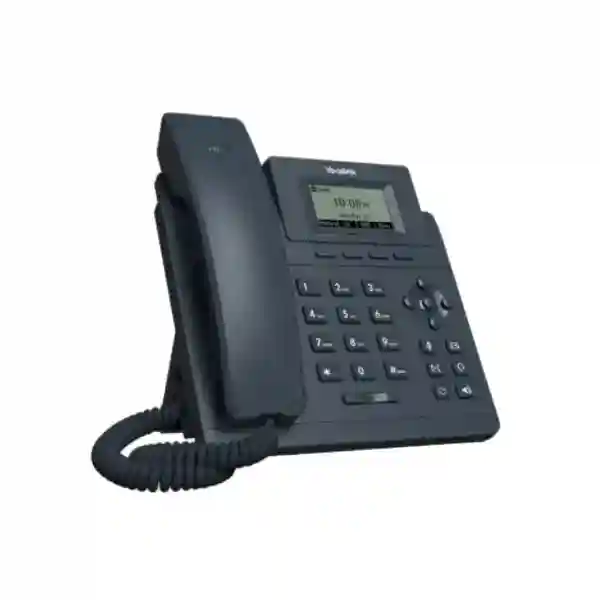
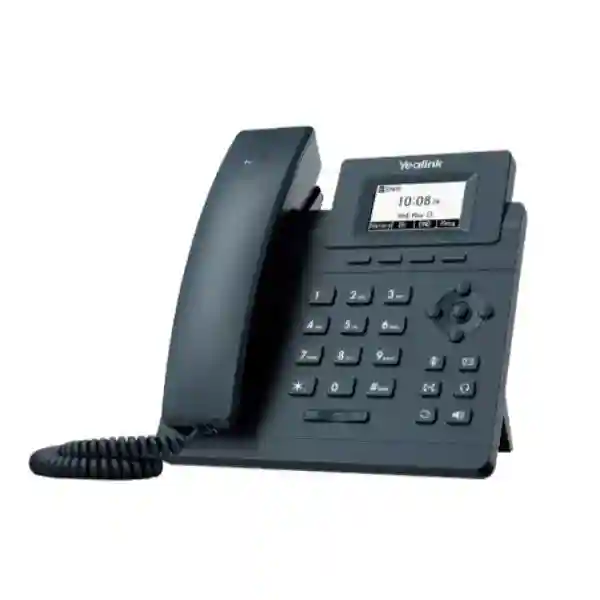
Yealink SIP-T30 Entry-Level Business IP Phone for Uganda
The Yealink SIP-T30 is a single-account SIP desk phone built for organizations that need dependable everyday voice communication without paying for unused high-end endpoint features. It is particularly relevant to small-business desks, branch counters, back-office extensions, service areas, stores, warehouses and other positions where the core requirement is straightforward calling, clear audio, manageable provisioning and predictable deployment. The platform combines a 2.3-inch 132×64-pixel graphical LCD, Yealink HD Voice, Smart Noise Filtering, a full-duplex speakerphone, local five-way conferencing and dual 10/100 Mbps Ethernet connectivity. Its physical design retains the familiar handset-and-keypad workflow that reduces user training while giving administrators browser, phone and automatic provisioning options.
For procurement teams, the important distinction is that SIP-T30 is intentionally a one-VoIP-account endpoint. That makes it well aligned with users who need one primary extension rather than multiple simultaneous line identities. It also means buyers should validate extension design before ordering large quantities. The phone can sit on a desk using its adjustable stand or be wall mounted where suitable. Headset users can use the dedicated RJ9 headset interface, and the platform supports EHS integration for compatible Yealink wireless headset arrangements. The unit is designed for standard IP telephony environments using SIP and provides enterprise-relevant controls such as VLAN tagging, QoS, SRTP, TLS 1.3, HTTPS management, AES256 configuration encryption, 802.1X, IPv6 and secure boot.
FourTeck supports Uganda buyers with product selection, quantity validation, voice-platform compatibility review, rollout planning and quotation preparation. For an accurate proposal, share the number of extensions, PBX or hosted SIP platform, office locations, headset needs, preferred power method and any provisioning requirements.
Instant Specifications & Procurement Fact Rail
Yealink SIP-T30
1 VoIP account
2.3-inch 132×64 LCD
2 × 10/100 Mbps RJ45
5V/600mA external adapter; verify supply scope
Contact FourTeck for current supply and project pricing
The fact rail gives procurement staff a fast way to determine whether the endpoint belongs in the project shortlist. SIP-T30 is positioned as a simple wired desk endpoint rather than a multi-line executive terminal. Its dual Fast Ethernet interfaces permit network continuation to a workstation where the deployment design allows it. Buyers should note that the SIP-T30 and SIP-T30P are distinct variants; power expectations must therefore be confirmed against the exact ordered model. The manufacturer lists an external 100–240V AC to 5V/600mA adapter arrangement for SIP-T30, with the power adapter shown as optional in package information. FourTeck recommends confirming the required adapter quantity and plug format on the quotation instead of assuming every carton configuration is identical.
Operational Product Architecture & Overview
A business IP phone is an endpoint in a wider voice architecture: user, handset, local Ethernet network, switching infrastructure, IP addressing, VLAN and QoS policies, SIP registrar or PBX, gateways where required, and upstream connectivity. The SIP-T30 concentrates on the endpoint portion of that architecture. It supports SIP v1 and SIP v2, static or DHCP addressing, DNS-SRV, UDP/TCP transport, STUN NAT traversal, peer-to-peer SIP operation and call-server redundancy. This breadth matters because the handset may be deployed against an on-premises IP-PBX, a hosted voice platform, or a branch architecture in which endpoints must register across routed networks.

At the user layer, the phone provides the functions expected at a routine business extension: hold, mute, do-not-disturb, speed dial, hotline, forwarding, waiting, transfer, redial, auto answer and local five-way conferencing. Directory functions include a local phonebook of up to 1,000 entries, blacklist support, XML/LDAP remote directories, search, import/export and call histories. Supported PBX-oriented features include voicemail, hot desking, flexible seating, call park, call pickup, executive/assistant functions, centralized call recording and visual voicemail, subject to the capabilities and configuration of the connected voice system.
Audio processing is a major practical consideration because an inexpensive endpoint still needs to be understandable in normal offices. SIP-T30 provides an HD handset and HD speaker, Smart Noise Filtering, G.722 wideband audio and a set of established narrowband codecs. Full-duplex hands-free operation uses acoustic echo cancellation, while supporting mechanisms include VAD, comfort-noise generation, packet-loss concealment, adaptive jitter buffering and automatic gain control. These functions cannot fix a badly engineered WAN, congested LAN or unsuitable acoustic environment, but they give the endpoint a solid foundation when the network is properly designed.
Administration is equally important in deployments of tens or hundreds of phones. Configuration can be performed through the handset, browser or automatic provisioning. The platform supports provisioning via FTP, TFTP, HTTP and HTTPS, plug-and-play methods and TR-069. Administrators can reboot or factory-reset endpoints and export packet traces and system logs for troubleshooting. This reduces dependence on desk-by-desk manual configuration and makes a standardized template approach more practical.
Enterprise Business Outcomes & Value Analysis
Key Hardware & Software Highlights
2.3-inch Graphical LCD
The 132×64-pixel monochrome graphical screen presents caller information, menus, soft-key context and status information without the cost or complexity of a large color display. It is appropriate for routine extensions where fast access to basic telephony information matters more than application-rich visuals.
Dual Fast Ethernet
Two RJ45 10/100 Mbps interfaces support the common desk topology in which the phone connects to the network and a workstation can connect through the phone. Network planners should verify that Fast Ethernet is sufficient for the attached workstation use case.
Headset Workflow
A dedicated RJ9 headset port and EHS support make the endpoint suitable for users who prefer headset calling. Compatibility should be checked against the exact headset and any required EHS accessory before purchase.
Unified Administration
Browser, handset and automated provisioning methods give IT teams options for both single-device configuration and fleet deployment. Yealink device-management ecosystem support can further simplify standardized administration where used.
Technical Specifications Ledger
| Category | Confirmed specification | Procurement relevance |
|---|---|---|
| SIP accounts | 1 VoIP account | Best for single-extension roles. |
| Display | 2.3-inch 132×64 graphical LCD | Clear basic status and navigation without color-screen premium. |
| Ethernet | 2 × RJ45 10/100 Mbps | Validate attached-PC bandwidth needs. |
| Audio | HD handset/speaker, Smart Noise Filtering, G.722; PCMU/PCMA, G.723.1, G.729 family, G.726, iLBC | Broad codec support for common SIP environments. |
| Conference | Local 5-way | Useful for ad-hoc multi-party calls. |
| Directories | Local phonebook up to 1,000 entries; XML/LDAP remote phonebook | Supports local and centralized directory approaches. |
| Security | SRTP, TLS 1.3, HTTPS certificate manager, AES256 config encryption, digest authentication, OpenVPN, 802.1X, secure boot | Supports controlled enterprise voice policies. |
| Network | IPv6, VLAN, LLDP/CDP/DHCP VLAN, 802.1p/Q, Layer 3 DSCP, STUN, DNS-SRV | Fits segmented voice LAN designs. |
| Power | External adapter: 100–240V AC input, 5V/600mA DC output; 2–3W PSU consumption | Confirm adapter inclusion and outlet availability. |
| Dimensions | 185 × 189 × 162 × 50 mm (manufacturer notation) | Check desk or wall space. |
| Environment | Operating -10 to +45°C; 10–95% humidity; storage -30 to +70°C | Useful for site environmental validation. |
| Provisioning | FTP/TFTP/HTTP/HTTPS, PnP, TR-069 | Supports repeatable fleet configuration. |
Specifications should be interpreted as endpoint capabilities, not guarantees that every feature will operate identically with every PBX. Features such as call recording, visual voicemail, executive/assistant workflows, remote directories and advanced provisioning depend on server-side support and configuration. Before a large rollout, FourTeck recommends testing a representative endpoint against the intended PBX, network policy and headset combination.
Configuration & Sizing Worksheet
- Count user roles, not merely desks. Identify permanent extensions, hot desks, reception points, stores, warehouses and temporary project positions. The SIP-T30 has one VoIP account, so users needing multiple line identities may require another model.
- Validate network topology. Record the switch port available at each desk, VLAN design, DHCP scope, DNS, PBX address, QoS policy and whether a workstation will pass through the phone’s 10/100 Ethernet switch. Where users transfer large files through the phone, assess whether Fast Ethernet is acceptable.
- Plan power explicitly. For SIP-T30, confirm the required external adapter arrangement and whether adapters are included in the proposed supply. Do not assume the power behavior of SIP-T30P applies to SIP-T30.
- Confirm voice-platform compatibility. List PBX vendor, software release, registrar address, authentication method, transport requirements, codecs, voicemail behavior and any required XML/LDAP services. Run a pilot when interoperability is business-critical.
- Define security baseline. Decide whether voice uses a dedicated VLAN, whether 802.1X is enforced, whether TLS/SRTP is mandatory, how certificates are issued and how configuration files are protected.
- Prepare provisioning. Establish naming conventions, extension templates, time zone, language, NTP/SNTP, dial plan, directory sources and firmware policy before devices reach desks.
- Build the quote checklist. Provide quantity, delivery city, expected installation date, adapter requirement, headset requirement, PBX platform, desired configuration service and any spare-unit percentage.
A small amount of planning prevents common rollout problems. For example, a buyer may focus on handset price but overlook the need for external power outlets, headset adapters, a voice VLAN, switch capacity or a provisioning template. Conversely, a project may over-specify endpoints when most staff need only one extension and basic call handling. The worksheet helps match equipment to actual user behavior rather than job title alone.
Deployment Scenarios & Industry Use Cases
Large Enterprise & Multi-Site Networks
Although positioned as an entry-level phone, SIP-T30 can serve standardized single-extension roles within a larger enterprise. A multi-site organization may reserve advanced multi-line phones for executives and reception teams while deploying SIP-T30 units at utility desks, stores, security posts, branch counters and back-office positions. Centralized provisioning is especially valuable here because administrators can apply common settings for VLANs, time, directory services, security and call-server registration.
Financial & Banking Environments
Banks and financial organizations generally require carefully governed endpoint security and network segmentation. SIP-T30 provides controls such as TLS 1.3, SRTP, certificate management, AES256 configuration encryption and 802.1X that can participate in such designs. Procurement should still treat the phone as one component of a broader control environment and validate it against institutional security policy, PBX requirements, logging expectations and lifecycle processes.
Educational & Campus Networks
Schools, universities and training institutions often have many low-to-moderate call-volume extensions across offices, departments, laboratories, stores and administrative spaces. A one-account endpoint can fit these locations while auto-provisioning reduces repetitive setup. Campus network teams should map voice VLANs, DHCP options, switch capacity and emergency-calling policies before mass rollout.
Government & Public-Sector Procurement
Public-sector deployments benefit from precise bills of materials, standardized configurations and clear acceptance criteria. Buyers can define the SIP-T30 as a single-account SIP endpoint with specified display, Ethernet, security, directory and environmental capabilities. Where procurement rules require particular certifications, warranty terms or interoperability evidence, these should be requested in the quotation and tender response rather than inferred from a generic product description.
Technical Deep Dive 1: Audio Processing & Endpoint Architecture
The practical quality of a desk phone depends on the complete voice path. At the endpoint, speech is captured by the handset or headset, encoded into a negotiated codec, packetized, transmitted through the LAN and WAN where applicable, reconstructed at the far endpoint and played back. SIP-T30 supports G.722 wideband audio as well as widely used narrowband codecs. The wideband option can provide a more natural speech range when the opposite endpoint and voice platform negotiate it. Narrowband options remain important for compatibility with older systems, gateways or constrained links.
Packet networks introduce challenges that traditional analog extension wiring did not present in the same way: variable delay, packet loss, congestion and jitter. SIP-T30 includes packet-loss concealment and adaptive jitter-buffer functions, while 802.1p/Q and Layer 3 DSCP support let administrators mark voice traffic for priority handling on compatible networks. These mechanisms work best when the switching and routing infrastructure is configured consistently end to end. A phone cannot independently guarantee quality across an overloaded WAN or poorly designed LAN.
At the acoustic layer, full-duplex speakerphone operation with echo cancellation permits both parties to speak naturally without the half-duplex behavior associated with simpler speakerphones. Smart Noise Filtering is intended to reduce distracting background noise. Automatic gain control, voice-activity detection and comfort-noise functions contribute to a stable calling experience. For particularly noisy environments, however, procurement teams should evaluate headset selection and physical placement rather than relying solely on endpoint processing.
Technical Deep Dive 2: Firmware Security & Operational Control
IP phones deserve the same disciplined lifecycle thinking as other managed network endpoints. SIP-T30 supports HTTPS administration, TLS 1.3, SRTP, certificate management, AES256 encryption for configuration files, digest authentication, 802.1X and secure boot. TLS protects supported signaling paths, while SRTP can protect voice media when configured with compatible infrastructure. Certificate management matters because encrypted transport without sound certificate practices can still leave administrative gaps.
Configuration security is equally important. Auto-provisioning is efficient, but provisioning servers can contain extension credentials and operational parameters. Organizations should favor protected transport where supported, control access to provisioning resources, use encrypted configuration files where appropriate and restrict administrative credentials. Device templates should be version-controlled operationally so changes can be traced and rolled back according to the organization’s processes.
Firmware governance should include a pilot ring rather than immediate fleet-wide changes. Administrators can test PBX registration, call transfer, voicemail, directories, headset operation and security policy on representative phones before broad deployment. This is particularly important when the phone fleet interacts with third-party PBX software or custom dial plans. FourTeck can help customers identify the information required for a pre-deployment validation plan.
Technical Deep Dive 3: Availability, Redundancy & Recovery
The manufacturer lists call-server redundancy support, but resilient calling requires more than an endpoint checkbox. A robust design considers redundant call-control servers, DNS behavior, WAN resilience, LAN switch availability, power continuity and configuration. If the PBX is redundant but the access switch or site power fails, desk phones may still be unavailable. Procurement teams should therefore map dependencies from handset to call control.
Recovery planning should include configuration restoration. Automatic provisioning can make replacement faster because a spare or replacement endpoint can receive a standardized template rather than being configured manually from notes. Maintain an inventory of model, extension assignment, MAC address where operationally appropriate, location, firmware baseline and accessories. Keep spare devices proportionate to operational criticality and geographic distribution.
For branches outside Kampala, replacement strategy deserves special attention. A low-cost spare held at a regional office can sometimes restore service faster than emergency transport of a single unit. Organizations with critical voice positions may also maintain alternative communication paths. The SIP-T30 should be incorporated into the broader continuity plan rather than treated as the entire availability solution.
Pre-Purchase Buyer Gap Checklist
Is this the PoE version? Buyers should distinguish SIP-T30 from SIP-T30P. For a SIP-T30 order, confirm the exact power method and adapter supply on the quotation. Does it provide Gigabit Ethernet? No; the specified interfaces are 10/100 Mbps. If a workstation will be daisy-chained through the phone and requires higher wired throughput, consider the topology or another endpoint. How many SIP identities can it register? One VoIP account. This is ideal for simple extensions but not for users requiring several line identities.
Are advanced PBX functions automatically available? Not necessarily. The phone exposes a broad set of telephony and IP-PBX features, but server-side support and interoperability determine actual behavior. Does it work with directories? It supports a local phonebook up to 1,000 entries and XML/LDAP remote phonebooks; integration should be validated against the intended directory design. Can it use a wireless headset? EHS support is listed, including support associated with Yealink EHS35; verify the exact headset and accessory combination.
What are the hidden project costs? Typical items to check include power adapters, headsets, EHS accessories, PBX licensing, hosted SIP subscriptions, switches, VLAN configuration, structured cabling, installation labor, provisioning, user training and spare units. Not every project needs every item, but excluding them from planning can distort the endpoint budget. What about physical installation? The phone supports desk use with two stand angles and wall mounting. Check cable routing, wall hardware, outlet placement and clearance before finalizing quantities.
How should security be evaluated? Review TLS/SRTP compatibility, certificate processes, 802.1X requirements, provisioning security, administrative password policy and firmware governance. What should be tested before bulk purchase? Registration, inbound/outbound calls, transfer, hold, voicemail, caller ID, directories, conference behavior, headset operation, VLAN/QoS behavior, failover where applicable and provisioning. A small representative pilot can expose compatibility issues before they affect a full rollout.
Uganda Procurement & Delivery Logistics
FourTeck can prepare a project quotation around the exact deployment rather than treating the handset as an isolated line item. Buyers should provide the required quantity, delivery location, expected deployment date, PBX or hosted voice platform, power-adapter requirements, headset requirements and any configuration service requested. For larger projects, include the number of sites and the intended allocation per site so packaging and dispatch can be planned efficiently.
Order processing can include bill-of-materials validation before dispatch. This is particularly useful when a deployment includes handsets, headsets, EHS accessories, switches, gateways or other voice components. Delivery timing depends on confirmed stock, project quantity, import position and destination, so current lead time should be stated on the formal quotation rather than assumed from a generic web page.
Where pre-configuration is requested, provide extension parameters and deployment standards through an agreed secure process. The configuration scope should clearly state whether it covers firmware baseline, SIP account templates, time settings, VLAN parameters, directory configuration, feature keys or other site-specific items. Acceptance testing can then compare delivered units against the approved template.
Local Coverage Matrix
Corporate offices, branches, contact points and multi-floor deployments.
Business, hospitality, logistics and administrative voice projects.
Industrial, education, commercial and branch communication requirements.
Regional offices, institutions and distributed business sites.
Regional operations, organizations and branch endpoint rollouts.
For each destination, quote preparation should account for quantity, shipment consolidation, installation schedule and the availability of local IT staff to receive and deploy equipment. Multi-site buyers can request a consolidated bill of materials with allocation by branch, helping internal teams reconcile delivered units against deployment plans.
Cross-Border & Regional Supply Chains
Organizations operating across several countries often benefit from a common endpoint standard and a coordinated bill of materials. FourTeck supports regional sourcing discussions across Uganda, Kenya, the broader African market, UAE and Kuwait. A regional project should still account for country-specific power accessories, delivery terms, taxes, import requirements, warranty routing and voice-platform configuration.
Standardizing on the SIP-T30 for appropriate single-extension roles can simplify spares and user familiarity across branches, while other Yealink models can cover users requiring additional SIP accounts, color displays or different network capabilities. The objective is not to force one handset into every role, but to create a manageable endpoint catalogue with clear use cases.
Related Products & Deployment Options
A complete voice project may require more than one endpoint class. Buyers comparing the SIP-T30 can also review the broader Yealink portfolio in Uganda for models suited to multi-line users, reception positions and advanced workspaces. For project consultation, use the FourTeck Uganda contact page. Where headset calling is important, include the required headset and EHS arrangement in the same bill of materials. Where a branch uses an IP-PBX, gateways, switching and structured cabling, ask for compatibility review across the full path rather than evaluating only the handset.
The related-model decision should start with user requirements: number of SIP identities, network speed, display preference, headset use, call volume, programmable-key needs and power method. A receptionist, executive assistant and warehouse extension can all need voice service but have very different endpoint requirements. Matching those roles avoids both under-specification and unnecessary cost.
FourTeck Technical Service Capabilities
FourTeck can support engineering validation before order placement by reviewing the intended voice platform, user roles, quantities, network environment and accessory requirements. Bill-of-materials verification helps identify omissions such as power adapters, headset accessories or model mismatches. For standardized rollouts, staging can align endpoints to an agreed firmware and configuration baseline before shipment, subject to project scope and the information provided by the customer.
Pre-shipment preparation can be especially useful for distributed deployments because branch staff receive devices closer to a defined operational state. Configuration requirements should be documented and approved before staging begins. Post-sales troubleshooting can then use that baseline to distinguish endpoint issues from PBX, network, credential or upstream service problems. Organizations should retain their own configuration records, extension inventory and change-control history as part of normal IT governance.
Extended Technical FAQ
1. Is Yealink SIP-T30 suitable for a small business in Uganda?
Yes, when the user requires one VoIP account and straightforward desk-phone functions. The SIP-T30 provides HD voice, a graphical LCD, two 10/100 Ethernet ports, common call-handling features, five-way local conferencing, directory support and centralized provisioning options. It is especially appropriate where a business wants standardized SIP endpoints without paying for features such as a large color display or numerous line identities. Before ordering, confirm the PBX or hosted SIP platform, power arrangement, network port availability and required accessories.
2. Does SIP-T30 support Power over Ethernet?
The SIP-T30 should not be confused with the SIP-T30P. Manufacturer documentation for SIP-T30 specifies an external Yealink AC adapter with 100–240V input and 5V/600mA output, and notes the power adapter as optional in package contents. Therefore, a procurement team should explicitly confirm adapter inclusion, quantity and plug type on the quotation. If PoE is a firm requirement, tell FourTeck during model selection so the correct variant can be proposed and validated.
3. Can a computer connect through the phone?
The phone provides two RJ45 10/100 Mbps Ethernet ports, allowing the common arrangement in which one port connects toward the network and the other provides a connection for a workstation. The key planning issue is bandwidth: these are Fast Ethernet ports, not Gigabit interfaces. For ordinary office workloads this may be adequate, but users transferring large files or requiring higher wired throughput should have their network topology reviewed before the phone is placed inline with the workstation.
4. What security features are available?
The platform lists SRTP for voice, TLS 1.3, an HTTPS certificate manager, AES256 encryption for configuration files, digest authentication, OpenVPN, IEEE 802.1X, IPv6 and secure boot, alongside VLAN and QoS capabilities. These are building blocks rather than a complete security program. Organizations should also control administrator credentials, provisioning-server access, certificate lifecycle, firmware updates, network segmentation and PBX permissions. Security features must be configured on both endpoint and supporting infrastructure where applicable.
5. Can FourTeck help configure phones before delivery?
Pre-configuration can be discussed as part of the project scope. Useful information includes PBX platform, registrar details, extension plan, authentication approach, VLAN settings, time zone, preferred language, directory services, firmware baseline and feature requirements. Customers should transmit credentials and sensitive configuration information through an agreed secure process. For large rollouts, a pilot template should be tested and approved before applying it broadly, reducing the risk of replicating an incorrect setting across the fleet.
6. Does the phone support wireless headsets?
SIP-T30 includes a dedicated RJ9 headset port and manufacturer documentation lists EHS wireless-headset support, including EHS35 support. Compatibility should still be checked against the exact headset model because electronic hook-switch arrangements depend on the handset, headset and accessory combination. When requesting a quote, specify whether users need wired headsets, wireless headsets or handset-only operation. FourTeck can then align the accessory list to the proposed endpoint configuration.
7. How are many SIP-T30 phones managed?
The phone supports configuration through its interface, web browser and automatic provisioning. Mass-deployment methods include FTP, TFTP, HTTP and HTTPS provisioning, plug-and-play mechanisms and TR-069. It also supports Yealink management-platform approaches. For a fleet deployment, administrators should create a standard configuration template covering network, security, time, directory and voice settings, then handle user-specific extension credentials separately as appropriate. Test the template on a small group before full rollout.
8. What happens if the PBX server fails?
The endpoint supports call-server redundancy, but actual failover behavior depends on the PBX architecture, DNS and registration configuration, network reachability and the redundancy design implemented by the organization. A resilient endpoint cannot compensate for every upstream single point of failure. Critical deployments should test failover under realistic conditions and document expected behavior. Consider redundant call control, network paths, switches and power where continuity requirements justify them.
9. What warranty and replacement information should be requested?
Warranty terms can vary by supply channel, project and region, so the applicable warranty baseline should be stated on the formal FourTeck quotation or order documentation. Buyers should ask how a suspected hardware fault is diagnosed, what information is required for a return, where replacement processing occurs and whether advance replacement is included or separate. Large organizations may also hold spare units locally so a failed desk can be restored quickly while warranty processing proceeds.
10. What information produces the most accurate quotation?
Provide the quantity, destination city, required delivery date, PBX or hosted SIP platform, number of extensions, external power-adapter requirement, headset requirement, wall-mount requirement, configuration scope and whether the order covers one site or several. If the phone will share its network connection with PCs, describe workstation bandwidth needs. If security policies mandate TLS, SRTP, 802.1X or a particular provisioning workflow, include those requirements so technical validation can occur before procurement.
Prepare Your Yealink SIP-T30 Uganda Procurement Quote
A reliable voice rollout starts with the correct endpoint variant, power plan, PBX compatibility and deployment scope. Send FourTeck the required quantity, Uganda delivery location, voice platform, adapter needs, headset requirements and desired staging or configuration service. The team can use those details to prepare a project-focused quotation and help validate the bill of materials before ordering. For multi-site deployments, include the allocation by Kampala, Entebbe, Jinja, Mbarara, Gulu or other destinations so logistics can be planned around the actual rollout.
If you are comparing SIP-T30 with other Yealink models, include the user roles and required number of SIP accounts. This allows the endpoint mix to be matched to real operational needs rather than applying a single model indiscriminately across every desk.


Reviews
There are no reviews yet.