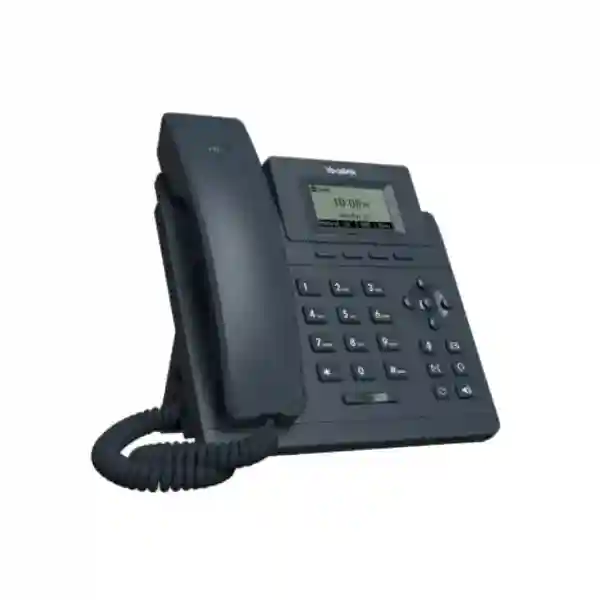
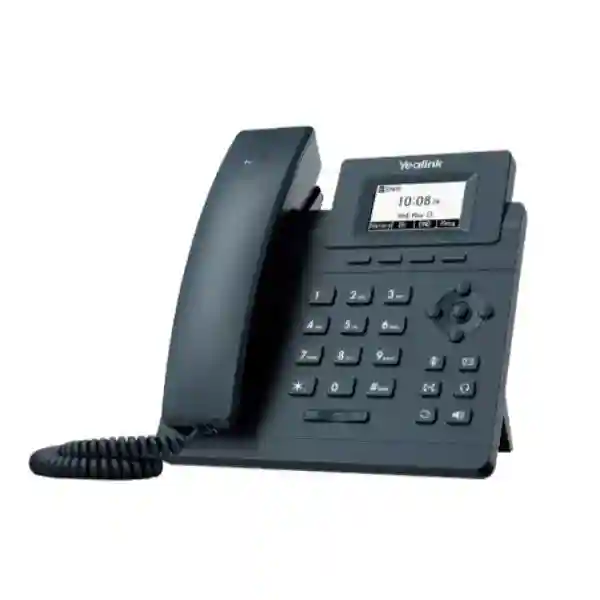
Yealink SIP-T30P Entry-Level PoE IP Phone for Business Voice
The Yealink SIP-T30P is a single-account SIP desk phone built for organizations that want clear voice communication, straightforward deployment and economical endpoint standardization. It combines HD audio, Smart Noise Filtering, a compact graphical display, dual Fast Ethernet connectivity and Power over Ethernet in a familiar desk-phone format.
For Uganda organizations, the model is particularly relevant where many users need a dependable fixed voice endpoint rather than advanced touch displays or numerous programmable line keys. Typical placements include general administration desks, branch offices, reception support positions, retail counters, classrooms, clinics, warehouses, security posts and back-office teams. The purchasing decision is therefore less about buying the most feature-heavy handset and more about matching a simple endpoint to the actual calling profile, network design, PBX platform and power arrangement.
FourTeck supports procurement teams with model validation, quantity planning, network and accessory checks, commercial quotation, staging requirements and delivery coordination. Before ordering, buyers should confirm whether the installation uses PoE, whether a local power adapter is required, the SIP platform in use and whether users need wired or electronic-hook-switch headset workflows.
Procurement Fact Rail
Yealink SIP-T30P
1 SIP account
2 × 10/100 Mbps RJ45
IEEE 802.3af PoE, Class 1 on V2-or-later label units; optional 5V adapter
2.3-inch 132×64 graphical LCD
Confirm quantity, destination and PBX platform
The SIP-T30P sits in Yealink’s T3 family as a deliberately straightforward endpoint. Its specification is appropriate for users whose primary requirement is to place, receive, transfer and manage routine calls. The two-port Ethernet arrangement can simplify a desk installation where the phone and a workstation share the same structured cabling drop, while PoE can remove the need for a separate power adapter when the switching infrastructure provides compatible power.
Operational Architecture and Deployment Overview
The SIP-T30P is based on standards-oriented SIP communications rather than a proprietary single-purpose telephony connection. It supports SIP v1 and SIP v2, static or DHCP addressing, common network discovery and VLAN mechanisms, and web-based or automated provisioning. That architecture matters to IT departments because an endpoint rollout is rarely only about the handset. Every desk phone becomes part of the access network, voice VLAN, DHCP plan, QoS policy, certificate lifecycle, PBX registration design and support process.
At the user edge, the handset provides HD voice through its handset and speaker, full-duplex hands-free operation with acoustic echo cancellation and Smart Noise Filtering. Codec support includes Opus and G.722 for wideband operation alongside commonly deployed narrowband codecs. Actual audio performance still depends on the PBX, carrier path, negotiated codec, LAN quality and WAN conditions. A good endpoint cannot compensate for excessive packet loss, unmanaged congestion or a poorly designed voice VLAN, so procurement should be paired with basic network readiness checks.
The dual 10/100 Mbps Ethernet ports allow the phone to sit between the wall network outlet and a workstation in suitable deployments. Buyers should note that these are Fast Ethernet interfaces, not Gigabit Ethernet. That distinction is important when a workstation requires sustained throughput above 100 Mbps or when a desk standard mandates Gigabit pass-through. In such cases, provide the network requirement during quotation so a more appropriate Yealink model can be evaluated instead of discovering the limitation after deployment.
Management is designed for repeatability. Administrators can configure the device through the phone interface, browser interface or automated provisioning. FTP, TFTP, HTTP and HTTPS provisioning methods are supported, along with Plug-and-Play and TR-069 mechanisms. Yealink’s management ecosystem can also be relevant for fleet operations. These capabilities allow a deployment team to define common account, time, dial-plan, security and network parameters and reproduce them across larger quantities rather than manually building every handset.
Security capabilities include SRTP for voice, TLS 1.3 transport support, HTTPS certificate management, AES256 configuration-file encryption, digest authentication, IEEE 802.1X, OpenVPN, IPv6, secure boot and network segmentation mechanisms. Security still requires correct configuration. Procurement teams should therefore establish who owns certificate management, PBX credentials, firmware maintenance and provisioning access before units reach user desks.
Business Outcomes and Value Analysis
Key Hardware and Software Highlights
The 2.3-inch 132×64 graphical LCD presents caller information, menus and status details without introducing the power and management overhead of a large color touchscreen. Six dedicated feature keys cover transfer, message, headset, redial, mute and speakerphone functions, while five navigation keys and volume controls provide familiar physical interaction.
Physical connectivity includes two RJ45 Fast Ethernet ports, one RJ9 handset port and one RJ9 headset port. The phone is wall mountable and uses an adjustable stand for desk positioning. For compatible wireless-headset workflows, Yealink EHS support should be checked against the intended headset and accessory combination before ordering.
Calling functions include hold, mute, do-not-disturb, speed dial, hotline, forwarding, waiting, transfer, redial, call return, auto answer, direct IP calling and local five-way conferencing. Directory functions include a local phonebook with up to 1,000 entries, blacklist support, XML or LDAP remote phonebook capability, smart dialing and call-history records. Feature availability can depend on the PBX or service provider, so platform compatibility should be validated for functions that are operationally mandatory.
Technical Specifications Ledger
| Model | SIP-T30P |
| VoIP accounts | 1 |
| Display | 2.3-inch, 132×64 graphical LCD |
| Ethernet | 2 × RJ45 10/100 Mbps |
| PoE | IEEE 802.3af Class 1; manufacturer notes applicability to units with V2 logo or later on label |
| Audio | HD handset and speaker, Smart Noise Filtering, full-duplex speakerphone with AEC |
| Wideband codecs | Opus, G.722 |
| Ports | RJ9 handset and RJ9 headset |
| Conferencing | Local 5-way conferencing |
| Adapter | External Yealink adapter, AC 100–240V input, DC 5V/0.6A output; optional package item |
| Power consumption | PSU 2–3W; PoE 3–4W |
| Dimensions | 185 × 189 × 162 × 50 mm |
| Operating temperature | -10°C to +45°C |
| Operating humidity | 10–95% |
| Storage temperature | -30°C to +70°C |
| Provisioning | Phone, browser, FTP/TFTP/HTTP/HTTPS auto-provisioning, PnP, TR-069 |
| Security | SRTP, TLS 1.3, HTTPS certificate management, AES256 configuration encryption, digest authentication, OpenVPN, IEEE 802.1X, secure boot |
Configuration and Sizing Worksheet
1. Count real endpoint requirements
Separate users who need one normal extension from receptionists, supervisors and executives who may need multiple line appearances or a larger programmable-key layout. The SIP-T30P is strongest when its one-account design genuinely matches the role. Count permanent desks, shared positions, branch counters, spare units and planned growth rather than quoting only today’s occupied desks.
2. Check LAN speed and voice VLAN design
Confirm that 10/100 Mbps pass-through is acceptable for any workstation connected through the phone. Document DHCP, VLAN, QoS and 802.1X requirements. If a workstation needs Gigabit connectivity, consider a topology with a separate switch port or evaluate another handset model with Gigabit Ethernet.
3. Validate power
Identify which access switches provide IEEE 802.3af PoE and whether their power budgets can support the planned quantity. If PoE is unavailable, include compatible power adapters and sufficient local outlets. Do not assume an adapter is included unless the quotation explicitly states it.
4. Confirm call platform compatibility
Record the PBX, hosted voice platform or SIP service, current firmware policy, registration method, required codecs, voicemail integration and any special call-control features. Standard SIP support provides broad interoperability, but specific platform functions can still require configuration or validation.
5. Define provisioning ownership
Decide whether phones will be delivered unconfigured, staged with network parameters, prepared with a provisioning URL or configured according to an approved template. For larger estates, document firmware version, certificate requirements, naming conventions and extension-assignment workflow.
6. Prepare the quotation brief
Provide quantity, delivery city, required date, PBX platform, PoE availability, adapter quantity, headset requirements, wall-mount needs and any staging or labeling requirements. This produces a more accurate bill of materials and reduces last-minute accessory gaps.
Deployment Scenarios and Industry Use Cases
Large enterprise and multi-site networks
In a larger organization, the SIP-T30P can serve as a standardized basic endpoint for roles that require one extension and predictable call handling. Central provisioning is particularly useful when many branch offices must follow the same network, security and dialing policy. Higher-tier phones can coexist for reception or executive roles while the T30P handles routine desks.
Financial and banking environments
Branch counters, operations rooms and support desks may require fixed SIP endpoints with controlled configuration. Features such as TLS, SRTP, 802.1X and encrypted configuration files can contribute to an endpoint security program, but they must be integrated with the institution’s own identity, certificate, switching and PBX controls. Procurement should verify internal standards before approval.
Education and campus networks
Administrative offices, departmental desks, libraries, laboratories and security points often need reliable voice access without premium handset features. PoE can simplify installation across managed campus switching, while auto-provisioning can help a small IT team maintain many devices. Network segmentation and emergency-calling policy should be defined centrally.
Government and regulated procurement
Public-sector deployments commonly require documented model specifications, bill-of-materials consistency, delivery records and controlled configuration. Buyers should state any mandatory compliance, firmware, security, warranty or acceptance requirements in the request for quotation. Where a tender specifies a particular hardware revision or feature, the exact supplied revision should be confirmed before dispatch.
Technical Deep Dive: Audio, Network and Endpoint Processing
Voice endpoints operate at the intersection of human acoustics and packet networking. The SIP-T30P includes HD handset and speaker operation, wideband codecs and Smart Noise Filtering, while full-duplex speakerphone operation uses acoustic echo cancellation. Voice activity detection, comfort noise generation, packet-loss concealment, adaptive jitter buffering and automatic gain control contribute to call handling under real network conditions. These functions do not remove the need for a stable network; instead, they form the endpoint side of a broader quality design.
On the LAN, 802.1p/Q VLAN tagging and Layer 3 DSCP support allow voice traffic to participate in a defined QoS architecture. The most reliable deployments configure switching, routing and WAN policy consistently rather than relying only on endpoint markings. DNS-SRV, DHCP or static addressing, LLDP/CDP/DHCP VLAN functions and IPv6 support give administrators multiple integration paths depending on existing infrastructure.
Technical Deep Dive: Firmware Security and Operational Control
A desk phone contains credentials, configuration data and a network stack, so firmware governance should be treated as part of the endpoint lifecycle. TLS 1.3 support, SRTP, secure boot, HTTPS management, certificate handling and AES256 configuration-file encryption provide mechanisms that administrators can incorporate into a secure deployment. The important operational question is not merely whether a feature exists, but whether the organization has a defined process for enabling it, rotating credentials and certificates, approving firmware and protecting provisioning servers.
Automated provisioning can reduce configuration drift. A controlled template can define SIP account behavior, time settings, dial rules, VLAN values, server addresses and selected security parameters. Before mass rollout, test that template on a small group of phones and confirm registration, inbound and outbound calling, transfer, voicemail, emergency calling, directory behavior and any headset workflows.
Technical Deep Dive: Availability and Recovery Planning
The endpoint supports call-server redundancy, but service availability ultimately depends on the wider voice design. Consider redundant PBX or hosted service architecture, DNS behavior, WAN diversity, PoE switch resilience, UPS runtime and recovery procedures. In a branch office, a phone can remain physically functional while voice service is unavailable because the WAN, SIP trunk, DNS service or call platform is down. Procurement planning should therefore distinguish handset resilience from complete service resilience.
For larger fleets, keep a controlled quantity of spare units and a documented replacement workflow. A spare phone that can obtain the approved firmware and configuration from a provisioning service is generally faster to restore than a manually configured device. Asset labels, MAC-address records and extension assignment procedures can further reduce recovery time.
Pre-Purchase Buyer Gap Checklist
Is PoE available on every intended desk? Confirm switch capability and total PoE budget. The manufacturer notes PoE applicability to phones with a V2 logo or later on the label, so revision requirements should be stated where material.
Will the connected PC be limited by Fast Ethernet? The phone uses 10/100 Mbps ports. For desks that require Gigabit pass-through, review the cabling topology or a Gigabit-capable phone model.
Does the user need more than one SIP account? The T30P supports one account. Multi-line roles should be identified before ordering.
Is a power adapter included? Treat the adapter as optional unless the commercial quotation explicitly includes it. PoE deployments may not need adapters.
Which headset is planned? Confirm connector type, EHS accessory requirements and headset compatibility. Do not assume every wireless headset integrates identically.
What will manage firmware and configuration? Define whether the customer PBX, provisioning server or Yealink management environment owns configuration. Record the approved firmware baseline and upgrade policy.
What happens when a phone is replaced? Decide how extensions, credentials and configuration are restored, and maintain spare units where downtime has operational impact.
Are advanced PBX features mandatory? Features such as centralized recording, visual voicemail, executive-assistant functions and call park can depend on the call platform. Validate required workflows with the intended PBX or service provider.
Does the physical location need wall mounting? The phone supports wall mounting, but mounting accessories and site conditions should be confirmed. Check cable routing, clearance and user reach before installation.
What is the warranty process? Warranty terms can vary by supply route and commercial agreement. Obtain the applicable regional warranty baseline and return procedure on the quotation rather than relying on assumptions.
Uganda Procurement, Delivery and Technical Preparation
FourTeck can prepare a commercial quotation around the exact quantity and deployment profile rather than treating the handset as an isolated item. For a useful request, provide the number of phones, destination, required delivery date, organization type, PBX or hosted voice platform and whether the network provides PoE. Include any need for power adapters, headsets, wall mounting, asset labeling, firmware alignment or configuration staging.
Order processing should preserve the approved model and accessory list so that receiving teams can reconcile delivered goods against the purchase order. For larger projects, it is sensible to separate endpoint quantity from spare quantity and to document any revision-sensitive requirement. Where pre-configuration is requested, an approved configuration brief should define network parameters and provisioning responsibility without exposing unnecessary production credentials in procurement documents.
Delivery timing depends on stock position, order quantity, commercial approval and destination. Buyers should request the current lead time in the formal quotation, especially for phased rollouts or tender deadlines. For deployment projects, coordinate delivery with switch readiness, PBX licensing, extension creation and installer availability so handsets do not arrive long before the network is prepared.
Uganda Coverage Matrix
Kampala: Suitable for head-office, branch, retail, hospitality, education and service-desk deployments requiring scalable SIP endpoints. Entebbe: Appropriate for offices, logistics, hospitality and institutional sites where centralized voice management is useful. Jinja: Supports commercial, industrial and education deployments with branch-oriented SIP requirements. Mbarara: Useful for regional offices, healthcare, education and distributed enterprise communications. Gulu: Applicable to branch, institutional and public-sector sites that need standardized fixed voice endpoints.
For every city, the same planning principle applies: confirm PBX compatibility, network switching, PoE availability, endpoint count, accessories and delivery requirements before finalizing the order.
Cross-Border and Regional Supply
Organizations operating across several countries may prefer to align handset standards, configuration templates and spares across their sites. FourTeck regional portals support procurement discussions for Uganda, Kenya, the broader African market, the United Arab Emirates and Kuwait. Cross-border projects should identify destination-specific quantities, delivery addresses, required documentation, local power arrangements and acceptance requirements at quotation stage.
Related Yealink Planning Paths
When the T30P is part of a wider voice project, buyers can review the FourTeck Uganda technology portfolio and request alternatives for roles that need additional SIP accounts, Gigabit Ethernet, color displays, more programmable keys or wireless connectivity. The Yealink T31 family can be considered for roles requiring a step up in line capability, while higher T3 and T4 family endpoints can suit more demanding desk profiles. Reception positions may require a larger programmable-key environment than the T30P provides.
Accessories should be selected as part of the endpoint bill of materials rather than after delivery. Common planning areas include PoE switching, optional power adapters, compatible headsets, electronic-hook-switch accessories, structured cabling and mounting requirements. Contact FourTeck with the user-role matrix so endpoint tiers can be matched to actual job functions.
FourTeck Technical Service Capabilities
Technical procurement support can include bill-of-materials review, model and accessory validation, deployment requirement capture and staging coordination. For multi-unit orders, consistent preparation is more valuable than ad-hoc handset setup. A defined staging brief can cover approved firmware, provisioning method, network parameters, labeling expectations and basic acceptance checks.
Pre-shipment preparation may include firmware alignment and configuration work where agreed and technically appropriate. Post-sales support should begin with a clear fault-isolation process that separates endpoint hardware issues from LAN, PoE, PBX, SIP trunk and WAN problems. For warranty cases, retaining serial information, purchase documentation and a description of troubleshooting already completed can accelerate assessment.
For organizations replacing an older phone estate, FourTeck can also help map basic, standard and advanced user profiles so that the SIP-T30P is deployed where its one-account architecture is appropriate and higher-tier phones are reserved for users who require additional functions.
Frequently Asked Technical and Procurement Questions
Does the Yealink SIP-T30P support Power over Ethernet?
Yes. Manufacturer documentation lists IEEE 802.3af Class 1 PoE for the SIP-T30P and notes that this applies to phones with a V2 logo or later on the label. This revision note is important for procurement and installed-base planning. If PoE is central to the project, state the requirement on the quotation and verify the switching infrastructure has sufficient PoE ports and power budget. Where PoE is not available, the phone can use the specified external 5V power adapter, which should be explicitly included in the bill of materials if required.
How many SIP accounts does the T30P support?
The SIP-T30P supports one VoIP account. This makes it a good fit for users who primarily need one extension and normal call handling. It is less appropriate for receptionists, executives or shared-service roles that require several independent line appearances or many programmable keys. Before buying in volume, classify user roles and identify which positions truly need multi-account capabilities. A mixed handset estate can be more economical than forcing one model onto every role.
Can a computer connect through the phone?
Yes. The phone provides two 10/100 Mbps RJ45 Ethernet ports, allowing suitable installations to connect the network to the phone and pass connectivity onward to a workstation. The important limitation is speed: these are Fast Ethernet ports, not Gigabit Ethernet. If the connected computer requires throughput beyond 100 Mbps, consider a separate switch connection or a Yealink model with Gigabit Ethernet. This should be decided before rollout because it affects cabling, switch-port planning and the user experience.
What audio technologies are included?
The SIP-T30P provides Yealink HD voice for handset and speaker use, Smart Noise Filtering, full-duplex speakerphone operation with acoustic echo cancellation and support for wideband codecs including Opus and G.722. It also supports multiple narrowband codecs used in SIP environments. Actual call quality depends on the complete path: PBX configuration, codec negotiation, LAN congestion, WAN latency, packet loss and carrier conditions all matter. A voice-ready network should use appropriate VLAN and QoS policy rather than expecting the handset alone to solve network-quality problems.
Can the phones be provisioned in bulk?
Yes. The platform supports configuration from the phone or browser and automated provisioning through FTP, TFTP, HTTP and HTTPS, along with Plug-and-Play and TR-069 mechanisms. This is useful when deploying many units because administrators can create a controlled template rather than manually repeating every setting. Before a mass rollout, validate the template on a pilot group, confirm firmware compatibility, registration, calling, transfer, voicemail and network behavior, and establish how credentials and certificates will be protected.
What security features are available?
Manufacturer specifications include SRTP for voice, TLS 1.3 transport support, HTTPS certificate management, AES256 encryption for configuration files, digest authentication, OpenVPN, IEEE 802.1X, IPv6 and secure boot. These features provide useful building blocks, but they do not automatically create a secure deployment. Administrators still need to define certificate trust, provisioning access, firmware governance, password policy, voice VLAN controls and PBX-side security. Organizations with regulated environments should map the phone’s capabilities to their own technical standard before approval.
Does the T30P support conferencing?
Yes. The handset supports local five-way conferencing. Whether a specific business workflow should use local handset conferencing or a PBX-hosted conference service depends on the organization’s call platform, participant requirements and operational policy. For frequent or larger meetings, a dedicated conferencing platform may provide more control. For occasional desk-based calls involving a small number of participants, the local conferencing capability can be convenient without requiring the user to move to another device.
Can the phone be wall mounted or used with a headset?
The SIP-T30P is wall mountable and includes an RJ9 headset interface. Manufacturer materials also reference EHS wireless-headset support within the T3 family. Buyers should confirm the exact headset model and any required EHS accessory before purchase because physical connection does not guarantee every call-control function with every headset. For wall installations, confirm the required mounting accessory, cable routing, user reach and clearance. These details are especially important in corridors, warehouses, reception points and compact service counters.
What should be supplied when requesting a Uganda quotation?
Provide the number of SIP-T30P phones required, destination city, desired delivery date, PBX or hosted SIP platform, PoE availability, power-adapter requirement, headset requirement, wall-mount requirement and any staging or labeling needs. For larger projects, include spare-unit quantity and rollout phases. If a tender requires a particular hardware revision, warranty baseline, firmware version or compliance document, state that explicitly. A complete request allows the supplier to validate the bill of materials and identify accessory or compatibility gaps before the purchase order is issued.
How should warranty and replacement planning be handled?
Warranty conditions can depend on the supply channel and commercial agreement, so the applicable regional terms should be confirmed on the formal quotation or order documentation. For operational continuity, larger customers should also plan a small pool of spare endpoints and maintain serial or asset records. When a device fails, first isolate whether the problem follows the handset, cable, switch port, PoE source, account or PBX configuration. A documented troubleshooting record helps distinguish hardware replacement from network or service faults and can shorten the support cycle.
Prepare Your Yealink SIP-T30P Uganda Procurement Request
For an accurate quotation, send the required quantity, delivery location, PBX or hosted SIP platform, PoE availability and any adapter, headset, wall-mount, staging or labeling requirements. FourTeck can review the proposed endpoint role and bill of materials before order processing so the handset, network and accessory plan align with the intended deployment.

Reviews
There are no reviews yet.