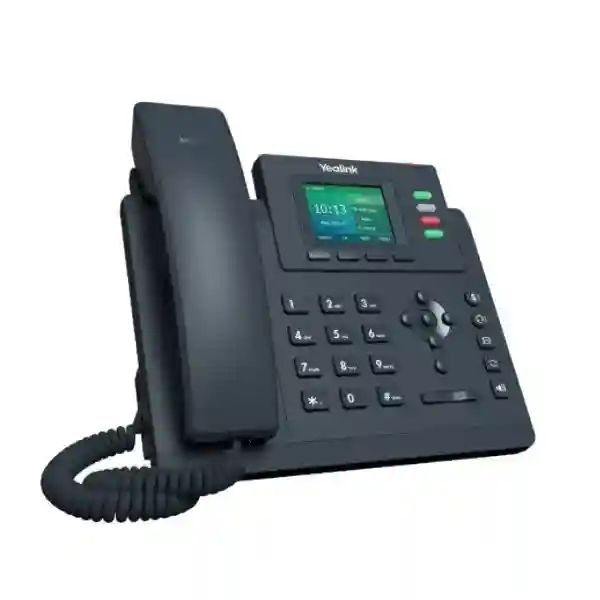
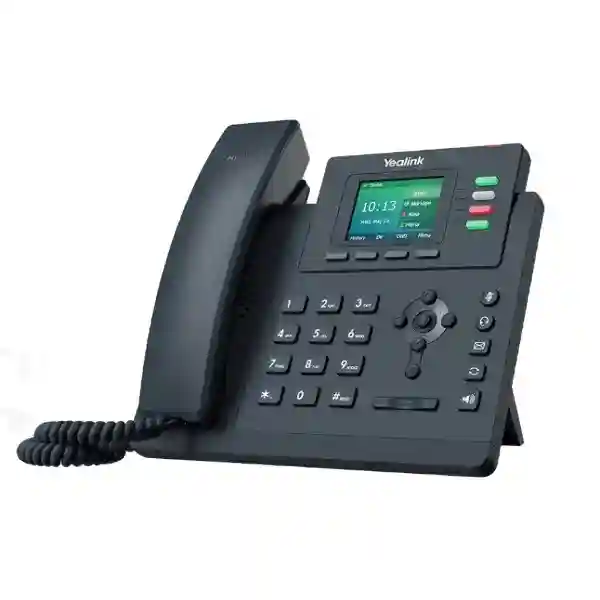
Yealink SIP-T33G Gigabit Color SIP IP Phone for Business Communications
The Yealink SIP-T33G is a professional entry-level SIP desk phone built for organizations that need dependable IP calling, Gigabit desktop connectivity, straightforward provisioning and a clear color interface without moving into a premium executive-phone price tier. In practical infrastructure terms, it is an endpoint that connects a user to a compatible SIP service or IP-PBX while also providing a second Gigabit Ethernet port for a nearby workstation. Its integrated IEEE 802.3af Power over Ethernet capability can simplify desks by allowing a compatible PoE switch to carry network connectivity and electrical power over the Ethernet link. For organizations standardizing many desks, that combination can reduce the number of separate power adapters required, subject to the available PoE budget and deployment design.
The SIP-T33G uses a 2.4-inch 320 × 240-pixel backlit color display and supports four VoIP accounts, local five-way audio conferencing, HD voice, Smart Noise Filtering and programmable line/DSS functions. These characteristics suit general offices, reception support positions, sales teams, service desks, administration areas and branch deployments where users need familiar physical keys and predictable wired connectivity. It is not a wireless-first handset and should therefore be planned as a wired Ethernet endpoint unless the surrounding solution introduces supported external network infrastructure.
For procurement teams, the important questions extend beyond the handset specification. A successful rollout also depends on SIP-platform compatibility, VLAN design, QoS policy, PoE capacity, headset requirements, firmware governance, configuration templates and the process used to stage devices before delivery. FourTeck can structure the quotation around those operational requirements so that phone quantities, accessories and deployment assumptions are visible before purchase.
Instant Specifications & Procurement Fact Rail
Yealink SIP-T33G
Cost-effective business SIP endpoint
Dual-port Gigabit Ethernet
IEEE 802.3af PoE; optional external adapter
Up to 4 VoIP accounts
Contact FourTeck for current supply, lead time and warranty terms
The procurement rail summarizes the factors most likely to affect a bill of materials. The T33G is the Gigabit member of its class, which matters when a workstation is connected through the phone and the LAN design expects Gigabit access. PoE can be used where the switch and cabling support it; an external Yealink adapter is a separate planning consideration and is listed by the manufacturer as optional. Warranty duration, stock position, delivery schedule and commercial terms should be confirmed on the issued quotation because these can vary by supply batch and project arrangement.
Operational Product Architecture & Overview

At the endpoint layer, the SIP-T33G combines a SIP client, audio processing functions, Ethernet switching, user-interface controls and device-management capabilities in one desktop appliance. It supports SIP v1 and SIP v2, static or DHCP addressing, DNS-SRV, SNTP, IPv6, LLDP, CDP and DHCP-based VLAN mechanisms. This allows administrators to fit the handset into common managed voice-network designs rather than treating it as an isolated appliance. QoS support includes 802.1p/Q tagging and Layer 3 ToS/DSCP, which can help a correctly configured network distinguish latency-sensitive voice traffic from ordinary data traffic.
The dual-port Gigabit architecture is especially relevant where one structured-cabling drop serves both a phone and a desktop computer. The LAN connection links the phone to the access network while the PC connection can pass network access onward to a workstation. This does not eliminate the need for correct switch configuration: voice and data VLAN policies, authentication, addressing, QoS and security controls still need to be designed deliberately. Where 802.1X is used, the endpoint’s support should be reviewed against the organization’s authentication method and access-switch policy before mass deployment.
Audio handling is centered on Yealink HD Voice and Smart Noise Filtering, with a full-duplex hands-free speakerphone and acoustic echo cancellation. Manufacturer documentation lists G.722 as a wideband codec in current support material, while some earlier datasheets also list Opus; because firmware and hardware revisions can affect feature sets, buyers with a codec-specific requirement should request confirmation against the exact offered hardware and firmware release. Narrowband support includes established enterprise telephony codecs such as G.711 variants, G.729-family options, G.726 and iLBC. The practical value is interoperability across many SIP calling environments, but final compatibility remains a system-level question involving the PBX, SBC, carrier and configured codec policy.
The color display provides a clearer operational surface than a basic monochrome endpoint. Four illuminated line keys can be programmed for line status and DSS use, with paperless DSS pages expanding the available programmable functions. Common telephony functions include hold, mute, do-not-disturb, call forwarding, waiting, transfer, speed dial, redial, auto answer, call park and pickup when supported by the connected call platform. Local five-way conferencing allows the endpoint itself to combine multiple parties within supported calling conditions.
Management is equally important in multi-phone projects. The phone supports configuration from the device, browser administration and auto-provisioning. FTP, TFTP, HTTP and HTTPS provisioning methods are documented, together with PnP, TR-069 and Yealink management-platform support. Administrators can therefore build repeatable configuration processes rather than manually entering settings at every desk. Secure configuration transport and controlled administrator access should be favored in production, and provisioning credentials should be governed as infrastructure secrets.
Enterprise Business Outcomes & Value Analysis
These outcomes should be evaluated as part of the complete communications system. A handset cannot compensate for congested WAN links, an undersized PoE switch, weak SIP security, unsuitable PBX licensing or inconsistent provisioning. Procurement therefore benefits from validating the endpoint and its surrounding infrastructure together.
Key Hardware & Software Highlights
2.4-inch Color LCD
320 × 240 pixels with backlight provides a compact visual interface for caller information, menus, soft keys, directories and status indications.
Dual Gigabit Ethernet
Supports a wired LAN connection and PC pass-through arrangement where the network design permits a shared desk drop.
Integrated PoE
IEEE 802.3af capability can power compatible hardware through the access network, reducing the need for a local power brick.
Four VoIP Accounts
Allows several SIP identities to be configured for roles that need multiple registrations, subject to call-platform design.
HD Audio
HD handset and speaker functions, Smart Noise Filtering and full-duplex speakerphone operation support clear office conversations.
EHS Headset Support
EHS35 support provides a route to compatible Yealink wireless headset deployments where hands-free mobility is required.
The physical and software feature set is balanced around daily office calling rather than multimedia collaboration. There is no large touchscreen or built-in video endpoint experience; organizations needing those functions should compare higher-tier models. The T33G instead concentrates on wired SIP calling, Gigabit access, physical controls, manageable provisioning and a compact color interface. That makes the procurement conversation relatively straightforward: validate the PBX, determine power method, confirm headset and mounting requirements, then standardize firmware and configuration.
Technical Specifications Ledger
| Category | Specification | Procurement relevance |
|---|---|---|
| Display | 2.4-inch, 320 × 240, backlit color LCD | Clear menus, caller ID and programmable-key context. |
| SIP capacity | Up to 4 VoIP accounts | Confirm required registrations per user role. |
| Conferencing | Local 5-way audio conferencing | Useful for ad-hoc voice collaboration. |
| Ethernet | Dual-port Gigabit Ethernet | Supports LAN plus PC pass-through topology. |
| PoE | IEEE 802.3af, Class 1 on applicable V2-or-later hardware documentation | Verify offered revision and PoE switch budget. |
| Physical ports | RJ9 handset; RJ9 headset | Check headset and accessory compatibility. |
| Audio | HD handset/speaker, Smart Noise Filtering, G.722 and multiple narrowband codecs | Confirm codec policy against PBX/SBC/carrier. |
| Security | SRTP, TLS 1.3 in current documentation, HTTPS, AES256 config encryption, digest authentication, 802.1X, secure boot | Map endpoint features to organizational security policy. |
| Network services | Static/DHCP, IPv6, STUN, SNTP, LLDP/CDP/DHCP VLAN, DNS-SRV | Supports common managed voice-LAN designs. |
| Management | Phone/browser configuration; FTP/TFTP/HTTP/HTTPS auto-provision; PnP; TR-069 | Enables repeatable fleet rollout and support. |
| Power adapter | Optional AC 100–240 V input, DC 5 V/600 mA output | Specify adapters where PoE is unavailable. |
| Power consumption | PSU 2–3 W; PoE 3.5–5 W | Supports preliminary UPS and PoE calculations. |
| Dimensions | 212 × 186 × 146 × 42 mm, manufacturer format W×D×H×T | Check desk and wall-mount clearances. |
| Operating environment | -10 to +45°C; 10–95% humidity | Install within documented indoor environmental limits. |
| Storage | -30 to +70°C | Relevant to warehousing and transport planning. |
| Mounting | Two-angle stand; wall mountable | Identify wall-mount requirements before ordering. |
Specifications can change with firmware, regional packaging and hardware revision. A project that depends on one particular protocol, codec, power classification or accessory should validate the exact offered revision before purchase. The carton documentation lists ten units per carton and an optional power adapter, which is useful for bulk logistics planning but should not be interpreted as a guarantee that every commercial bundle includes the same accessories.
Configuration & Sizing Worksheet
Step 1 — Estimate endpoint workload and scale
Count permanent desks, shared desks, reception positions, meeting support areas and spare units separately. Record how many SIP identities each role needs and whether programmable BLF/DSS functions are required. The T33G supports four accounts and programmable line keys, but a receptionist requiring a very large number of visible monitored extensions may be better served by a different endpoint class or supported expansion strategy.
Step 2 — Validate the physical environment
Measure desk space and confirm whether phones will sit on the adjustable stand or be wall mounted. Ensure operating conditions remain within the documented temperature and humidity range. For warehouses, exposed sites or industrial environments, do not assume a standard office handset has environmental hardening that is not documented.
Step 3 — Calculate power and cabling
Determine which access switches provide IEEE 802.3af PoE, calculate aggregate PoE budget and include UPS runtime objectives. If PoE is not available at selected desks, specify the appropriate external adapter. Check structured cabling quality and switch-port availability. Where the workstation connects through the phone, confirm VLAN and authentication behavior for both voice and data traffic.
Step 4 — Define call-platform and service requirements
List the IP-PBX, hosted SIP provider or unified communications environment, SBC architecture, codecs, extension count and any feature dependencies such as BLF, voicemail, call recording, call pickup or hot desking. Some features require corresponding PBX support or service configuration; presence in the handset feature set alone does not guarantee platform-side availability.
Step 5 — Establish provisioning and security standards
Choose a secure provisioning method, administrator credential policy, certificate approach, VLAN configuration, QoS marking and firmware-management process. For larger fleets, prepare a standard template and a controlled exception process. Avoid manual one-off configuration wherever a repeatable provisioning workflow can reduce errors.
Step 6 — Prepare the quotation package
Include phone quantity, spare ratio, power method, optional adapters, headset requirements, mounting requirements, PBX/platform details, delivery locations, desired staging, firmware baseline and target deployment date. This information makes it easier to identify missing accessories or infrastructure assumptions before purchase approval.
Deployment Scenarios & Industry Use Cases
Large Enterprise and Multi-Site Networks
In a multi-site organization, the SIP-T33G can serve as a standardized desk endpoint for users whose work centers on voice calling rather than video or touchscreen applications. A common template can define SIP servers, VLAN parameters, time settings, DSS behavior and security controls, while site-specific variables provide local addressing or extension information. Branch resilience should be considered separately: call-server redundancy is supported by the handset, but the design must also account for WAN loss, DNS availability, local switching, power backup and PBX failover architecture.
Financial and Banking Institutions
Banks and financial organizations typically require controlled endpoint configuration, network segmentation and predictable support processes. The T33G provides security capabilities such as SRTP, TLS, HTTPS, 802.1X and encrypted configuration options that can participate in a broader security architecture. Those features should be configured according to institutional policy and tested with the selected call platform. Procurement should also define replacement-unit handling, configuration retention, administrator access and asset tracking so that endpoint lifecycle procedures match internal controls.
Educational and Campus Networks
Campuses can use wired SIP phones across administration offices, faculties, reception points, libraries and support departments. Gigabit pass-through can be useful where a desk has a single data outlet. Central provisioning helps reduce the operational effort of managing endpoints distributed across buildings. Network teams should map voice VLANs, PoE switch capacity and emergency-calling requirements per building rather than assuming every location has identical infrastructure.
Government and Regulated Procurement
Government projects often require documented specifications, clear bills of materials, serial-number handling, staged delivery and formal acceptance. The T33G specification can be mapped into a compliance matrix covering SIP capability, Ethernet interfaces, PoE, audio, environmental limits and management. Where a tender mandates particular certifications, warranty periods, country-of-origin documentation, security functions or interoperability approvals, those requirements should be confirmed explicitly on the project submission rather than inferred from a generic product description.
Technical Deep Dive: Processing, Audio and Endpoint Architecture
Yealink positions the T3 family around an updated processing platform intended to provide smooth office operation and support an expanded feature set. From a deployment perspective, the useful consequence is not an abstract processor specification but the phone’s ability to combine SIP signaling, audio processing, user-interface activity, Ethernet forwarding and management functions within a compact endpoint. Audio functions include acoustic echo cancellation for the full-duplex speakerphone, packet-loss concealment, adaptive jitter buffering, automatic gain control, comfort-noise generation and voice-activity detection. These mechanisms address common impairments encountered in packet voice, although they cannot repair a fundamentally congested or unstable network.
The two Gigabit Ethernet interfaces are also part of the endpoint architecture. In a typical desk topology, the phone connects upstream to a managed access switch and the workstation connects to the phone’s PC port. Administrators may separate voice and data using VLAN policy while QoS markings help preserve voice treatment across correctly configured infrastructure. This topology saves a dedicated wall port in many offices, but it creates a dependency: rebooting, disconnecting or servicing the phone can affect the downstream workstation path. Critical users may therefore warrant separate cabling depending on organizational standards.
Technical Deep Dive: Firmware Security & Operational Control
Endpoint security is a combination of supported protocols and disciplined administration. The T33G supports SRTP for media protection and TLS for protected signaling scenarios, together with HTTPS, certificate management, digest authentication, AES-encrypted configuration capability, 802.1X and secure boot in current manufacturer documentation. These controls provide useful ingredients, but they must be enabled and integrated with the PBX, provisioning server, certificate infrastructure and network-access policy. Leaving default credentials, using unprotected provisioning or exposing management interfaces unnecessarily can undermine an otherwise capable endpoint.
Operational control improves when firmware and configuration are treated as managed baselines. A staging process can verify the intended firmware, set administrator policy, apply provisioning addresses, test registration and document the configuration template before devices reach users. Logs and packet-trace export can support troubleshooting when registration, audio or network issues occur. Firmware changes should be tested on representative devices before broad deployment, particularly where a project depends on specific PBX behavior or security interoperability.
Technical Deep Dive: Availability, Redundancy & Recovery
The manufacturer documents call-server redundancy support, which can be valuable when the telephony platform provides multiple reachable servers. Endpoint failover should be tested rather than assumed. Teams should confirm how registrations move between servers, how long recovery takes, whether active calls survive specific failure types, and how DNS or provisioning dependencies behave. The phone itself is only one layer in the service chain.
Power design deserves equal attention. PoE can centralize endpoint power on managed switches protected by UPS systems, giving administrators a practical way to keep desk phones operating during short utility interruptions. The switch, PBX/SBC, routers and WAN equipment must also remain powered. Disaster-recovery planning should document alternate call routing, spare endpoints, configuration backups and replacement procedures. Keeping a small pool of pre-approved spare units can reduce recovery time compared with sourcing and configuring replacements after a failure.
Pre-Purchase Buyer Gap Checklist
Are there hidden licenses? The physical phone is a SIP endpoint, but PBX extension licenses, hosted-seat subscriptions, SBC capacity, call recording, management services or carrier charges may belong to the surrounding solution. Ask for these as separate commercial lines where applicable.
Will it work with an existing PBX? SIP provides broad interoperability, but platform-specific features vary. Basic registration and calling are different from validating BLF, shared lines, voicemail indicators, hot desking or centralized recording. Identify the exact PBX version and required functions before committing to a large quantity.
Does the box include a power adapter? Manufacturer material identifies the power adapter as optional. If desks do not have suitable PoE, include adapters explicitly in the quotation.
Does Gigabit matter? It matters particularly when a Gigabit workstation connects through the phone. The T33G’s dual Gigabit ports preserve a Gigabit-capable physical interface at the desk, while actual throughput remains dependent on network conditions and configuration.
What about headsets? The phone provides an RJ9 headset interface and supports EHS35 for compatible Yealink wireless headset arrangements. Validate the exact headset model, EHS accessory and required call-control behavior before ordering.
What changes between hardware revisions? Manufacturer documentation notes that some specifications, including a PoE classification note, apply to phones with a V2 logo or later. Any project with revision-sensitive requirements should have the offered hardware revision confirmed.
How much power should the network reserve? Published consumption figures provide a useful starting point, but switch sizing should include all PoE devices, switch overhead, redundancy policy and growth margin. Do not size a large deployment by multiplying only the lowest published phone figure.
Is it appropriate for harsh environments? It is an office IP phone with documented temperature and humidity ranges. Outdoor, dusty, wet or specialized industrial environments require a separate suitability assessment.
What should be staged before shipment? Typical staging can include firmware validation, basic provisioning parameters, asset labeling, registration testing where credentials and platform access permit, and packing by destination. Agree the exact scope in advance.
Uganda Procurement & Delivery Logistics
For Uganda projects, quotation preparation should begin with quantities and deployment context rather than a handset count alone. A useful request identifies the destination, target installation date, IP-PBX or SIP service, whether PoE is available, optional adapter quantities, headset requirements, wall mounting, staging expectations and any tender documentation needed. FourTeck can then align the commercial offer with the requested scope and indicate applicable supply terms, lead time and warranty baseline on the quotation.
Order processing for multi-site projects can be structured around phased delivery where required. For example, headquarters and priority branches may be staged first, followed by regional locations after acceptance of the initial configuration. This can reduce rollout risk because the provisioning template and user workflow are tested before the largest shipment is distributed. Delivery timelines depend on stock position, quantity, project documentation, import or logistics conditions and destination, so project dates should be confirmed commercially rather than assumed from a generic web page.
Pre-configuration can also be discussed where the customer supplies the required technical parameters and authorization. Typical preparation may include firmware baseline checks, configuration-template application, labeling and basic functional validation. Security-sensitive credentials should be handled through an agreed process, and customers may prefer final SIP secrets to be injected through their own secure provisioning system.
Local Coverage Matrix
Head-office, branch and campus endpoint projects.
Office, hospitality and service-location deployments.
Branch communications and administrative rollouts.
Regional office and multi-site procurement support.
Regional endpoint supply planning and project coordination.
Coverage planning should account for the actual delivery address, quantity, staging needs and installation schedule. Organizations distributing phones beyond major hubs should consolidate destination lists early so that packing, labeling and transport arrangements can be reflected in the project plan. For dispersed deployments, spare-unit allocation and remote provisioning procedures are particularly useful because they reduce the need to return every replacement device to a central office before use.
Cross-Border & Regional Supply Chains
Organizations operating across several countries can coordinate endpoint standards while still accounting for local commercial, logistics and regulatory conditions. FourTeck regional resources include Uganda, Kenya, broader African markets, UAE and Kuwait. A shared endpoint model can simplify user training and configuration governance, while country-specific quotations address delivery, taxes, warranty routing and local project requirements.
For cross-border projects, prepare one technical standard and separate commercial destination schedules. Record quantities, spares, adapters, headsets, firmware baseline, labeling convention and PBX parameters per location. This avoids a common failure mode in regional rollouts: treating a consistent phone model as evidence that every site’s power, switching and telephony infrastructure is also identical.
Related Yealink Solutions & Internal Navigation
A complete voice project may require more than the SIP-T33G. Explore FourTeck Uganda for enterprise communications supply and project assistance. Buyers comparing desk-phone tiers can ask about other Yealink T3-series and higher-tier office phones, while reception, executive, call-center and wireless roles may require different endpoint designs. The available Yealink deployment imagery also reflects common solution areas such as office communications, reception endpoints, call-center phones, unified communications and small-business deployments.
When requesting alternatives, state what the T33G does not cover for the target role: more SIP accounts, integrated Wi-Fi, Bluetooth, a larger display, touchscreen controls, expansion modules, USB accessories or video. This allows the comparison to focus on actual requirements instead of selecting a higher-cost model simply because it sits further up a product family. For power and accessory planning, request compatible PoE switching, UPS protection, headsets, Ethernet patching and any required mounting accessories as explicit bill-of-materials lines.
FourTeck Technical Service Capabilities
Technical procurement support can begin with engineering validation of the intended environment. This means reviewing the proposed handset quantity, PBX or SIP platform, PoE switching, VLAN approach, codec requirements and accessory list before the bill of materials is finalized. The objective is to expose assumptions early—for example, a branch with no PoE, a headset model requiring an interface accessory, or a feature that depends on PBX-side licensing.
Bill-of-materials verification is particularly valuable for large deployments because small omissions repeat at scale. FourTeck can align phones, optional adapters, relevant accessories and staging scope with the project request. Where agreed, staging may include firmware checks, template preparation, device labeling and pre-shipment validation. Customers should provide configuration data through an approved method and define which credentials, if any, may be loaded before dispatch.
Post-sales technical support can focus on supplied-product issues, configuration guidance and troubleshooting coordination within the agreed support scope. For faults, maintaining serial-number records, purchase documentation, firmware information and a clear symptom description can accelerate diagnosis and warranty processing. Complex issues involving the PBX, carrier, firewall or LAN may require collaboration across several vendors because the endpoint is one component of the calling path.
Extended Technical FAQ
1. How many SIP accounts does the Yealink SIP-T33G support?
Current Yealink support documentation describes the SIP-T33G with up to four VoIP accounts, and the T3-series comparison material also lists four lines for the T33P/T33G class. This is suitable for users who need several registrations or line appearances without moving to a larger premium endpoint. The way those accounts behave depends on the connected SIP platform. Before procurement, define whether the user needs independent extensions, shared lines, BLF monitoring or merely several outbound identities, then validate the intended behavior with the PBX configuration.
2. Can the SIP-T33G be powered entirely through Ethernet?
Yes, the T33G supports IEEE 802.3af Power over Ethernet in manufacturer documentation, allowing a compatible PoE switch or injector to supply the endpoint through the network cable. This can reduce desk-level adapters and allows phone power to be centralized behind switch-room UPS protection. Confirm the exact offered hardware revision, switch PoE standard and available power budget. If a location does not provide suitable PoE, specify the compatible external adapter because the manufacturer lists the power adapter as optional rather than something that should automatically be assumed in every package.
3. Will it slow down a computer connected through the phone?
The SIP-T33G uses dual-port Gigabit Ethernet, so its physical interfaces are designed for Gigabit network connectivity rather than the Fast Ethernet limitation found on some entry-level phones. This is useful when a workstation shares a single wall outlet through the phone. Actual workstation throughput still depends on switch configuration, cabling, upstream capacity, VLAN policy and network load. Organizations with very high-performance or critical desktop requirements may still choose separate physical network connections to remove the phone as an intermediate link.
4. Is the phone compatible with every SIP PBX?
The phone supports standard SIP protocols, which provides a strong basis for interoperability, but no endpoint should be described as universally compatible with every platform and every feature. Basic registration and calling may work while advanced functions such as BLF, shared-line behavior, hot desking, visual voicemail, recording controls or failover require platform-specific support. For a large purchase, identify the exact PBX or hosted service and firmware version, then test the functions that matter to the organization before standardizing the device fleet.
5. What security functions are available?
Yealink documentation lists SRTP for voice, TLS, HTTPS certificate management, AES256 configuration-file encryption capability, digest authentication, OpenVPN, IEEE 802.1X, IPv6 and secure boot among the network and security functions. These are capabilities rather than automatic guarantees of a secure deployment. Administrators should select protected provisioning, restrict management access, replace default credentials, manage certificates appropriately, segment voice traffic where required and maintain an approved firmware baseline. PBX and SBC settings must also support the selected signaling and media security modes.
6. Can FourTeck preconfigure a batch before delivery?
Pre-configuration can be scoped as part of a project where the customer provides the necessary technical parameters and authorizes the work. A staging plan may include firmware validation, template application, labeling and basic functional checks. The exact service depends on project size, platform access and security requirements. Some organizations prefer not to disclose SIP credentials to a supplier; in that case, phones can be prepared with non-secret network or provisioning parameters and receive final credentials later from the customer’s secure provisioning environment.
7. Does the T33G support headsets for call-heavy users?
The phone includes an RJ9 headset port, and Yealink documentation highlights EHS35 support for compatible Yealink wireless headset arrangements. Headset selection should still be treated as a compatibility exercise because connector type, electronic hook-switch control and call-answer behavior vary across headset families. Provide the desired headset model—or the requirement for wired versus wireless operation—when requesting a quotation. For a call center with intensive headset use and specialized workflow requirements, compare the T33G against endpoint models designed specifically for that role.
8. What happens if the primary call server fails?
The SIP-T33G documents call-server redundancy support, but the real failover experience is determined by the complete telephony architecture. Secondary servers must be correctly configured and reachable, and DNS, network routing, firewall rules and registration policy must support the intended recovery path. Test failure scenarios during acceptance: primary server loss, WAN interruption, DNS failure and endpoint restart. Record how long service recovery takes and which calling functions remain available. For sites that require local survivability during WAN outages, that capability must exist in the broader call-platform design.
9. How should warranty and hardware replacement be planned?
Warranty terms should be confirmed on the FourTeck quotation for the specific supply because commercial coverage can depend on the project and supply channel. Internally, organizations should record model, serial number, assigned user or location, purchase reference and configuration profile. Keeping a small number of approved spare endpoints can reduce downtime because a failed unit can be swapped while diagnosis or warranty processing continues. Before returning hardware, preserve relevant logs and document the symptom, firmware version, network context and troubleshooting already performed.
10. What information produces the most accurate quotation?
Provide the required quantity, delivery locations, target date, PBX or hosted SIP platform, PoE availability, optional adapter count, headset requirements, wall-mount needs, staging expectations and any tender or compliance documentation. For multi-site projects, add a quantity schedule per branch and indicate whether devices should be labeled or packed by destination. If the organization has a fixed firmware baseline or security standard, include that as well. A detailed request reduces later bill-of-material changes and makes it easier to distinguish hardware supply from optional engineering and deployment services.
Prepare Your Yealink SIP-T33G Procurement Request
A useful procurement request is concise but technically complete. State how many SIP-T33G phones are required, where they will be deployed, which SIP or IP-PBX platform will serve them, and whether the access network provides PoE. Add headset, adapter and mounting requirements, then identify any staging, labeling, firmware or configuration work expected before shipment. For multi-site Uganda deployments, include quantities by Kampala, Entebbe, Jinja, Mbarara, Gulu or other destination so logistics can be planned around the real rollout.
FourTeck can use these details to prepare a commercial offer aligned to the intended environment and to identify questions that should be resolved before rollout. Current stock, lead time, warranty baseline and commercial terms will be stated or confirmed through the quotation process. For revision-sensitive requirements, request confirmation of the exact offered hardware and firmware baseline.

Reviews
There are no reviews yet.