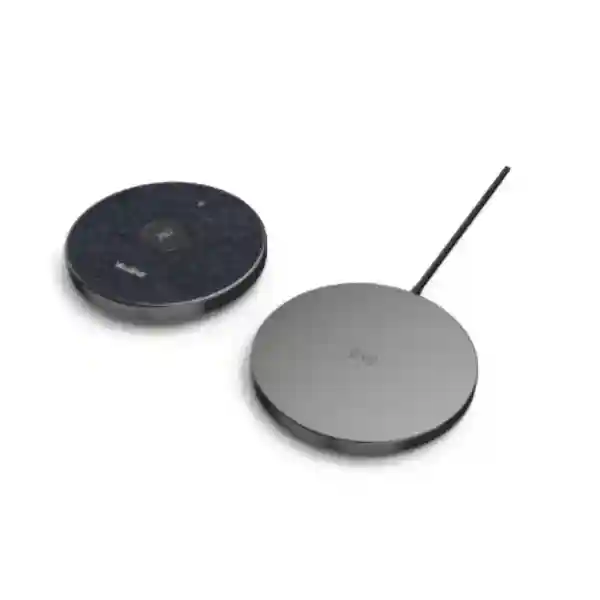
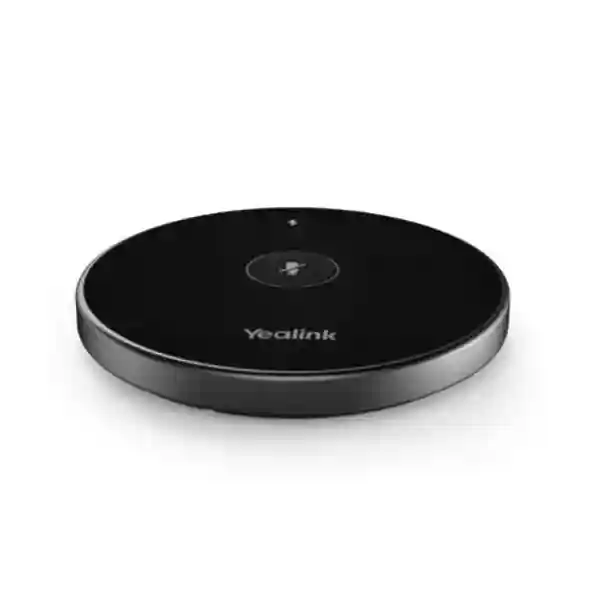
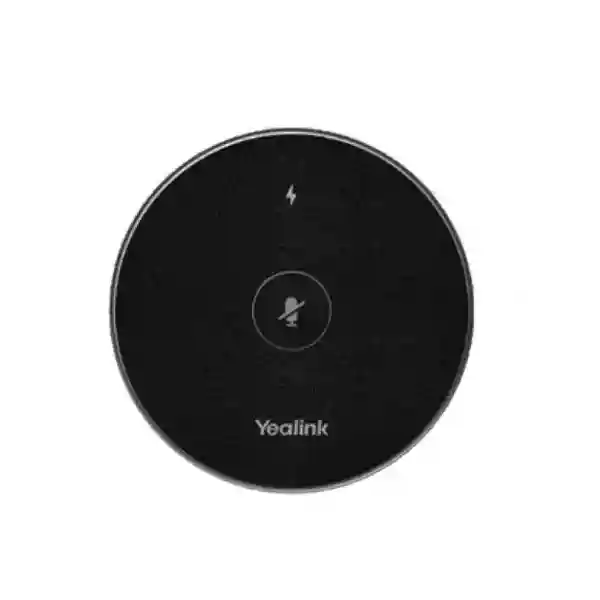
Yealink VCM36-W Wireless Microphone for Professional Video Conferencing
The Yealink VCM36-W is a wireless Wi-Fi conference microphone engineered for organizations that need dependable tabletop voice capture without permanent microphone cabling. It combines a three-microphone array, 360-degree pickup, a maximum pickup radius of 6 metres, full-duplex conversation handling, acoustic echo cancellation and Yealink Noise Proof technology in a compact rechargeable unit. For boardrooms, training rooms, executive meeting spaces and adaptable collaboration rooms, this architecture gives integrators greater freedom to position audio pickup near participants rather than forcing seating around a fixed cable route.
Its operational value is straightforward: meeting participants need to be heard clearly, the room team needs equipment that can be deployed consistently, and procurement teams need a defined accessory that can be checked against the selected Yealink room endpoint before purchase. The VCM36-W addresses those requirements with dual-band 2.4 GHz and 5 GHz Wi-Fi, WPA-PSK/WPA2-PSK wireless security, a capacitive mute touchpad and a rechargeable 2450 mAh battery. Yealink specifies up to 12 hours of conference use and up to seven days of standby time. The included charging cradle gives facilities teams a predictable location for charging between meetings.
For Uganda projects, FourTeck can assist with compatibility validation, microphone quantity planning, room-layout review, bill-of-materials checking and delivery coordination. Because compatible microphone counts and operating behavior can vary by Yealink endpoint and solution generation, the endpoint model and firmware context should be confirmed before a purchase order is finalized. This avoids a common procurement problem: buying a technically capable microphone that is not the correct expansion option for the deployed room system.
Procurement Fact Rail
VCM36-W
Wireless video conferencing microphone
360°, up to 6 m
2.4/5 GHz Wi-Fi
2450 mAh, up to 12 hours use
Quotation and project validation
The VCM36-W belongs in the audio layer of a Yealink meeting-room deployment. It is not a standalone conferencing endpoint, loudspeaker or USB desktop microphone. The purchasing decision therefore starts with the room system it will join. A correct quotation should identify the host Yealink device, desired microphone count, room dimensions, expected seating arrangement and power/charging location. Warranty terms can depend on channel, shipment and project conditions, so the applicable regional warranty baseline should be stated on the commercial quotation rather than assumed from an unrelated market.
Operational Architecture and Meeting-Room Design
The VCM36-W replaces the traditional fixed signal cable between the tabletop microphone and supported Yealink room equipment with a wireless connection. This matters in rooms where furniture moves, cable pathways are limited or a clean executive-table appearance is required. Its three-microphone array listens around the device rather than in a narrow forward direction. The maximum 6-metre pickup specification gives designers useful coverage, but practical room design should still account for participant distance, wall reflectivity, ceiling height, HVAC noise and reverberation. A maximum radius is not the same as a guarantee that every acoustically difficult seat will sound identical.
Audio processing is designed around real conversations. Full-duplex operation allows participants at both ends to speak naturally without the clipped, walkie-talkie effect associated with poor conferencing systems. Acoustic echo cancellation helps prevent far-end audio played in the room from returning as disruptive echo. Noise Proof processing is intended to reduce environmental interference; Yealink states that the VCM36-W can filter environmental noise up to 90 dB. These functions are especially valuable in mixed-use spaces where air-conditioning, corridor noise, keyboard activity or furniture movement can otherwise reduce intelligibility.
The wireless subsystem supports 802.11 b/g/n/ac across 2.4 GHz and 5 GHz bands. For an enterprise rollout, this should be treated as part of the room design rather than an afterthought. Wireless spectrum conditions, endpoint support and local configuration policy influence reliability. WPA-PSK/WPA2-PSK support provides encrypted wireless operation. IT teams should document the pairing process, ownership of room credentials and firmware maintenance procedure so that a microphone replacement or room refresh does not become an undocumented support event.
Power is handled by an internal 2450 mAh battery. Yealink rates the microphone for up to 12 hours of use and up to seven days of standby. That is well suited to normal meeting-room schedules, but organizations with continuous training sessions or long operating days should establish a charging routine. The supplied cradle is therefore operational infrastructure, not merely packaging. Facilities teams should keep the cradle accessible, powered and associated with the correct room so the microphone returns to a known charging point after use.
The VCM36-W can function as an expansion microphone in supported Yealink solutions. Compatibility and maximum supported microphone quantities vary by endpoint, which makes validation essential. A procurement team should never infer compatibility merely because two devices carry the same brand. FourTeck can check the proposed endpoint, software generation and room topology before order placement.
Business Outcomes and Value Analysis
Three microphones, 360° coverage and up to 6 m pickup help place the capture point near the natural center of conversation. The result is a room layout driven by collaboration rather than by a microphone cable.
Full-duplex operation, echo cancellation and noise processing support natural two-way discussion. These capabilities are important for executive reviews, customer meetings and hybrid workshops where interruptions and rapid exchanges are normal.
Supported Yealink systems can use the VCM36-W as an expansion microphone. The exact count depends on the endpoint, allowing room designs to be validated according to platform capability rather than a one-size-fits-all assumption.
Dual-band Wi-Fi and WPA-PSK/WPA2-PSK support provide a defined wireless foundation. Organizations should still apply their room-device governance, firmware and credential policies.
Single pairing, local mute control and a dedicated charging cradle reduce day-to-day handling complexity. Users can reposition the microphone without recabling the table.
Wireless placement can reduce dependence on custom table penetrations and microphone cable routing. A validated bill of materials also reduces the risk of purchasing incompatible accessories or unnecessary adapters.
The strongest financial case is not based on the microphone alone. It comes from reducing installation friction, protecting meeting usability and standardizing rooms around a supportable design. A consistent conference-room pattern lets IT teams document charging, pairing, endpoint configuration and replacement procedures once, then reuse them across suitable spaces. Procurement should compare the VCM36-W not only with another microphone price, but with the total cost of cabling, furniture modifications, deployment labor and operational support over the room lifecycle.
Key Hardware and Software Highlights
| Component | Confirmed Capability | Operational Outcome |
|---|---|---|
| Microphone array | Built-in 3-microphone array | Omnidirectional room pickup |
| Audio processing | Full duplex, echo cancellation, Noise Proof | Clearer natural conversation |
| Wireless | 802.11 b/g/n/ac, 2.4/5 GHz | Flexible tabletop placement |
| Security | WPA-PSK/WPA2-PSK | Encrypted wireless connectivity |
| Battery | 2450 mAh | Up to 12 hours conference use |
| User control | Capacitive mute touchpad | Immediate local privacy control |
The architecture deliberately concentrates on meeting-room audio rather than adding unrelated interfaces. This is useful for standardization: the microphone has a clear purpose and can be documented as a specific room-system accessory. The 100 Hz to 8 kHz frequency response is oriented toward intelligible conferencing speech. Procurement teams should view these specifications alongside room acoustics and endpoint compatibility because microphone performance depends on the complete collaboration environment.
Technical Specifications Ledger
| Specification | Yealink VCM36-W |
|---|---|
| Product class | Wireless video conferencing microphone |
| Microphone array | 3 microphones |
| Pickup coverage | 360°; up to 6 m / 20 ft |
| Frequency response | 100 Hz–8 kHz |
| Audio functions | Optimal HD Audio, Full Duplex, Acoustic Echo Canceling, Noise Proof |
| Mute | Capacitive touchpad |
| Wi-Fi standards | 802.11 b/g/n/ac |
| Wireless bands | 2.4 GHz / 5 GHz |
| Wi-Fi security | WPA-PSK / WPA2-PSK |
| Battery | Built-in 2450 mAh |
| Use time | Up to 12 hours |
| Standby | Up to 7 days |
| Microphone dimensions | 100 × 16.5 mm |
| Charging cradle dimensions | 100 × 10.5 mm |
| Operating humidity | 10%–90% |
| Storage temperature | 0°C–40°C |
| Box contents | VCM36-W, charging cradle, 1.2 m USB-C cable, USB adapter where applicable, double-sided adhesive, quick-start guide |
Specifications should be read as manufacturer-defined capabilities rather than a substitute for room validation. For example, the maximum pickup distance is a useful design boundary, but reverberant rooms or participants speaking softly from behind obstacles may require a different microphone layout. Similarly, battery endurance is an upper specification and can vary with operating conditions and lifecycle. A professional quotation should therefore connect the specification ledger to the actual room rather than treating each number independently.
Configuration and Sizing Worksheet
1. Establish room workload and scale
Record room length, width, table shape, normal participant count, maximum participant count and the positions where remote participants most often struggle to hear local speakers. Note whether the room hosts short executive calls, all-day training sessions or rotating workshops. This information determines whether one microphone is sufficient and whether a supported multi-microphone design should be considered.
2. Review the acoustic environment
Identify hard glass walls, exposed ceilings, air-conditioning outlets, projectors, corridor doors and other noise sources. Wireless freedom lets the VCM36-W move closer to participants, but placement should still avoid obvious noise sources. A central tabletop location is often useful, provided it remains within the supported room topology.
3. Validate charging and power
Choose a permanent location for the charging cradle. The microphone should have a repeatable end-of-day home so it is not left uncharged after a long session. Confirm access to power for the supplied charging arrangement and keep the USB-C cable associated with the room. For high-utilization rooms, include charging checks in facilities procedures.
4. Confirm host compatibility
Provide the exact Yealink endpoint model, room-system generation and current software information. The VCM36-W can operate as an expansion microphone in supported systems, but maximum quantities and behavior differ across endpoints. Compatibility should be confirmed from the current Yealink matrix before ordering.
5. Prepare the quotation request
Include product quantity, endpoint model, site location, room dimensions, expected delivery date, required accessories, warranty expectations and whether staging or pre-shipment checks are required. If the project covers multiple branches, list room types separately. This allows repeated room designs to be grouped while unusual spaces receive individual validation.
Deployment Scenarios and Industry Use Cases
Large Enterprise and Multi-Site Networks
Enterprises often need the same collaboration experience in headquarters, branch offices and project rooms. The VCM36-W can support a standardized room pattern where wireless tabletop pickup is preferred. A central IT team can define approved endpoint combinations, charging procedures and room-layout guidance, while local facilities teams handle daily operation. The major advantage is repeatability: once a room archetype has been validated, procurement can reuse the bill of materials for comparable rooms rather than redesigning audio for every branch.
Financial and Banking Institutions
Banks and financial organizations frequently use meeting rooms for management reviews, customer discussions, audit meetings and distributed operations. Clear speech is essential because misunderstood figures or instructions can slow decision-making. WPA-PSK/WPA2-PSK wireless support provides an encrypted transport foundation, while the organization remains responsible for its broader room security and device-management policy. Procurement should document endpoint compatibility and firmware ownership as part of the approved collaboration standard.
Educational and Campus Networks
Universities, colleges and training organizations benefit from movable room layouts. Tables may be rearranged between lectures, hybrid seminars and group workshops. A wireless microphone can follow the active seating plan without requiring floor or table recabling. The 360-degree pickup pattern is useful around shared tables, while the charging cradle gives AV support teams a simple recovery point between sessions.
Government and Public-Sector Procurement
Public-sector projects commonly require clear bills of materials, documented specifications and predictable support channels. The VCM36-W can be quoted as a defined Yealink accessory with its model, wireless standards, security support, battery specification and physical dimensions stated explicitly. For sensitive environments, the buyer should separately review organizational wireless policy and endpoint approval requirements before deployment. FourTeck can support pre-order validation and documentation preparation without replacing the customer’s internal security authorization process.
Technical Deep Dive: Audio Processing and Pickup Architecture
The VCM36-W’s three-microphone array is designed to collect speech around the tabletop in 360 degrees. Rather than requiring a presenter to face a directional microphone, participants can speak naturally from different seats. The specified maximum pickup radius is 6 metres, giving the unit reach for medium and larger meeting spaces when room acoustics are suitable. Full-duplex technology is equally important: modern meetings involve interruption, agreement and overlapping discussion. Full duplex supports simultaneous speech paths so the room does not feel artificially gated.
Echo cancellation addresses another core conferencing problem. Loudspeaker audio from the remote side can be captured by a local microphone and sent back, producing distracting echo. The VCM36-W’s acoustic echo cancellation is designed to reduce that feedback path. Noise Proof processing addresses environmental sound. Yealink describes filtering of environmental noise up to 90 dB, but room owners should still control major noise sources wherever practical. Signal processing works best as part of good room design, not as a substitute for it.
Technical Deep Dive: Wireless Control and Operational Security
Wireless operation uses 802.11 b/g/n/ac across 2.4 GHz and 5 GHz. Dual-band capability gives deployment teams flexibility in environments where one band is crowded or subject to local planning constraints. WPA-PSK and WPA2-PSK support provide encryption options for the wireless link. The relevant Yealink endpoint still needs to support the microphone, so compatibility validation remains the first technical gate.
Operational security also includes process. IT teams should know who can pair room accessories, who owns firmware maintenance, how replacement units are introduced and how a room is returned to service after hardware changes. These procedures matter because conference rooms are shared infrastructure. A technically secure device can still become difficult to support when configuration ownership is unclear. FourTeck can help document the intended hardware pairing and bill of materials at supply time.
Technical Deep Dive: Availability, Charging and Service Continuity
The VCM36-W does not use redundant power supplies because it is a compact rechargeable conference accessory. Service continuity therefore comes from battery discipline, spare planning where business impact justifies it and a clear charging routine. The built-in 2450 mAh battery is rated for up to 12 hours of conference use, covering a normal working day in many organizations. Up to seven days of standby helps rooms remain ready between less frequent meetings.
For high-dependency boardrooms, procurement may consider holding a validated spare microphone or ensuring another compatible room is available as a fallback. The charging cradle should remain in a fixed, labeled location. Replacement planning should include the exact model because visually similar conference microphones may have different endpoint compatibility. Continuity is therefore achieved through standardization, documentation and controlled spares rather than through datacenter-style component redundancy.
Pre-Purchase Buyer Gap Checklist
Is a subscription required for the microphone itself? The published VCM36-W hardware specification does not identify a separate microphone subscription. However, the complete room platform, conferencing service or endpoint may have its own licensing requirements. Buyers should separate accessory hardware requirements from platform licensing.
Will it work with every Yealink video device? Compatibility should not be assumed. Yealink publishes accessory compatibility information, and supported microphone counts vary by endpoint. Supply should be based on the exact room device and current compatibility documentation.
Does 6 metres mean every room is covered by one microphone? No. Six metres is the stated maximum pickup radius. Room acoustics, seating geometry and noise conditions influence practical results. Large or difficult spaces may require another supported topology.
Are there hidden cabling requirements? The microphone communicates wirelessly, which removes the normal signal cable across the table. Charging infrastructure still matters. The package includes a charging cradle and USB-C cable, and the cradle needs an appropriate power arrangement.
What about crowded wireless environments? The VCM36-W supports both 2.4 GHz and 5 GHz bands. IT teams should still consider local spectrum conditions and the behavior of the paired Yealink system. Wireless freedom is most reliable when treated as part of the room’s technical design.
Can it be permanently moved between rooms? The physical design makes relocation easy, but operational ownership should be controlled. A microphone paired and documented for one room should not casually migrate to another if that creates pairing, charging or inventory confusion.
How should lifecycle planning be handled? Record model numbers, purchase dates, room assignments and compatible endpoints. Before expanding an older deployment, confirm that the current accessory matrix and firmware guidance still support the intended combination.
Uganda Procurement, Delivery and Project Logistics
FourTeck Uganda can structure VCM36-W supply around a single-room requirement or a multi-site collaboration rollout. A useful quotation request includes quantity, Yealink host endpoint, site location, desired delivery date and room information. Where the microphone forms part of a wider conferencing project, the quotation can be aligned with cameras, meeting bars, touch consoles, displays, mounting accessories and required cabling so procurement receives a coherent bill of materials rather than disconnected line items.
Order processing should begin only after the commercial scope and technical compatibility are clear. For project orders, lead time depends on stock position, quantity, import cycle and delivery destination. Buyers should request the current lead time on the quotation instead of relying on a generic delivery promise. FourTeck can also support pre-shipment model verification and, where agreed for the wider solution, staging or firmware checks before dispatch.
Delivery planning within Uganda should identify the receiving contact, site access requirements and whether equipment is being delivered to a central store or directly to deployment locations. For larger projects, staged deliveries may help align equipment arrival with installation schedules. Serial-number and asset-record requirements should be stated early where they form part of the customer’s receiving process.
Uganda Coverage Matrix
Organizations in Kampala can request VCM36-W quotations for headquarters boardrooms, corporate offices, hospitality facilities, financial institutions and collaboration-room upgrades. Entebbe projects may include corporate, aviation-adjacent, hospitality and institutional environments where clean wireless meeting-room installations are desirable. Jinja deployments can support industrial, education and branch-office collaboration requirements. Mbarara customers can source equipment for regional offices, institutions and distributed enterprise teams, while Gulu projects can be planned for northern-region operations, education and public-sector facilities. Delivery timing and project logistics vary by order size and destination, so the commercial quotation should define the applicable dispatch arrangement. For multi-city rollouts, standardizing room types and approved bills of materials can make procurement, installation and support substantially easier.
Cross-Border and Regional Supply
Regional organizations often need the same meeting-room standard across several countries. FourTeck’s regional web presence can support coordinated sourcing discussions for Uganda, Kenya, broader African markets, the UAE and Kuwait. Cross-border projects should define destination country, quantities, required delivery dates and whether each site uses the same Yealink endpoint generation. Import procedures, taxes, local delivery and warranty handling can differ by destination, so those commercial details should be confirmed per quotation. The technical advantage of a regional standard is consistency: the same validated room archetype can be documented across branches while allowing local logistics to be handled appropriately.
Related Yealink Collaboration Options
A VCM36-W purchase is commonly part of a broader room design. Buyers planning a complete deployment can review Yealink solutions in Uganda and discuss compatible meeting-room endpoints, cameras, touch consoles, audio accessories and room bundles with FourTeck. Where a wired microphone is more appropriate, ask about Yealink’s current wired conference microphone options. For rooms where ceiling pickup is preferred, request validation of current Yealink ceiling microphone choices. Large spaces may also require dedicated loudspeaker planning rather than relying on the audio architecture of a smaller room system.
The correct related product is determined by the host endpoint and room requirement, not by accessory appearance. Before adding microphones, speakers or cameras, identify the room system first and validate the supported topology. This keeps the final design within the manufacturer’s documented limits and gives procurement a cleaner bill of materials.
FourTeck Technical Service Capabilities
FourTeck can support procurement teams with engineering validation before supply. For the VCM36-W, this means checking the proposed host endpoint, intended microphone count, room dimensions and required accessories. Bill-of-materials verification is particularly valuable when a project includes multiple Yealink components because it reduces the chance that an apparently minor accessory mismatch delays commissioning.
For wider room-system projects, staging can include model verification, agreed firmware preparation and component checks before shipment where included in the project scope. Pre-shipment work should be documented against the customer’s approved bill of materials so receiving teams know what was supplied. Post-sales technical support can then reference the same room design, model numbers and configuration assumptions rather than restarting diagnosis from incomplete information.
Organizations planning many rooms should consider defining standard room archetypes—such as small, medium, boardroom and training room—and assigning approved Yealink components to each. This improves procurement consistency, simplifies spares planning and gives support teams a predictable environment.
Technical FAQ
What is the voice pickup range of the Yealink VCM36-W?
Yealink specifies 360-degree voice pickup with a maximum radius of 6 metres, or about 20 feet. This gives the microphone broad coverage around a conference table and allows participants to speak from different directions. The maximum figure should be treated as a technical boundary rather than a universal room-size guarantee. Reverberation, background noise, speaker volume, table geometry and microphone position all influence practical results. For an important boardroom or unusually shaped space, provide the room dimensions and seating layout during quotation so the proposed microphone quantity and placement can be reviewed before purchase.
Does the VCM36-W require a cable to the conference-room endpoint?
The VCM36-W is designed as a wireless Wi-Fi microphone, so it does not need the conventional microphone signal cable running across the table to the supported Yealink endpoint. That is one of its main deployment advantages in rooms with movable furniture or premium tables. It still requires charging. Yealink supplies a charging cradle and USB-C cable in the package, so facilities teams should provide a reliable charging location. Wireless operation also means the host endpoint and compatibility must be validated before procurement; the absence of a signal cable does not make the microphone universally compatible.
How long does the VCM36-W battery last?
The built-in battery is rated at 2450 mAh, with Yealink specifying up to 12 hours of use time and up to seven days of standby. This is suitable for many normal meeting-room schedules and can cover a full business day of conferences under appropriate conditions. Actual endurance can vary with operating conditions and battery age, so high-utilization rooms should adopt a simple charging routine. The supplied cradle should have a permanent location, and users should return the microphone after meetings. Organizations with mission-critical rooms can also discuss spare planning as part of the wider support strategy.
What wireless standards and security does the VCM36-W support?
The microphone supports 802.11 b/g/n/ac and operates across both 2.4 GHz and 5 GHz bands. Yealink lists WPA-PSK and WPA2-PSK as supported wireless security methods, and product materials also reference WPA2/AES128 encryption. Dual-band operation is useful where one band is crowded or where local wireless planning favors a particular band. Security should still be considered at system level: pairing control, endpoint administration, firmware maintenance and room access are all part of a professional deployment. Customers with formal security policies should have their IT team review the proposed room architecture before installation.
Can the VCM36-W be used with any Yealink MeetingBar or room system?
Compatibility varies by Yealink endpoint and solution generation, so it should be checked rather than assumed. Yealink maintains compatibility information for room accessories, and the maximum number of VCM36-W units supported can differ by endpoint. Some systems can use the microphone as an expansion microphone, and behavior with a built-in microphone can depend on the host device and configuration. When requesting a FourTeck quotation, provide the exact endpoint model and, for an existing deployment, current software details if available. This allows the proposed combination to be validated before the purchase order is placed.
Does the VCM36-W include echo cancellation and noise reduction?
Yes. Yealink lists Acoustic Echo Canceling and Noise Proof technology among the VCM36-W’s audio features, together with Full Duplex technology and Optimal HD Audio. The manufacturer states that the microphone can filter environmental noise up to 90 dB. These functions are designed to improve meeting intelligibility, particularly when remote audio is playing through room speakers or when the room contains common background noise. They do not eliminate the need for reasonable acoustics. Rooms with severe reverberation, loud machinery or persistent external noise should be assessed as complete acoustic environments rather than relying on microphone processing alone.
Is a separate software licence required for the VCM36-W?
The published VCM36-W hardware specification does not identify a separate licence or subscription for the microphone itself. However, a complete conferencing room may depend on a meeting platform, room account, endpoint licence or service subscription that is separate from this accessory. Procurement teams should therefore ask for licensing to be itemized at solution level. If the microphone is being added to an existing room, the main technical question is normally hardware and software compatibility with the current Yealink endpoint rather than a standalone microphone licence. FourTeck can help distinguish accessory requirements from wider platform requirements during quotation.
What comes in the VCM36-W package?
Yealink’s current datasheet lists one VCM36-W video conference microphone, one charger cradle, one 1.2-metre USB-C cable, a USB adapter where applicable, double-sided adhesive and a quick-start guide. Package contents can be subject to regional or production changes, so the final commercial quotation and received package should be checked against the applicable supply. The charging cradle is operationally important because it provides a defined location for recharging the microphone. For multi-room projects, labeling chargers and microphones by room can help prevent accessories from migrating between spaces and creating avoidable support issues.
How is warranty or replacement handled in Uganda?
Warranty handling should follow the terms stated on the FourTeck quotation or invoice for the supplied unit. If a fault occurs, keep the purchase documentation, product identification and a clear description of the symptom. Troubleshooting may first distinguish a microphone fault from pairing, endpoint, firmware, charging or room-configuration issues. Where replacement is required under applicable warranty terms, the support process can then reference the original supply record. Customers purchasing for multiple branches should keep an asset register that maps each VCM36-W to its room and host endpoint, which makes diagnosis and replacement administration significantly easier.
Can FourTeck help configure and deploy the microphone?
FourTeck can assist with pre-sales compatibility checks, bill-of-materials validation and project planning, and broader deployment support can be scoped according to the complete Yealink room solution. For a VCM36-W addition, useful information includes the host endpoint, room dimensions, seating plan, microphone quantity and deployment location. For new room builds, the microphone should be considered together with camera placement, loudspeaker coverage, display position, network readiness and touch-console requirements. Defining those elements before equipment arrives reduces commissioning delays and gives the customer a documented configuration that can be repeated across similar rooms.
Request a Yealink VCM36-W Uganda Quotation
Send FourTeck your required quantity, Yealink room endpoint model, room dimensions, delivery location and target deployment date. The team can use those details to check the intended microphone topology, prepare the commercial scope and identify any related accessories needed for a complete room deployment. For multi-site projects, include a room schedule so repeatable configurations can be grouped and exceptional spaces can be reviewed separately. This approach gives procurement a clearer bill of materials and helps technical teams avoid compatibility surprises during installation.

Reviews
There are no reviews yet.