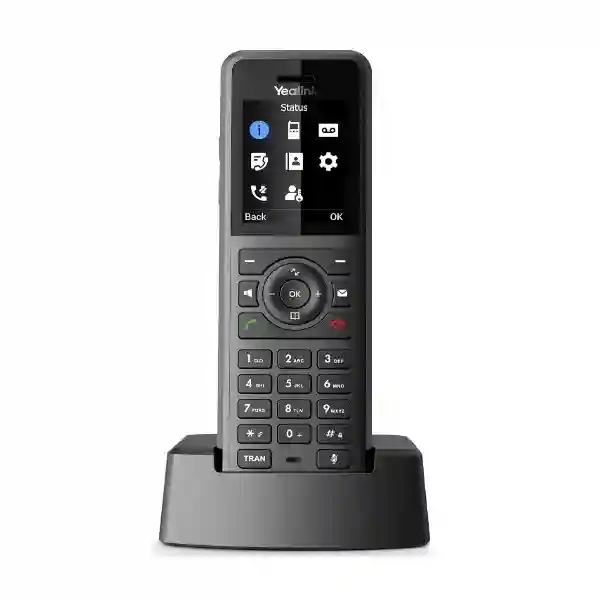
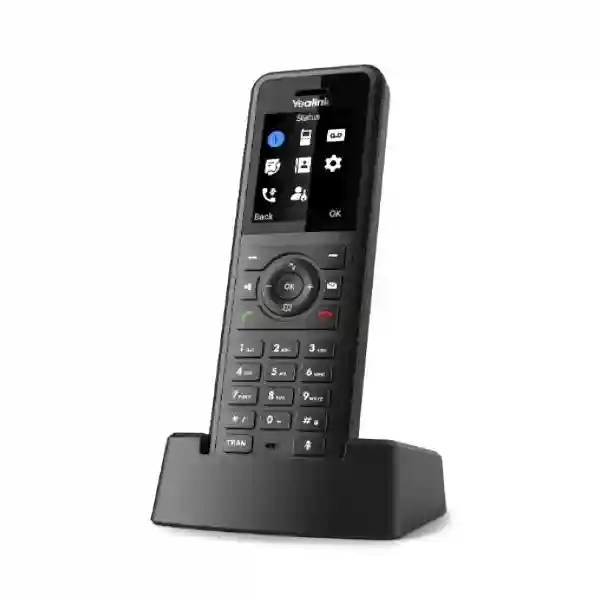
Yealink W57R Rugged DECT Handset for Mobile Business Communications
The Yealink W57R is a professional ruggedized DECT handset built for organizations that need reliable voice mobility beyond a conventional desk-phone environment. It is intended for staff who move continuously through warehouses, service corridors, production support areas, campuses, workshops, retail back rooms, logistics facilities and large offices while remaining reachable on the business telephone system. Rather than placing network connectivity directly inside the handset, the W57R operates as part of a compatible Yealink DECT architecture. It can register with the W70B single-cell base for smaller deployments and with compatible W80 or W90 multi-cell infrastructure where broader coverage, roaming and handover are required.
The defining procurement advantage is physical resilience. Yealink specifies IP54 protection, resistance to drops of up to 3.5 metres, a scratch-resistant and disinfectant-resistant exterior, vibration alert and a durable rubberized surface. These characteristics address a common operational problem: a mobile extension is useful only when the handset can tolerate the conditions in which mobile employees actually work. The W57R combines that durability with a 1.8-inch 128 × 160 TFT colour display, keypad backlight, HD voice and Flexible Noise Reduction. It therefore targets practical voice communication rather than consumer-style application use.
For Uganda procurement teams, the important design question is not simply how many handsets are required. A complete deployment should account for building dimensions, wall materials, indoor and outdoor movement, expected simultaneous calls, base placement, network switching, power for DECT infrastructure, firmware compatibility and charging locations. FourTeck can help translate those variables into a bill of materials suitable for a single site or a phased multi-site rollout.
Instant Specifications & Procurement Fact Rail
Yealink W57R rugged DECT handset
IP54; specified to withstand drops up to 3.5 m
1.8-inch 128 × 160 TFT colour screen
W70B single-cell; compatible W80/W90 multi-cell systems
HD voice and Flexible Noise Reduction
Contact FourTeck for current Uganda supply, lead time and warranty terms
The W57R should be treated as a handset component within a DECT solution, not as a standalone IP desk phone. The base or multi-cell infrastructure connects the DECT environment to the IP network. This distinction matters when preparing a quotation because a customer starting from zero may need base stations, manager components for certain multi-cell architectures, network switching, PoE capacity, handset chargers and implementation services in addition to the handsets themselves. Existing Yealink DECT customers should provide their current base model and firmware level so compatibility can be validated before ordering. Regional warranty duration and replacement procedure should be confirmed on the formal quotation because terms can depend on supply channel and project conditions.
Operational Product Architecture & Overview
The W57R separates user mobility from wired network access. Staff carry the handset while compatible Yealink DECT radio infrastructure provides the wireless voice layer. In a smaller office, shop floor or compact warehouse, a W70B can provide a straightforward single-cell architecture. In larger environments, compatible W80 or W90 multi-cell systems can extend the design across multiple radio cells so users can move between coverage zones while maintaining service. Yealink specifies ideal DECT radio coverage of up to 50 metres indoors and 300 metres outdoors for its compatible infrastructure, but those values are planning references rather than guaranteed site dimensions. Reinforced concrete, metal racking, machinery, lift shafts, fire doors, reflective surfaces and neighboring radio systems can alter real-world coverage significantly.
This architecture addresses a recurring business problem: employees who are rarely seated still need an extension that behaves as part of the organization’s managed voice environment. Warehouse supervisors may cross aisles and loading areas; maintenance teams may move between plant rooms; security staff may patrol buildings; hospitality operations may need mobile coordination; and campus support personnel may cover several zones. A rugged DECT handset allows these roles to remain reachable without relying on a desk endpoint at every work position.

Physical durability is integrated into the operating concept. IP54 indicates protection against limited dust ingress and splashing water; it does not mean the handset should be submerged. Yealink also states that the handset can withstand falls of up to 3.5 metres. The rubberized exterior helps resist slipping and everyday scratches, while the disinfectant-resistant surface is useful where shared devices are cleaned routinely. Procurement teams should still define an operational care policy because ruggedization reduces risk but does not eliminate damage from crushing, chemical exposure outside approved cleaning methods, deliberate misuse or unsuitable charging environments.
Voice usability is equally important in active workplaces. The handset supports HD audio and Flexible Noise Reduction, helping improve intelligibility where background sound would otherwise compete with speech. Vibration alert adds another notification path in noisy locations. The keypad is backlit and lockable, supporting use in changing light conditions and helping prevent unintended key presses while carried. A belt clip supports hands-free carrying between calls.
Battery specifications require careful interpretation because W57R hardware revisions differ. Yealink’s current product information distinguishes earlier V0–V3 units, specified for up to 40 hours of talk time and 575 hours standby under ideal conditions, from V4, specified for up to 28 hours of talk time and 320 hours standby. Actual endurance depends on calling patterns, signal conditions, battery age, charging behavior and environmental conditions. For shift-based operations, buyers should size charging points and spare-device procedures around the revision supplied and their real duty cycle rather than relying solely on maximum laboratory figures.
Enterprise Business Outcomes & Value Analysis
Key Hardware & Software Highlights
| Feature | Technical Role | Operational Outcome |
|---|---|---|
| IP54 enclosure | Protection against limited dust ingress and splashing water | Better fit for warehouses, service areas and active workplaces |
| 3.5 m drop resistance | Rugged mechanical design | Reduced exposure to routine drop damage |
| 1.8-inch TFT display | 128 × 160 colour interface | Clear call and menu interaction |
| HD voice + FNR | Voice processing for intelligibility | Improved conversations in active environments |
| Vibration alert | Tactile call notification | Helps staff notice calls in noisy locations |
| OTA firmware support | Managed handset software maintenance | Supports controlled fleet lifecycle administration |
Technical Specifications Ledger
| Item | Specification / Procurement Note |
|---|---|
| Product type | Ruggedized professional DECT handset |
| Protection | IP54; dust and splash resistance within the limits of the rating |
| Drop specification | Up to 3.5 metres as specified by Yealink |
| Display | 1.8-inch 128 × 160-pixel TFT colour display |
| Audio | HD voice, Flexible Noise Reduction and full-duplex capabilities in the Yealink design |
| Alerts | Audible ringing plus vibration alarm |
| Battery | 1460 mAh lithium-ion specified for established W57R documentation; supplied revision should be confirmed on quote |
| Battery endurance | V0–V3: up to 40 h talk / 575 h standby; V4: up to 28 h talk / 320 h standby, ideal conditions |
| Quick charge | Yealink documentation for earlier versions specifies 10 minutes charging for up to 2 hours talk time |
| Handset size | Approximately 157 × 51 × 24 mm |
| Single-cell compatibility | Yealink W70B; current support documentation also lists compatible Yealink DECT bases subject to firmware |
| Multi-cell compatibility | Yealink W80/W90 families subject to system design and firmware compatibility |
| Radio planning reference | Compatible Yealink DECT infrastructure is commonly specified up to 50 m indoors / 300 m outdoors under ideal conditions; survey actual sites |
| Surface | Scratch resistant and disinfectant resistant; Yealink states resistance to UV-C fading |
| User controls | Backlit keypad, keypad lock, navigation and telephony function keys |
| Firmware | OTA upgrade support; validate base and handset firmware before fleet rollout |
Specifications should be interpreted at system level. Ethernet and PoE interfaces belong to compatible DECT base infrastructure rather than to the W57R handset itself. Likewise, SIP account capacity, simultaneous system calls and PBX interoperability depend on the selected base or multi-cell architecture. This prevents a common procurement mistake: copying base-station specifications into the handset line item and assuming the handset itself provides those network interfaces.
Configuration & Sizing Worksheet
1. Estimate users and simultaneous calling
Start with the number of people who need a handset, then identify whether devices are individually assigned or shared by shifts. Record peak concurrent calls rather than only total extensions. A warehouse with 40 handset users may have a very different radio and call-capacity requirement from an office with the same user count. Include growth for new shifts, departments or buildings.
2. Map coverage zones
Mark every location where calls must remain usable: offices, aisles, loading bays, stairwells, workshops, outdoor yards and connecting corridors. Note concrete walls, metal racks and other obstructions. Published radio distances are ideal-condition references. For larger or difficult sites, a survey and staged placement test are preferable to designing solely from floor-plan scale.
3. Select the DECT architecture
Use a compatible single-cell base where one radio cell can meet the operational requirement. Choose an appropriately designed multi-cell system when users need continuous mobility across a larger footprint. Multi-cell design involves radio overlap, synchronization, network connectivity and capacity planning; adding bases without a coverage plan can create avoidable dead zones or inefficient overlap.
4. Validate power, LAN and cabling
The handset charges locally, while base infrastructure requires network connectivity and appropriate power. Confirm switch-port availability, PoE budget where applicable, VLAN design, DHCP or addressing policy, voice routing and firewall requirements. For critical sites, review switch and power resilience so a building power event does not defeat the mobility system.
5. Review licensing and call platform requirements
The W57R itself should not be treated as a substitute for PBX licensing. Extension licenses, hosted service subscriptions, SIP trunks or call-platform entitlements depend on the customer’s telephony environment. Ask the PBX administrator or service provider to confirm what is required for each registered user or line. This avoids discovering after delivery that endpoints are available but extension capacity is not.
6. Prepare the quotation brief
Provide FourTeck with the site address, floor count, approximate dimensions, handset quantity, expected simultaneous calls, existing Yealink DECT equipment, PBX or hosted platform, LAN/PoE details, coverage expectations, desired spares, target delivery date and whether configuration assistance is required. A complete brief improves bill-of-materials accuracy and reduces revision cycles.
Deployment Scenarios & Industry Use Cases
Large Enterprise and Multi-Site Networks
A large organization may standardize the W57R for mobile operational roles while retaining desk phones for fixed staff. Each site should be engineered independently because building geometry and user density differ. Multi-cell infrastructure can be used where continuous movement across floors or operational zones is required. Central procurement can standardize handset models, spare ratios, charger placement, firmware policy and labeling while local implementation teams validate radio coverage. For multi-site rollouts, a pilot site is valuable because it establishes configuration templates and user procedures before wider deployment.
Financial and Banking Institutions
Banks may use rugged mobile handsets for facilities, security coordination, cash-handling support areas, archives or operations teams rather than customer-facing desk roles. Network segmentation, call permissions and device administration should follow the institution’s security policy. The DECT system should be integrated with approved voice infrastructure, and any recording or compliance requirement must be validated against the PBX and recording platform rather than assumed from the handset.
Educational and Campus Networks
Universities, schools and training campuses can use mobile DECT for maintenance, estates, security, laboratories, stores and event support. Campus environments often combine open outdoor paths with concrete buildings, making coverage planning especially important. A multi-cell design can provide controlled voice mobility across defined zones, while the W57R’s rugged enclosure is useful for teams that carry devices throughout the day.
Government and Public-Sector Procurement
Government buyers typically require clear model identification, compliant quotations, warranty information, delivery terms and documented bill of materials. The W57R can be specified where rugged mobile voice is appropriate, but solution scope should state every dependency: handset, charger, compatible base infrastructure, switching, call platform and implementation services. For sensitive environments, the customer should apply its own communications security requirements and approval process to the complete system.
Technical Deep Dive 1: Radio, Audio & Handset Architecture
The W57R’s design is intentionally focused. It is not a miniature Wi-Fi desk phone and does not need to duplicate the IP-network functions of its base station. DECT separates the local cordless radio link from the IP-side voice connection handled by compatible infrastructure. This can provide predictable voice mobility when the radio plan is engineered for the site. The handset’s role is to maintain its DECT relationship, present calls and directories to the user, process voice and alerts, and provide durable portable operation.
Audio quality combines Yealink’s HD voice implementation with Flexible Noise Reduction. In practice, the benefit is most relevant where background sound is persistent but workers still need concise operational conversations. No noise-processing system can remove every competing sound, so buyers should test the handset in unusually loud environments before a large rollout. The vibration alert is a complementary feature: when ringing is difficult to hear, tactile notification can improve awareness without requiring the ringtone to be set excessively loud.
Radio coverage is a system property. The commonly stated ideal figures of up to 50 metres indoors and 300 metres outdoors should be used as initial planning references, not as contractual coverage promises. Metal shelving can produce reflections and shadowing; reinforced concrete can sharply reduce signal penetration; and multiple floors can require carefully located cells. A proper design seeks usable overlap for handover while avoiding assumptions that a single base can cover every corner of a nominal radius.
Technical Deep Dive 2: Firmware, Security & Operational Control
Handset fleets require lifecycle management. Yealink supports over-the-air firmware workflows for the W57R, reducing the need to connect each handset individually for routine software maintenance. The surrounding Yealink DECT infrastructure provides the network-facing security and provisioning controls, while the PBX or hosted platform governs extension credentials, routing and telephony policy. Procurement documents should therefore separate handset capabilities from system capabilities and identify who owns each administrative layer.
Before deployment, establish a tested firmware combination for base stations, managers where applicable, and handsets. Upgrade a small test group first, verify registration, roaming, handover, directory behavior, audio and call features, then schedule the broader fleet. Configuration backups for network-side components and a record of handset assignments make recovery easier. Where the organization has formal change control, DECT firmware should be included in the same maintenance discipline as switches, gateways and PBX systems.
Security also depends on the broader environment. Use approved management access methods, restrict administrative credentials, segment voice infrastructure where required, and keep associated systems supported. The handset is one endpoint in a chain that can include switching, DHCP/DNS, call servers, SIP trunks and remote provisioning. A secure handset cannot compensate for weak credentials or unmanaged infrastructure elsewhere in that chain.
Technical Deep Dive 3: Availability, Redundancy & Recovery
Availability planning begins by identifying what failure actually matters to the business. A damaged handset can be addressed with a spare pool. A failed charger may require replacement hardware. A base-station or network outage affects a wider group and should be considered in the infrastructure design. Multi-cell systems offer architectural capabilities beyond a simple single-cell deployment, but resilience still depends on network switching, power, system topology and configuration.
Critical operations should maintain documented spares and a replacement workflow. Label handsets and chargers, keep a small quantity of charged spare units where justified, and document registration procedures. For network components, retain configuration backups and record firmware versions. If the site uses UPS-backed switches, confirm that DECT base infrastructure is connected to the protected power path. Otherwise, a mains failure can leave fully charged handsets unable to place calls because the radio and IP infrastructure is offline.
Disaster recovery should also consider the call platform. If the PBX or SIP service becomes unavailable, the handset cannot independently restore external calling. Organizations with strict continuity requirements should evaluate PBX redundancy, WAN resilience and alternate communication procedures alongside the DECT design. The W57R improves endpoint durability; continuity is achieved only when the entire communications chain is engineered appropriately.
Pre-Purchase Buyer Gap Checklist
Is a base station included? Treat the W57R as a handset unless the quotation explicitly states a bundle. A new deployment normally requires compatible Yealink DECT infrastructure. Will it work with any third-party DECT base? Yealink documentation states that its DECT technology is not compatible with third-party DECT devices, so do not assume generic DECT interoperability. Does it connect directly to Ethernet? No network cable connects to the handset; Ethernet belongs to the compatible base infrastructure.
Are there hidden licenses? Handset procurement and call-platform licensing are separate questions. Your PBX, hosted telephony service or SIP environment may require extension or subscription capacity. Confirm this before purchase. Which battery figure applies? Hardware revision matters. Earlier V0–V3 documentation specifies up to 40 hours talk and 575 hours standby; V4 lists up to 28 hours and 320 hours under ideal conditions. Ask which revision is being quoted if endurance is operationally critical.
Is IP54 waterproof? No. IP54 provides a defined level of dust and splash protection, not immersion protection. If the use case involves heavy water exposure, chemicals or wash-down procedures, validate whether a different protection class is needed. Does rugged mean unbreakable? No. The specified drop resistance and durable exterior reduce risk within intended use, but crushing, severe impacts and unsuitable chemicals can still damage equipment.
Can published range replace a site survey? Not for complex sites. Radio figures are measured under ideal conditions. Warehouse racking, machinery and reinforced structures can materially change coverage. Will roaming work automatically? Seamless mobility depends on compatible multi-cell infrastructure being correctly designed, installed, synchronized and configured. A collection of unrelated single-cell bases does not create the same result.
What should be included in the order? Confirm handset quantity, chargers, belt clips where required, compatible bases/managers, network power requirements, PBX capacity, implementation, spares and warranty terms. What about lifecycle? Confirm current supply revision, firmware support and replacement strategy on the quotation. Standardizing firmware and retaining spare units can reduce operational disruption later.
Uganda Procurement & Delivery Logistics
FourTeck can prepare a Uganda quotation based on the required W57R quantity and the surrounding DECT architecture. For an accurate commercial response, provide whether the project is an expansion of an existing Yealink system or a new installation. Existing customers should identify their base-station models and current topology. New customers should provide user count, site dimensions, floor count and mobility zones so the quotation can distinguish handset supply from infrastructure requirements.
Order processing should confirm exact model description, quantity, accessories, delivery destination, warranty basis and any requested configuration service. Availability and delivery timing can vary with project quantity and supply conditions, so lead time should be taken from the current formal quotation rather than assumed from generic stock language. Where pre-configuration is included, provide extension information and approved settings through the agreed project process.
For larger deployments, staged delivery can support controlled rollout. A pilot batch may be used to validate radio coverage, user procedures and firmware before the balance is commissioned. This is particularly useful for warehouses and multi-building facilities where floor plans alone may not reveal all radio obstacles. FourTeck can also assist with bill-of-materials verification so the purchasing team does not receive handsets without the compatible infrastructure needed to operate them.
Local Coverage Matrix
Kampala: suitable for corporate offices, warehouses, retail operations, service facilities and multi-floor commercial deployments. Entebbe: useful for hospitality, logistics, institutional and operations teams requiring mobile voice within defined sites. Jinja: relevant to industrial, education, warehousing and business facilities where staff move between work zones. Mbarara: supports regional offices, healthcare-support operations, campuses, distribution and commercial facilities. Gulu: applicable to institutional, logistics, service and enterprise environments requiring rugged cordless business communications.
Coverage in these cities refers to commercial supply and project support planning, not a guarantee of immediate local stock. Delivery arrangements, installation scope and lead times should be confirmed on the current quotation. For sites outside major hubs, provide the exact delivery destination and implementation requirements so logistics can be incorporated into the proposal.
Cross-Border & Regional Supply Chains
Organizations operating across East Africa and the Gulf can coordinate product standardization while purchasing through the appropriate regional channel. Visit FourTeck Uganda for Uganda requirements, FourTeck Kenya for Kenya projects, FourTeck Africa for broader African requirements, FourTeck UAE for United Arab Emirates supply and FourTeck Kuwait for Kuwait requirements.
Regional standardization should define the approved handset model, compatible infrastructure family, firmware baseline, labeling convention and spare policy while allowing each site to receive its own radio design. Import procedures, tax treatment, warranty routing and delivery lead times differ by country, so each destination should receive a country-specific commercial quotation even when the technical standard is shared.
Related Products & System Components
A W57R deployment may require more than handsets. Buyers planning a smaller installation can ask FourTeck about the Yealink W70B single-cell base and W77P system bundle where appropriate. Larger sites can evaluate the Yealink W80 or W90 multi-cell families for wider roaming environments. Customers comparing rugged requirements can also review other Yealink rugged DECT handset options, while conventional office users may be better served by standard DECT handsets rather than paying for ruggedization they do not need.
Explore Yealink business communications in Uganda, request a DECT solution quotation, or discuss base stations, chargers, network switching and compatible call-platform requirements as one bill of materials. Internal solution design should link the handset choice to coverage, concurrent call capacity and PBX integration instead of treating each endpoint as an isolated purchase.
FourTeck Technical Service Capabilities
FourTeck can support engineering validation before procurement by reviewing the proposed handset count, existing Yealink infrastructure, target coverage and network dependencies. Bill-of-materials verification is particularly valuable for new DECT deployments because it identifies missing base infrastructure, manager components where applicable, switching, PoE capacity, chargers and spares before an order is finalized.
For suitable projects, staging can establish a consistent firmware baseline and configuration approach before equipment reaches the operational site. Pre-shipment checks can verify model identity and planned component relationships. During implementation, a pilot zone can validate coverage assumptions and user behavior before broader deployment. Post-sales support can then focus on registration, firmware alignment, replacement procedures and troubleshooting within the agreed support scope.
Customers should retain their project documentation after handover: model and serial records, firmware baseline, radio plan, extension mapping, administrator ownership, configuration backups for infrastructure and warranty documentation. This turns the DECT environment from an undocumented collection of devices into a maintainable communications system.
Extended Technical FAQ
Does the Yealink W57R work without a DECT base station?
No. The W57R is a DECT handset and needs compatible Yealink DECT infrastructure to provide service. In a smaller deployment, this may be a compatible single-cell base such as the W70B. Larger environments can use compatible W80/W90 multi-cell architecture where roaming and handover across multiple radio cells are required. The base infrastructure connects to the IP network and telephony platform; the handset communicates over DECT radio. When requesting a quote for a completely new site, state clearly that no base infrastructure exists so the required system components can be included.
Can the W57R register to a third-party DECT base?
Do not plan a deployment on that assumption. Yealink’s own DECT documentation states that its DECT technology is not compatible with third-party DECT devices. For predictable operation, use supported Yealink base infrastructure and verify firmware compatibility for the chosen architecture. If replacing an existing cordless system from another manufacturer, treat the project as a migration rather than assuming the old bases can be retained. The PBX itself may still be interoperable through standard IP telephony methods, but handset-to-base compatibility is a separate issue.
How rugged is the W57R?
Yealink specifies an IP54 protection rating and resistance to drops of up to 3.5 metres. The rubberized exterior is designed to resist slipping and scratching, and the surface is described as disinfectant resistant. IP54 is appropriate for dust and splash exposure within the limits of that rating, but it is not an immersion rating. Ruggedization should therefore be matched to the real workplace. For environments involving wash-downs, heavy rain exposure, corrosive chemicals or unusually severe impacts, confirm whether a higher-protection device is required.
What battery life should we expect?
Check the hardware revision being supplied. Yealink’s current W57R product information distinguishes V0–V3 from V4. Earlier revisions are specified for up to 40 hours of talk time and 575 hours standby under ideal conditions, while V4 is listed at up to 28 hours talk time and 320 hours standby. Real results vary with signal conditions, call volume, battery age and operating environment. For shift operations, plan charging around actual duty cycles and consider spare handsets where continuous availability is important.
Is the W57R suitable for warehouses?
Warehouses are a strong use case because the handset combines rugged construction, vibration alert and mobile DECT calling. However, warehouse radio planning deserves care. Tall metal racks, stored goods, moving equipment and partitioned areas can affect signal propagation. A published indoor range should not be used as the sole basis for base placement. Map loading bays, aisles, offices, cold or service zones and outdoor movement, then validate the proposed design. For larger sites, a correctly engineered multi-cell system can provide roaming across coverage zones.
Does the W57R support roaming and handover?
Yes, when used within a compatible Yealink multi-cell architecture that is correctly designed and configured. Roaming allows a handset to move among radio cells, while handover is important when a user crosses cell boundaries during an active call. These are system capabilities, not something created merely by purchasing several handsets. Base placement, synchronization, firmware compatibility, network connectivity and adequate overlap all matter. For a new large site, provide a floor plan and mobility requirements so the radio design can be sized before hardware quantities are finalized.
Are PBX licenses included with the handset?
Normally, PBX or hosted-service licensing is a separate commercial item unless a quotation explicitly bundles it. The W57R is an endpoint in the voice system. Your call platform may require an extension license, user subscription, SIP account capacity or other entitlement. Existing customers should ask their PBX administrator or service provider whether unused capacity is available. New projects should include the call platform in the solution scope. Confirming this before ordering prevents a situation where handsets and bases arrive but cannot be activated because the telephony service lacks capacity.
How should firmware upgrades be handled?
Use a controlled maintenance process. Record the current base, manager and handset firmware versions; review compatibility; test upgrades on a limited group; and verify registration, calls, roaming, handover and directory functions before fleet-wide rollout. The W57R supports over-the-air upgrade workflows in the Yealink ecosystem, which can simplify maintenance. For business-critical sites, schedule changes within an approved window and retain configuration backups for network-side components. Avoid introducing several unrelated firmware changes at once because that makes troubleshooting more difficult if behavior changes.
What warranty and replacement information should be requested?
Ask the quotation to state the applicable warranty basis, supply channel, return or replacement procedure and any exclusions relevant to physical damage. Rugged construction does not mean every form of damage is covered by warranty. Keep serial-number and purchase records for deployed units, and maintain a small spare pool where downtime is costly. If a handset fails, having documented firmware, registration and assignment information speeds replacement. Warranty processing can vary by project and region, so use the terms on the current FourTeck quotation rather than relying on a generic assumption.
Can FourTeck help configure and size the solution?
Yes, project scope can include bill-of-materials review and deployment guidance. The most useful starting information is handset count, site dimensions, floor plans, user movement, expected concurrent calls, existing Yealink equipment, PBX platform, LAN/PoE environment and target deployment date. For complex radio environments, configuration should be paired with coverage validation. The objective is to ensure the order contains not only the requested W57R handsets but also the compatible infrastructure, power, network capacity and implementation steps needed to put them into service reliably.
Prepare Your Yealink W57R Procurement Request
For an accurate Uganda quotation, send FourTeck the number of W57R handsets required, delivery location, existing Yealink DECT equipment if any, PBX or hosted telephony platform, approximate coverage area, number of floors, expected simultaneous calls and target implementation date. Include whether the devices will be individually assigned or shared across shifts and whether spare handsets are required.
FourTeck can use this information to distinguish the handset requirement from base-station, multi-cell, network and call-platform dependencies. This is especially important for new installations, warehouses and multi-building sites where radio design can materially affect the final bill of materials. Current availability, supplied hardware revision, warranty terms and delivery timing should be confirmed on the formal quotation.

Reviews
There are no reviews yet.