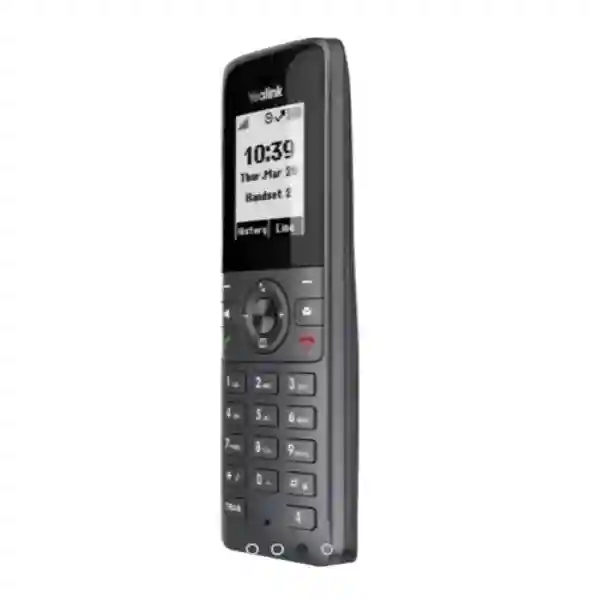
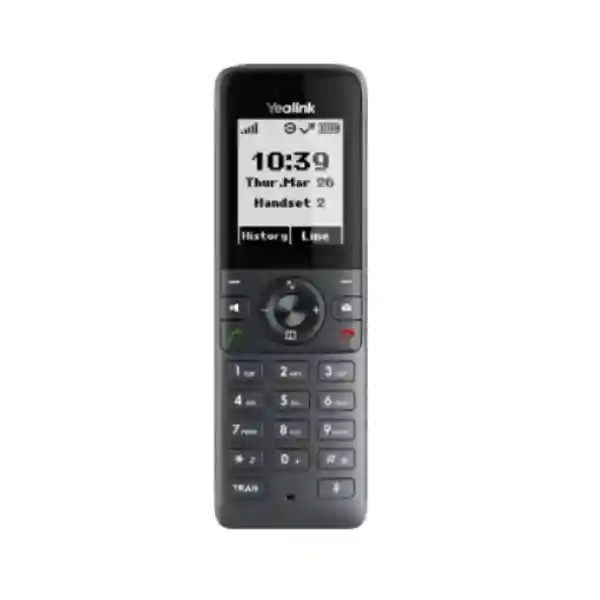
Professional cordless business communications
Yealink W71H DECT Handset for Enterprise Cordless Voice
The Yealink W71H is a lightweight business DECT handset built for users who need to move through the workplace while remaining reachable on the corporate voice system. Rather than extending Ethernet cabling to every moving employee, the handset connects through a compatible Yealink DECT base infrastructure. This makes it useful for reception support, stock-room teams, supervisors, service counters, clinics, hospitality operations and office staff who regularly leave a fixed desk.
Its value is not based on a long list of decorative features. The W71H focuses on the functions that matter during a working shift: clear audio, a physical illuminated keypad, straightforward call controls, practical battery endurance and compatibility with both single-cell and scalable multi-cell Yealink DECT architectures. Yealink specifies a 1.8-inch 90 × 65 black-and-white display, HD audio, full-duplex speakerphone, Flexible Noise Reduction, hearing-aid compatibility, up to two simultaneous calls per handset and three-way conferencing. A 1010 mAh lithium-ion battery provides up to 30 hours of talk time and up to 340 hours of standby time in ideal conditions.
For procurement teams, the important distinction is that W71H is the handset component. Coverage, SIP registration capacity, roaming design and network connection are determined by the selected compatible base platform. The handset can be paired with Yealink W70B single-cell deployments and W75B, W80B or W90B multi-cell environments, so the same handset family can serve projects ranging from a compact branch to larger premises requiring coordinated DECT coverage.
Instant Specifications & Procurement Fact Rail
W71H DECT handset
1.8 in, 90 × 65 monochrome
1010 mAh Li-ion
30 h talk / 340 h standby*
Single-cell or multi-cell
Project quotation on request
The W71H should be quoted as part of a complete communications design rather than selected only by handset count. Confirm whether the project already has a compatible Yealink base, whether new base stations are required, the number of concurrent users, expected call traffic, building construction, floor layout, PBX or hosted SIP platform, charger locations and any requirement for continuous roaming. Warranty terms should be confirmed on the Uganda quotation because the applicable coverage can depend on supply channel, project terms and manufacturer policy. *Battery and radio-range figures are manufacturer ratings under ideal conditions; actual results vary with use and environment.
Operational Product Architecture & Overview
A DECT deployment separates the mobile user endpoint from the IP network edge. The W71H provides the user interface, microphone, receiver, speakerphone, battery and DECT radio. A compatible Yealink base station provides the bridge into the IP voice environment. This separation is valuable when staff movement makes a conventional desk telephone inconvenient. Users carry the handset while the base infrastructure remains fixed and connected to the voice network.
For a small office, a W70B can form a compact single-cell system. Yealink states that W70B supports up to ten compatible DECT handsets or headsets, up to ten SIP accounts and up to twenty simultaneous calls at the base-system level. For buildings where one radio cell cannot provide adequate coverage, the W71H can participate in compatible W75B, W80B and W90B multi-cell architectures. That distinction matters because a buyer should not assume that adding handsets automatically expands radio coverage. Coverage is created by base placement and system topology; handset quantity is a separate sizing variable.
The handset itself supports two simultaneous calls, allowing common hold, swap and call-waiting workflows. Three-way conferencing, transfer, forwarding, do-not-disturb, voicemail, speed dial, redial, auto answer, intercom and phonebook capabilities cover typical business telephony needs. The base can hold phonebook information, while remote, LDAP and XML phonebooks can be supported according to the surrounding system configuration. Over-the-air handset upgrading reduces the need to physically cable individual devices for routine firmware maintenance.
Audio is central to the W71H design. HD audio and a stated 100 Hz to 7 kHz frequency response support wideband voice when the end-to-end platform and codec path permit it. Flexible Noise Reduction helps suppress distracting environmental sound, while the full-duplex speakerphone provides hands-free operation. Hearing Aid Compatibility supports organizations with accessibility requirements. These capabilities are especially relevant where a cordless phone is used in shared operational spaces rather than quiet executive offices.
The radio specification varies by regional version. Yealink lists 1880–1900 MHz for Europe and additional bands for the United States, Thailand and Brazil. Uganda buyers should therefore procure the correct regional hardware through an appropriate channel rather than importing an arbitrary frequency variant. Radio planning should also consider reinforced concrete, metal shelving, lift shafts, machinery, dense storage and other obstacles. Yealink cites up to 50 metres indoor and 300 metres outdoor range under ideal conditions, but these figures are planning ceilings rather than guaranteed real-building coverage.
Enterprise Business Outcomes & Value Analysis
HD audio, noise reduction and full-duplex speakerphone capabilities help users communicate clearly while moving between work areas. The practical benefit is reduced dependence on fixed extensions and fewer interruptions caused by returning to a desk simply to answer a call.
The physical keypad provides tactile access to calling functions, while the dedicated notification light makes missed calls and voicemail visible. Battery endurance rated at up to 30 hours of talk time and 340 hours of standby in ideal conditions is designed for sustained business use, although charging procedures should still be incorporated into shift planning.
Compatibility across W70B single-cell and W75B/W80B/W90B multi-cell platforms gives architects several growth paths. A business can select the surrounding DECT architecture according to coverage and user density instead of changing handset families merely because the site becomes larger.
The W71H is an endpoint in a wider voice system. On platforms such as W70B, Yealink documents SIP networking controls and protections including TLS and SRTP. Procurement should validate the PBX, provisioning, network segmentation and credential policies as part of the complete security design rather than treating handset selection as the only control.
Over-the-air handset upgrades and base-oriented provisioning can reduce repetitive endpoint handling. This becomes increasingly valuable when many cordless users are deployed across a branch, campus or distributed estate.
Cordless endpoints can reduce the need to provide a fixed phone position wherever a mobile employee may work. Cost modelling should include bases, handsets, chargers, network switch capacity, PoE where applicable to bases, installation labour and any PBX licensing.
Transfer, hold, forwarding, voicemail, conferencing and directory functions remain available in a portable form. This is useful for roles where employees must remain part of formal business call flows while circulating through the premises.
Key Hardware & Software Highlights
| Component or capability | Technical role | Operational outcome |
|---|---|---|
| 1.8-inch 90 × 65 display | Monochrome status and calling interface | Simple visibility for caller information, menus and call state. |
| Backlit physical keypad | 25-key tactile control layout | Familiar operation for users who need rapid call handling. |
| 1010 mAh Li-ion battery | Portable power source | Supports long mobile shifts with scheduled cradle charging. |
| HD audio and FNR | Voice reproduction and noise suppression | Improves intelligibility in normal business environments. |
| Full-duplex speakerphone | Hands-free two-way conversation | Useful when a worker needs both hands available. |
| OTA upgrade support | Wireless handset firmware delivery | Reduces physical servicing effort across larger fleets. |
Technical Specifications Ledger
The following ledger consolidates manufacturer-published W71H specifications. Buyers should confirm regional version and current firmware compatibility at quotation stage because platform capabilities can evolve and radio variants differ by market.
| Category | Specification |
|---|---|
| Display | 1.8-inch, 90 × 65 black-and-white screen; intuitive icon/soft-key interface; caller ID; notification light; keypad backlight. |
| Calling | Up to 2 simultaneous calls per handset; 3-way conference; hold; transfer; call waiting; forward; DND; redial; speed dial; voicemail; intercom and auto answer. |
| Audio | HD audio; full-duplex speakerphone; Flexible Noise Reduction / noise cancellation; HAC; stated 100 Hz–7 kHz frequency response. |
| Battery | 1010 mAh lithium-ion, 3.7 V, 3.73 Wh; up to 30 hours talk and 340 hours standby in ideal conditions. |
| Charging | Charger output DC 5 V / 0.6 A; adapter input 100–240 V AC, 50/60 Hz, 0.2 A; output 5 V / 0.6 A. |
| Dimensions | 144.5 × 48 × 21 mm. |
| Weight | 112 g. |
| Colour | Space Gray. |
| Radio range | Up to 50 m indoors and 300 m outdoors in ideal conditions. |
| Operating environment | -10 to +50°C operating temperature; 10–95% operating humidity; -30 to +70°C storage temperature. |
| Compatible base families | W70B single-cell; W75B, W80B and W90B multi-cell families, subject to current firmware/support matrix. |
| Package | W71H handset, charger cradle, rechargeable battery and power adapter. |
A key procurement point is that the W71H is not an Ethernet desk phone and does not itself connect to a switch port. The IP interface belongs to the compatible base system. Consequently, specifications such as Ethernet speed, PoE class, SIP account capacity and system concurrent calls must be assessed against the selected base. For example, the W70B includes a 10/100M Ethernet interface and IEEE 802.3af Class 1 PoE and supports up to ten SIP accounts and twenty simultaneous calls. Multi-cell designs have different capacities and architecture. Keeping handset specifications separate from base-system specifications prevents incorrect bills of materials.
Configuration & Sizing Worksheet
Step 1 — Count mobile users and concurrency
Start with named users and shared handsets. Record the peak number of people expected to be on calls at the same time. A handset supports up to two simultaneous calls locally, but overall system call capacity is governed by the selected base architecture and SIP service. Separate the number of physical devices from the number of SIP identities because shared-role deployments may use different registration models.
Step 2 — Map the radio environment
Draw the building footprint, floors, stairwells, outdoor work zones and high-priority call areas. Note concrete walls, metal racking, plant rooms and other obstructions. Manufacturer maximum range figures should never replace an actual coverage design. Large or difficult sites may require a multi-cell architecture so users can move between radio cells while maintaining service.
Step 3 — Validate network and power for bases
The handset uses its charging cradle; the base infrastructure connects to the IP network. Identify switch ports, VLAN policy, DHCP/static addressing, voice QoS and power availability. When W70B is used, IEEE 802.3af Class 1 PoE can simplify base placement. For multi-cell systems, verify every required network and power connection against the chosen design.
Step 4 — Confirm platform and licensing
Document the PBX or hosted telephony platform, SIP account requirements, extension plan, authentication method, codecs, directory integration and any subscription charges imposed by the communications platform. Do not assume that purchasing the handset includes PBX extensions, hosted SIP service or third-party licenses. Those commercial elements belong to the voice platform and should appear separately on the project bill.
Step 5 — Prepare the quotation pack
Provide quantity, site address, floor plans where available, base model already installed, PBX platform, expected concurrent calls, number of SIP accounts, preferred warranty terms and required delivery date. State whether you need supply only, configuration, staging, installation support or post-deployment assistance. This information lets the supplier identify missing bases, chargers, network accessories and deployment services before purchase rather than after equipment reaches site.
Deployment Scenarios & Industry Use Cases
Large enterprise and multi-site networks
Enterprises with multiple branches can standardize on a handset family while selecting base architecture per site. A small branch may need only a single-cell base, whereas a headquarters building may need a multi-cell design. Standardized handset operation can simplify user training, spare-device planning and support procedures. Each location should nevertheless be surveyed independently because floor layout and radio attenuation differ.
Financial and banking environments
Branch supervisors, operations personnel and back-office teams may need controlled mobility while remaining available through corporate telephony. The W71H can support that mobility, while the surrounding IP voice design should enforce the institution’s network segmentation, credential, encryption, logging and change-control requirements. Procurement teams should verify security requirements against the selected base and PBX rather than assuming that all controls reside in the handset.
Educational and campus networks
Administrative offices, libraries, facilities teams and departmental support staff often move within buildings while handling calls. A DECT design can provide a dedicated voice mobility layer without depending on staff personal phones. Campus projects should map each building, determine whether seamless roaming is required, and coordinate base placement with existing LAN and power infrastructure.
Government and controlled procurement
Public-sector procurement commonly requires precise model identification, documented specifications, warranty terms and a complete bill of materials. The W71H can be specified as the endpoint while compatible bases, network components, PBX services and implementation work are itemized separately. Where tender documents require particular standards, frequency bands, certificates or security controls, those requirements should be validated against the exact regional product and current manufacturer documentation before award.
Retail, warehouse and service operations
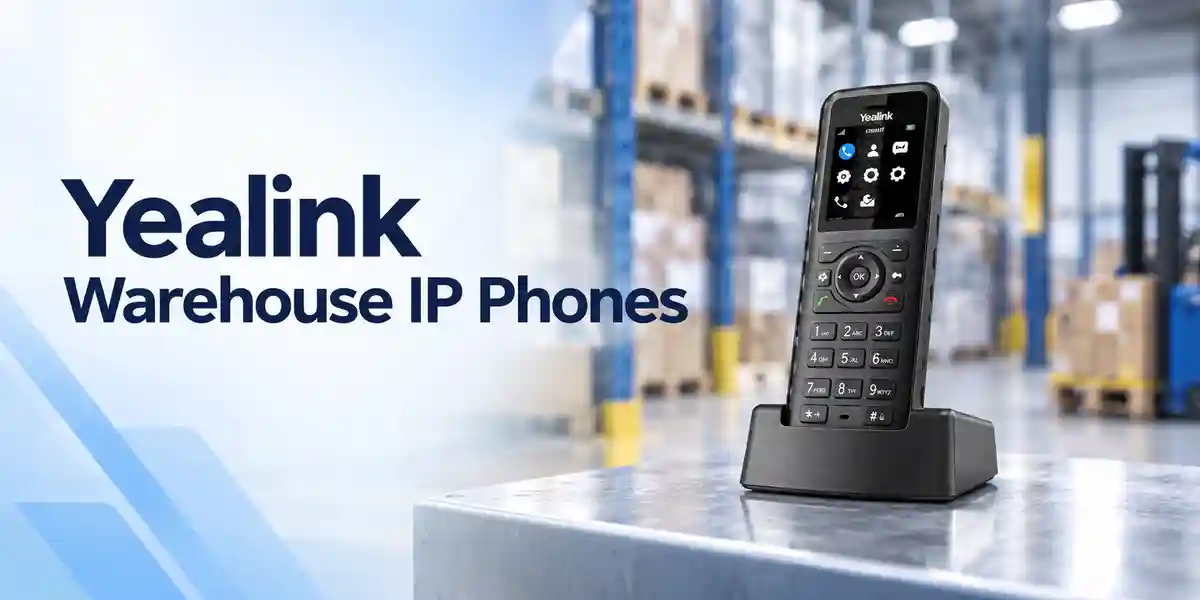
Cordless voice can be useful for managers and service personnel who spend much of the day away from a fixed desk. In warehouses, metal racks and stored goods can materially change radio behaviour, so practical coverage planning is especially important. The W71H is a general business handset rather than a rugged IP-rated model; buyers needing drop, dust, water or alarm protections should compare Yealink’s rugged handset families instead of assuming the W71H provides those protections.
Three Technical Deep-Dives
1. Voice processing, radio path and endpoint architecture
The W71H sits at the human end of a multi-stage voice path. Speech is captured by the handset, processed through its acoustic functions and transported over the DECT radio link to the compatible base. The base then participates in the IP telephony environment. This architecture means voice quality is influenced by more than the handset: DECT radio conditions, base placement, LAN congestion, codec selection, SIP service and the remote endpoint all matter. Flexible Noise Reduction is useful at the acoustic edge, while HD audio can improve clarity where wideband voice is maintained end to end. The 100 Hz–7 kHz stated frequency response aligns with business wideband voice use. For project validation, test representative calls from the most difficult coverage zones rather than judging quality only beside the base station. A properly engineered cordless system is therefore a combination of endpoint, radio and IP network design.
2. Firmware, provisioning and operational control
Fleet manageability matters when cordless handsets grow from a few devices into dozens or hundreds. W71H supports over-the-air upgrading, allowing firmware delivery through the supported DECT environment rather than requiring a technician to attach every handset to a maintenance cable. The surrounding Yealink base ecosystem provides configuration and provisioning functions, while the PBX controls extensions and service policy. Operational teams should define approved firmware, maintenance windows, administrator credentials, backup procedures and a documented process for replacing lost or damaged handsets. Before broad upgrades, test representative devices and confirm compatibility with the base and PBX. Directory sources should also be governed centrally where possible so users do not maintain inconsistent contact lists. These controls reduce configuration drift and make the cordless estate easier to support.
3. Availability, redundancy and recovery planning
A handset cannot create high availability by itself. Availability depends on the complete service chain: handset battery, radio coverage, base infrastructure, Ethernet switching, power, IP addressing, PBX and upstream connectivity. A single-cell base is simple but creates a local dependency on that device. Multi-cell architectures can provide broader coverage and, depending on platform design, additional system resilience features. Critical deployments should map failure domains and decide what must remain operational during switch failure, power interruption or PBX outage. UPS-backed network equipment, redundant switching, PBX resilience and spare handsets may be appropriate. Charger availability is another practical consideration: even a healthy communications platform cannot serve a handset with a depleted battery. Disaster-recovery documentation should therefore include endpoint charging and replacement procedures alongside network recovery.
Pre-Purchase Buyer Gap Checklist
Does the handset include a base station? W71H is the handset product; verify the quotation contents. A W71P bundle is a different purchasing configuration that pairs a handset with a base. If the site has no compatible base infrastructure, include it in the bill of materials.
Will one base cover the entire building? Not necessarily. Yealink’s ideal-condition range figures are useful references, not guarantees. Walls, floors, metal, machinery and building geometry affect propagation. Large premises should be designed around actual coverage requirements.
Are there hidden subscriptions? The physical handset is not a substitute for a SIP/PBX service. Extension or hosted-voice licensing depends on the chosen communications platform. Request a quotation that clearly separates hardware, PBX subscriptions, configuration and support.
Can the W71H roam between bases? The handset is compatible with Yealink multi-cell systems; roaming and handover behaviour depend on the selected multi-cell architecture and configuration. A W70B single-cell deployment does not become multi-cell simply by adding another independent W70B.
Is it rugged? W71H is a compact business handset, not an IP-rated rugged device. Projects requiring protection against water, dust, harsh handling or specialized alarms should compare rugged Yealink models.
What about third-party DECT bases? Treat interoperability as a validation item. Yealink documents its DECT ecosystem around compatible Yealink base/handset combinations, and its W70B documentation states that third-party DECT devices are not compatible. Do not buy on the assumption that generic DECT branding guarantees interoperability.
What happens to battery performance over time? Published talk and standby figures are ideal-condition ratings. Real endurance changes with call volume, signal conditions, age, temperature, charging behaviour and firmware. For continuous operations, plan charging routines and replacement batteries according to usage.
Which frequency version should Uganda use? Procure through the intended regional channel and have the supplier confirm the compliant regional variant. Avoid grey-market imports with an inappropriate radio band.
Uganda Procurement & Delivery Logistics
FourTeck can structure a W71H quotation around the actual project rather than simply listing a handset quantity. A useful request includes the delivery location, required units, existing Yealink DECT infrastructure, PBX or hosted-voice platform, number of extensions, floor count and whether the requirement is supply-only or includes staging and configuration. This allows compatible base stations and accessories to be identified before order confirmation.
For projects with multiple sites, quantities can be separated by branch so packaging, labeling and deployment schedules can be planned around the rollout. Lead time should be confirmed on the formal quotation because availability can vary with order volume, regional stock and import scheduling. Buyers with a fixed commissioning date should state it early so supply and technical preparation can be coordinated.
Pre-configuration requirements may include base settings, extension mapping, firmware alignment and device labeling, subject to the project scope and availability of the necessary PBX credentials and configuration data. For sensitive environments, organizations can choose to retain credentials internally and request hardware staging without production authentication details.
Local Coverage Matrix
Head offices, branches, hotels, healthcare, retail and service operations requiring cordless business voice.
Hospitality, logistics, administration and service sites where staff mobility is part of daily operations.
Commercial, industrial and institutional deployments with single-building or multi-zone requirements.
Regional offices, education, healthcare and distributed enterprise branch requirements.
Government, NGO, commercial and institutional projects requiring documented business telephony equipment.
Delivery arrangements, installation scope and onsite support availability should be confirmed for the exact project location. Regional procurement is most effective when the quote includes site-by-site quantities and the intended voice architecture, allowing compatible components to be consolidated into one bill of materials.
Cross-Border & Regional Supply Chains
Organizations operating across East Africa, the Gulf and wider African markets often benefit from keeping model standards consistent while sourcing through the appropriate regional operation. Explore FourTeck Uganda, FourTeck Kenya, FourTeck Africa, FourTeck UAE and FourTeck Kuwait. Cross-border projects should confirm regional radio variants, local power accessories, warranty handling, customs requirements and final delivery responsibilities before purchase. A common handset standard can simplify support, but the surrounding DECT and PBX architecture should still be validated country by country.
Related Products & Solution Paths
The W71H is most useful when selected with the correct surrounding system. Buyers planning a compact branch can review Yealink DECT base options and business cordless solutions through the Uganda technology catalogue. Projects requiring larger coverage should consider multi-cell DECT architecture rather than treating a single-cell base as a campus solution. Teams that need a richer colour display or additional handset capabilities can compare other Yealink professional DECT handsets, while warehouses and harsher environments should assess ruggedized models designed for tougher conditions.
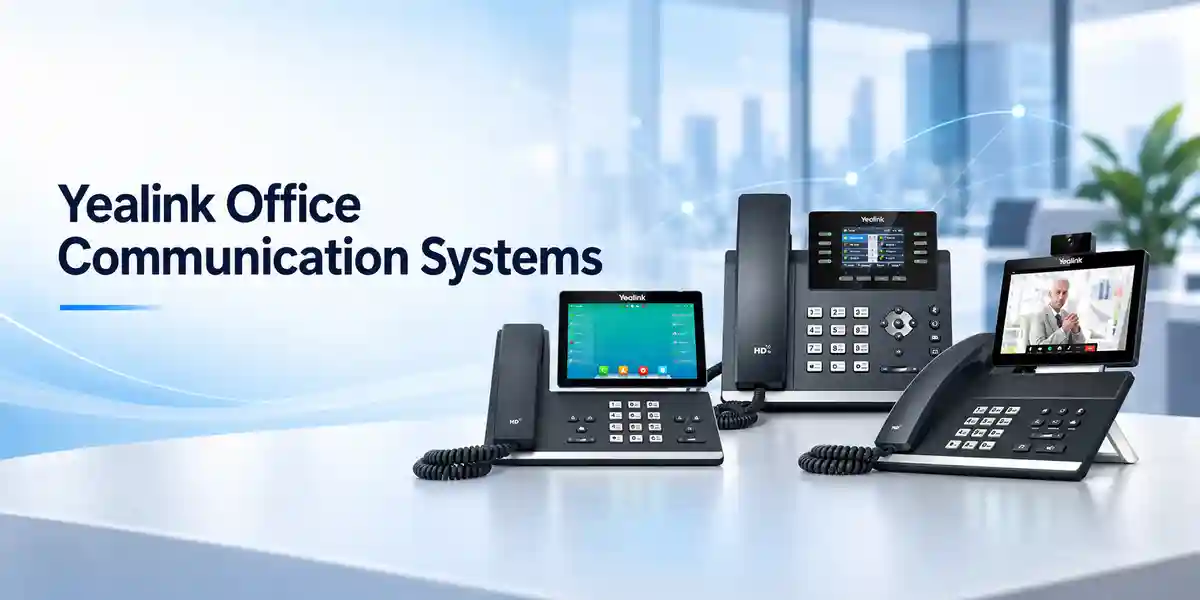
For complete deployments, related procurement lines can include the compatible DECT base system, network PoE switching for applicable bases, UPS protection for voice infrastructure, SIP/PBX services, structured cabling for fixed base locations, replacement batteries and spare charging cradles. Organizations integrating cordless endpoints with a broader office voice refresh can also evaluate Yealink office communication solutions and fixed IP phones for users who do not require mobility. For assistance matching these elements into one validated bill of materials, use the FourTeck Uganda contact page.
FourTeck Technical Service Capabilities
A successful DECT procurement begins with engineering validation. FourTeck can review the requested handset count against base capacity, site coverage expectations and the intended PBX environment. Bill-of-materials verification helps identify common omissions such as missing bases, insufficient coverage infrastructure, network power requirements or incompatible assumptions about existing equipment.
Where included in project scope, staging can organize devices by site or user group before dispatch. Firmware alignment can reduce avoidable differences between newly supplied and existing devices. Configuration planning can document extension mappings, directory sources, VLAN assumptions and deployment responsibilities. The objective is to move uncertainty out of the installation window and into the controlled planning stage.
Post-sales support can assist with product-level troubleshooting and coordination of warranty processes according to the applicable supply terms. For complex voice issues, diagnosis may require examining the handset, DECT base, LAN, SIP platform and upstream service as a chain. Clear demarcation between these layers speeds fault isolation and prevents a radio or network issue from being incorrectly treated as a handset defect.
Extended Technical FAQ
1. Is the Yealink W71H a complete DECT phone system?
No. The W71H is the cordless handset component and needs a compatible Yealink DECT base environment for business calling. If a site is starting from zero, the bill of materials should include the appropriate base system as well as any network, PBX and service requirements. For a small site, W70B is a compatible single-cell option. Larger sites can use compatible multi-cell platforms such as W75B, W80B or W90B. Always distinguish W71H handset-only procurement from packaged system bundles so the delivery contains everything needed for operation.
2. How many calls can one W71H handle?
Yealink specifies up to two simultaneous calls per W71H handset. This supports practical workflows such as placing one call on hold while handling another. It does not mean every deployment has unlimited system capacity. Total concurrent calls, SIP accounts and registered devices depend on the base platform and PBX. For example, W70B is specified for up to twenty simultaneous calls, ten SIP accounts and ten compatible DECT handsets or headsets. Multi-cell platforms have different capacities, so system sizing should consider handset-level and infrastructure-level limits separately.
3. What range should we expect inside a Ugandan office or warehouse?
Yealink publishes an ideal-condition figure of up to 50 metres indoors and 300 metres outdoors. Actual coverage can be significantly different. Reinforced concrete, metal doors, warehouse racking, machinery, multiple floors and the location of the base all influence radio propagation. A project should therefore map the required call zones and, for larger or operationally critical sites, validate coverage before finalizing base quantities. Multi-cell systems are appropriate when one radio cell cannot reliably cover the required area or when users must move across a broader site.
4. Does W71H require a separate license?
The handset hardware itself should be distinguished from licensing on the wider voice platform. A PBX, hosted SIP service or unified communications platform may require an extension, user or device subscription, depending on the provider. Directory integrations or optional codecs may also have platform-specific considerations. Ask for a quotation that identifies hardware and third-party service charges separately. This prevents a handset purchase from being mistaken for a complete telephony subscription and makes recurring operating costs visible before approval.
5. Can W71H work with third-party DECT base stations?
Do not assume generic DECT branding guarantees compatibility. Yealink documents W71H for its supported DECT base ecosystem, including W70B and compatible multi-cell systems. Yealink’s W70B documentation explicitly notes incompatibility with third-party DECT devices. For an existing installation, provide the exact base model and firmware version during quotation. This lets the proposed handset/base combination be checked against the current manufacturer compatibility matrix rather than relying on a broad protocol label.
6. How long does the W71H battery last?
The manufacturer rates the 1010 mAh lithium-ion battery for up to 30 hours of talk time and up to 340 hours of standby time under ideal conditions. Real-world endurance varies with signal quality, call duration, speakerphone use, temperature, firmware, battery age and charging patterns. Organizations operating long or continuous shifts should establish a charging routine and consider spare-device or replacement-battery policy. Battery endurance should be treated as an operational planning figure rather than a guaranteed duration in every environment.
7. Is W71H suitable for a warehouse?
It can be suitable for normal indoor warehouse communications when the environmental conditions and physical handling demands match the handset’s design. However, W71H is a standard business handset and is not presented as an IP-rated rugged model. Sites with frequent drops, dust, moisture, outdoor exposure or safety-alarm requirements should evaluate Yealink rugged handset options. Warehouse radio planning also needs extra care because metal racking and stock can alter coverage. A coverage design should reflect the loaded warehouse, not only an empty building survey.
8. What warranty applies in Uganda?
Warranty should be confirmed on the formal FourTeck quotation for the exact supply because coverage can depend on the sales channel, project terms and manufacturer policy. Procurement teams should request the warranty duration, return procedure, required proof of purchase and handling of replacement or repair before issuing a purchase order. For larger fleets, it is also sensible to keep operational spares so a user can remain productive while a warranty case is being assessed. Warranty service should not be confused with onsite managed support unless that service is separately included.
9. Can FourTeck help configure the handsets and bases?
Configuration assistance can be scoped according to the project. Useful inputs include the PBX platform, SIP extension list, authentication method, base models, network addressing, VLAN details, directory requirements and site grouping. Some customers prefer fully staged equipment, while others keep credentials internal and perform production registration themselves. For multi-cell projects, configuration should follow a documented radio and network design. State the desired level of staging and technical assistance in the quotation request so responsibilities are clear before shipment.
10. What information should be sent for the fastest accurate quotation?
Send the required W71H quantity, delivery city, existing Yealink base model if any, PBX or hosted-voice platform, number of SIP extensions, approximate concurrent calls, building size or floor count, required coverage areas and target deployment date. Mention whether you need single-cell or multi-cell guidance, network switches, UPS protection, configuration, installation support or spare units. For larger premises, a floor plan is particularly helpful. A complete request allows the quote to address the full deployment rather than supplying handsets that later reveal missing infrastructure.
Build the Correct W71H Deployment Before You Order
A reliable cordless voice project depends on more than handset quantity. The correct regional W71H version, compatible DECT base architecture, radio coverage, PBX capacity, network connectivity, charging plan and support scope should be aligned before purchase. Send FourTeck your site count, user quantity, current voice platform and coverage requirements. The resulting quotation can then separate handsets, base infrastructure, accessories and services so procurement teams can approve a complete, auditable bill of materials.
For branch offices, the design may be straightforward. For campuses, warehouses and multi-floor facilities, early coverage planning can prevent dead zones and unnecessary rework. Organizations with existing Yealink DECT systems should include the installed base model and firmware information so compatibility can be validated against the intended W71H rollout.

Reviews
There are no reviews yet.