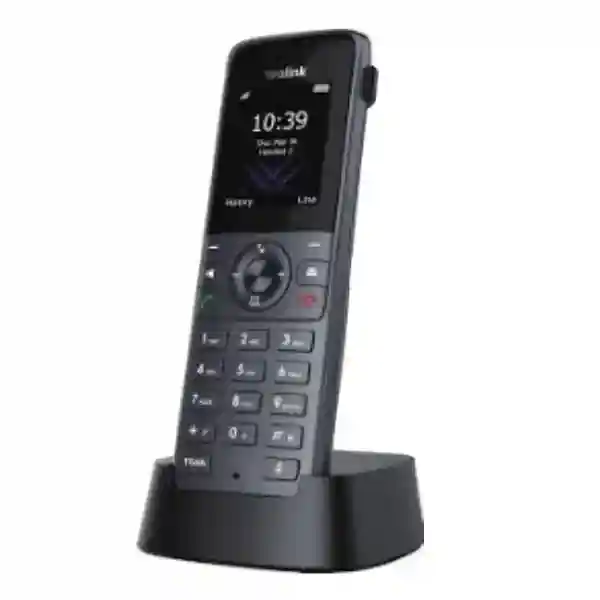
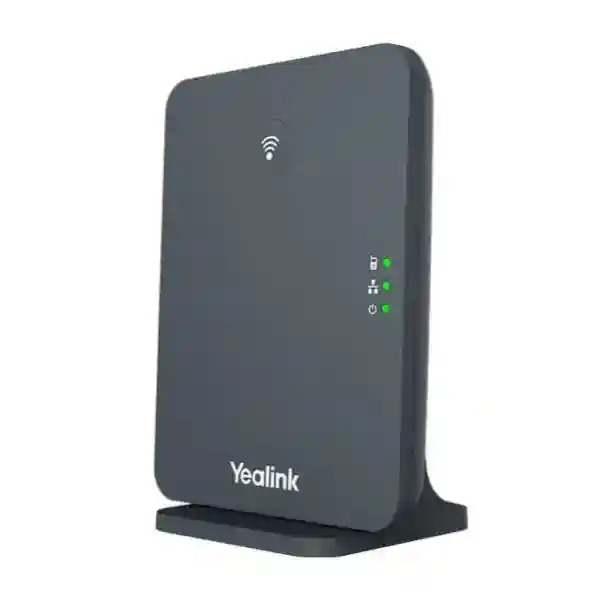
Yealink W74P DECT Phone System – Professional SIP Cordless Communications
The Yealink W74P is a business DECT IP phone system built for organisations that need staff to move freely while remaining connected to their SIP voice platform. The package combines the Yealink W70B IP base station with the W74H cordless handset, creating a practical starting point for small and medium-sized deployments that need more mobility than fixed desk phones can provide. One W70B supports up to ten compatible Yealink DECT handsets, ten SIP accounts and twenty simultaneous calls, allowing a business to begin with the included handset and expand within the supported single-base capacity as staffing requirements develop.
For Uganda organisations, the W74P is particularly relevant where reception staff, supervisors, technicians, warehouse teams, clinic personnel, retail managers or hospitality employees cannot remain at a desk. The handset combines HD voice, full-duplex speakerphone operation, flexible noise reduction, vibration alerts, Bluetooth 5.1 and a 3.5 mm headset interface. Under ideal conditions the DECT radio specification provides up to 50 metres of indoor coverage and up to 300 metres outdoors. Actual usable coverage depends on walls, reinforced concrete, shelving, machinery, interference, building geometry and base placement, so site conditions should always be considered during procurement.
The W70B connects to the IP network through a 10/100 Mbps Ethernet port and supports IEEE 802.3af Class 1 Power over Ethernet. This simplifies suitable installations by allowing network and power delivery through the same Ethernet run. Organisations can also use supported provisioning methods including HTTPS, HTTP, TFTP, FTP, RPS and plug-and-play mechanisms. Security capabilities include TLS, SRTP, HTTPS, digest authentication and encrypted configuration files. These features make the W74P suitable for structured business telephony rather than merely acting as a consumer cordless phone.
Instant Specifications & Procurement Fact Rail
W70B base + W74H handset
Up to 10 handsets / 10 SIP accounts
Up to 20 simultaneous calls
1 × RJ45 10/100M Ethernet
IEEE 802.3af Class 1 PoE
Quote-based Uganda supply
The W74P should be purchased as a system rather than evaluated only by the handset specification. The base station defines registration capacity, SIP account capacity, concurrent call limits and network integration. The handset defines the daily user experience, including battery endurance, display, audio, Bluetooth and mobility. For project purchasing, confirm the exact number of handsets, charger locations, headset requirements, PBX platform, PoE availability and expected radio footprint. Warranty terms can vary by sales channel and project, so the commercial quotation should state the applicable regional warranty baseline rather than relying on an assumed universal period.
Operational Product Architecture & Overview
The W74P architecture separates the IP network edge from the roaming user. The W70B base station is the bridge between the organisation’s Ethernet network and the DECT radio environment. It registers SIP identities to a compatible PBX or hosted voice service, handles supported signalling and media functions, and provides the DECT radio link used by registered handsets. This arrangement removes the need to cable an Ethernet connection to every roaming user. A handset can move within the effective radio area while the base remains connected to the voice network.
This architecture addresses a common operational problem: many employees need a business extension but their work is not performed at a fixed desk. A warehouse supervisor may move between receiving, storage and dispatch. A clinic administrator may move between reception and treatment areas. A retail manager may need to answer calls while checking stock. A hotel team may need internal and external calling while moving through service areas. The W74P provides a SIP-based approach for these roles without forcing users to depend on personal mobile phones for ordinary internal business communications.
Capacity planning is straightforward but important. A W70B can register up to ten supported Yealink DECT endpoints and ten SIP accounts, while the W74P platform supports up to twenty simultaneous calls and up to two simultaneous calls per handset. This does not mean every environment should automatically be designed to the maximum. Procurement teams should count active users, concurrent call expectations, shared extensions, hunt groups, call queues and future additions. Where a site will exceed the single-base design or requires roaming across a much larger footprint, a Yealink multi-cell architecture may be more appropriate than stretching a W74P beyond its intended role.
The W74H contributes practical mobility features. Its 1.8-inch 128 × 160 colour display provides caller and menu information without making the handset bulky. Bluetooth 5.1 enables compatible wireless headset use, while a 3.5 mm jack supports wired headset options. Vibration is useful in noisy or attention-sensitive environments where a ringtone may be missed or inappropriate. The handset also supports a full-duplex speakerphone and hearing-aid compatibility. Yealink specifies up to 24 hours of talk time and 320 hours of standby time under ideal conditions, with quick charging that can provide up to two hours of talk time from a ten-minute charge.
Network administrators gain familiar enterprise controls. The base supports static or DHCP addressing, VLAN capabilities, 802.1X, LLDP, NAT traversal through STUN, UDP/TCP/TLS transport, and outbound proxy backup. Provisioning can be automated, which is valuable when several systems are being staged for branches. Over-the-air handset upgrades reduce the need to physically connect every handset for maintenance. Logs and trace packages can also assist troubleshooting.
Radio planning remains the most important physical design consideration. Published maximum range values are measured under ideal conditions and should not be interpreted as guaranteed coverage through every building. Reinforced walls, lift shafts, dense shelving, metal partitions and equipment rooms can attenuate DECT signals. Up to six RT30 repeaters can be used with a base where appropriate, but repeater placement should be planned around actual signal conditions and traffic needs. A pre-deployment walk-through or staged test is preferable for complex sites.
Enterprise Business Outcomes & Value Analysis
Total cost should be assessed beyond the kit price. Include extra handsets, charger cradles, headsets, repeaters, PoE switch capacity, PBX licensing, hosted SIP subscriptions, installation labour, configuration time, spare batteries where relevant and support. A lower initial hardware figure can become misleading if the deployment later requires unplanned radio extensions or platform licences. Conversely, a correctly sized DECT system can reduce cabling and simplify staff mobility.
Key Hardware & Software Highlights
| Component | Capability | Operational value |
|---|---|---|
| W70B base | 10 handsets, 10 SIP accounts, 20 calls | Consolidates small-business cordless voice onto one IP-connected base. |
| W74H handset | 1.8-inch colour screen, Bluetooth 5.1, vibration | Supports mobile staff and multiple alert/headset preferences. |
| Ethernet/PoE | 10/100M RJ45, 802.3af Class 1 | Simplifies base placement where PoE switching is available. |
| Provisioning | TFTP/FTP/HTTP/HTTPS/RPS, PnP | Supports repeatable configuration and remote deployment workflows. |
| Security | TLS, SRTP, HTTPS, AES configuration encryption | Provides controls for protected signalling, media and configuration handling. |
The design is intentionally compact. There is no requirement for a high-speed Gigabit interface because the base handles voice traffic rather than acting as a workstation pass-through switch. The important considerations are VLAN placement, quality-of-service policy, PoE availability, SIP reachability and radio coverage. Buyers should therefore resist comparing the W74P to desk phones solely by Ethernet speed. Its value is in DECT mobility and multi-handset SIP operation.
Technical Specifications Ledger
| Specification | Confirmed detail |
|---|---|
| Bundle | W70B DECT IP base station and W74H handset |
| Handsets | Up to 10 compatible Yealink DECT handsets/endpoints per supported configuration |
| SIP accounts | Up to 10 |
| Concurrent calls | Up to 20 system-wide; up to 2 per handset |
| DECT range | Up to 50 m indoors / 300 m outdoors under ideal conditions |
| Repeaters | Up to 6 RT30 repeaters per base station |
| Display | 1.8-inch 128 × 160 TFT colour display |
| Headset | Built-in Bluetooth 5.1 and 3.5 mm headset jack |
| Audio | Full-duplex speakerphone, HAC, FNR/noise cancellation, G.722; additional narrowband codecs supported |
| Ethernet | 1 × RJ45 10/100M |
| Power | IEEE 802.3af PoE Class 1; external adapter support |
| Network | SIP v1/v2, VLAN 802.1Q/802.1P, 802.1X, LLDP, STUN, static/DHCP |
| Security | TLS, SRTP, HTTPS, OpenVPN, digest authentication, AES-encrypted configuration |
| Talk/standby | Up to 24 hours talk / 320 hours standby under ideal conditions |
| Handset size | 144.5 × 48 × 21 mm |
| Base size | 130 × 100 × 25.1 mm |
| Operating humidity | 10–95% |
| Handset operating temperature | -10 to +50°C |
Battery construction can differ by W74H hardware revision, while Yealink maintains the published ideal-condition talk and standby figures for current documented revisions. Procurement teams ordering replacements should identify the exact handset revision and use supported replacement parts. DECT frequency variants are market-dependent, so regional sourcing should be matched to the intended country of operation and local regulatory requirements.
Configuration & Sizing Worksheet
1. Estimate users and call load
List every employee who needs a cordless extension and distinguish dedicated users from shared handsets. Record peak concurrent calls, not merely total staff. A ten-person team does not necessarily make ten calls at once, but call centres or busy reception environments may have higher concurrency. The W74P supports ten SIP accounts and twenty simultaneous calls, subject to PBX and service capacity.
2. Map the physical environment
Draw the expected walking routes and mark walls, floors, metal storage, lifts and equipment rooms. Identify a central network location for the W70B. Do not assume the maximum published range will survive every obstruction. For complex premises, test coverage before finalising repeater quantities.
3. Confirm power and cabling
Check whether the network switch supplies 802.3af PoE and whether the selected switch port has sufficient power budget. If PoE is unavailable, plan for the appropriate supported external power arrangement and a nearby outlet. Confirm that structured cabling reaches the intended base position.
4. Validate the voice platform
Record the PBX or hosted SIP service, registrar, outbound proxy requirements, authentication model, VLAN, certificate policy and codec preferences. Some business features depend on the server platform. Do not assume every PBX exposes every handset feature in the same way.
5. Check licensing and subscriptions
The hardware purchase does not automatically include third-party PBX licences, hosted extensions, SIP trunks, call recording subscriptions or support contracts. Ask the voice provider to confirm per-user or per-extension costs. Where optional codecs or platform features are required, validate entitlement before issuing a purchase order.
6. Prepare the quote
Include W74P system quantity, additional W74H or other compatible endpoints, RT30 repeaters if required, headsets, spare charging accessories, network switching requirements, PBX licences, installation, configuration, training, warranty terms and delivery destination. This creates a bill of materials that can be compared on a like-for-like basis.
Deployment Scenarios & Industry Use Cases
Large enterprise and multi-site networks
Within a large enterprise, the W74P is best considered for individual small branches, reception zones, workshops or departmental areas that fit a single-base design. A central IT team can standardise SIP, VLAN and provisioning settings, then stage systems for branches. Sites requiring broad campus roaming should be assessed for multi-cell DECT instead. This distinction prevents a small-system product from being forced into a topology it was not designed to serve.
Financial and banking institutions
Branch operations can use cordless extensions for supervisors or authorised staff who need mobility between customer service and back-office areas. Network segmentation, strong credentials, secure provisioning, TLS/SRTP configuration and controlled administration should form part of the deployment. Financial organisations should align the phone system with internal security policies and any applicable compliance requirements rather than treating the handset as an isolated device.
Educational and campus environments
A W74P can serve an administration office, library team, laboratory support group or smaller school building where staff need to answer calls away from desks. Coverage testing is important in buildings with thick walls or multiple floors. Larger universities may use W74P systems only in contained zones while adopting a multi-cell solution for continuous roaming across wider facilities.
Government and public-sector procurement
Government projects typically require documented bills of materials, warranty terms, serial-number traceability, delivery schedules and configuration records. The W74P supports a structured IP voice deployment, but the procuring organisation should define approved firmware, network segmentation, credential policy and PBX interoperability. For restricted environments, technical approval should precede rollout.
Healthcare, hospitality, retail and warehousing
These environments often share a common requirement: users move while working. A cordless SIP handset can keep a business number reachable without relying on a personal cellular device. Bluetooth and vibration are useful for hands-free or noisy workflows. Warehouses should pay special attention to metal racks and radio shadowing; hospitality sites should map floors and service corridors; healthcare deployments should consider cleaning policies and whether a more specialised rugged endpoint is needed for particular roles.
Technical Deep Dive 1: Processing, Voice Handling & Radio Architecture
The W74P’s meaningful performance metrics are voice-session capacity and radio endpoint capacity rather than packet-forwarding throughput. The W70B is not a general-purpose network switch. It is a SIP/DECT base that terminates the Ethernet connection and manages voice sessions for registered cordless endpoints. Up to ten SIP accounts and twenty simultaneous calls provide the practical ceiling for the single-base system. Each handset supports up to two simultaneous calls, enabling hold, transfer and call-waiting workflows.
DECT gives the product a dedicated cordless architecture separate from ordinary Wi-Fi client traffic. That can be valuable in offices where wireless LAN airtime is already heavily used by laptops and phones. However, radio quality still depends on the building. Coverage design should consider attenuation and base location, and optional RT30 repeaters should be treated as engineered extensions rather than assumed fixes for every dead zone. Audio processing includes full-duplex speakerphone behaviour, echo control, packet-loss concealment and noise-reduction functions, while G.722 provides wideband voice when supported end to end.
Technical Deep Dive 2: Software Ecosystem, Firmware Security & Operational Control
Administrators can configure the platform through the handset, browser interface or automated provisioning. Supported transport and provisioning methods enable organisations to build repeatable templates rather than configure every base manually. Over-the-air handset upgrades reduce maintenance friction. Trace packages and system logs are useful when diagnosing registration, media or configuration issues.
Security is layered. TLS can protect supported signalling paths, SRTP can protect media, HTTPS can protect management/provisioning sessions, and configuration files can be encrypted. The device also supports digest authentication and multiple administrative access levels. These capabilities are controls, not guarantees. Administrators still need strong credentials, current firmware, trusted provisioning endpoints, correct certificates and network access policies. Yealink’s current product materials also describe TLS 1.3 availability with relevant firmware, so organisations with strict requirements should validate the exact firmware branch selected for deployment.
Technical Deep Dive 3: Availability, Redundancy & Recovery Planning
The W74P supports outbound proxy server backup, which can contribute to voice-service resilience when the surrounding SIP platform is designed appropriately. Yet a single W70B remains a physical point of dependency for the handsets registered to it. If the base loses power, network access or fails, those handsets cannot simply continue through that same base. Organisations requiring higher availability should plan spare hardware, protected PoE switching, UPS power, configuration backups and a recovery procedure.
Disaster recovery should include more than spare hardware. Maintain a record of SIP account assignments, provisioning templates, VLAN details, firmware versions, handset registrations and site-specific radio notes. A replacement base can then be introduced in a controlled way. For operations where cordless telephony is mission-critical across a broad site, evaluate a multi-cell design with architecture appropriate to the required resilience and roaming model rather than relying on a single-base kit.
Pre-Purchase Buyer Gap Checklist
Are there hidden licence costs? The W74P hardware itself does not replace the commercial requirements of your PBX or hosted voice provider. Extension licences, SIP trunks, call recording, contact-centre features or support subscriptions may be separate. Obtain those costs before comparing total project value.
Can third-party DECT handsets be assumed to work? No. Yealink explicitly states that its DECT implementation is not compatible with third-party DECT base stations or handsets in the manner buyers may expect from generic consumer DECT. Use the supported Yealink endpoint matrix for planning.
Will 50 metres indoors always be achieved? No. That figure is an ideal-condition maximum. Walls, floors, metal and interference alter real coverage. Survey or test challenging sites.
Does the base need a mains adapter? Not necessarily. The W70B supports IEEE 802.3af Class 1 PoE. Where suitable PoE is available, the Ethernet cable can power the base. Confirm the exact package and regional power accessories in the quotation.
Is Bluetooth on the base or handset? The W74H handset provides built-in Bluetooth 5.1 for supported Bluetooth headset use. It also has a 3.5 mm headset jack.
What happens when the business outgrows ten handsets? That is a design transition point. Rather than adding unsupported capacity to one base, review Yealink’s multi-cell DECT options and the physical site topology.
What is the battery reality? Yealink publishes up to 24 hours talk time and 320 hours standby under ideal conditions. Actual endurance depends on use, signal conditions, battery age, temperature and features. Plan charging discipline for shift work.
Will every SIP provider expose every feature? Not necessarily. Basic SIP interoperability is broad, but directories, feature synchronisation, transfer behaviour, presence or hosted-platform functions can differ. Validate the intended PBX or service before volume deployment.
What should be checked for lifecycle planning? Confirm current firmware support, handset compatibility, availability of accessories and the migration path if future scale exceeds the W70B. Keep procurement records that identify exact hardware and regional variants.
Uganda Regional Procurement & Delivery Logistics
FourTeck can structure a Uganda quotation around the actual deployment rather than only the starter kit. A useful request includes the number of cordless users, PBX or hosted voice platform, site location, approximate floor area, number of floors, network switch model, PoE availability, preferred headsets and any requirement for repeaters. This information helps distinguish a simple W74P purchase from a project that needs additional endpoints or a different DECT topology.
Order processing should confirm the exact model, regional radio variant, included accessories, warranty terms, commercial lead time and delivery destination. For project quantities, organisations should request a bill of materials so that handsets, repeaters, chargers and network requirements are visible as separate line items. Where pre-configuration is requested, provide SIP parameters through an approved secure process rather than ordinary public correspondence.
Delivery timelines depend on stock position, quantity, import routing and final destination, so they should be stated on the quotation instead of assumed from generic product availability. FourTeck can also coordinate staging requirements such as firmware alignment, labelling, baseline configuration and packing by branch where agreed in the project scope.
Local Coverage Matrix
Corporate offices, retail, hospitality and professional services.
Hospitality, logistics, offices and service operations.
Industrial, education, commercial and branch deployments.
Regional offices, healthcare, education and business sites.
Institutional, branch, NGO and commercial communications.
For any location, the most useful procurement input is the actual building profile. A compact office in Kampala and a warehouse in Jinja may need very different radio planning even with the same number of users. Multi-floor sites in Entebbe, Mbarara or Gulu should likewise be evaluated for attenuation between levels. Delivery and implementation scope should be confirmed per project.
Cross-Border & Regional Supply Chains
Organisations operating across East Africa and the Gulf can coordinate sourcing through FourTeck’s regional web presence. Uganda requirements can be handled through FourTeck Uganda, Kenya projects through FourTeck Kenya, wider continental requirements through FourTeck Africa, UAE requirements through FourTeck UAE, and Kuwait requirements through FourTeck Kuwait.
Cross-border projects should standardise the bill of materials while still respecting regional DECT frequency variants, power accessories, warranty channels, taxes, customs and local communications regulations. A model name alone is not sufficient for multinational procurement. Record country, quantity, delivery address and intended operating region for each batch.
Related Products & Internal Planning Paths
A W74P project commonly expands through additional Yealink DECT handsets, RT30 repeaters, compatible headsets and network power infrastructure. Buyers can review IP phone options, Yealink products, networking solutions and project quotation support. Where a larger site needs seamless mobility beyond one base, ask for a comparison with Yealink W80/W90 multi-cell architecture. Where the role is harsh or industrial, consider whether a rugged Yealink DECT handset is more appropriate than the standard W74H. Where users remain desk-based, a fixed SIP phone may provide a larger display and more programmable keys at lower mobility complexity.
FourTeck Technical Service Capabilities
FourTeck can support engineering validation before order placement by reviewing user counts, coverage assumptions, PBX requirements, VLAN design, PoE availability and accessory quantities. Bill-of-materials verification is particularly important for DECT because a starter kit may be only one part of the finished system. A project may also require additional W74H handsets, repeaters, headsets, switch capacity, UPS protection or voice-platform licensing.
Staging can include agreed baseline configuration, firmware alignment, device labelling and branch grouping before shipment. Pre-shipment firmware work should follow the customer’s approved version policy; the newest release is not automatically the correct release for every managed environment. Post-sales support can assist with deployment troubleshooting, registration, network reachability and configuration review within the agreed service scope. Customers should preserve configuration documentation and serial records to simplify future support and warranty processing.
Extended Technical FAQ
How many handsets can the Yealink W74P support?
The W74P system uses the W70B base, which supports registration of up to ten compatible Yealink DECT handsets or supported endpoints. The kit includes one W74H handset, so additional units can be added within the base’s supported capacity. Capacity should be planned alongside SIP accounts and call concurrency. Ten registered handsets does not automatically mean ten separate external lines; account assignment and routing depend on the PBX configuration. For sites expecting to exceed ten endpoints or needing broader roaming, request a multi-cell design review.
How many simultaneous calls are supported?
The platform supports up to twenty simultaneous calls, with up to two simultaneous calls per handset. This capacity supports normal business workflows such as holding one call while handling another, subject to PBX configuration and service capacity. The upstream SIP trunk or hosted voice plan must also provide enough concurrent sessions. A base capable of twenty calls cannot override a provider plan limited to fewer channels. Procurement teams should therefore validate both device capacity and telephony service capacity.
What coverage should we expect inside a building?
Yealink specifies up to 50 metres indoors and 300 metres outdoors under ideal conditions. Real buildings often reduce those distances. Reinforced concrete, metal shelving, lift shafts, machinery, tinted glass and multiple floors can change radio behaviour substantially. For a straightforward office, central base placement may be sufficient. For warehouses or complex multi-floor buildings, conduct a coverage test and plan RT30 repeaters where suitable. Published maximum range should be used as a planning reference, not a guaranteed wall-to-wall measurement.
Does the W74P support Power over Ethernet?
Yes. The W70B base supports IEEE 802.3af Class 1 PoE through its 10/100 Mbps RJ45 Ethernet port. This can simplify installation because a compatible PoE switch can provide both network connectivity and power to the base. Before deployment, verify the switch standard, available PoE budget, VLAN configuration and cable path. If the base is placed for optimum radio coverage rather than near a desk, PoE can be especially useful because it reduces dependence on a nearby mains outlet.
Can the W74H use Bluetooth headsets?
Yes. The W74H includes Bluetooth 5.1 and also provides a 3.5 mm headset jack. This gives users a choice between supported Bluetooth and wired headset workflows. Compatibility should be confirmed for the exact headset model, especially where advanced controls are required. The handset also includes a full-duplex speakerphone. In busy environments, headset selection should consider comfort, microphone noise handling, battery endurance and whether staff need one-ear or two-ear designs.
What security functions are available?
The documented platform includes TLS, SRTP, HTTPS, digest authentication, AES-encrypted configuration files, OpenVPN support and administrative access levels. These functions can support secure deployment when correctly configured with the surrounding network and SIP platform. They do not eliminate the need for operational controls. Use strong credentials, restrict management access, maintain supported firmware, validate certificates and place voice devices in an appropriate network segment. Organisations with formal security requirements should review the intended firmware version and PBX configuration before rollout.
Does the W74P require special licensing?
The physical system does not by itself provide your organisation’s SIP service. Licensing depends on the PBX, hosted telephony provider and optional services in use. You may need extension licences, SIP trunk channels, hosted-user subscriptions, call recording, contact-centre licences or support agreements. Some codec capabilities are also documented as optional. Ask both the hardware supplier and voice-platform provider to identify recurring and one-time charges so the project budget reflects the complete communications service rather than only the handset and base.
Can we use third-party DECT handsets with the W70B?
Do not plan a project on that assumption. Yealink’s documentation states that its DECT technology is not compatible with third-party DECT devices such as base stations and handsets. Use Yealink’s current compatibility documentation to choose endpoints for the W70B. This is particularly important when replacing an older cordless system: existing generic DECT handsets should not be counted as reusable without explicit compatibility confirmation. A verified endpoint list prevents unexpected replacement costs during installation.
How is firmware and configuration managed?
The W74P supports browser, phone and automated provisioning methods, including TFTP, FTP, HTTP, HTTPS, RPS and plug-and-play workflows. Handsets support over-the-air upgrade mechanisms, reducing the need for direct physical connection during routine maintenance. Enterprise deployments should define an approved firmware baseline, test changes before broad rollout and preserve configuration templates. Where a managed provisioning server is used, secure transport, access controls and change management should be part of the operational process.
How should warranty replacement and support be planned?
Warranty terms should be taken from the commercial quotation because coverage can vary by channel, project and region. Keep invoices, serial numbers, model details and deployment records. For business-critical sites, consider maintaining an approved spare base or handset so a hardware fault does not depend entirely on replacement transit time. Before replacing a base, preserve the configuration and document handset registrations. FourTeck can clarify the applicable warranty process, replacement workflow and technical support scope for the quoted Uganda project.
Plan Your Yealink W74P Deployment in Uganda
A successful cordless voice deployment starts with the right bill of materials and realistic coverage assumptions. Share your user count, building type, PBX or hosted SIP platform, number of floors, expected roaming area, PoE availability and preferred delivery location. FourTeck can use those details to prepare a quotation covering the W74P starter system, additional compatible handsets, repeaters, headsets and agreed configuration or staging services. For larger environments, the same review can identify when a multi-cell design is more appropriate than a single W70B base.
Request the commercial proposal before finalising the purchase order so model variants, warranty, lead time, accessories and service scope are documented. This reduces deployment surprises and gives the technical team a clear implementation baseline.

Reviews
There are no reviews yet.