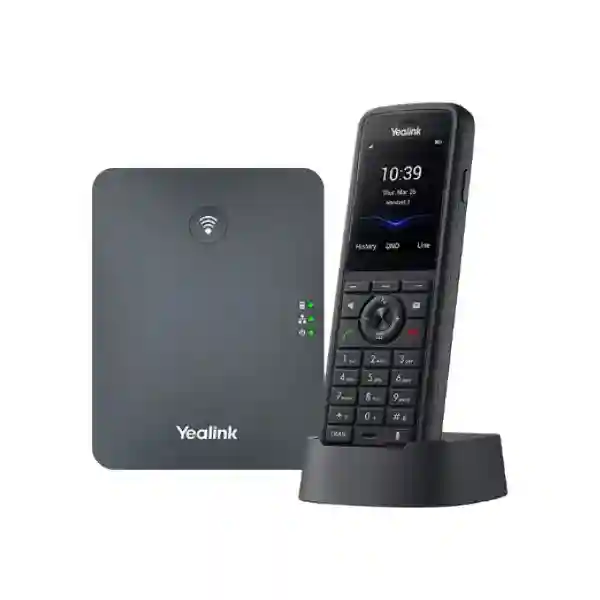
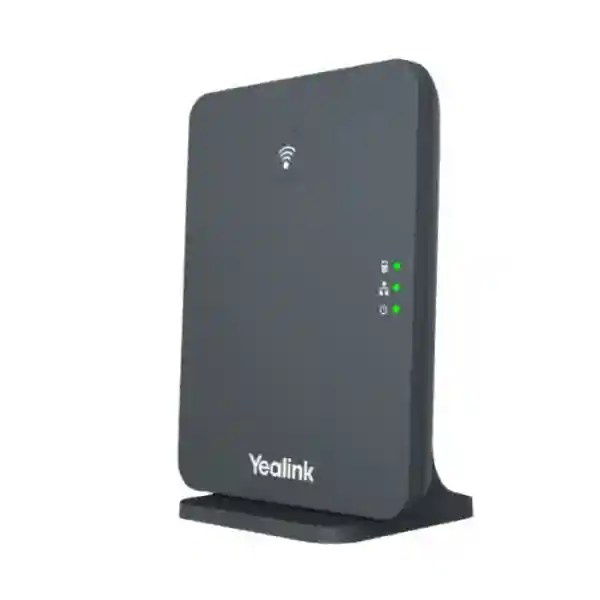
Yealink W79P Pro DECT Phone System – Rugged Business Mobility
The Yealink W79P Pro is a professional SIP cordless communication system designed for organizations whose employees need dependable voice access while moving beyond a fixed desk. It combines the Yealink W70B IP base station with a W59R Pro rugged DECT handset, creating a practical bridge between a SIP-based business phone platform and personnel working in operational areas such as warehouses, service bays, production spaces, clinics, hotel service zones and logistics facilities. The system architecture is designed around dedicated DECT mobility rather than Wi-Fi calling, helping businesses create a controlled cordless voice layer with predictable handset behavior and centralized SIP registration.
At system level, the W70B platform supports up to 10 SIP accounts, up to 10 registered compatible Yealink DECT endpoints and up to 20 simultaneous calls. The rugged W59R Pro handset is IP67 rated, built to tolerate demanding workplace conditions, and incorporates a 2.4-inch 240 × 320 TFT colour screen, Bluetooth headset connectivity, vibration alerts and safety-oriented alarm functions. Yealink specifies indoor DECT coverage up to 50 metres and outdoor coverage up to 300 metres under ideal conditions; actual coverage depends on walls, shelving, machinery, interference and building materials. Optional RT30 repeaters can be considered when a single-cell deployment needs carefully planned range extension.
For Uganda procurement, the important question is not simply whether a cordless handset can make calls. Buyers should validate coverage, handset count, concurrent-call demand, SIP/PBX compatibility, network power, environmental exposure, charging locations and the operational consequence of a handset being unavailable. FourTeck can structure a quotation around these requirements and help align the bill of materials before shipment.
Instant Specifications & Procurement Fact Rail
W70B base + W59R Pro rugged handset
Up to 10 handsets, 10 SIP accounts, 20 simultaneous calls
1 × RJ45 10/100 Ethernet; IEEE 802.3af PoE Class 1 on W70B
DECT; ideal-condition range up to 50 m indoors / 300 m outdoors
IP67, Bluetooth, vibration and alarm functions
Quote-based availability; warranty baseline confirmed on quotation
The W79P Pro should be sized as a communications system rather than as an isolated handset. A procurement request should therefore state the number of mobile users, anticipated peak call concurrency, approximate floor area, construction type, SIP service or PBX, required alarm workflows and whether PoE switching is available. Warranty term, lead time and exact package contents should be confirmed on the commercial quotation because supply batches and regional channel conditions can vary.
Operational Architecture and System Overview
The W79P Pro separates IP network access from user mobility. The W70B base station attaches to the Ethernet LAN and registers SIP services, while the W59R Pro handset communicates wirelessly with the base over DECT. This design means the mobile employee does not need an Ethernet drop at every working position. It is especially useful where workers move between shelves, service counters, loading areas, corridors or technical rooms during a shift.
The base supports auto-provisioning mechanisms including HTTP, HTTPS, TFTP, FTP and Yealink RPS workflows, allowing administrators and service providers to standardize configuration. Security capabilities include TLS, SRTP, HTTPS, digest authentication and encrypted configuration options. Network teams can use VLAN and related enterprise network functions to place voice devices within an appropriate communications segment.
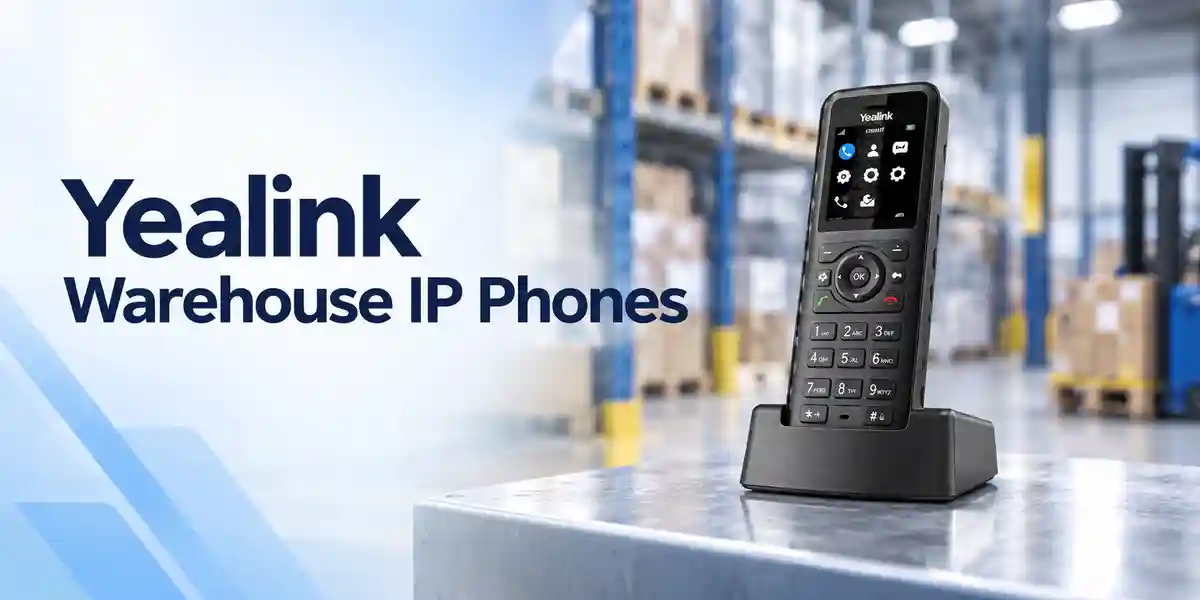
Operationally, the most common friction point is coverage planning. Published maximum range figures describe ideal conditions and should not be treated as guaranteed building-wide coverage. Reinforced concrete, metal racks, cold-room structures, lift shafts and machinery can attenuate radio signals. A sensible rollout maps expected user routes, identifies areas where a call must remain reliable and tests those paths before a large handset quantity is committed. Up to six RT30 repeaters can be supported by the W70B where suitable, but repeater placement should be engineered rather than assumed.
The W59R Pro is particularly relevant where ordinary office cordless phones are too delicate. Its IP67 classification, rugged construction, emergency button and automatic alarm capabilities support workplace use cases where drops, dust, moisture or safety procedures are meaningful procurement considerations. These capabilities do not replace a formal occupational safety system, but they can form part of a communication design that keeps mobile staff reachable.
Enterprise Business Outcomes & Value Analysis
Key Hardware & Software Highlights
| Component / capability | Technical role | Operational outcome |
|---|---|---|
| W70B DECT IP base | SIP registration and DECT radio anchor | Central cordless voice service for mobile users |
| W59R Pro handset | IP67 rugged mobile endpoint | Better fit for demanding work areas |
| 2.4-inch colour display | 240 × 320 TFT user interface | Clear call and menu visibility |
| Bluetooth | Wireless headset connection | Hands-free mobility where workflows permit |
| FNR / noise cancellation | Reduces distracting environmental noise | More intelligible conversations in active spaces |
| Auto provisioning | Remote configuration and fleet rollout | Lower manual deployment effort |
Technical Specifications Ledger
| Specification | Yealink W79P Pro detail |
|---|---|
| System capacity | Up to 10 DECT handsets, 10 SIP accounts and 20 simultaneous calls |
| Per-handset call capacity | Up to 2 simultaneous calls |
| Handset display | 2.4-inch 240 × 320 TFT colour screen |
| Protection | W59R Pro IP67 ruggedized handset; Yealink also specifies 2 m drop resistance for W79P Pro |
| Audio | Full-duplex speakerphone, HD audio, FNR, HAC compliance |
| Wideband codec | G.722; AMR-WB optional where applicable |
| Base interface | 1 × RJ45 10/100M Ethernet |
| Base power | IEEE 802.3af PoE Class 1 or Yealink 5 V / 0.6 A adapter |
| Ideal DECT range | Up to 50 m indoors / 300 m outdoors |
| Repeaters | Up to 6 RT30 repeaters per W70B base |
| W59R Pro battery | Lithium-ion; up to 28 h talk and 320 h standby under ideal conditions |
| Handset temperature | 0 to 40°C operating; -30 to +70°C storage |
| Operating humidity | 10–95% |
| Security | TLS, SRTP, HTTPS, digest authentication and encrypted configuration support |
| Provisioning | TFTP, FTP, HTTP, HTTPS, RPS and PnP workflows |
Specification values are manufacturer figures and may be dependent on firmware, region, configured services and ideal test conditions. Radio range and battery endurance in particular should be treated as planning references rather than guaranteed site results.
Configuration & Sizing Worksheet
1. Estimate users and call load
Count every employee who needs a dedicated handset and every shared handset assigned to a shift, security desk or operational zone. Then estimate how many conversations may overlap during peak periods. A W70B supports up to ten registered endpoints and twenty simultaneous calls, but PBX extensions, SIP trunks and upstream bandwidth must also support the desired concurrency.
2. Map the radio environment
Mark the proposed base location and every area where staff must place or receive calls. Note concrete walls, steel shelving, elevators, machinery and outdoor transitions. Test coverage in the real building. Do not purchase repeaters solely from a floor-plan distance calculation; physical materials can change practical range significantly.
3. Validate power and cabling
Confirm an Ethernet run is available at the base location. If the switch supplies IEEE 802.3af PoE, the base can receive network and power through the same cable. Where PoE is unavailable, plan an AC outlet and use the appropriate Yealink adapter. For critical communications, consider how the Ethernet switch, PBX and Internet edge remain powered during an outage.
4. Confirm service compatibility
Document the PBX or hosted SIP platform, extension quantity, authentication method, VLAN requirements, codec policy and provisioning approach. Yealink DECT endpoints are designed around the Yealink ecosystem; third-party DECT handset/base interoperability should not be assumed. SIP interoperability and any service-specific feature behavior should be validated before a large deployment.
5. Prepare the quotation
Provide site, quantity, handset allocation, spare requirements, repeaters, headsets, power method, SIP/PBX platform, delivery destination and required deployment assistance. This turns a simple unit-price request into a bill of materials that can be checked against the actual operating requirement.
Deployment Scenarios & Industry Use Cases
Large Enterprise & Multi-Site Operations
Within branch offices, service depots and operational buildings, W79P Pro systems can provide cordless SIP extensions to employees who move within defined local zones. Multi-site organizations can standardize handset behavior and provisioning while keeping each site’s radio design appropriate to its building. Sites requiring broader seamless roaming than a single-cell W70B design should be evaluated against Yealink multi-cell architecture rather than forcing a single base beyond its intended role.
Financial & Banking Operations
Back-office operations, facilities teams, secure stores and support personnel can use mobile voice while remaining integrated with the organization’s SIP communications environment. Security teams should define VLAN, TLS/SRTP, management credentials and provisioning policies as part of deployment. The phone system is one component of the institution’s security architecture and does not replace broader controls.
Education & Campus Facilities
Maintenance teams, laboratories, stores, security posts and administrative support personnel may benefit from cordless extensions within individual buildings. Rugged construction can be useful for staff who move through practical work areas rather than remaining at desks. Each building should be surveyed independently because campus construction varies widely.
Government & Institutional Procurement
Public-sector buyers can specify model, quantity, environmental requirements, SIP compatibility, warranty expectations, delivery destination and acceptance criteria in the request for quotation. FourTeck can help translate those requirements into a product bill of materials, while the procuring organization retains responsibility for policy, security accreditation and formal acceptance.
Three Technical Deep-Dives
Processing, Radio and Voice Architecture
The W70B performs the core role of connecting DECT mobility to an IP voice network. SIP signaling and media reach the base over Ethernet, while cordless endpoints use DECT for their local wireless link. This separation is valuable because the handset’s voice mobility is not competing as a generic client on the organization’s Wi-Fi access layer. The base is sized for up to ten SIP accounts and twenty simultaneous calls, which gives small and medium workgroups a clear capacity boundary for planning. Each handset supports up to two simultaneous calls, allowing normal hold and switching workflows. Voice quality depends on the complete path: handset radio conditions, DECT coverage, LAN configuration, WAN quality where hosted services are used, codec selection and PBX/SIP provider performance. The W59R Pro includes full-duplex speakerphone operation, HD audio and flexible noise reduction. These features are particularly useful where environmental sound would otherwise make a mobile call tiring or difficult to understand.
Software Ecosystem, Firmware Security & Operational Control
A business phone fleet becomes expensive when every configuration change requires manual intervention. The W70B supports browser-based configuration and multiple automatic provisioning protocols, while compatible handsets can receive over-the-air updates through the base. For administrators, this makes it possible to maintain repeatable configuration templates and coordinate firmware changes. Security controls include TLS for signaling, SRTP for media, HTTPS for protected management transport, digest authentication and encrypted configuration-file capabilities. Those functions must be configured correctly to provide value; simply purchasing a device with security features does not automatically secure a voice environment. Administrators should change default credentials, restrict management access, maintain approved firmware, use appropriate network segmentation and align SIP security with the PBX or hosted provider.
Availability, Redundancy & Recovery Planning
A single W70B is a single radio and network anchor, so organizations should identify how important cordless voice is to operations before choosing the topology. A power failure at the PoE switch, an Ethernet outage, base failure or PBX outage can interrupt service even when handset batteries remain charged. Critical environments should consider UPS-backed switching, resilient PBX/SIP services, documented spare strategy and tested replacement procedures. The W70B supports outbound proxy server backup, but end-to-end resilience still depends on upstream architecture. For larger premises or requirements involving seamless movement across multiple cells, a Yealink multi-cell system may be more appropriate. Disaster recovery planning should include configuration backups, firmware records, extension mapping and a known process for enrolling replacement endpoints.
Pre-Purchase Buyer Gap Checklist
Are there hidden licences? The hardware’s published capacity does not by itself establish the commercial terms of your PBX, hosted SIP service, Microsoft environment or third-party platform. Confirm extension licences, SIP subscriptions and any provider-specific charges separately. Will any DECT handset work? No assumption should be made about third-party DECT compatibility; Yealink states its DECT implementation is not compatible with third-party DECT devices. Select endpoints from the supported Yealink range and verify firmware compatibility. Will published range cover the building? Not necessarily. The 50 m indoor and 300 m outdoor figures are ideal-condition references. Survey real routes through the site.
Does PoE mean the handset charges from Ethernet? No. PoE powers the W70B base station. The cordless handset uses its rechargeable battery and charging cradle. What happens during a power cut? The handset battery may remain charged, but calls depend on the base, Ethernet switching and SIP/PBX path remaining operational. UPS design should therefore cover the communications chain. Is W79P Pro suitable for a huge campus? A single-cell base is best considered for defined coverage zones. Large facilities requiring broader seamless roaming should be assessed for a multi-cell solution.
What should be ordered as spares? The answer depends on business criticality. High-utilization operations may keep a spare handset, battery/charging capability or base strategy available so an accidental failure does not wait for an international replacement cycle. Can Bluetooth be used? The W59R Pro supports Bluetooth headset connectivity. Validate the intended headset model and workplace policy before standardization. How should firmware be handled? Record approved versions, test changes before broad rollout and maintain a controlled provisioning process. What is the practical procurement boundary? Hardware, SIP service, PBX licences, LAN switching, PoE, UPS, cabling, configuration and support are separate layers; a complete quote should identify which are included and which remain customer-provided.
Uganda Procurement, Delivery & Technical Preparation
FourTeck Uganda can prepare a commercial quotation around the W79P Pro system and associated requirements. A useful request includes the organization name, delivery city, quantity, current PBX or hosted SIP platform, number of required extensions, approximate site dimensions, working environment and whether the network already provides PoE. This information allows the quote to distinguish the core W79P Pro bundle from additional handsets, repeaters, compatible headsets, network equipment or support requirements.
Order processing and delivery timing depend on confirmed stock, quantity and supply route at the time of purchase. Buyers should request the required delivery date rather than assume a fixed lead time. For project deployments, allow time for configuration validation, site readiness and acceptance testing. Where pre-configuration is agreed, extension parameters and provisioning information should be transferred through an appropriate secure process.
Warranty handling should be confirmed on the quotation and invoice, including the applicable term and process for diagnosis or replacement. Serial-number records and original commercial documentation should be retained by the customer. For multi-unit deployments, keeping an asset register of base stations, handsets and assigned users simplifies later support.
Uganda Coverage Matrix
Organizations in Kampala can request supply for offices, logistics operations, healthcare facilities, hospitality properties and industrial sites. Entebbe deployments may include hospitality, aviation-adjacent businesses, stores and service operations. In Jinja, rugged cordless communications can be considered for manufacturing, warehousing and institutional environments. Mbarara buyers can request solutions for regional businesses, education, healthcare and distributed operations, while Gulu projects can be quoted for commercial, institutional and service-sector requirements. Delivery feasibility, cost and lead time are confirmed per order and destination.
Cross-Border & Regional Supply
Organizations operating across multiple countries can coordinate related requirements through FourTeck regional channels. Visit FourTeck Uganda for Uganda enquiries, FourTeck Kenya for Kenya, FourTeck Africa for broader African projects, FourTeck UAE for United Arab Emirates requirements and FourTeck Kuwait for Kuwait. Cross-border projects should account for regional DECT frequency rules, power accessories, tax/import requirements, warranty routing and local service-provider compatibility rather than assuming that every regional SKU is identical.
Related Solutions & Internal Navigation
A W79P Pro project often touches more than the cordless phone itself. Explore enterprise technology solutions in Uganda and contact the team for compatible Yealink DECT handsets, DECT repeaters, SIP desk phones, PoE switching, UPS power protection, network cabling and business communication accessories. Where the requirement grows beyond a single-cell deployment, request an assessment for Yealink multi-cell DECT architecture. For users who remain at desks, a wired SIP phone may be more economical than assigning rugged cordless endpoints universally. For reception and meeting spaces, dedicated desk and conference endpoints can coexist with the cordless layer when supported by the same communications platform. A mixed endpoint design frequently provides better value than forcing one phone type into every role.
FourTeck Technical Service Capabilities
Technical procurement begins with validation. FourTeck can review the requested bill of materials against user quantity, radio coverage assumptions, SIP/PBX environment and network power design. This helps identify common gaps such as ordering a base without enough handsets, overlooking repeater requirements, assuming unsupported third-party DECT compatibility or forgetting the network and power infrastructure behind the phone system.
Where included in the agreed project scope, staging can cover basic device inspection, firmware alignment, configuration preparation and documentation before shipment. Pre-shipment work is especially useful when equipment will be distributed to branches that do not have dedicated voice engineers. Post-sales technical support can then focus on configuration verification and fault isolation rather than reconstructing an undocumented deployment. The exact service scope, response arrangement and any chargeable engineering work should be stated in the quotation so both technical and procurement teams have the same expectations.
Extended Technical FAQ
1. What exactly is included in a Yealink W79P Pro system?
The W79P Pro architecture combines a W70B DECT IP base station with a W59R Pro rugged handset and the applicable charging and power accessories for the regional package. Exact carton contents should be checked on the quotation because regional packaging and revisions can change. The base provides the Ethernet/SIP connection and DECT radio service, while the handset is the mobile user endpoint. Additional compatible handsets and repeaters are separate requirements unless explicitly included in the commercial offer.
2. How many handsets and calls can one W70B support?
The W70B supports up to ten compatible DECT endpoints, up to ten SIP accounts and up to twenty simultaneous calls at system level. A W59R Pro handset supports up to two simultaneous calls. These are platform limits, not guarantees that an upstream SIP service will provide the same capacity. The PBX, hosted voice plan, SIP trunk and Internet/LAN design must also be sized for the intended calling load. For deployments approaching platform limits, document peak concurrency before purchase.
3. Is the W59R Pro suitable for warehouses and industrial areas?
It is specifically positioned as a rugged handset and carries an IP67 protection rating, making it more appropriate for demanding workplaces than a conventional office handset. Yealink also describes the Pro generation as drop resistant and suitable for challenging environments. However, IP ratings do not make a device indestructible or suitable for every hazardous location. Buyers should compare the site’s dust, moisture, chemical, temperature and safety requirements against the manufacturer’s specifications and any industry-specific rules.
4. Can the W79P Pro use our existing SIP PBX?
The system is SIP based and supports standard SIP functionality, but feature-level interoperability depends on the PBX or hosted service. Before a large rollout, validate registration, inbound and outbound calling, transfer, hold, caller ID, voicemail indication, directory integration and any provider-specific functions that matter to users. Also confirm whether the service requires device licences or certified firmware. A successful basic SIP registration does not automatically guarantee every advanced PBX feature.
5. Does the system require separate licensing?
The Yealink hardware capacity should be considered separately from third-party commercial licensing. Your PBX, hosted SIP service or communications platform may charge per user, extension, trunk, feature or subscription. Network management and support contracts may also be separate. Before purchase, request a complete cost picture that distinguishes hardware from recurring service charges. This prevents a low hardware price from masking a larger operational subscription requirement and makes multi-year budgeting more accurate.
6. What range should we expect inside a real building?
Yealink publishes an ideal-condition figure of up to 50 metres indoors and 300 metres outdoors. Real indoor performance can be lower because concrete, metal, glass coatings, storage racks, machinery and building geometry affect radio propagation. Treat published range as an initial design reference only. The strongest procurement method is to test the actual routes staff use, especially stairwells, loading bays, cold rooms, basement areas and transitions between indoor and outdoor zones. Optional RT30 repeaters can extend coverage where properly planned.
7. How does PoE work with the W79P Pro?
The W70B base station supports IEEE 802.3af PoE Class 1, so a compatible PoE switch or injector can deliver base power over the Ethernet connection. This can simplify installation and makes it easier to place voice infrastructure behind a centralized UPS. PoE does not charge the cordless handset. The W59R Pro uses its rechargeable battery and charging cradle. If PoE is not available, the base can use the appropriate Yealink AC adapter. Confirm switch power budget before deploying many powered network devices.
8. What security features are available?
The platform supports mechanisms including TLS, SRTP, HTTPS, digest authentication and secure configuration-file handling. These provide building blocks for protected signaling, media and management. Effective security still depends on configuration and operational practice: use strong administrator credentials, restrict management access, maintain supported firmware, separate voice traffic where appropriate, protect provisioning credentials and align encryption settings with the SIP platform. Organizations with formal security standards should test the complete voice path against their policy before production acceptance.
9. How should warranty and replacement be handled in Uganda?
The applicable warranty baseline should be stated on the FourTeck quotation or invoice for the supplied unit. Keep serial numbers, purchase documents and deployment records so a reported fault can be traced efficiently. If mobile voice is operationally critical, consider purchasing spare capacity rather than relying entirely on replacement turnaround. Troubleshooting normally begins by separating handset, battery/charger, DECT coverage, base, Ethernet, SIP registration and upstream service issues so the failed layer can be identified before hardware is returned.
10. Can FourTeck help with configuration before delivery?
Configuration and staging support can be discussed as part of the project scope. Useful preparation information includes the SIP server or PBX, extension plan, authentication details, VLAN requirements, codec policy, time settings, directory requirements and firmware policy. For security, credentials should be exchanged through an agreed protected method. Even when devices are pre-configured, the customer site must still provide a functioning LAN, correct VLAN/PoE environment and reachable SIP service. Final acceptance testing should be performed in the actual deployment environment.
Prepare Your Yealink W79P Pro Uganda Quotation
For an accurate commercial proposal, send the required handset quantity, delivery location, PBX or hosted SIP platform, approximate coverage area and any repeater, headset, PoE or staging requirements. FourTeck can review the requested system against the W70B capacity and W59R Pro operating profile, identify obvious bill-of-material gaps and prepare a quote based on the current supply position. For larger or more complex buildings, include a floor plan or describe the areas where staff must remain reachable so the conversation can begin with the correct architecture rather than only a handset count.

Reviews
There are no reviews yet.