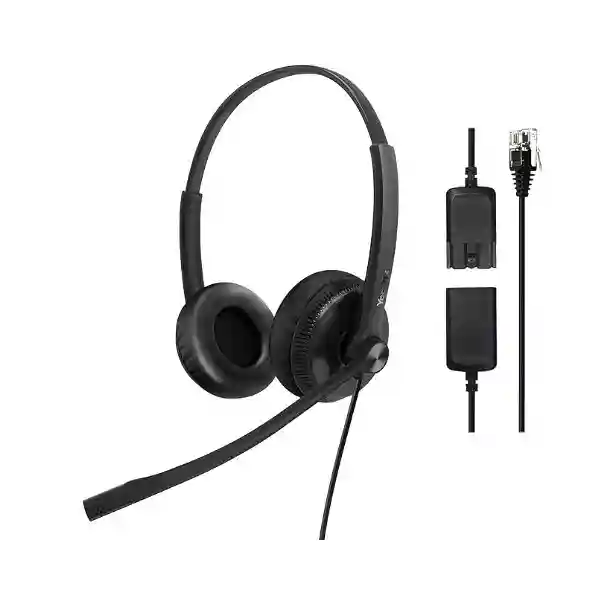
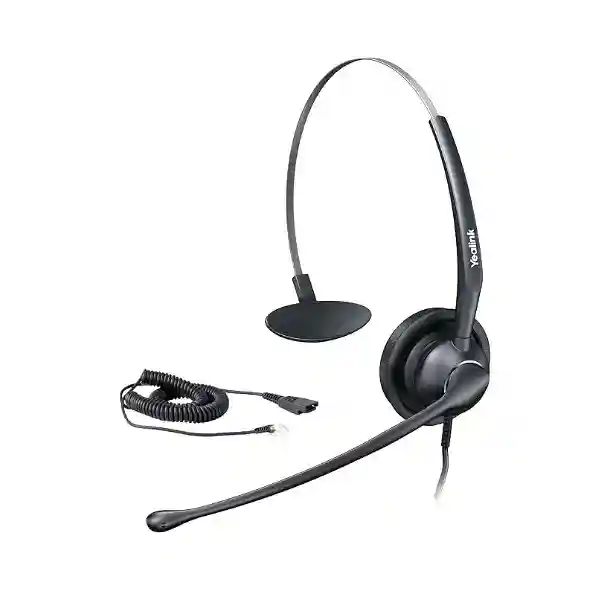
Yealink YHS34 Lite Wired Headset – Professional RJ9 Business Communications
The Yealink YHS34 Lite is a professional analog headset created for users who spend a significant part of the working day on voice calls. It connects through a Quick Disconnect cable to an RJ9 headset interface on compatible Yealink IP phones, giving organizations a direct, uncomplicated headset path without batteries, wireless pairing or desktop software. For reception desks, customer-service teams, sales departments, support desks and general office users, this design addresses a familiar operational requirement: consistent voice quality with minimal setup and a wearable form factor suited to repeated calls.
The Lite designation identifies the version supplied with foam ear cushions. Yealink offers the family in mono and dual configurations, allowing procurement teams to choose between greater awareness of the surrounding workplace and stronger passive isolation. The headset supports wideband audio, uses a unidirectional ECM microphone, and incorporates passive noise reduction and Yealink ActiveProtection. These characteristics make it a practical endpoint accessory when organizations want standardized headsets around an existing Yealink desk-phone estate.
FourTeck supports Uganda buyers with compatibility validation, quantity planning, bill-of-materials review and quotation. Before purchasing, confirm the exact desk-phone models, mono or dual preference, user count, deployment sites and delivery schedule. This prevents connector assumptions and makes large rollouts easier to stage.
Instant Specifications & Procurement Fact Rail
YHS34 Lite Mono / Dual
QD to RJ9 analog
Wideband / HD voice performance
Unidirectional ECM, noise canceling
Office, SOHO, reception and call center
Quote subject to current stock and project quantity
Unlike USB headsets, the YHS34 Lite is centered on the analog headset port of compatible Yealink desk phones. This matters during procurement because the endpoint interface determines whether the headset can be deployed directly. The supplied headset cable is approximately 0.9 m and the QD-to-RJ9 cable approximately 1.2 m, providing a combined working cable arrangement suitable for normal desk use. The headset is black and is supplied with a quick-start guide and connection cable. Warranty terms should be confirmed on the commercial quotation for the destination, quantity and supply batch.
Operational Product Architecture & Overview
The YHS34 Lite uses a deliberately simple architecture: an analog acoustic endpoint, a Quick Disconnect junction and an RJ9 termination designed for compatible Yealink phones. This removes several moving parts associated with wireless devices. There is no battery fleet to charge, no radio spectrum to manage and no per-user desktop application required for the basic headset path. In environments where hundreds of agents or office users need dependable desk-phone audio, that simplicity can reduce setup variation and support effort.
At the microphone stage, the unidirectional ECM design is intended to favor speech arriving from the user while reducing unwanted surrounding sound compared with an omnidirectional pickup pattern. Yealink specifies a microphone response of 100 Hz to 8 kHz and sensitivity of -44 dB re 1 V/Pa. At the listening stage, the 28 mm speaker is specified at 93 dB SPL at 1 kHz, with 32-ohm impedance and a 20 Hz to 20 kHz response range. The headset is engineered around voice communications, with wideband operation and an independent acoustic cavity design.
For a procurement manager, the practical questions are rarely limited to audio specifications. Teams need to know whether the connector matches the installed phone fleet, whether users can wear the headset for long shifts, whether replacement and staging are straightforward, and whether a standard model can cover several departments. The YHS34 Lite responds to these concerns with plug-and-play RJ9 integration across a broad Yealink phone portfolio, lightweight construction, foam cushions, and mono/dual choices. Its Quick Disconnect point can also be useful in fixed-desk operations because a user can separate the headset from the lower cable without repeatedly accessing the rear phone port.
The physical design supports long-duration work. The boom microphone can be positioned around the user’s mouth and adjusted through a broad bendable range. Passive noise isolation comes from the headset structure and ear coupling rather than electronic active noise cancellation. This distinction should be understood when specifying the product for very loud workplaces: it is well suited to ordinary office and contact-center noise, but organizations with unusually high ambient sound should evaluate the actual environment and compare alternative acoustic designs before standardizing.
Enterprise Business Outcomes & Value Analysis
For large organizations, value comes from repeatability. A headset that can be issued with a consistent connection method and known acoustic behavior is easier to document, stock and support. Users can be trained on the same basic workflow, while IT teams can validate compatibility against a controlled list of Yealink phone models. Procurement teams should calculate total requirement by active seats, spare pool, training desks and anticipated growth rather than purchasing only the exact current headcount.
Key Hardware & Software Highlights
| Component | Design | Operational Outcome |
|---|---|---|
| Connection | QD to RJ9 | Direct analog integration with compatible Yealink phones. |
| Microphone | Unidirectional ECM | Speech-focused pickup for business conversations. |
| Speaker | 28 mm, wideband | Clear voice reproduction and comfortable listening. |
| Cushion | Foam | Defines the Lite edition and supports lightweight wear. |
| Protection | ActiveProtection | Helps safeguard frequent users from acoustic injury. |
Technical Specifications Ledger
| Product family | Yealink YHS34 / YHS34 Lite |
| Variants | YHS34 Lite Mono and YHS34 Lite Dual |
| Interface | QD to RJ9 |
| Microphone | Unidirectional ECM; 100 Hz–8 kHz; -44 dB re 1 V/Pa |
| Speaker | 28 mm; 93 dB SPL @ 1 kHz; 20 Hz–20 kHz; 32Ω @ 1 kHz; max input 10 mW |
| Headset cable | 0.9 m |
| QD-to-RJ9 cable | 1.2 m |
| Operating temperature | -10°C to +50°C |
| Storage temperature | -30°C to +70°C |
| Gift box | 170 × 195 × 63 mm |
| Carton | 345 × 325 × 400 mm; 20 pieces/carton |
Because this is a passive wired endpoint rather than an independently powered network device, conventional network throughput, rack-unit consumption and AC power-draw specifications do not apply. Procurement documentation should not invent those values. Instead, validation should focus on phone interface compatibility, acoustic requirements, user comfort, cable routing and the chosen mono or dual variant.
Configuration & Sizing Worksheet
Step 1 – Count active users: record the number of permanent desks, shared shift desks and spare units required for rapid replacement. For call centers, include training positions and supervisor desks.
Step 2 – Map phone models: export or manually record the exact Yealink desk-phone models. RJ9 compatibility must be validated before the purchase order is finalized, especially in mixed-generation estates.
Step 3 – Choose mono or dual: mono suits roles where awareness of colleagues and surrounding activity matters; dual is often preferred where users need greater acoustic focus.
Step 4 – Check workspace: confirm that cable length, desk layout and phone placement allow safe routing without tension or snag points. Unlike a rack product, the critical physical consideration is the user’s workstation.
Step 5 – Confirm commercial scope: include quantity, site, required delivery date, warranty expectation, tax treatment and any staged delivery requirement. The YHS34 Lite itself does not require a recurring software subscription for basic analog headset operation.
Step 6 – Build a spare policy: for large deployments, hold a controlled spare pool so damaged or heavily worn units can be swapped without interrupting a user’s working day.
Quote checklist: Yealink phone model list, user quantity, mono/dual split, Uganda delivery town, contact person, target deployment date and any requirement for related desk phones or communication accessories.
Deployment Scenarios & Industry Use Cases
Large Enterprise and Multi-Site Offices
Enterprises can standardize the YHS34 Lite across reception, support, sales and administrative teams where compatible Yealink desk phones are already deployed. A shared bill of materials simplifies purchasing across branches, while mono and dual choices allow role-specific deployment without introducing unrelated headset platforms. For multi-site rollouts, label quantities by destination and retain a small spare allocation at each major office.
Financial and Banking Institutions
Branch personnel and customer-contact teams often require dependable fixed-desk calling. A wired headset avoids wireless charging routines and provides a predictable physical connection. Procurement teams should still validate internal endpoint policies, desk-phone models and any institutional requirements concerning accessories before rollout.
Educational and Campus Networks
Universities, schools and training institutions can use the headset for admissions desks, finance offices, ICT support and administrative calling. In campuses with distributed offices, standardizing accessories around supported Yealink phones reduces the number of headset types that technical teams must troubleshoot.
Government and Public-Sector Procurement
Public-sector buyers commonly need clear model identification, repeatable specifications and documented quantities. FourTeck can structure quotations around department, site and required variant. Where tender documents specify compatibility or warranty evidence, those requirements should be identified before order placement so the commercial response matches the procurement file.
Technical Deep Dive 1: Acoustic Engine and Signal Path
The YHS34 Lite does not contain the packet-processing silicon found in an IP phone or network appliance; its engineering value is in the acoustic signal path. The microphone converts speech into an electrical signal for the connected phone, while the phone provides the telephony processing and network transport. This separation is important when diagnosing voice quality. A problem may originate in microphone positioning, the physical headset connection, phone configuration, network conditions or the remote endpoint. Good deployment practice therefore starts with a known-good phone and cable, correct headset mode and a test call.
The unidirectional microphone helps reject sound arriving away from its principal pickup direction. Correct boom placement remains important: users should position it consistently near the mouth rather than above the nose or far below the chin. The 28 mm speaker and wideband design are intended for speech clarity, while passive isolation is influenced by ear-cushion fit and whether the mono or dual version is selected.
Technical Deep Dive 2: Phone Integration and Operational Control
Integration is intentionally direct. The headset terminates through the QD-to-RJ9 path at the Yealink phone’s headset interface. Compatible Yealink phones can optimize acoustic parameters for the headset. There is no independent firmware image to maintain on the YHS34 Lite itself in the way an IP endpoint would require. Operational control therefore remains largely with the connected phone: headset enablement, call handling and telephony behavior are governed by the phone and its deployment configuration.
This architecture reduces software maintenance at the accessory layer, but it makes phone compatibility a central purchasing criterion. Organizations refreshing older phones or mixing several endpoint generations should validate the complete estate rather than assuming every four-conductor handset-style socket is electrically interchangeable.
Technical Deep Dive 3: Continuity, Spares and Recovery
High availability for a wired headset is operational rather than electronic. There is no redundant power supply or failover radio. Continuity comes from standardized models, spare stock, replaceable connection paths and clear support procedures. In a contact center, a failed headset can immediately affect agent productivity; keeping tested spares near the floor can therefore be more valuable than complex repair workflows.
The QD design also supports practical separation between the wearable headset and the phone-side cable. Support teams should maintain a simple fault-isolation procedure: test the phone headset port, inspect the QD and RJ9 connections, swap the cable where appropriate, and then test with a known-good headset. This approach shortens incident resolution and helps identify whether replacement of the complete unit is necessary.
Pre-Purchase Buyer Gap Checklist
Licensing: basic analog headset use does not introduce a headset software subscription. Any broader telephony licenses belong to the phone or communications platform and should be assessed separately.
Generation lifecycle: verify that the Yealink phone fleet remains supported and that the intended headset interface is available on current and future replacement models.
Connector assumptions: RJ9 is a physical connector family, but purchasing should be based on confirmed compatibility rather than connector appearance alone.
Power: the headset does not require an external AC adapter or charging base. It operates through its wired connection to the phone.
Comfort: the Lite version uses foam cushions. Buyers comparing it with the standard YHS34 should note the different cushion material and consider user preference during pilots.
Mono versus dual: select according to job role and ambient noise rather than making a single arbitrary choice for every employee.
Cross-vendor use: this model is positioned for Yealink phone integration. For non-Yealink phones, obtain explicit electrical and functional compatibility confirmation before purchase.
Environmental fit: specified operating temperature is -10°C to +50°C, but office comfort, humidity, dust and handling conditions also affect real-world service life.
Consumable planning: high-use environments should plan for hygiene, wear, spare headsets and user handover procedures, particularly at shared desks.
Uganda Procurement & Delivery Logistics
FourTeck can prepare Uganda quotations for single-site requirements and larger organization-wide deployments. A useful request includes exact product name, mono or dual preference, quantity, delivery town, organization details and target date. Where the headset is being purchased alongside new Yealink phones, provide the phone models so the complete endpoint combination can be reviewed as one bill of materials.
Order processing depends on quoted stock position, quantity and supply route. Buyers with fixed project dates should request lead-time confirmation before issuing a purchase order. For larger rollouts, staged delivery can be discussed where operationally appropriate. Pre-deployment support can include compatibility review and documentation of the intended phone/headset pairing. Commercial quotations should be treated as the source for current price, availability, warranty baseline and delivery commitments because these can vary by supply batch and project scope.
Local Coverage Matrix
Kampala: central offices, call centers, corporate headquarters and branch deployments can be quoted with quantity-based planning. Entebbe: hospitality, aviation-adjacent offices and business operations can request endpoint compatibility review. Jinja: industrial and commercial organizations can plan branch or department rollouts. Mbarara: regional offices, education and healthcare administration can source standardized Yealink communication accessories. Gulu: public, NGO, education and enterprise teams can request project quotations and delivery planning. Coverage outside these hubs can be discussed according to destination and shipment requirements.
Cross-Border & Regional Supply Chains
Organizations operating across East Africa, the Gulf and broader African markets often benefit from keeping endpoint specifications consistent between countries. FourTeck regional channels can support procurement discussions through Uganda, Kenya, Africa, UAE and Kuwait. Cross-border requirements should identify destination country, quantities, required delivery windows and whether a single standardized Yealink phone/headset combination will be used across all sites. Import, tax, warranty and lead-time conditions can differ by destination, so each commercial quotation should be reviewed on its own terms.
Related Yealink Communication Options
A headset purchase is often part of a wider endpoint project. Buyers can review FourTeck Uganda for Yealink IP phones, office communication systems, reception endpoints and unified communications accessories. For teams requiring computer connectivity rather than an RJ9 phone connection, consider Yealink USB wired headset families. For users who need mobility away from the desk, evaluate Yealink DECT wireless headset options. When replacing desk phones at the same time, request a combined quotation so headset compatibility can be validated against the proposed phone model before shipment.
Related planning areas include Yealink executive IP phones, reception IP phones, call-center phone deployments, SIP phones and unified communications solutions. Selecting these components as an integrated endpoint stack reduces the risk of discovering connector or workflow differences after equipment reaches the site.
FourTeck Technical Service Capabilities
FourTeck’s procurement support can begin before a purchase order. Engineering validation focuses on the intended endpoint combination: phone model, headset interface, deployment role and quantity. Bill-of-materials verification is particularly valuable when an organization has multiple Yealink phone generations or is refreshing phones and headsets together.
For staged projects, the deployment list can be organized by site or department so quantities are easier to reconcile. Where associated IP phones require firmware preparation or configuration, those services can be scoped separately from the passive headset itself. Post-sales technical support can assist with connection checks, headset enablement on supported phones and basic fault isolation. Organizations should retain purchase and serial/batch documentation where applicable to simplify warranty processing and replacement administration.
Extended Technical FAQ
1. Is the Yealink YHS34 Lite compatible with Yealink IP phones?
Yes. Yealink positions the YHS34/YHS34 Lite as a QD-to-RJ9 wired headset for its enterprise IP phone range, and current Yealink support material lists the family among tested wired headsets for multiple phone generations. Compatibility should nevertheless be confirmed against the exact phone model and firmware environment before a large purchase. This is especially important in estates that contain older endpoints, newly released phone families or devices from another manufacturer. Provide FourTeck with the phone model list when requesting a project quotation.
2. What is the difference between YHS34 and YHS34 Lite?
The principal published distinction is ear-cushion material: the standard YHS34 uses leather-style cushions, while the YHS34 Lite uses foam cushions. Both families are designed around professional wired calling and are offered in mono and dual configurations. Cushion choice affects feel and user preference, so organizations with large user populations may wish to pilot a small number before standardizing. The Lite model is a sensible choice where buyers prioritize a straightforward lightweight headset design and foam ear contact for daily desk-phone use.
3. Does the YHS34 Lite require software licensing?
The headset itself is an analog wired accessory and does not require a recurring software license for basic operation. It does not behave like a cloud-managed application endpoint. The connected Yealink phone and the organization’s PBX, hosted telephony service or unified communications platform may have their own licensing requirements, but those are separate from the headset. Procurement teams should therefore distinguish headset cost from phone licensing, SIP service, PBX subscriptions and any support agreements associated with the broader communications environment.
4. Does it need a power adapter or battery?
No separate headset battery, charging dock or AC power adapter is required for the basic YHS34 Lite connection. The product is designed as a wired analog headset connected to the phone through the supplied QD-to-RJ9 cable. This can be operationally attractive for fixed workstations because users do not need to remember to recharge a headset between shifts. It also removes battery replacement from the headset maintenance cycle. The connected IP phone, of course, still needs its own normal power source, such as PoE or an appropriate adapter depending on the phone model.
5. Is the microphone suitable for a call center?
The YHS34 Lite is explicitly positioned for office workers, SOHO users and call-center staff. It uses a unidirectional ECM microphone, passive noise reduction and a wideband voice design. In a conventional contact center, these features can improve speech focus compared with an open microphone arrangement. However, ambient noise differs substantially between sites. Very loud floors should conduct a real-world pilot, compare mono and dual versions and review seating density and acoustic treatment. Headset technology should complement, not replace, good workplace acoustic design.
6. Should we buy mono or dual?
Choose according to work role. A mono headset leaves one ear open, which can be useful for receptionists, supervisors and office staff who need to hear nearby colleagues or visitors. A dual headset covers both ears and can help users concentrate on calls in busier environments. Neither choice is universally better. For mixed departments, a practical procurement approach is to define role profiles and assign variants accordingly. Include the required mono/dual split on the quotation request so quantities are clear and accidental substitution is avoided.
7. What happens if a headset fails?
First isolate the fault. Confirm that headset mode is enabled on the phone where applicable, reseat the RJ9 and Quick Disconnect connections, inspect the cable for damage and test the phone with a known-good headset. If the issue follows the headset, replacement may be appropriate. For larger installations, keeping a small spare pool avoids downtime while warranty or service questions are handled. Warranty processing should follow the terms stated on the FourTeck quotation or invoice, with purchase documentation retained to support the claim.
8. Can it be used with non-Yealink phones?
Do not assume compatibility solely because another phone has an RJ9-style headset socket. Physical connector shape does not guarantee identical electrical pinout, acoustic tuning or call-control behavior. The YHS34 Lite is designed and documented for Yealink IP phone integration. If a project includes another phone brand, provide the exact manufacturer and model for validation before purchasing. Where cross-vendor use is a firm requirement, a different headset family or an appropriate approved adapter may be more suitable than relying on an unverified direct connection.
9. What comes in the package?
Yealink’s published package information identifies the selected YHS34/YHS34 Lite mono or dual headset, a QD-to-RJ9 cable and a quick-start guide. The YHS34 Lite uses foam ear cushions. Package specifications can change over a product lifecycle, so large tenders should use the current quotation and manufacturer documentation as the controlling reference. If a project requires additional spare cables, hygiene accessories or other communication equipment, identify these separately so the bill of materials can be reviewed before the order is confirmed.
10. What information should be sent for a Uganda quotation?
Send the product name, required quantity, preferred mono or dual version, exact Yealink phone models, delivery location in Uganda, organization name and target deployment date. For multi-branch projects, split quantities by site and identify whether deliveries must be staged. If the headsets are part of a new phone rollout, include the proposed phone models and quantities as well. This allows FourTeck to review compatibility, prepare a clearer bill of materials and provide commercial terms that reflect the actual project rather than an incomplete single-item request.
Plan Your Yealink YHS34 Lite Deployment in Uganda
For a reliable quotation, specify your Yealink phone models, number of users, mono or dual preference, delivery destination and required timeline. FourTeck can help validate the headset-to-phone pairing, structure quantities for branch or departmental rollout, and identify related Yealink endpoint requirements. This is particularly useful for contact centers, reception environments and organizations standardizing communications accessories across multiple sites. Current price, stock, lead time and warranty terms should be confirmed through the project quotation before procurement approval.

Reviews
There are no reviews yet.