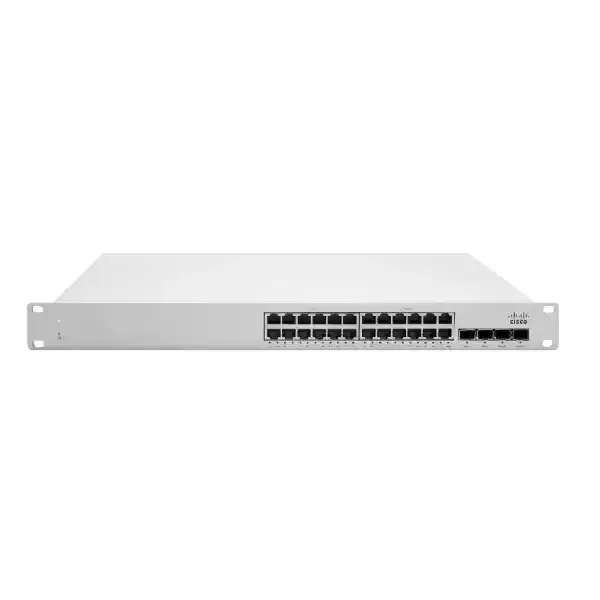
Cisco Meraki MS150-24P-4X Cloud-Managed 24-Port PoE+ Enterprise Access Switch
The Cisco Meraki MS150-24P-4X is designed for organizations seeking centrally administered wired access with power delivery to connected equipment. It brings together 24 Gigabit copper ports, four 10GbE SFP+ uplinks, a 370W shared PoE budget and dedicated hardware stacking. The switch is suited to a managed access layer where staff devices, telephones, cameras and wireless access points must operate under consistent policies across one or many sites.
A well-chosen access switch does more than connect cables. It establishes the foundation for endpoint availability, network segmentation, power planning, monitoring and troubleshooting. For a procurement team, the critical question is whether the chosen model can support the actual endpoint mix without exceeding the power budget or constraining uplink capacity. For the MS150-24P-4X, the answer depends on the port schedule, total connected PoE demand, optics selection, licensing and site design. FourTeck can help customers in Uganda assemble those requirements into a clear request for quotation.
At-a-Glance Procurement Facts
MS150-24P-4X; 24 Gigabit RJ45 access interfaces and four 10GbE SFP+ uplinks.
370W shared budget; up to 30W per supported access port, subject to the total budget.
Cloud-managed with the Cisco Meraki Dashboard; compatible licensing must be included in procurement planning.
Two dedicated stacking interfaces with 80Gbps stacking bandwidth.
Price, stock, import lead time, warranty terms and deployment services: confirm on quotation.
Architecture and Operational Role
The MS150-24P-4X belongs at the access layer of a branch or campus design. Endpoint connections terminate on its copper ports, while higher-speed SFP+ interfaces can connect toward a distribution switch, aggregation layer or suitable server infrastructure. The four 10GbE uplinks allow the network architect to allocate fiber paths for resilient upstream connectivity, subject to the selected topology and supported configuration. The 128Gbps switching capacity published for this model describes its internal switching capability; it should not be confused with the speed available to an individual copper-connected device, which remains 1Gbps.
Dedicated physical stacking can simplify administration when a wiring closet needs more access ports than a single chassis provides. Stacking is not a substitute for reviewing uplink paths, failure domains or power distribution. An organization should decide whether the stack will connect to one or two upstream systems, how fiber routes will be protected and how endpoint connections are distributed across members. Dashboard-based visibility can reduce the need to dispatch an engineer for every configuration change or initial diagnostic task, although onsite intervention remains necessary for cable faults, physical damage and power problems.
The product offers VLAN tagging, 802.1X authentication, access-control capabilities, DHCP snooping and dynamic ARP inspection. These mechanisms can help separate employee, guest, voice, camera and building-management traffic. Their effectiveness depends on accurate network design and policy implementation. Static routing is available for suitable designs, but buyers should not assume this access model provides the full dynamic routing feature set of a dedicated campus core platform.
Business Benefits for Enterprise Buyers
- Predictable access connectivity: Twenty-four Gigabit copper ports provide a defined endpoint capacity for desks, cameras and access points.
- PoE consolidation: A shared 370W power budget can reduce the need for individual endpoint power adapters when properly sized.
- Faster uplink options: Four 10GbE SFP+ ports support aggregation paths that exceed the rate of individual Gigabit access links.
- Consistent access controls: VLANs, 802.1X and supported protective controls help administrators apply common network policies.
- Centralized oversight: Dashboard administration, remote packet capture and monitoring help distributed IT teams investigate faults.
- Growth planning: Physical stacking allows an organization to consider additional access capacity without treating every chassis as an isolated management island.
- Procurement clarity: Separately itemizing hardware, licenses, optics and support terms helps avoid surprises after delivery.
Verified Technical Specifications
| Parameter | MS150-24P-4X |
|---|---|
| Access interfaces | 24 × 10/100/1000 Mbps RJ45 |
| Uplinks | 4 × 10GbE SFP+ |
| PoE | Up to 30W per port; 370W shared switch budget |
| Stacking | 2 dedicated interfaces; 80Gbps stacking bandwidth |
| Switching capacity | 128Gbps |
| Routing | Static routing |
| Management interface | 1 dedicated management interface |
| Input | 100–240VAC |
| Published idle/max load | 22.9W / 422.2W |
| Rack mounting | Integrated 1U rack mounting |
| Operating environment | 0–45°C; 5–95% humidity |
| Administration | Cisco Meraki Dashboard, subject to licensing |
Specifications are based on Cisco’s published MS150 documentation. Confirm the current regional hardware revision, accessory compatibility and contractual conditions before purchase.
Configuration and Sizing Worksheet
1. Count actual powered endpoints
List each access point, camera, phone and other powered device by port. Include a reserve for future devices rather than filling every available port immediately.
2. Calculate the PoE requirement
Add the maximum expected draw for each powered device. Compare the sum with the 370W chassis limit and verify that no device requires more than the applicable per-port allowance. Twenty-four devices drawing 30W each would require 720W and therefore exceed this model’s total budget.
3. Size the uplinks
Document traffic destinations, peak utilization and the required fiber reach. Select compatible SFP+ modules and check the receiving switch’s optical specifications.
4. Confirm rack and power readiness
Allow 1U mounting space plus suitable airflow and cabling clearance. Verify grounding, electrical feed, UPS capacity and the room’s operating temperature.
5. Review licensing and support
Identify the correct MS150 licensing entitlement, intended term and Dashboard organization. Ask for the license line item to appear separately on the quotation where appropriate.
6. Build the purchase request
Provide model, quantity, delivery city, license term, optics, stacking cables, desired support arrangements and deployment schedule. Request written confirmation of availability and applicable warranty procedures.
Deployment Scenarios
Corporate offices and distributed branches
A standard office floor can allocate separate VLANs to workstations, voice endpoints and guest-facing systems. High-speed uplinks can carry aggregated traffic toward the organization’s security and distribution infrastructure. Centralized management supports consistent templates and monitoring across branch locations.
Banking and financial institutions
Financial environments often require tightly controlled access, change records and resilient connectivity. The switch can participate in a segmented access design, but compliance, logging retention and redundancy must be assessed at the solution level rather than assumed from a single device.
Education and campuses
Schools and universities may connect classroom access points, telephones and administrative endpoints. A room-by-room port and power plan helps determine whether the 370W PoE allocation is adequate for the selected wireless infrastructure.
Public sector and regulated facilities
Government and other regulated buyers should confirm approved supply channels, documentation, applicable procurement procedures and security controls. Deployment acceptance should include port labeling, configuration review and evidence of the requested license entitlement.
Three Engineering Considerations
Switching fabric and packet movement
The 128Gbps switching capacity provides a useful planning reference, but the network must still be evaluated at individual access and uplink speeds. Traffic oversubscription can occur when many active Gigabit ports share fewer upstream links. Estimate realistic concurrent demand, prioritize critical applications where supported and monitor utilization after commissioning.
Cloud operations and secure configuration
Dashboard administration can simplify multi-site inventory, configuration changes and troubleshooting. Organizations should define administrator roles, authentication requirements, change windows, firmware approval processes and a procedure for handling management connectivity interruptions. Security functions must be explicitly configured and tested against the intended access policy.
Stacking and continuity
Physical stacking offers a convenient way to manage multiple compatible switches, but it does not eliminate the need for resilient power, uplinks or spare equipment planning. Assess maintenance windows, failure scenarios and replacement procedures. For critical sites, document how service is restored if a member, optic, cable or upstream device fails.
Buyer Questions to Resolve Before Ordering
Is the license included? Do not assume so. Ask for an itemized license and support quotation.
Will it power all 24 attached devices? Only if the combined load stays within 370W and each port remains within its supported limit.
Are the copper ports multigigabit? No. This specific variant has 24 Gigabit RJ45 interfaces. Buyers needing multigigabit access should evaluate the relevant MP variant.
Are fiber modules included? Verify the bill of materials; uplink transceivers and cables should be listed explicitly.
Can the switch replace a core router? It supports static routing but should be assessed primarily as an access switch, not as a universal replacement for an advanced routing platform.
What is the real landed price? Confirm equipment, licensing, shipping, duties, taxes and services in the formal quotation.
Uganda Procurement and Delivery Planning
For procurement in Uganda, FourTeck can receive requirements for the MS150-24P-4X and prepare a quotation subject to sourcing confirmation. Buyers should identify the delivery destination, target date, billing details and whether onsite assistance is required. Shipping timelines depend on supplier inventory, import procedures and final delivery location; no specific delivery window is guaranteed without a confirmed offer.
Coverage: Kampala, Entebbe, Jinja, Mbarara and Gulu
Projects in Kampala may prioritize headquarters switching and staged rollouts. Entebbe sites may need reliable branch connectivity and carefully coordinated deliveries. Jinja industrial and administrative environments benefit from clear cabinet and cabling surveys. Mbarara and Gulu deployments should allow time for site readiness checks, transport coordination and local acceptance testing. For every location, the quotation should identify shipping arrangements and any separately priced engineering visit.
Regional sourcing options
For organizations managing networks across borders, procurement coordination may involve FourTeck Uganda, FourTeck Kenya, FourTeck Africa, FourTeck UAE and FourTeck Kuwait. Confirm local taxes, import responsibility, licensing region and warranty handling for each destination.
Related Switching and Access Planning
Compare the MS150-24P-4X with the MS150-24T-4X non-PoE model if endpoint power is not needed, the MS150-24MP-4X multigigabit model for higher-speed copper requirements, and the MS150-48FP-4X for larger port counts and higher total PoE allocation. Buyers can also review compatible uplink optics and Meraki licensing options. These are catalogue searches, not promises of availability or compatibility.
FourTeck Technical Assistance
Procurement support can include validating the proposed bill of materials, identifying suitable license terms, checking transceiver requirements and discussing pre-deployment configuration needs. Where specifically agreed, staging, firmware planning, configuration review and post-delivery support can be incorporated into the project scope. Buyers should request a written statement of included services and acceptance criteria rather than assuming that all implementation activities accompany hardware supply.
Frequently Asked Questions
What is the MS150-24P-4X designed to do?
It provides cloud-managed Gigabit access switching for enterprise branches and campus networks. Twenty-four copper ports connect endpoints, four SFP+ interfaces provide 10GbE uplink options, and a shared PoE budget can power compatible equipment. It is best evaluated as part of a broader network design that includes security, routing, cabling and management requirements.
Does it support PoE+ devices?
Yes. The model offers up to 30W per supported port with a 370W total switch power budget. The total matters: not all ports can simultaneously deliver their individual maximum. Calculate each endpoint’s demand and allow a reasonable operating margin before purchase.
Does it have 10GbE access ports?
Its four SFP+ ports support 10GbE uplink connectivity, while its 24 RJ45 access ports are Gigabit Ethernet. A requirement for faster-than-Gigabit copper access calls for evaluation of a different model with multigigabit interfaces.
Can it be managed remotely?
Yes, through the Cisco Meraki Dashboard with the appropriate licensing and connectivity. Dashboard functions can help teams review device status, administer ports and troubleshoot remotely. Organizations should also define local access and incident response procedures for periods when upstream connectivity is unavailable.
Is licensing required?
Meraki switching is sold within a licensing framework. The precise entitlement and duration should be confirmed for the customer’s organization and procurement arrangement. Request hardware and licensing to be clearly identified so that the full ownership cost is visible.
Can it be stacked?
Yes. The MS150-24P-4X includes two dedicated stacking ports with published 80Gbps stacking bandwidth. Confirm the compatible cables, intended stack membership and deployment topology. Stacking is useful for management and expansion but does not automatically make every component fault tolerant.
What security capabilities are available?
Published MS150 features include 802.1X authentication, VLAN tagging, IPv4/IPv6 access controls, DHCP snooping and dynamic ARP inspection. These controls require careful policy configuration and verification. Sensitive environments should combine access-switch features with upstream firewalls, identity controls and organizational security processes.
What warranty will apply in Uganda?
Warranty coverage and replacement handling depend on the applicable Cisco terms, the sales channel and the agreed supply arrangement. Ask FourTeck to state warranty conditions, required documentation, support entitlement and replacement logistics on the quotation. Do not assume a particular local replacement timeframe.
Can FourTeck assist with configuration?
Configuration and staging requirements can be discussed during quotation preparation. Share VLAN plans, IP addressing, uplink architecture, port inventory and desired management settings. Any agreed engineering work, travel or post-sales assistance should be specified in the commercial scope.
How do I obtain an accurate Uganda price?
Submit the quantity, delivery city, license duration, required optics, stacking accessories and deployment timeline. A formal quotation can then distinguish hardware, subscriptions, transport, taxes and optional services. Pricing and stock must be confirmed rather than inferred from an indicative online figure.


Reviews
There are no reviews yet.