ENTERPRISE ACCESS SWITCHING | UGANDA
Cisco Meraki MS150-48FP-4G Cloud-Managed 48-Port PoE+ Access Switch
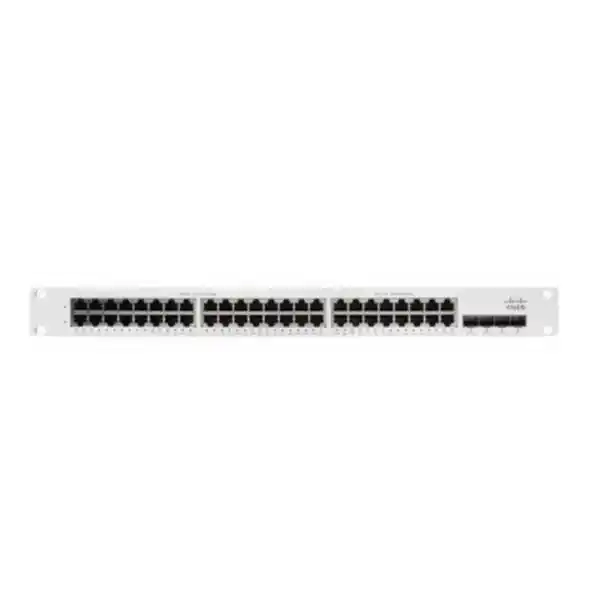
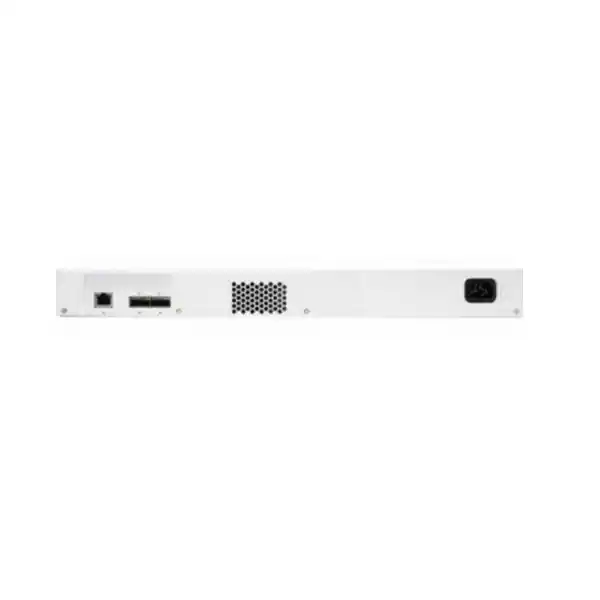
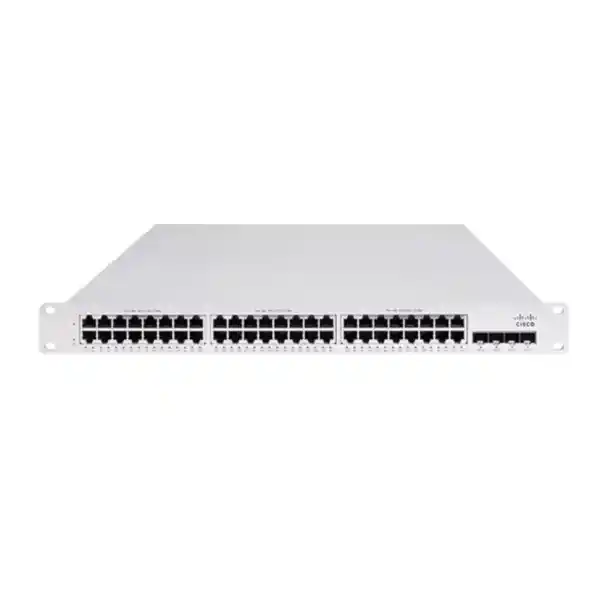
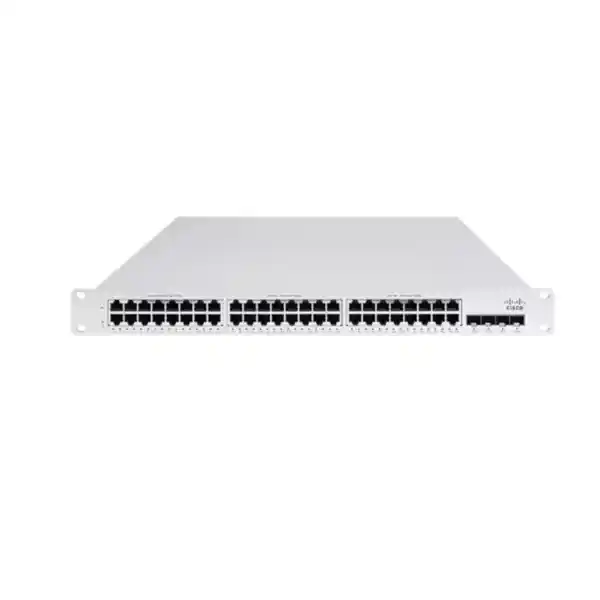
The Cisco Meraki MS150-48FP-4G is a centrally managed enterprise access switch designed to connect and power large groups of network endpoints. It combines 48 1GbE RJ45 interfaces with four dedicated 1GbE SFP uplinks, a 740W aggregate PoE budget and integrated physical stacking support. For businesses refreshing access infrastructure, the model offers a practical route to consistent network configuration across branch offices, corporate floors and institutional buildings. Rather than maintaining independent device configurations at every location, administrators can work through the Meraki dashboard to deploy common policies, monitor devices and troubleshoot connectivity. The platform is especially relevant when a network must accommodate wired users, voice handsets, security cameras and wireless equipment while maintaining predictable operating procedures. Buyers should distinguish the four 1G SFP uplinks on this exact variant from the faster SFP+ ports offered on separately named 4X models. A quote should also cover licensing, optics, cabling, power capacity and service requirements; hardware alone does not represent the full deployment budget.
At-a-Glance Procurement Facts
Role: Managed access switching
Downlinks: 48 × 1GbE RJ45
PoE pool: 740W
Per-port power: up to 30W
Stacking bandwidth: 80Gbps
Power input: 100–240VAC
Stock and price: By quotation
Warranty: Confirm applicable Cisco terms
The product is intended for access-layer use rather than serving as a substitute for a high-throughput data-center core. Power planning should consider the total simultaneous consumption of connected devices, not simply the number of available RJ45 sockets. A fully populated switch with 48 endpoints each requesting 30W would exceed the shared 740W allowance; therefore, a port-by-port power worksheet is recommended. Regional supply, installation services and warranty handling depend on the agreed commercial package.
Architecture and Operating Model
The MS150 series brings wired access, PoE delivery and cloud-based operations into a common management experience. Its hardware switching fabric is rated at 104Gbps for this 4G model, while two dedicated stacking connections support an 80Gbps stacking bandwidth specification. These figures describe different functions and should not be treated as interchangeable end-user throughput guarantees. Traffic design must account for application patterns, uplink oversubscription, VLAN structure, the chosen upstream switch and physical topology. The device offers static routing, but teams requiring extensive dynamic routing should assess an appropriate distribution or core platform. Cloud management helps organizations apply consistent configuration standards and observe port status across multiple locations, while site connectivity and license compliance remain important operational dependencies.
For a 48-port access closet, power delivery is often as important as forwarding performance. Telephones, surveillance cameras and access points may have different draw profiles during startup and peak activity. Reserve a sensible operating margin instead of budgeting the full advertised PoE pool against estimated typical consumption. For fiber links, choose transceivers according to fiber type, distance and Cisco compatibility guidance. The four 1G SFP ports should be assessed against the aggregate traffic of attached clients. Where a faster uplink is mandatory, compare the MS150-48FP-4X rather than assuming the 4G model supports 10G optics.
Business Outcomes and Technical Advantages
- Performance consistency: Forty-eight Gigabit access ports consolidate client connections, while planned uplink capacity reduces avoidable congestion.
- Operational resilience: Stacking capability supports coordinated switch deployments; design actual failover behavior with the complete topology and upstream equipment.
- Scalable rollout: Dashboard-based templates and common operating practices can reduce configuration differences between branches.
- Access security: Apply appropriate VLAN separation, port access controls and monitoring according to supported firmware capabilities and security policy.
- Central visibility: Remote administration assists teams responsible for dispersed facilities and smaller sites without permanent network staff.
- Power consolidation: A 740W PoE pool can reduce the need for individual power adapters when endpoint loads are correctly sized.
- Lifecycle planning: Include subscriptions, support, firmware maintenance and replacement strategy in total ownership calculations.
Verified Technical Specifications
| Attribute | MS150-48FP-4G |
|---|---|
| Access interfaces | 48 × 1GbE RJ45 |
| Fiber uplinks | 4 × 1GbE SFP; not 10GbE SFP+ |
| Management interface | 1 dedicated management interface |
| PoE capability | Up to 30W per supported port; 740W aggregate |
| Stacking | 2 stacking ports; 80Gbps stacking bandwidth |
| Switching capacity | 104Gbps |
| Routing | Static routing |
| Power input | 100–240VAC |
| Management | Cisco Meraki cloud dashboard; appropriate license required |
Dimensions, weight, acoustics, environmental ratings and exact power consumption should be checked against the latest Cisco revision and the applicable installation guide before approving cabinet clearances or UPS sizing. Do not substitute series-wide specifications for model-specific values.
Configuration and Sizing Worksheet
Step 1 — Count endpoints: List computers, access points, cameras, telephones, printers and spare ports by location. Confirm how many need PoE and their maximum rated demand. Step 2 — Calculate power: Add simultaneous peak draw, allow headroom and ensure the sum remains within 740W and individual port limits. Step 3 — Plan fiber: Identify each uplink destination, cable type, transceiver requirement and traffic profile. Step 4 — Validate stacking: Decide whether multiple switches require a stack, appropriate cables and an approved topology. Step 5 — Confirm licensing: Identify the organization’s current Meraki licensing model and select an eligible license and duration. Step 6 — Assess facilities: Check cabinet depth, airflow, earthing, AC power, UPS runtime and cable-management space. Step 7 — Prepare the quote: Specify the model, quantity, site location, optics, patch leads, rack accessories, subscription, staging and delivery address.
Deployment Scenarios in Uganda
Corporate and Multi-Site Offices
Deploy the switch in floor distribution cabinets to connect users, desk phones and wireless access points. Use consistent VLAN and port policies across offices while checking 1G uplink capacity against actual traffic.
Financial Services
Separate approved device groups, document access controls and maintain change records. Include redundant upstream connectivity and tested restoration procedures where business continuity requires them.
Schools and Universities
Support classrooms, administration, IP phones and campus security endpoints. Plan PoE capacity carefully during simultaneous device startup and coordinate fiber runs between buildings.
Public Sector and Institutional Procurement
Include model-specific compliance checks, license entitlement, warranty evidence, delivery acceptance tests and approved procurement documentation. Security configuration must follow the institution’s own policy and audit requirements.
Technical Deep Dives
Switching Fabric and Uplink Design
Hardware forwarding capacity does not eliminate uplink contention. Forty-eight client-facing Gigabit interfaces can create more aggregate demand than four Gigabit uplinks can carry simultaneously. Design link distribution, VLAN placement and application traffic based on measurements. The advertised 104Gbps switching capacity and 80Gbps stacking bandwidth describe separate architectural capabilities.
Cloud Operations and Software Maintenance
The Meraki dashboard supports centrally administered configuration, monitoring and remote troubleshooting. Assign administrator permissions carefully, maintain configuration documentation and schedule firmware maintenance windows. Confirm the applicable Enterprise or Advanced license features and the organization’s licensing model before placing an order. Cloud reachability, administrative access and license compliance should be part of the operational readiness plan.
Availability and Recovery
Physical stacking may simplify coordinated access-switch management, but it does not by itself guarantee uninterrupted application delivery. Plan upstream diversity, protected power, documented replacement processes and periodic recovery tests. Keep serial numbers, license information, approved configurations and transceiver inventories available to the support team.
Pre-Purchase Buyer Checklist
Confirm the 4G model is suitable: its uplinks are 1GbE SFP, not 10GbE SFP+. Verify all connected endpoints can operate within the 30W per-port and 740W aggregate PoE limits. Check whether your organization’s license model supports the intended subscription and whether the quote includes the correct term. Verify switch depth, rack ventilation, acoustic requirements and UPS sizing from the model-specific installation documents. Ask for documented optical module compatibility, stacking cable requirements, current lifecycle status, support eligibility and warranty processing conditions. Ensure the bill of materials includes the accessories required for a complete, deployable installation.
Uganda Delivery and Procurement Coordination
FourTeck can receive technical purchase requests for Kampala, Entebbe, Jinja, Mbarara, Gulu and other Ugandan destinations. Provide quantities, deployment schedule, delivery site and purchasing documentation requirements to request an itemized offer. Hardware supply, lead time, licensing availability, warranty entitlement, configuration services and shipping charges must be confirmed in writing rather than assumed. For multi-location projects, organize deliveries by site and align installation scheduling with network readiness and change windows.
Regional Procurement Coverage
Kampala enterprise buyers may need campus refresh planning and multi-floor switching. Entebbe sites may prioritize branch connectivity and controlled rollout dates. Jinja industrial and institutional deployments can require cabinet and power validation. Mbarara regional offices often benefit from standardized remote operations. Gulu facilities can benefit from advance staging and documented recovery procedures. Actual service coverage and delivery timelines depend on the agreed quotation.
Cross-Border Coordination
For regional projects, explore FourTeck Uganda, FourTeck Kenya, FourTeck Africa, FourTeck UAE and FourTeck Kuwait. Cross-border shipments require confirmation of destination-specific taxes, import procedures, lead times, support eligibility and commercial terms.
Related Network Planning Options
Compare the MS150-48FP-4X when 10G SFP+ uplinks are necessary, or the MS150-48LP-4G for a lower aggregate PoE requirement. For smaller port counts, investigate the MS150-24P-4G. Explore compatible SFP optics, Meraki licensing and network rack accessories. These links are discovery searches, not confirmation of product inventory.
FourTeck Technical Service Scope
Request bill-of-materials review, PoE load validation, uplink selection, licensing checks, pre-shipment staging and a deployment checklist. Where contracted and supported, technical preparation can include firmware readiness review, inventory labeling, documentation and handover coordination. Clarify which services are included in the final commercial offer and which require a separate statement of work.
Frequently Asked Questions
How many Ethernet ports does the MS150-48FP-4G provide?
It offers 48 1GbE RJ45 access interfaces plus four 1GbE SFP uplink interfaces. The SFP ports are distinct from the copper access ports. Count transceiver modules and fiber patch leads separately when preparing the installation bill of materials.
Does this model support 10GbE uplinks?
No. The MS150-48FP-4G is the four-port 1GbE SFP uplink variant. If the network design requires 10GbE SFP+ uplinks, compare the separately specified MS150-48FP-4X. Select the model based on measured aggregate traffic rather than copper port count alone.
What is its PoE power budget?
The shared PoE budget is 740W, with a stated 30W per-port power limit. A full set of 48 devices each consuming 30W would require more than the shared budget, so power allocation must be calculated from the actual endpoints and peak loads.
Is a Meraki license required?
Yes. Meraki cloud-managed switching requires an appropriate license. The correct SKU, license tier, term and organization licensing model should be validated before purchase. Ask for a quotation that distinguishes hardware cost from licensing and any optional services.
Can multiple MS150 switches be stacked?
The model includes two physical stacking ports and the series specifies 80Gbps stacking bandwidth. Confirm supported stack composition, cable requirements and topology in Cisco documentation before procurement. A stack should still be designed with suitable upstream and power resilience.
Can this switch route between VLANs?
Cisco lists static routing capability for the MS150-48FP-4G. Evaluate required inter-VLAN policies and routing scale against the current feature documentation. Networks requiring advanced dynamic routing should use a properly specified distribution or core solution.
Is it suitable for cameras and access points?
It can support compatible PoE-powered devices such as IP cameras and wireless access points, provided their power and Ethernet requirements fit the model. Verify the devices’ negotiated power class, cabling quality and expected traffic before finalizing the port map.
What should be checked before installation?
Check cabinet dimensions, power feed, UPS capacity, ventilation, cable management, fiber modules, stack accessories, internet access for dashboard management and license entitlement. Confirm any model-specific environmental and acoustic specifications from the latest installation guide.
How are warranty and replacements handled in Uganda?
Warranty and replacement eligibility depend on the applicable Cisco support and licensing terms, hardware status and commercial supply arrangement. Ask FourTeck to state warranty coverage, escalation route, proof-of-purchase requirements and replacement lead-time assumptions in the quote.
Can FourTeck assist with configuration planning?
Buyers can request help with technical validation, bill-of-materials preparation, PoE calculations, uplink selection and staging requirements. Availability and pricing of installation, configuration and after-sales services should be agreed before ordering.
Plan Your Cisco Meraki MS150-48FP-4G Purchase
Share your endpoint count, PoE demand, uplink requirements, license term, project locations and target deployment date. FourTeck can prepare a tailored Uganda quotation for the correct hardware and associated procurement components. Stock, delivery, support and warranty conditions are subject to confirmation.

Reviews
There are no reviews yet.