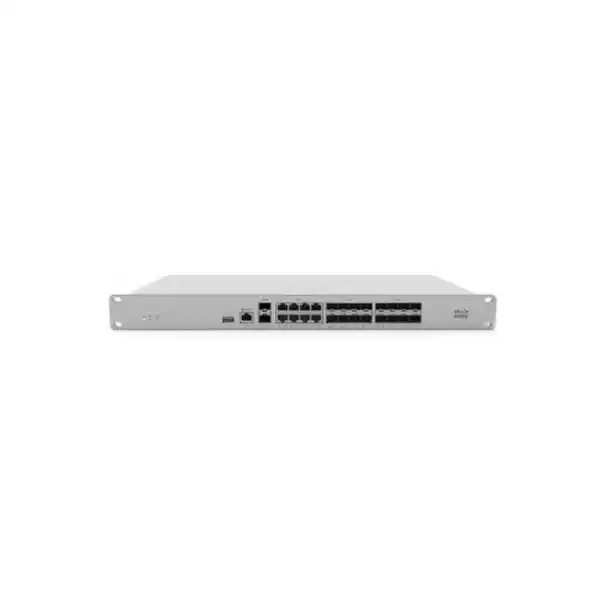
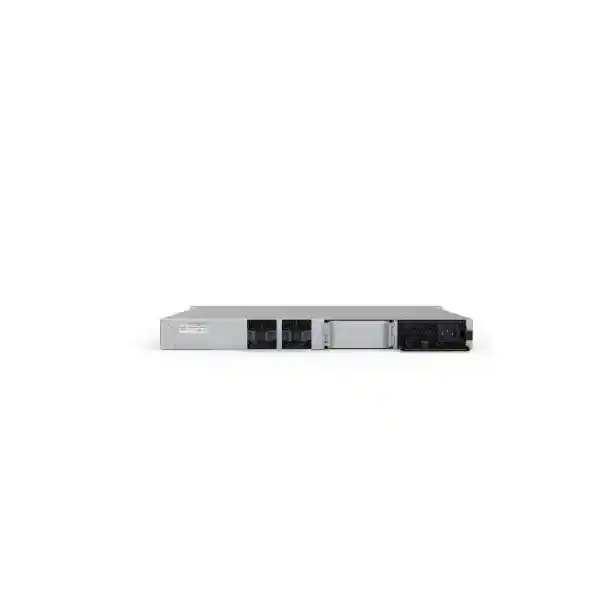
Cisco Meraki MX450 Cloud-Managed Enterprise Firewall and SD-WAN Appliance
A high-capacity network security gateway for large Ugandan organizations that need consistent policy enforcement, resilient connectivity and centralized oversight across demanding sites.
The MX450 brings security enforcement, routing, site-to-site connectivity and managed network visibility into a rack-mounted appliance. Rather than buying only on headline bandwidth, enterprise teams should examine how much inspected traffic must pass through the device, how many VPN relationships it will maintain, and what operational response is required when a circuit or appliance fails. The MX450 is particularly relevant when a growing campus has outgrown branch-class security equipment or when a central concentrator must connect a substantial distributed estate. Its cloud-managed approach helps administrators coordinate changes across offices without treating every location as a separate management island.
FourTeck supports specification-led quotations for Uganda. A useful request includes the number of sites, present and projected bandwidth, preferred license level, desired support term and any integration constraints. Hardware, licensing, optical modules, cabling and deployment work should be clearly itemized. Published performance figures describe controlled test conditions and should be evaluated against the intended mix of inspection, tunnels and services. Delivery and warranty terms depend on the actual offer, not merely the model name.
Procurement facts at a glance
MX450-HW; the FourTeck regional listing identifier is CISCO-MX450-UGANDA.
Campus security gateway or VPN concentrator, with Cisco guidance indicating up to 10,000 devices.
10 Gbps firewall, 7 Gbps advanced security services and 6.5 Gbps maximum site-to-site VPN throughput.
Two dedicated 10GE SFP+ WAN; eight 1GE RJ-45, eight 1GE SFP and eight 10GE SFP+ fixed LAN.
1RU chassis, two 250W modular power supplies, 100–220V AC at 50/60Hz.
Stock, delivery, support entitlement and warranty terms are confirmed in the written proposal.
Procurement teams should distinguish hardware configuration from licensing entitlement. The Meraki Dashboard requires a suitable active license, and service bundles have different functional scopes. The intended deployment should also be checked for optical compatibility, available rack depth, dual power feeds and maintenance access. An appliance purchased without these supporting elements may remain physically installed but operationally incomplete. A complete purchase order should therefore reference the appliance identifier, license term, applicable service tier, any transceivers, delivery destination and installation responsibility.
Architecture and operating model
The MX450 occupies the enterprise edge, where external connectivity meets internal routing, application access and organizational security policy. Its role may be north-south traffic inspection for a campus, a central termination point for branch VPN tunnels, or a strategic component of an SD-WAN architecture. The exact design determines whether the appliance should be placed behind a provider router, connected directly to handoff equipment, or paired with an equivalent MX appliance for resilience. WAN termination should be planned around SFP+ media and provider demarcation requirements rather than assuming an RJ-45 handoff can connect directly.
Centralized Dashboard administration allows an authorized team to inspect appliance status, configure policies and review network events from a shared operational interface. This changes the support model for organizations with branches outside Kampala: a network administrator can examine remote-site behavior without immediately dispatching an engineer. Central visibility does not eliminate the need for local hands, reliable out-of-band access or documented recovery procedures. It does, however, create a more consistent foundation for repeatable changes and incident investigation.
Firewall throughput is only one element of sizing. The stated 10 Gbps figure is not a promise that every security feature and traffic pattern will simultaneously deliver that rate. Cisco publishes 7 Gbps for advanced security services and 6.5 Gbps for site-to-site VPN traffic. Real deployments involve packet sizes, connection counts, encrypted traffic, policy complexity and concurrent workloads. A financial institution processing transactional connections may have a different profile from a university carrying large software downloads. Measure peak traffic, not just monthly averages, and reserve capacity for growth, maintenance and unexpected events.
The fixed LAN interface mix supports multiple uplink media and segmented internal connections. Eight 10GE SFP+ LAN interfaces can be useful for high-speed switch interconnection or security zones, while 1GE copper and SFP interfaces accommodate lower-bandwidth links. Confirm supported transceiver types and cabling distances before ordering. A fiber connector that physically fits is not proof of compatibility with the appliance firmware or the switch at the other end.
Power and thermal design matter in Ugandan equipment rooms where utility interruptions and cooling limitations can affect uptime. The chassis uses dual modular 250W supplies and Cisco lists a 105W idle and 190W maximum power load. Two installed supplies should be connected to independently protected power paths where the site architecture permits. A UPS, adequate airflow, proper grounding and documented replacement procedures are part of an effective resilience design, not optional finishing touches.
Enterprise value and operational outcomes
- Performance integrity: Match measured internet and inter-site traffic to the relevant firewall, inspected-traffic and VPN specifications. A realistic headroom policy prevents a purchase from becoming undersized shortly after deployment.
- Service continuity: Design an appliance pair, diverse uplinks and power separation when outages have material business consequences. Test failover behavior under production-like conditions instead of relying on topology diagrams alone.
- Scalable connectivity: A high-capacity central appliance can aggregate many remote locations, but tunnel limits and per-site bandwidth still require a capacity model. Cisco publishes a maximum of 5,000 site-to-site VPN tunnels under its stated laboratory conditions.
- Policy consistency: Apply network security rules and access segmentation through a centrally managed platform. Formal change approval and periodic policy reviews remain essential for regulated environments.
- Operational simplicity: Dashboard-based administration can reduce fragmented configuration workflows across a large estate. Assign clear administrator roles and retain a record of approved changes.
- Lifecycle visibility: Include license renewal dates, firmware planning and hardware support eligibility in asset management. A hardware-only quote is not a complete operating-cost estimate.
- Energy and facilities planning: Published idle and maximum power loads support UPS sizing and cooling estimates. Budget for resilient power and cooling, not just the appliance purchase.
- Procurement control: A validated bill of materials reduces the risk of receiving a chassis without the required subscription, optics or compatible rack accessories.
Hardware and software highlights
10 Gigabit connectivity: Two dedicated 10GE SFP+ WAN ports and eight 10GE SFP+ LAN ports provide flexible high-speed handoff options. The practical value depends on upstream provider media, downstream switch capability and the transceivers selected.
Mixed-media LAN: Eight 1GE RJ-45 and eight 1GE SFP LAN ports support copper and fiber connections in environments with different cabling generations. Confirm the intended role and any port constraints during design review.
Cloud-managed security: Dashboard administration supports centralized visibility and configuration. Feature availability is determined by the applicable Meraki license tier and current software capabilities.
VPN concentration: The MX450 is suited to aggregation designs where many sites terminate secure tunnels at a central point. Capacity planning should account for simultaneous throughput and tunnel count rather than treating either maximum as universally achievable.
Modular power: Dual 250W supplies create an opportunity for resilient electrical feeds. Validate the actual supplied configuration, power cables and site electrical standards in the purchase documents.
Rack deployment: The 1RU form factor conserves vertical rack space, while the 440 mm depth requires appropriate rack clearance and cable-management planning.
Confirmed technical specifications
| Attribute | Cisco published MX450 specification |
|---|---|
| Hardware SKU | MX450-HW |
| Recommended scale | Campus or VPN concentrator, up to 10,000 devices |
| Firewall throughput | 10 Gbps |
| Advanced security services throughput | 7 Gbps |
| Maximum site-to-site VPN throughput | 6.5 Gbps |
| Maximum site-to-site VPN tunnels | 5,000, subject to Cisco laboratory-test caveats |
| Dedicated WAN | 2 × 10GE SFP+ |
| Fixed LAN | 8 × 1GE RJ-45, 8 × 1GE SFP, 8 × 10GE SFP+ |
| Mounting | 1RU |
| Dimensions | 483 × 440 × 44 mm |
| Weight | Approximately 7.3 kg |
| Power supplies | 2 × 250W modular PSU, 100–220V, 50/60Hz |
| Power load | 105W idle / 190W maximum |
| Operating temperature | 0–45°C |
| Humidity | 5–95% |
These are model-level specifications from Cisco’s MX family datasheet, not an independently measured guarantee for every configuration. Optical transceivers, license entitlement, installed firmware and site topology can change the deployable solution. Request written confirmation for any compliance, certification or interoperability requirement that is critical to the purchase.
Sizing and configuration worksheet
1. Workload and growth
Record current peak WAN throughput, projected three-year growth, inspected traffic, encrypted VPN volume and concurrent users. Identify burst periods such as payroll processing, campus examinations or backup replication. Compare each workload against the applicable published throughput metric. Leave sufficient headroom for failures that shift traffic to the remaining circuit.
2. Rack and environment
Reserve 1RU plus space for ventilation and cabling. Confirm the rack accommodates a 440 mm deep chassis with front and rear cable clearance. Check ambient temperature, airflow direction, physical security and access for service personnel.
3. Power and optics
Inventory electrical circuits, UPS runtime and power distribution units. Determine whether separate power feeds are available. Specify fiber type, distance, transceiver form factor, connector and provider handoff for each SFP+ WAN connection. Include spare patch leads when operational policy requires them.
4. Licensing
Choose an eligible Meraki licensing tier and term based on required security and SD-WAN functionality. Cisco lists Enterprise, Advanced Security and Secure SD-WAN Plus options for the MX450 family. Confirm the current commercial model, subscription compatibility and renewal responsibility in writing.
5. Quote preparation
Provide company name, delivery location, requested quantity, required date, license duration, technical contact, rack constraints, provider handoff details and desired commissioning services. Ask for a separated breakdown of hardware, subscriptions, optics, freight, taxes and support. A detailed request reduces revisions and clarifies ownership of each deployment activity.
Deployment patterns across Ugandan industries
Large enterprise headquarters
At a major headquarters, the MX450 can form the managed security boundary between multiple high-speed provider circuits and a segmented campus core. Network teams should document which traffic is inspected, which routes are advertised internally and how internet breakout interacts with branch connectivity. For high availability, evaluate an appropriate MX pair and test circuit failure, appliance failure and maintenance events separately. A successful design keeps security policy understandable even when the topology becomes complex.
Banking and financial services
Financial institutions commonly require strict change controls, resilient access to transaction services and clear audit responsibilities. The MX450 can be assessed for central VPN aggregation and policy enforcement, but no firewall purchase alone establishes regulatory compliance. Teams must validate logging retention, privileged administration, segmentation, encryption policy and incident procedures against their own requirements. Where sensitive systems are involved, use formal acceptance tests and documented rollback steps before cutover.
Universities and campus networks
Campuses face sharp traffic variations as students return, examination platforms open or learning resources are downloaded. Sizing should consider inspected throughput during peaks, large numbers of endpoints and upstream switching capacity. Separate administrative, student, guest and laboratory networks according to policy, then verify the MX450’s placement relative to existing core routing and wireless infrastructure.
Government and public-sector environments
Government projects often involve formal tender requirements, defined warranty expectations and security controls extending beyond the network appliance. Procurement teams should specify the required subscription period, delivery acceptance criteria, firmware policy and configuration handover. Security accreditation or special compliance claims should be confirmed with the manufacturer and the relevant authority rather than assumed from the product category.
Technical deep dives
Traffic processing and capacity planning
Firewall, inspected-security and VPN traffic are different workload classes. The MX450’s published 10 Gbps firewall figure is a useful starting point, but a production design should model the actual share of traffic requiring advanced inspection and encryption. Avoid assuming that port speed equals sustained service throughput. Investigate traffic direction, packet size distribution, concurrent flows and branch aggregation. Cisco’s maximum VPN tunnel count is derived from laboratory scenarios without client traffic crossing those tunnels, so real capacity depends on concurrent demand. Run a proof of concept when service-level commitments are strict.
Dashboard software and controlled operations
The Meraki software ecosystem emphasizes centralized administration and visibility. Teams should establish role-based access, documented administrative ownership, maintenance windows and firmware review processes. A dashboard is not a substitute for configuration governance: incorrect policies can be distributed efficiently as well as correct ones. Identify who approves firewall rules, who can change WAN routing and who responds to security events. Review feature entitlement against the selected subscription and maintain records of software versions and support cases.
High availability and disaster recovery
Redundancy requires more than dual power supplies. Evaluate appliance-level failover, upstream and downstream switch dependencies, circuit diversity, shared failure domains and the behavior of active sessions during a switchover. Record the expected recovery objective and test it using representative applications. Keep spare optics, approved configuration documentation and a supplier escalation path available. If the design relies on cloud management, document local troubleshooting and recovery procedures for periods of impaired management connectivity.
Pre-purchase questions procurement teams should resolve
Does the price include a license? Never assume so. Ask for separate hardware and subscription lines, including the tier and term.
Are the SFP+ optics included? Treat them as separate unless the quotation explicitly lists compatible modules.
Will it fit the existing cabinet? Check the 440 mm chassis depth plus clearance for cables and ventilation.
Can it handle our traffic? Compare inspected and encrypted workloads with the relevant Cisco figures, then allow headroom.
Can it replace every existing firewall feature? Review the exact policy, routing, remote-access and integration requirements. Feature parity should be validated rather than inferred.
What happens at renewal? Assign a subscription owner and budget for recurring costs before approving the initial capital expenditure.
Is the appliance current? Check Cisco’s official lifecycle notices at the point of purchase. Hardware and software lifecycle dates can change.
Who installs it? Identify responsibilities for ISP coordination, rack work, optics, Dashboard claiming, licensing, migration and acceptance testing.
What is covered by warranty? Request written confirmation of eligibility, service geography and the replacement process for the specific supplied unit.
Uganda procurement and delivery coordination
FourTeck Uganda handles specification-led enquiries for enterprise networking projects. A proposal should identify the requested hardware, license option, accessories and any engineering services, followed by clear commercial conditions. Stock availability and delivery estimates are confirmed during quotation; they should not be assumed from the presence of an online product page. Import logistics, local taxes, project scheduling and acceptance requirements can affect the final offer.
For Kampala headquarters projects, delivery planning may include a defined installation window and a receiving contact with access to the equipment room. Entebbe deployments may involve airport-area facilities or distributed offices with their own access controls. Jinja industrial sites should consider maintenance scheduling and production continuity. Mbarara and Gulu locations may need additional transport coordination and remote commissioning arrangements. FourTeck can discuss the relevant scope during the quotation process; specific service availability is subject to confirmation.
For organizations purchasing across borders, coordinate the bill of materials and entitlement details so equipment delivered to different countries follows a consistent standard. Regional FourTeck information is available through FourTeck Uganda, FourTeck Kenya, FourTeck Africa, FourTeck UAE and FourTeck Kuwait. Confirm cross-border ordering, taxes, import responsibilities and manufacturer support eligibility for each destination.
Related solutions and purchase dependencies
For smaller aggregation requirements, compare the MX450 with the Meraki MX250. For another campus or large-branch sizing point, review the Meraki MX105. Explore Meraki security and SD-WAN appliances for family-level context and Meraki switches when planning the downstream campus network. The Meraki wireless portfolio may also be relevant to an integrated campus architecture. Confirm Meraki product and license options against the final bill of materials. These references are planning aids, not claims that any linked model or accessory is in FourTeck stock.
Technical services and project readiness
Ask FourTeck to scope a pre-purchase bill-of-materials review covering the appliance, subscription, optical modules, power leads and mounting requirements. Where contracted, staging activities may include inventory validation, serial-number records, firmware review, Dashboard organization planning and a basic connectivity checklist. Actual services and deliverables should be stated in the quotation. A useful handover includes the installed topology, management ownership, license records, escalation contacts and test outcomes.
For migrations, define a maintenance window, a rollback path and the party responsible for each configuration change. A technically correct design can still cause avoidable disruption if ISP coordination or change approvals are incomplete. Post-sales support expectations should be aligned with the purchased manufacturer entitlement and any separately contracted FourTeck engineering assistance.
Frequently asked questions
1. What is the Cisco Meraki MX450 best suited for?
The MX450 is intended for high-capacity campus security and VPN concentration roles. Cisco recommends it for campus or concentrator deployments with up to 10,000 devices. That figure is a planning reference rather than a guaranteed number of active clients under every workload. An appropriate deployment considers firewall inspection, encrypted throughput, uplink speeds, site count and future expansion. The device is especially worth evaluating where a central location needs to aggregate substantial traffic from branch networks while retaining centralized management.
2. Does the MX450 require licensing?
Yes. Meraki operation depends on an appropriate active license and the licensing arrangement must be included in the procurement plan. Cisco lists Enterprise, Advanced Security and Secure SD-WAN Plus license options for the MX450 family, with multiple terms. The exact feature set and currently available commercial options should be checked when quoting. Request separate line items for hardware and subscriptions so renewal costs remain visible. A procurement comparison that excludes licensing can materially understate the cost of ownership.
3. What throughput should our team use for sizing?
Use the specification that matches your intended workload. Cisco publishes 10 Gbps firewall throughput, 7 Gbps advanced security services throughput and 6.5 Gbps maximum site-to-site VPN throughput for the MX450. None should be treated as a universal guaranteed rate for every packet size and feature combination. Gather peak traffic data, estimate growth and include failover conditions in the sizing model. Where service availability is critical, validate the design through controlled testing before committing to production cutover.
4. Which interfaces are provided?
The MX450 includes two dedicated 10GE SFP+ WAN interfaces. Its fixed LAN connections comprise eight 1GE RJ-45 ports, eight 1GE SFP ports and eight 10GE SFP+ ports. These connections offer flexibility across copper and optical networks, but the correct transceiver and cable selection remains essential. Verify supported optics, fiber type, distance and interoperability with the upstream provider or downstream switch. Do not assume that a generic optical module will work simply because it fits mechanically.
5. Can it support resilient enterprise connectivity?
The MX450 includes dual modular power supplies, and an appropriately designed deployment can address appliance and circuit resilience. However, availability depends on the entire architecture. A redundant firewall pair is of limited benefit if both units depend on one switch, one power circuit or one provider route. Define failure scenarios, confirm the supported high-availability configuration and perform acceptance testing. Maintain documentation for recovery actions, service contacts and maintenance windows.
6. How much rack space and power are required?
The appliance occupies 1RU and measures approximately 483 × 440 × 44 mm. Cisco lists two modular 250W power supplies, an idle load of 105W and a maximum load of 190W. Verify the cabinet’s usable depth and allow room for airflow and cable bends. UPS planning should account for the complete equipment stack, including switches, provider devices and monitoring systems. The operating temperature range is 0–45°C, but practical room design should preserve adequate thermal margin.
7. Can it connect branches across Uganda?
The MX450 can be considered as a central VPN concentrator for a distributed network, including branches in Kampala, Entebbe, Jinja, Mbarara and Gulu. Cisco publishes a maximum of 5,000 site-to-site VPN tunnels, subject to the stated laboratory conditions. Real-world design must consider concurrent tunnel traffic, branch appliance compatibility, internet reliability and routing requirements. A branch rollout should include a repeatable configuration standard, staged testing and documented escalation for remote-site connectivity issues.
8. How do warranty and replacement arrangements work?
Warranty eligibility and replacement processes should be confirmed for the exact hardware supplied, its manufacturer entitlement and destination. Meraki support policies distinguish hardware lifecycle milestones and may affect future replacement arrangements. Ask for the written warranty baseline, service contact, expected replacement process and any geographical limitations. The product page alone does not guarantee a specific turnaround time or an immediate local spare. Critical deployments should separately evaluate spare equipment or resilient pairs.
9. Is configuration assistance available?
FourTeck can discuss technical validation and deployment services as part of the enquiry. A scoped engagement may cover bill-of-materials checking, network topology review, license planning, staging, cutover coordination and handover documentation. Availability and pricing of these services require written confirmation. Before commissioning, assign responsibility for Dashboard access, provider changes, firewall rules, routing, testing and rollback. A defined scope avoids uncertainty between the customer, internet provider and equipment supplier.
10. How do we request a reliable quote?
Send the required quantity, destination, intended application, current and future bandwidth, number of sites, preferred subscription tier and term, optical requirements and installation deadline. Include any tender conditions, warranty expectations and special delivery procedures. Ask for separate pricing for MX450-HW hardware, licensing, optics, logistics and engineering work. FourTeck can then respond with a proposal based on the actual requirement, subject to supply and commercial confirmation. Use the contact page to initiate the review.
Build an MX450 proposal around your real network
Tell FourTeck Uganda what the appliance must protect, how many sites it must connect and which security services are required. A clear project brief helps determine whether the MX450 is the appropriate model and which licensing, optics, power arrangements and engineering activities belong in the offer. Ask for documented stock status, lead time, commercial terms and warranty conditions before approval. The objective is a deployable enterprise solution, not an isolated hardware box.

Reviews
There are no reviews yet.