
Fortinet FortiADC 2000G Application Delivery Controller in Uganda
Fortinet FortiADC 2000G is a hardware-accelerated application delivery controller built for organisations that need to keep business applications responsive, available and securely presented while handling substantial encrypted traffic. It sits in front of application servers and services, distributing connections according to policy and health while providing Layer 4–7 load balancing, SSL processing, global server load balancing and application-security capabilities. This makes the appliance relevant to enterprise data centres, financial platforms, government systems, universities, service providers and other environments where application outages or overloaded servers have direct operational consequences.
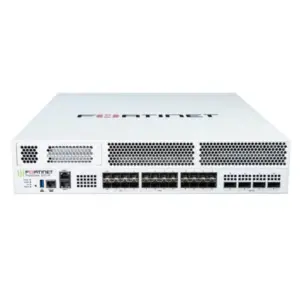
For Uganda procurement teams, the practical value of the 2000G is its combination of high-speed interfaces, dedicated acceleration, compact 1U deployment and redundant power architecture. Fortinet currently lists the platform at up to 90 Gbps L4/L7 performance and 60 Gbps SSL throughput, with four 25GbE SFP28 and six 40GbE QSFP interfaces. Those specifications make it suitable for architectures where the ADC must avoid becoming a bottleneck between high-capacity switching fabrics and application server farms. Actual production capacity depends on traffic composition, cryptographic profile, security features, persistence logic and configuration, so sizing should always be based on workload rather than headline throughput alone.
FourTeck supports Uganda customers with quotation preparation, model validation, interface planning, licensing selection and deployment readiness. A good procurement request should identify expected peak traffic, encrypted-traffic percentage, concurrent users or connections, applications to be published, data-centre topology, high-availability requirements, optic types and desired support period.
Instant Specifications & Procurement Fact Rail
FortiADC 2000G
Up to 90 Gbps L4/L7
Up to 60 Gbps
4×25G SFP28, 6×40G QSFP
1U appliance
Dual hot-swappable PSU
The fact rail is intended as a first procurement checkpoint. Confirm that the required switch ports, transceiver standards and cabling plan align with the 25GbE and 40GbE interfaces before issuing a purchase order. Support coverage, subscription bundle, optics and accessories should be confirmed on the final quotation because these can vary by project and contract.
Operational Architecture and Application Delivery
The FortiADC 2000G is designed to provide a controlled application-delivery layer between users and backend services. In a typical deployment, clients connect to virtual services hosted on the ADC. The appliance evaluates traffic and distributes requests across healthy application servers according to configured load-balancing logic. This helps prevent individual servers from becoming overloaded and enables failed or unavailable nodes to be removed from active service pools. Layer 7 awareness enables decisions to be made with application context, while Layer 4 processing supports efficient transport-level distribution.
Encrypted application delivery is a central consideration in modern infrastructure. SSL processing consumes compute resources when performed entirely on application servers, particularly when connection volumes and certificate operations rise. Fortinet positions the 2000G with ASIC SSL acceleration and lists 60 Gbps SSL throughput. Offloading suitable cryptographic processing to the ADC can reduce pressure on backend systems and centralise certificate and encryption policy handling. Procurement teams should nevertheless model certificate types, cipher suites, key sizes, new connection rates and inspection features because these variables can materially affect real-world capacity.
The high-speed interface layout is especially relevant in consolidated data-centre environments. Four 25GbE SFP28 interfaces can align with modern server or leaf-switch connectivity, while six 40GbE QSFP interfaces provide options for high-capacity aggregation and redundant network paths. The 1U form factor helps preserve rack space in facilities where density matters. Dual hot-swappable power supplies support connection to separate power feeds or UPS paths, reducing the risk that a single power-supply failure will interrupt service.
FortiADC also provides global server load balancing, web application firewall functionality and agentless application gateway capabilities. GSLB can be relevant when applications are delivered from more than one site and traffic must be directed according to availability or policy. Integrated application-security functions can add useful protection at the delivery layer. The exact security architecture should still be designed according to the organisation’s broader controls, regulatory obligations and existing Fortinet or third-party security stack.
Enterprise Business Outcomes
1. Performance & Throughput Integrity
A high-capacity ADC must sustain application traffic without creating a new choke point. The 2000G’s published 90 Gbps L4/L7 and 60 Gbps SSL figures position it for substantial workloads, while high-speed 25G and 40G connectivity helps integrate it into contemporary data-centre fabrics.
2. Reliability & High Availability
Dual hot-swappable power supplies reduce single-component power risk. For business-critical deployments, two appliances can be considered as part of a broader high-availability architecture, subject to design and licensing requirements.
3. Infrastructure Scalability
Load balancing lets organisations add application servers behind stable virtual services as demand grows. This can support staged capacity expansion rather than forcing a complete redesign every time server resources are increased.
4. Application Security
Integrated web application firewall, traffic inspection and access capabilities can help place security controls close to published applications. Security policies should be validated against the organisation’s risk model and other deployed controls.
5. Centralized Operational Control
Centralising virtual services, health checks, persistence rules, certificates and delivery policies can simplify operations compared with managing equivalent logic independently on every application server.
6. Lifecycle and Cost Planning
The right ADC can consolidate load balancing, SSL offload and selected application-security functions. Total cost should include hardware, support, subscription bundles, optics, rack power, implementation and lifecycle renewal rather than appliance price alone.
Key Hardware and Software Highlights
FortiADC 2000G combines hardware acceleration with application-delivery software. Its ASIC-based SSL acceleration is intended to handle cryptographic workloads efficiently. The 4×25G SFP28 and 6×40G QSFP port set gives network architects multiple options for connecting to aggregation or leaf layers. Dual hot-swappable power supplies provide a hardware resilience feature that is particularly valuable in production data centres. A Trusted Platform Module is also listed for the model.
At the application layer, FortiADC supports L4–L7 load balancing and scripting, global server load balancing, web application firewall capabilities and agentless application gateway functions. These capabilities allow a single platform to participate in availability, acceleration, traffic steering and application access designs. The precise features available to a project can depend on the selected bundle and software entitlement, so procurement should match the commercial bundle to the required technical functions rather than assuming every optional service is included indefinitely.
Technical Specifications Ledger
| Specification | FortiADC 2000G |
|---|---|
| Product class | Hardware-accelerated application delivery controller |
| L4/L7 performance | Up to 90 Gbps |
| SSL throughput | Up to 60 Gbps |
| 25GbE | 4×25G SFP28 |
| 40GbE | 6×40G QSFP |
| SSL acceleration | ASIC |
| Power supply | Dual, hot-swappable |
| Trusted Platform Module | Yes |
| Form factor | 1U appliance |
| Core delivery functions | L4–L7 load balancing, scripting, GSLB |
| Application protection | Web application firewall capabilities |
| Application access | Agentless Application Gateway |
Performance values are vendor-published platform figures and should not be interpreted as guaranteed application throughput under every configuration. Real-world results vary with packet size, encryption profile, enabled services, connection behaviour, persistence and application architecture. A project bill of materials should also verify rack depth, power characteristics, included cables, transceivers, software bundle and support coverage against the current regional quotation.
Configuration and Sizing Worksheet
Step 1 — Measure workload
Record current and projected peak application throughput, encrypted traffic, concurrent connections, new connections per second, number of virtual services, backend server count and growth expectations. Include seasonal or event-driven peaks rather than relying only on average traffic.
Step 2 — Map the physical environment
Confirm available 1U rack space, rack depth and airflow practices. Identify the upstream and downstream switches, available 25G/40G ports, transceiver types, fibre type and distance. A technically suitable ADC can still cause project delays when optics and patching are not specified correctly.
Step 3 — Plan resilient power and paths
Use the dual power supplies with independent power paths where the facility supports them. For high-availability application services, consider redundant switching paths and an ADC pair so that network, appliance and power failures are addressed as part of one design.
Step 4 — Define software functions and subscriptions
List required functions such as local load balancing, GSLB, web application protection, access gateway services and support. Fortinet offers bundle choices for the FortiADC family, including Network Security and Application Security bundles. Confirm the selected bundle and service term on the quotation.
Step 5 — Prepare the quote request
Provide model, quantity, high-availability requirement, optics, cables, rack accessories, bundle, support duration, delivery location and any staging services. Include the target implementation date and whether pre-shipment configuration or firmware preparation is required.
Deployment Scenarios and Industry Use Cases
Large Enterprise and Multi-Site Networks
Large organisations often publish ERP, customer portals, collaboration systems, APIs and internal business services through central or regional data centres. FortiADC can distribute traffic across server pools, monitor server health and maintain a consistent virtual service while backend resources change. Where applications span more than one location, GSLB can form part of a multi-site availability strategy.
Financial and Banking Institutions
Banks, payment environments and financial institutions place a premium on predictable application availability, encrypted transaction handling and controlled change. A high-capacity ADC can sit in front of internet banking, mobile banking middleware, API platforms or internal transaction applications. Procurement should incorporate redundancy, certificate management, audit requirements, support response and disaster-recovery topology into the design.
Educational and Campus Networks
Universities and large education networks may operate learning platforms, student portals, identity services, libraries, administrative applications and research services with sharp traffic peaks around registration, examinations or results. Load balancing can distribute those peaks across application infrastructure while health monitoring removes failed servers from service.
Government and Public-Sector Procurement
Government systems may need to support citizen services, internal portals, data-centre applications and inter-agency platforms with defined availability requirements. A procurement plan should document capacity, security controls, redundancy, support entitlement, acceptance testing and lifecycle responsibilities. For sensitive deployments, configuration baselines and change-control procedures should be agreed before production rollout.
Technical Deep Dive: Processing and Acceleration
Application delivery performance is not simply a matter of Ethernet port speed. An ADC must terminate and establish connections, inspect protocol state, execute load-balancing decisions, maintain persistence information and often process encryption. FortiADC 2000G’s hardware acceleration is designed to move demanding cryptographic work away from general-purpose processing paths. This is particularly useful when many HTTPS services are consolidated behind the appliance.
Sizing should distinguish aggregate bandwidth from transactional intensity. A workload carrying large file transfers behaves differently from an API platform with many short-lived TLS sessions. Likewise, enabling application-security inspection can alter the processing profile. Engineers should therefore collect representative traffic statistics and include growth headroom before choosing a final configuration.
Technical Deep Dive: Software Ecosystem and Operational Control
The FortiADC software layer provides the policy framework for virtual servers, real-server pools, health monitoring, traffic steering, persistence, SSL handling and application protection. Operational teams should establish naming conventions, configuration backup routines, certificate-renewal procedures, monitoring thresholds and a controlled firmware lifecycle. These disciplines matter as much as appliance capacity because application delivery infrastructure sits directly in the production request path.
Integration with the broader Fortinet ecosystem can be useful for organisations already standardising on Fortinet technologies. Cross-platform architecture should still be validated carefully, especially where third-party firewalls, switches, monitoring tools, certificate authorities or automation systems are involved.
Technical Deep Dive: High Availability and Disaster Recovery
Resilience should be designed in layers. Dual hot-swappable PSUs address a power-supply failure but do not replace appliance-level redundancy. A production architecture may therefore use multiple ADCs, redundant upstream and downstream switches, separate power feeds and multiple application servers. Multi-site environments can add global server load balancing and disaster-recovery procedures so that a site outage does not automatically become an application outage.
Failover design must be tested rather than assumed. Acceptance testing should cover loss of a server, link, switch path, power feed and—where applicable—an ADC node. Operations teams should also verify configuration synchronisation, monitoring alerts and documented recovery procedures.
Pre-Purchase Buyer Gap Checklist
Before approving the FortiADC 2000G, procurement and engineering teams should close several common information gaps. First, confirm exactly which FortiADC bundle and support term is quoted. The appliance may be technically capable of a function while a service or subscription is commercially packaged separately. Second, validate the lifecycle status and software support expectations for the intended deployment period. Third, verify rack dimensions and clearance against the exact hardware documentation supplied with the quote.
Fourth, confirm the power design. Dual supplies are valuable only when connected to appropriately independent feeds. Fifth, identify every required transceiver, fibre patch lead and switch-side optic. SFP28 and QSFP connectivity must be matched to the switch platform and cabling standard. Sixth, determine whether the deployment needs a single appliance or a resilient pair. Critical services generally warrant a discussion about node redundancy and failure domains.
Seventh, estimate SSL workload realistically. Do not size purely on total internet bandwidth. Record encrypted traffic percentage, connection rates, certificate types and security inspection requirements. Eighth, confirm cross-vendor interoperability for adjacent switches, firewalls, monitoring platforms and authentication systems. Ninth, define who will own certificate renewals, firmware upgrades, configuration backup and policy changes after handover. Finally, agree the acceptance criteria before shipment so the delivered system can be tested against a known checklist.
Uganda Procurement and Delivery Logistics
FourTeck can support Uganda organisations from initial bill-of-materials development through quotation and deployment preparation. The procurement process should begin with the exact appliance quantity, bundle, support period, interface requirements, optics and redundancy objectives. For regulated or tender-driven projects, include any mandatory compliance documentation, delivery terms and acceptance-test requirements in the request.
Lead times depend on stock position, distribution channel, configuration and logistics at the time of order, so they should be confirmed on the quotation rather than assumed. Pre-configuration requirements can be discussed before dispatch, including firmware preparation, baseline configuration and documentation where included in the project scope. Delivery planning should account for the receiving data centre, rack readiness, power feeds, fibre patching and change window.
Local Coverage Across Uganda
FortiADC 2000G procurement can be coordinated for organisations in Kampala and surrounding business districts, Entebbe, Jinja, Mbarara and Gulu, as well as other Uganda locations subject to logistics arrangements. Kampala projects commonly include corporate headquarters, financial institutions, service providers and data-centre environments. Entebbe deployments may support hospitality, aviation-linked and institutional networks. Jinja and Mbarara organisations can use centralised application delivery for regional operations, while Gulu projects may require careful planning around delivery schedules and remote implementation support. For every location, the most reliable approach is to validate the bill of materials before shipment and make sure the site is ready for rack installation, power, cabling and commissioning.
Cross-Border and Regional Supply Chains
Regional organisations operating across East Africa and the Gulf can coordinate infrastructure standards across multiple procurement territories. FourTeck maintains regional web presences for Uganda, Kenya, Africa, UAE and Kuwait. Multi-country projects should standardise model numbers, subscription terms, optics and configuration templates while allowing for local delivery, import and support requirements.
Related Infrastructure Planning
A FortiADC project should be evaluated as part of the complete application path. Review enterprise networking solutions in Uganda alongside the ADC requirement, and consider upstream switching, firewall capacity, server interfaces, optics, UPS capacity and monitoring. Organisations using Fortinet security platforms may also evaluate FortiGate integration, while multi-site environments should assess WAN and disaster-recovery connectivity. For assistance identifying compatible accessories, support subscriptions and related models, use the FourTeck Uganda contact page with your current topology and required service levels.
FourTeck Technical Service Capabilities
Technical procurement support can reduce deployment delays caused by incorrect optics, incomplete subscriptions or mismatched capacity assumptions. FourTeck can assist with engineering validation of the requested architecture, bill-of-materials review, interface and transceiver checks, licensing and support-term confirmation, and staging requirements. Where included in project scope, pre-shipment preparation may cover firmware alignment, baseline configuration and documentation.
After delivery, implementation support should follow an agreed change plan. Application pools, health monitors, virtual services, certificates, persistence and security policies need to be mapped to the customer’s application architecture. For high-availability deployments, failover testing and operational handover should be included. Post-sales support requirements should be defined in the quotation so escalation and replacement expectations are clear before production use.
Frequently Asked Technical and Procurement Questions
What is the FortiADC 2000G primarily used for?
It is an enterprise application delivery controller used to distribute client traffic across application servers, improve application availability, accelerate encrypted traffic and provide application-delivery and security functions. Typical deployments place it between users and backend application infrastructure. It can support local Layer 4–7 load balancing, global server load balancing, SSL processing, web application firewall capabilities and agentless application access. The final configuration should reflect the applications being published, traffic profile and availability objectives.
What performance does Fortinet publish for the 2000G?
Fortinet’s current ordering information lists the FortiADC 2000G at up to 90 Gbps L4/L7 performance and 60 Gbps SSL throughput. These are platform performance figures rather than a guarantee for every production workload. Encryption profile, packet sizes, connection behaviour, enabled security services, scripting and other configuration factors can affect observed throughput. For procurement, provide measured traffic and growth projections so capacity can be assessed with reasonable headroom.
Which high-speed network interfaces are available?
The 2000G is listed with four 25GbE SFP28 interfaces and six 40GbE QSFP interfaces. This port mix is suitable for high-capacity data-centre connectivity, but optics and cabling must be planned carefully. Confirm whether each link will use fibre or an appropriate direct-attach solution, the required distance, fibre type and the exact transceiver supported by both the FortiADC and adjacent switch platform.
Does the FortiADC 2000G have redundant power supplies?
Yes. Fortinet lists dual hot-swappable power supplies for the FortiADC 2000G. In a resilient facility, the two supplies should normally be connected to appropriately independent power paths, such as separate PDUs or UPS-backed feeds. Redundant power supplies protect against a PSU failure or one power-path failure, but they do not provide complete appliance redundancy. Critical services may require two ADC appliances and redundant network paths as well.
Does the appliance support global server load balancing?
Yes, GSLB is listed for the hardware-accelerated FortiADC family including the 2000G. GSLB is relevant when applications are available from multiple sites or locations and organisations want traffic directed according to service availability or policy. The broader disaster-recovery design still needs resilient DNS, network connectivity, replicated application data and tested operational procedures. GSLB is one component of a multi-site continuity architecture rather than a substitute for complete disaster-recovery planning.
Are application-security capabilities included?
FortiADC supports web application firewall and other security-related capabilities, and Fortinet offers different FortiADC bundles. The correct commercial package should be selected according to the required functions and service term. Procurement teams should ask for the exact bundle SKU and entitlement description on the quotation, especially where application protection is a mandatory project requirement. This avoids assuming that a feature shown in the platform family is automatically covered by every commercial package.
Can FortiADC 2000G be used with third-party switches and servers?
Application delivery controllers are commonly deployed in heterogeneous data centres, but interoperability should be validated at the interface and protocol level. Check Ethernet speed, optics, VLAN and routing design, server protocols, authentication dependencies, monitoring and automation requirements. Where the surrounding infrastructure uses third-party switching or security platforms, include those models in the design review so link compatibility and traffic flows can be confirmed before deployment.
What should be included in a Uganda quotation request?
Include FortiADC 2000G quantity, whether high availability is required, desired support period, selected security or application bundle, required transceivers, fibre or DAC requirements, rack location and delivery city. Also provide expected throughput, SSL percentage, number of applications, backend servers and target implementation date. If configuration or staging support is needed, describe the scope. A detailed request reduces the risk of receiving a quote that covers the appliance but omits necessary optics, subscriptions or services.
How should warranty and hardware replacement be planned?
Warranty and replacement expectations should be confirmed against the exact Fortinet support entitlement quoted for the project. Fortinet offers priority RMA options across the FortiADC family, but service availability and response conditions depend on the purchased support level and region. For critical infrastructure, define acceptable replacement time, escalation path and spare strategy before deployment. The final commercial quotation should identify the support SKU and duration so procurement and operations have a shared understanding of coverage.
Can FourTeck help with configuration preparation?
Configuration assistance can be scoped around the project requirements. Useful preparation includes reviewing the proposed topology, confirming VLAN and interface assignments, defining virtual services and server pools, planning health checks, identifying certificates, documenting high-availability expectations and establishing firmware requirements. For complex migrations, provide the existing load-balancer configuration or application inventory so the new design can be mapped methodically. Confirm the exact implementation and staging services included in the commercial proposal.
Request a FortiADC 2000G Uganda Procurement Quote
For a useful quotation, send FourTeck the required quantity, application traffic profile, high-availability design, interface and optic requirements, subscription bundle, support term and Uganda delivery location. If you are replacing an existing ADC, include the current model, peak utilisation and major application services. For a new data-centre deployment, include the upstream switch models and server connectivity so the interface bill of materials can be checked. This preparation helps align hardware, licensing, accessories and implementation services before purchase and reduces avoidable changes during installation.
Reviews
There are no reviews yet.