
Fortinet FortiADC 5000G High-Capacity Application Delivery Controller
The Fortinet FortiADC 5000G is a high-capacity hardware application delivery controller designed for organizations that need to keep critical applications responsive, available, secure, and reachable while handling very large volumes of network and encrypted application traffic. In practical terms, the appliance sits between users and application servers and makes intelligent decisions about where each connection should go, whether a server is healthy enough to receive new sessions, how encrypted traffic should be processed, how applications should remain available when infrastructure fails, and how multiple sites can participate in a resilient delivery architecture. For Ugandan enterprises operating banking platforms, government portals, campus systems, payment services, telecommunications applications, large business portals, or regional digital services, those functions can remove a major point of operational risk from the application path.
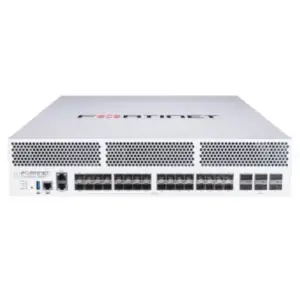
The 5000G sits at the upper end of Fortinet’s current FortiADC hardware range. Published platform figures include up to 350 Gbps L4/L7 performance, up to 180 Gbps TLS bulk encryption throughput, high connection-scale capability, dedicated acceleration for cryptographic processing, and a dense high-speed interface layout consisting of eight 100GbE QSFP28 ports and four 40GbE QSFP ports. The 2U platform also provides dual hot-swappable power supplies, two dedicated high-availability interfaces, solid-state storage, centralized management options, virtual domain capability, and hardware trust support. These characteristics make it suitable for data-center cores and application environments where a lower-tier appliance may become constrained by interface density, encrypted traffic volume, connection scale, or future growth.
Procurement of a platform at this level should be driven by a validated design rather than a model name alone. FourTeck Uganda can review traffic levels, encrypted session behavior, rack space, transceiver requirements, upstream switch compatibility, redundancy objectives, support term, application security requirements, and delivery location before preparing the commercial offer. This helps avoid common mistakes such as selecting the correct chassis but omitting required optics, choosing a support bundle that does not match the intended security functions, or underestimating the rack power and cooling profile.
Instant Specifications and Procurement Fact Rail
Fortinet FortiADC 5000G, high-capacity hardware application delivery controller.
Large enterprise, data center, service provider, regional application hub, high-volume transaction environment.
Up to 350 Gbps L4/L7 platform performance, subject to configuration and traffic characteristics.
Up to 180 Gbps TLS bulk encryption throughput with hardware acceleration.
8 × 100GbE QSFP28 and 4 × 40GbE QSFP interfaces.
Dual hot-swappable power supplies for redundant data-center operation.
2U rack appliance designed for front-to-back airflow.
Project quotation recommended; final price depends on hardware, bundle, support term, optics, quantity, freight, and current supply position.
A correct purchase order for the 5000G normally includes more than the base chassis. Buyers should determine whether the project requires a Network Security, Application Security, or other supported commercial bundle; the duration of FortiCare coverage; the number and type of QSFP/QSFP28 optical or direct-attach connections; spare optics; rack accessories; redundant upstream switch paths; and whether a second appliance is required for high availability. Regional warranty and replacement commitments also depend on the selected FortiCare level and the final order terms. FourTeck therefore recommends preparing the quotation from an engineering checklist rather than requesting only the appliance part number.
Operational Product Architecture and Overview
FortiADC 5000G is engineered as an application delivery layer rather than a simple high-speed Ethernet forwarding device. Its value appears when the network must understand service health, distribute connections across multiple application resources, process encrypted sessions, enforce delivery policies, and maintain application continuity when a server, link, or site experiences failure. At Layer 4, traffic decisions can be based on transport behavior and service endpoints. At Layer 7, delivery policies can operate with awareness of application requests and content patterns. This allows infrastructure teams to build more deliberate traffic flows than basic network routing or simple round-robin distribution.
The platform’s interface architecture is especially relevant in modern data centers. Eight 100GbE QSFP28 ports provide substantial high-speed attachment capacity for aggregation, core switching, server fabrics, or routed application zones, while four 40GbE QSFP ports provide additional design flexibility. Fortinet also documents breakout capability on supported 5000G interfaces, allowing certain 100G physical ports to operate as multiple 25G logical interfaces and certain 40G ports to operate as multiple 10G logical interfaces when supported cables, connected switches, and device configuration are used. This matters for migration projects in which the application delivery layer must bridge older 10G or 25G server-side infrastructure with a newer 40G or 100G core without requiring immediate replacement of every adjacent component.
Hardware acceleration is central to the 5000G design. Encrypted application traffic places heavy computational load on conventional server processors because every secure connection requires cryptographic negotiation and ongoing encryption or decryption work. Offloading those functions to an appliance built for encrypted delivery can protect application servers from unnecessary cryptographic overhead and can create a centralized point for certificate and secure service handling. Published TLS performance figures are useful for first-stage sizing, but engineering validation should also examine cipher choice, transaction size, connection reuse, session duration, certificate design, and expected handshake rate. Two applications with identical bandwidth can create very different processing requirements if one uses long-lived sessions and the other creates extremely large numbers of short secure transactions.
Connection scale is another reason organizations move to the 5000G class. Fortinet publishes capacity figures in the hundreds of millions of concurrent Layer 4 connections for this model family generation, along with multi-million request-rate capabilities. Those numbers illustrate the intended scale, but procurement teams should interpret them as laboratory maximums rather than guaranteed production outcomes. Real environments contain logging, security inspection, persistence rules, content rewriting, health checks, encryption, scripting, backend latency, and mixed request sizes. A prudent design uses headroom, because an application delivery controller is generally expected to absorb demand spikes, failover load, maintenance windows, and abnormal traffic without becoming the next bottleneck.
The software layer supports advanced load balancing, global server load balancing, health monitoring, persistence, content routing, application access functions, scripting, compression, certificate handling, and security capabilities according to the selected license bundle and release. Virtual domains provide operational separation where one physical appliance must support multiple business units, application groups, customers, or administrative boundaries. This can be useful for large organizations that want to consolidate several delivery services while retaining logical separation. However, virtual domain count should be planned alongside routing tables, certificates, virtual servers, logging, operational ownership, and change-control policies.
A recurring procurement pain point is buying for average traffic rather than failure conditions. Suppose an organization operates two data centers, each carrying roughly half of production demand. If one site is unavailable, the surviving location may suddenly need to handle most or all production traffic. The application delivery design should therefore be assessed under normal load, peak load, maintenance load, and site-failure load. The same principle applies to dual-device clusters: each node must have enough reserve to carry the intended failover share. The 5000G can be attractive not simply because its headline throughput is high, but because it creates room for continuity planning in environments where loss of application access has a substantial financial or public-service impact.
Enterprise Business Outcomes and Value Analysis
1. Performance and Throughput Integrity
The primary business reason to deploy a high-capacity ADC is to preserve application responsiveness while traffic volumes, encrypted sessions, and backend complexity grow. With up to 350 Gbps L4/L7 platform performance and up to 180 Gbps TLS bulk throughput, the 5000G is designed for environments that would quickly outgrow entry or midrange appliances. High-speed 100G interfaces also reduce the need to create large bundles of lower-speed links merely to reach the required aggregate bandwidth. For procurement teams, this supports longer design life and provides expansion headroom when new applications, customer traffic, or additional data-center links are introduced.
2. System Reliability and High Availability
Application availability is often more valuable than raw throughput. The 5000G supports dedicated high-availability connectivity and redundant hot-swappable power supplies, allowing the appliance to participate in architectures designed to reduce single points of failure. The business value comes from planned continuity: an ADC can stop directing users toward unhealthy application servers, support failover arrangements, and form part of a redundant pair. This can reduce outage exposure during server failures, software maintenance, hardware replacement, and power events when the surrounding data-center infrastructure has also been designed for redundancy.
3. Network and Infrastructure Scalability
Dense 40G and 100G connectivity allows the platform to fit into modern spine-leaf and core distribution designs. Breakout options can extend that flexibility where the project must connect to 10G or 25G infrastructure. This supports staged modernization rather than forcing every adjacent switch or server interface to be upgraded at the same time. Virtual domains add logical scaling by allowing multiple delivery contexts to reside on one appliance while remaining separated operationally. The result can be a more efficient infrastructure footprint when several application teams require high-capacity services but do not each need a dedicated appliance.
4. Enterprise Security and Access Control
Application delivery increasingly overlaps with application protection. FortiADC can provide web application firewall functions, secure access capabilities, encrypted traffic handling, certificate management, and additional security services depending on the selected bundle. Centralizing some of these controls in the delivery tier can make policy more consistent across application pools, especially when legacy servers cannot easily be modified. Buyers should map required functions to the exact commercial bundle because the chassis alone does not imply every subscription service is included.
5. Centralized Management and Operational Simplicity
The appliance supports browser-based management, SSH command-line administration, console access, and SNMP-based monitoring. Centralized delivery control can simplify operations because health checks, virtual services, backend pools, persistence rules, certificates, and traffic policies are managed from a purpose-built platform rather than distributed across every application server. Operational simplicity still depends on governance: role separation, configuration backup, certificate renewal processes, maintenance windows, logging, and change approval should be documented before production rollout.
6. Total Cost of Ownership and Energy Planning
A high-end ADC represents a significant capital and support commitment, but total cost should be evaluated against the alternative architecture. Consolidating multiple lower-capacity devices may reduce rack units, management points, spare holdings, and cabling complexity. Hardware encryption offload can also preserve compute resources on application servers. At the same time, the 5000G’s power and cooling demand must be budgeted accurately. Published average and maximum draw values are far above those of a branch appliance, so rack power availability, redundant feeds, PDU capacity, and heat removal are part of the financial design, not merely facilities details.
7. Growth and Lifecycle Flexibility
The combination of high throughput, 100G interfaces, breakout support, logical segmentation, and security bundle options can allow the platform to serve multiple phases of an infrastructure roadmap. A buyer may deploy it initially for a small number of high-value services and later add more applications or higher-speed upstream connectivity. Capacity should still be validated against realistic growth forecasts, because future encryption standards, application behavior, or policy depth can change processing requirements even if total bandwidth remains stable.
Key Hardware and Software Highlights
| Component or Capability | 5000G Design | Operational Outcome |
|---|---|---|
| Application delivery performance | Up to 350 Gbps L4/L7 | Supports high-volume data-center applications and large traffic consolidation points. |
| TLS acceleration | Hardware-assisted, up to 180 Gbps bulk throughput | Reduces cryptographic processing pressure on backend infrastructure and supports encrypted service scale. |
| 100GbE interfaces | 8 × QSFP28 | High-bandwidth core and fabric integration with fewer physical links. |
| 40GbE interfaces | 4 × QSFP | Supports mixed-speed data centers and migration from earlier high-speed fabrics. |
| Port breakout | Supported on documented interfaces with compatible cabling and switches | Can increase logical interface density for 25G and 10G connectivity designs. |
| Power architecture | Dual hot-swappable PSU | Supports redundant A/B power feeds and field replacement without planned full chassis shutdown where procedures permit. |
| High availability | Two dedicated HA interfaces | Provides dedicated links for cluster heartbeat and synchronization designs. |
| Virtual domains | Up to 150 published for this generation | Supports logical segmentation for business units, tenants, projects, or application groups. |
| Management | HTTPS, SSH CLI, direct console, SNMP | Fits enterprise operations, monitoring, troubleshooting, and controlled change processes. |
These features should be treated as parts of one system rather than isolated specifications. For example, eight 100G ports are valuable only when the chosen transceivers, fiber type, switch optics, lane configuration, and routing design are compatible. Similarly, hardware encryption capacity is most useful when certificate ownership, renewal responsibilities, cipher policy, application behavior, and logging requirements are defined. The procurement process should connect each physical specification to a deployment outcome so the bill of materials reflects the complete production path.
Technical Specifications Ledger
| Specification | FortiADC 5000G | Planning Note |
|---|---|---|
| L4/L7 performance | Up to 350 Gbps | Use production headroom; actual results depend on policy and traffic. |
| L4 connections per second | Up to 2.5 million published | Validate short-session workloads separately from bulk bandwidth. |
| L4 HTTP requests per second | Up to 18.5 million published | Request size and feature stack materially affect production results. |
| L7 requests per second | Up to 4.2 million published | Model advanced policies and scripting in sizing tests. |
| Maximum L4 concurrent connections | Up to 400 million published | Useful for large-scale persistent or internet-facing services. |
| TLS bulk encryption throughput | Up to 180 Gbps | Cipher mix, key type, handshake rate, and session reuse influence results. |
| TLS transaction rate, RSA-based published profile | Up to 90,000 TPS | Confirm current release and test methodology for exact project comparison. |
| TLS transaction rate, ECDSA-based published profile | Up to 140,000 TPS | Certificate and cipher choices should match application standards. |
| Compression throughput | Up to 175 Gbps | Benefit depends on payload compressibility and application policy. |
| Virtual domains | Up to 150 | Design administrative ownership and logging boundaries early. |
| Memory | 512 GB | Supports large-scale connection and policy operations. |
| Network interfaces | 4 × 40G QSFP, 8 × 100G QSFP28 | Optics and cables should be specified in the quotation. |
| Management interface | 1 × 10/100/1000 | Place on a controlled out-of-band or management network where possible. |
| Dedicated HA interfaces | 2 | Reserve according to the final HA design. |
| Storage | 1.92 TB SSD class | Published capacity can vary by hardware revision; validate at order time. |
| Power supplies | Dual, hot-swappable | Connect to independent A/B feeds where available. |
| Hardware trust | TPM supported | Useful for platform trust and secure enterprise design requirements. |
| Form factor | 2U | Confirm rack depth, rail clearance, airflow, and cable bend radius. |
| Approximate dimensions | 440 × 88 × 600 mm class | Use current shipping documentation for final cabinet fit verification. |
| Weight | About 15.68 kg published | Allow for rails, optics, and safe handling procedures. |
| Input voltage | 100–240V AC, 50/60 Hz class | Verify the supplied power cords and data-center outlet standard. |
| Power consumption | Approximately 796 W average / 915 W maximum published | Plan UPS, PDU, generator, and cooling capacity for maximum draw with margin. |
| Heat dissipation | Approximately 2716 BTU/h published | Coordinate with facility cooling design. |
| Operating temperature | 0°C to 40°C published | Maintain stable data-center inlet temperature and unobstructed airflow. |
| Humidity | 10% to 85% non-condensing published | Avoid condensation and uncontrolled equipment-room conditions. |
| Airflow | Front to back | Align with hot-aisle/cold-aisle cabinet practice. |
| Regulatory / safety | FCC/ICES, RCM, VCCI, BSMI class; UL/cUL and CB published | Confirm the current regional compliance statement for tender documentation. |
Performance values are published upper limits observed under defined test conditions and can vary materially according to software release, policy stack, encryption profile, logging, packet size, connection behavior, backend responsiveness, and enabled security functions. Tender documents should distinguish between vendor maximums and the project’s required sustained production capacity. FourTeck can help convert the application profile into a sizing worksheet so the quotation is based on real operating conditions.
Configuration and Sizing Worksheet
Step 1: Estimate Workload and Scale
Start with present peak throughput rather than monthly averages. Record inbound and outbound application traffic, then separate encrypted from unencrypted flows. Collect new connections per second, active concurrent sessions, HTTP request rates, average and maximum response sizes, and the number of virtual services. If those metrics are not available, use firewall, server, application monitoring, or existing load-balancer statistics to create a representative baseline. Apply a realistic growth factor for the intended service life. Then model failure conditions: if one site or one ADC node fails, determine how much extra traffic the surviving device must carry. A 60-percent steady-state design may already be too aggressive if failover would push the remaining node beyond safe headroom.
Step 2: Validate Environment and Rack Space
Reserve two rack units and verify physical rack depth, rail support, front service clearance, rear cable clearance, airflow direction, and weight limits. Large QSFP and QSFP28 cables can have meaningful bend-radius requirements, so cabinet depth and patching layout should be checked before shipment. Confirm that the cold aisle can deliver clean intake air and that the cabinet can remove the appliance’s heat output without hot-air recirculation. Facilities teams should receive the published maximum power draw and heat dissipation rather than a generic network-appliance estimate.
Step 3: Plan Redundant Power and Cabling
The dual hot-swappable power supplies should ideally terminate on independent A and B power feeds, backed by separate PDU circuits where the data center provides that architecture. Confirm plug type, power cord compatibility, UPS capacity, and generator-backed load. On the network side, list each required 100G, 40G, 25G, or 10G path and specify whether it will use optical transceivers, active optical cables, passive direct-attach cables, or structured fiber. Verify switch-vendor interoperability, fiber mode, wavelength, distance, connector type, and breakout support. The appliance should not arrive before the cabling design is complete.
Step 4: Select License and Support Tiers
FortiADC is offered with different bundles and support terms. The appropriate selection depends on whether the project requires primarily traffic distribution, additional application protection, advanced subscription services, or a broader security stack. FortiCare level affects support and replacement arrangements. Buyers should request a line-by-line bill of materials that identifies the base hardware, selected bundle, subscription duration, support level, and any separately ordered optics or accessories. This makes renewal planning clearer and prevents an apparently attractive chassis-only price from being mistaken for a complete production solution.
Step 5: Prepare the Quote Checklist
For the fastest and most accurate quotation, provide the number of appliances, whether the design is standalone or high availability, required delivery city, target go-live date, support duration, interface speeds, quantity of each transceiver type, estimated peak traffic, encrypted traffic percentage, required application security functions, virtual domain count, and any tender or compliance documentation. For government or regulated projects, include the required validity period for the commercial offer, payment terms, bid format, delivery documentation, warranty wording, and whether installation or configuration services must appear as separate line items.
Deployment Scenarios and Industry Use Cases
Large Enterprise and Multi-Site Networks
A large enterprise may operate customer portals, enterprise resource systems, collaboration tools, mobile backends, partner APIs, and internal business applications from two or more data centers. In this design, the 5000G can be positioned as the primary application delivery tier between the network core and application server zones. Virtual services present stable addresses to users while backend pools contain multiple application nodes. Health checks continuously evaluate service availability so new traffic can be redirected when a server fails. Persistence policies can maintain session affinity where the application requires it. Global server load balancing can extend the design across multiple sites, helping the organization decide which location should serve a user according to availability and configured policy. High-capacity interfaces reduce pressure at the aggregation layer as business traffic scales.
Financial and Banking Institutions
Banks, payment processors, fintech platforms, and insurance systems often combine high transaction sensitivity with strict availability requirements. The application delivery tier may serve mobile banking, internet banking, payment APIs, authentication systems, card-related services, or internal transaction applications. These workloads can involve large numbers of encrypted sessions and very low tolerance for service interruption. The 5000G’s hardware-assisted TLS processing and high connection scale can support such environments when properly sized. A production design should include redundant appliances, independent power feeds, diverse switch paths, certificate lifecycle procedures, configuration backup, monitored failover, documented rollback, and clearly defined support escalation. Application security functions should be selected according to the institution’s risk and compliance requirements rather than assumed from the base platform.
Educational and Campus Networks
Large universities and education groups increasingly operate student portals, learning platforms, research systems, identity services, admission portals, digital libraries, and public web services. Demand can spike sharply around registration, examination results, admissions deadlines, and online learning events. A high-capacity ADC can distribute those bursts across server clusters while preserving a consistent service endpoint. Virtual domains may help separate central IT applications from research, administrative, or hosted institutional services. The 5000G is most appropriate for very large campuses, national education platforms, or shared data centers rather than ordinary single-campus deployments; smaller FortiADC models may be commercially more efficient where throughput requirements are modest.
Government and Defense Procurement
Government portals and defense-support systems often require predictable availability, controlled administrative access, formal procurement documentation, lifecycle support, and clear replacement procedures. The 5000G can form part of a resilient application delivery architecture for citizen services, identity systems, digital revenue platforms, internal applications, or inter-agency services where traffic scale justifies the platform. Procurement teams should request current compliance statements, warranty terms, support coverage, country of origin documentation where required, and exact hardware part numbers. Engineering teams should define management-network isolation, administrator roles, certificate custody, logging destinations, configuration backup, change-control approval, and disaster-recovery operation before commissioning. Where a tender specifies exact protocols, throughput tests, interface standards, or security functions, those requirements should be mapped individually to current manufacturer documentation.
Technical Deep Dive 1: Processing, Acceleration and Hardware Engine Architecture
At very high application traffic levels, raw CPU capacity is not the only determinant of performance. Packet classification, connection tracking, secure session establishment, bulk encryption, compression, health monitoring, content switching, and policy execution all compete for processing resources. FortiADC 5000G is designed around high-capacity hardware and acceleration so these tasks can be handled in an appliance architecture purpose-built for application delivery. The published 350 Gbps L4/L7 figure indicates the aggregate class of traffic processing the platform is designed to address, while the 180 Gbps TLS bulk figure illustrates its role in encrypted service delivery. These figures should be interpreted together. An environment dominated by encrypted short-lived connections may reach a transaction-rate limit before it reaches bulk throughput. Conversely, a large file-delivery workload may stress bandwidth while creating comparatively fewer handshakes.
The correct sizing exercise therefore decomposes traffic. Measure or estimate connections per second, concurrent connections, requests per second, encrypted handshakes, cipher suites, certificate key type, average payload size, and expected compression usage. Then add the policy stack: persistence, rewrite rules, scripting, inspection, logging, security functions, and virtual domains. This approach is more reliable than dividing internet bandwidth by a headline throughput number. High-speed interfaces add another dimension. Eight 100G ports can provide substantial physical bandwidth, but the intended deployment rarely drives every port simultaneously at line rate with every advanced function enabled. Port count should instead be used to create resilient network paths, multiple zones, link aggregation where supported by the design, and sufficient headroom for growth.
Technical Deep Dive 2: Software Ecosystem, Firmware Security and Operational Control
The operational value of an ADC comes from policy control. FortiADC can define virtual servers, map them to backend pools, run health checks, establish persistence behavior, rewrite or route requests, manage certificates, support global delivery logic, and provide application protection capabilities depending on the licensed services. For infrastructure teams, this creates a dedicated control layer between client connections and application servers. The application can be scaled horizontally by adding backend nodes without changing the address users reach. A server can be removed from the pool for maintenance without exposing the change directly to clients. Health monitoring can distinguish between a reachable server and a functioning application when checks are designed correctly.
Firmware governance is equally important. Production ADCs should not be upgraded casually because they sit in the path of critical services. Organizations should maintain a documented release policy, review vendor advisories, back up configurations before change, validate compatibility with licensed functions, and test upgrades in a representative environment where possible. High-availability pairs can support phased maintenance strategies, but failover behavior must be tested rather than assumed. Administrative access should be restricted to management networks, strong authentication should be enforced, unused services should be disabled where appropriate, and configuration changes should be logged. SNMP and centralized monitoring should watch interface status, resource consumption, server health, certificate expiry, cluster state, and application response indicators.
Technical Deep Dive 3: High Availability, Redundancy and Disaster Recovery
High availability is not achieved simply by purchasing two appliances. A resilient design requires independent failure domains. Each 5000G should have redundant power connected to separate feeds. Network links should terminate on diverse switches where the architecture allows. Cluster heartbeat and synchronization links should be dedicated and protected from ordinary traffic congestion. Upstream routing and downstream server paths should be designed so a surviving ADC can still reach both clients and applications after a switch or link failure. Monitoring should detect not only chassis failure but also partial faults such as an unreachable server farm, broken routing adjacency, unavailable certificate dependency, or unhealthy application response.
Disaster recovery extends beyond the local cluster. If the primary site becomes unavailable, global server load balancing or external DNS control may direct users to a secondary facility. The secondary site must have enough application, database, network, internet, security, and ADC capacity to carry the intended recovery load. Configuration synchronization practices should ensure that virtual services, certificates, health checks, policies, and backend definitions are aligned between sites where required. Organizations should run controlled failover exercises and record recovery time, dependencies, manual steps, and rollback conditions. A recovery design that exists only on a diagram is not equivalent to an operationally proven plan.
Pre-Purchase Buyer Gap Checklist
Are there costs beyond the chassis? Yes. A complete deployment can include a FortiADC bundle, FortiCare support, subscription services, QSFP/QSFP28 optics, breakout cables, rack accessories, spare transceivers, implementation services, training, freight, taxes, and a second appliance for high availability. The quote should separate recurring and one-time items.
How long will this hardware generation remain suitable? Lifecycle suitability depends on Fortinet product status, software support, traffic growth, interface roadmap, and application requirements. Buyers should request the current lifecycle position and support eligibility at quotation time. Do not base a five-year infrastructure plan on a reseller page that may not reflect the latest manufacturer status.
Will the chassis physically fit the rack? The 5000G is a 2U appliance, but U-height alone is insufficient. Verify cabinet depth, rail compatibility, rear clearance, power connector space, airflow, and the bending radius of high-speed cables. This is especially important in older data-center racks or telecom cabinets that were designed for shallower switching hardware.
What is the real power requirement? Published data for the current 5000G generation indicates roughly 796 W average and 915 W maximum. Plan for maximum draw with engineering margin, not the average alone. In an HA pair, double the chassis power requirement and then account for switch optics, UPS efficiency, and growth.
Will 100G optics from another vendor work? Physical form factor does not guarantee interoperability. Transceiver coding, optical standard, wavelength, fiber type, connector, reach, forward error correction, and vendor support policy all matter. The safest approach is to validate both FortiADC and switch-side compatibility for the exact optical part numbers before purchase.
Can one 100G port be used as several 25G ports? Fortinet documents breakout support on the 5000G for supported interfaces and supported cables. However, the connected switch must also support the matching breakout mode, and enabling breakout can affect port numbering and configuration. Plan this before production deployment rather than after cabling is installed.
Does the base appliance include every application security feature? No assumption should be made. FortiADC commercial bundles differ. Request a feature-to-license matrix for required functions and the exact term. This is especially important where web application protection, advanced subscription services, or additional threat services are required by policy.
Can the appliance replace a firewall? An ADC and a next-generation firewall have different primary roles. FortiADC can provide application delivery and application-layer security functions, but network perimeter policy, segmentation, threat prevention, remote access, and other firewall responsibilities should be evaluated separately. Many enterprise designs use FortiADC together with FortiGate and other security controls.
What happens when certificates expire? Secure application delivery depends on certificate lifecycle management. The operations team should know who owns each certificate, when it expires, how renewals are approved, where private keys are stored, and how replacement is tested. Monitoring should provide advance notification so certificate expiry does not become an avoidable outage.
Can a single 5000G serve multiple business units? Virtual domains can provide logical segmentation, and the current platform publishes support for a large number of VDOMs. Whether consolidation is appropriate depends on administrative separation, performance headroom, change governance, security policy, and the consequences of a chassis-level maintenance event.
Uganda Regional Procurement and Delivery Logistics
FourTeck Uganda can support commercial and technical preparation for FortiADC 5000G projects from initial sizing through quotation and supply coordination. Because this is a high-value enterprise appliance, the most efficient process is to begin with a documented requirement rather than an informal request for a single unit. The commercial team can work from the target configuration, support term, site location, interface list, implementation scope, and required delivery window. Where the buyer is operating under a tender, the response can be structured around the requested model, quantity, warranty terms, validity period, and associated services.
Order processing normally involves validation of the final bill of materials, commercial acceptance, sourcing confirmation, shipment planning, customs and import handling as applicable, and local delivery coordination. Lead time can vary with factory or distributor stock, chosen bundle, project quantity, and transport route. For this reason, delivery should not be promised from a generic website stock indicator. A formal quotation should state the current availability position and any assumptions. If the required go-live date is fixed, share it at the beginning so alternatives such as phased delivery, reserved stock, or equivalent design options can be discussed if necessary.
Pre-configuration support can be arranged according to project scope. Typical preparation may include firmware validation, configuration template review, interface mapping, management addressing, high-availability planning, certificate requirements, and deployment documentation. Sensitive production credentials and private keys should follow the customer’s security policy; they do not need to be embedded in a staging process unless an approved procedure exists. For regulated environments, a clear handover document should record serial numbers, software version, support entitlement, configuration backup procedure, and support escalation path.
Local Coverage Matrix
Kampala
Primary commercial and enterprise deployment requirements, including data-center, banking, government, telecom, and corporate infrastructure projects.
Entebbe
Support for organizations requiring enterprise application delivery infrastructure, airport-area operations, hospitality platforms, logistics systems, and regional offices.
Jinja
Procurement support for industrial, manufacturing, education, public-sector, and multi-site business networks requiring resilient application access.
Mbarara
Regional enterprise, healthcare, education, government, and distributed business projects that need secure access to centralized applications.
Gulu
Support for regional offices, public institutions, NGOs, education networks, and enterprises extending centralized digital services into northern Uganda.
For every city, delivery planning should consider site readiness, rack capacity, network optics, power feeds, implementation ownership, and the availability of qualified staff during commissioning. High-capacity equipment should not be dispatched to a site that has not completed its physical and logical readiness checklist.
Cross-Border and Regional Supply Chains
Organizations operating across East Africa and the Gulf often standardize application delivery platforms across multiple sites. FourTeck can help coordinate requirements for Uganda, Kenya, the UAE, Kuwait, and broader African markets while keeping each country’s commercial and logistics conditions separate. This is important because local delivery routes, tax treatment, support entitlements, stock positions, and implementation ownership can differ even when the technical model is the same.
For Uganda project inquiries, visit FourTeck Uganda. For Kenya deployments, use FourTeck Kenya. Broader regional requirements can be coordinated through FourTeck Africa. UAE projects can be handled through FourTeck UAE, while Kuwait requirements can be directed to FourTeck Kuwait. Multi-country projects should include a site list, appliance quantities, support term, target delivery dates, local contact details, and whether each site forms part of a single global server load-balancing architecture.
Related Products and Internal Planning Links
The 5000G should be compared against adjacent FortiADC models before a final order is released. A project that needs 100G connectivity but lower aggregate throughput may be better served by a smaller current-generation model, while very large designs may justify the 5000G because of both performance headroom and port density. Review the broader enterprise networking portfolio for switching and connectivity requirements, and use the Uganda project quotation desk to request model comparisons.
A complete ADC deployment may also require high-speed transceivers, fiber patching, data-center switches, rack power distribution, uninterruptible power systems, firewall integration, and monitoring tools. Buyers planning a Fortinet-centered environment can ask FourTeck to include compatible FortiGate security appliances, switching options, and structured high-availability components in the same bill of materials. For multi-country projects, the regional links above can be used to coordinate the same architecture across different locations. Where exact internal category URLs change, FourTeck can provide direct links to current Fortinet application delivery, firewall, switch, optical, and data-center power options during quotation.
FourTeck Technical Service Capabilities
Engineering validation begins by converting the requested model into a deployable design. FourTeck can review whether the 5000G is appropriately sized, whether an HA pair is required, which interface speeds will be used, how many optics are needed, and which support or application security bundle matches the requirement. Bill-of-materials verification is particularly important for 100G and 40G projects because a chassis without the correct optical components cannot be commissioned on schedule.
Staging services can include hardware inspection, serial recording, support entitlement verification, approved firmware preparation, baseline management configuration, interface mapping, configuration template review, and pre-shipment checks. Firmware changes should follow customer approval and compatibility review rather than being performed automatically. For high-availability projects, engineering teams can validate the intended heartbeat connections, redundant network paths, addressing plan, and failover sequence before site deployment.
Post-sales technical support can cover installation guidance, policy configuration assistance, health-check design, certificate deployment planning, application pool creation, high-availability troubleshooting, upgrade preparation, and escalation support. Service scope should be stated clearly in the quotation so the customer knows whether the purchase includes only product supply, remote configuration support, on-site commissioning, migration from an existing ADC, or a broader managed implementation. This separation makes project responsibilities clearer and reduces delays during production change windows.
Extended Technical FAQ
1. What type of organization should consider FortiADC 5000G?
The 5000G is designed for very high-capacity application delivery requirements. It is most appropriate for large enterprises, service providers, financial institutions, government data centers, digital platforms, and organizations consolidating many critical applications behind a single delivery tier. Its 350 Gbps class L4/L7 performance, 180 Gbps class encrypted throughput, and dense 100G connectivity are far beyond what many ordinary business networks need. A smaller FortiADC can be more economical when traffic is moderate. The decision should be based on measured peak bandwidth, connections, encrypted session rate, interface requirements, failover load, expected growth, and the cost of future expansion.
2. Does FortiADC 5000G support 100GbE connectivity?
Yes. The current 5000G hardware specification includes eight 100GbE QSFP28 interfaces together with four 40GbE QSFP interfaces. Those ports provide substantial flexibility for data-center core, aggregation, and server-fabric connectivity. The port itself is only one part of the link, however. Buyers must choose compatible transceivers or cables, confirm fiber type and distance, verify switch-side support, and determine whether the design needs single links, aggregated links, redundant paths, or breakout operation. FourTeck can prepare an optics schedule alongside the chassis quotation to prevent mismatched transceiver purchases.
3. Can the 100G and 40G ports be broken into lower-speed interfaces?
Fortinet documents breakout capability for supported FortiADC 5000G ports. In supported configurations, a 100G port can operate as multiple 25G logical interfaces and a 40G port can operate as multiple 10G logical interfaces. This can be useful when the ADC connects simultaneously to newer 100G infrastructure and existing 10G or 25G systems. Breakout requires compatible direct-attach or optical breakout cabling, support on the connected switch, and correct configuration on both ends. Enabling breakout may also require a reboot and change how interfaces appear in the system, so the choice should be made during design rather than during an unplanned production change.
4. What licensing or subscriptions are required?
The required commercial package depends on the functions the organization intends to use. FortiADC is available with different hardware bundles and service combinations, and FortiCare support terms can be purchased for defined periods. Basic application delivery requirements may differ from projects that need additional application security or advanced subscription services. For procurement clarity, the quotation should identify the exact hardware part number, bundle code, subscription term, support level, and renewal implications. This prevents a chassis-only comparison from being treated as equivalent to a complete supported solution. FourTeck can map requested functions to the appropriate current Fortinet bundle before pricing.
5. How should high availability be designed?
A robust design normally uses two appliances when the application delivery layer cannot tolerate a single chassis failure. The 5000G provides dedicated high-availability interfaces and dual hot-swappable power supplies. Each appliance should connect to independent power feeds and diverse network paths where possible. Heartbeat and synchronization links should be reserved for cluster operation. The network design must ensure that the surviving appliance still reaches upstream networks and backend servers after a failure. Capacity planning should also assume that one node may need to carry the required production load during maintenance or fault conditions. High availability is therefore an end-to-end architecture, not simply a checkbox on the appliance.
6. How is warranty or hardware replacement handled in Uganda?
Warranty and replacement handling depend on the FortiCare coverage, contract term, regional entitlement, and the circumstances of the fault. Different support levels can provide different response and replacement expectations. Buyers with strict uptime requirements should specify the desired replacement objective at quotation stage rather than assuming a standard return process will meet operational needs. FourTeck can confirm the support option quoted, assist with entitlement information, and coordinate escalation for diagnosed hardware issues. Customers should retain serial-number records, support contract details, configuration backups, and current contact information so a replacement case can be opened efficiently if required.
7. Can FourTeck assist with configuration and migration?
Yes, configuration assistance can be included according to the project scope. Typical tasks may include reviewing the addressing plan, creating virtual servers and backend pools, defining health checks, configuring persistence, planning certificates, preparing HA settings, mapping interfaces, and validating failover. Migration from another ADC requires additional discovery because feature names and policy behavior vary across vendors. The existing configuration should be inventoried, including virtual services, server pools, monitors, certificates, persistence methods, rewrite rules, scripts, and DNS dependencies. A controlled cutover plan should include testing, rollback, monitoring, and responsible contacts for application, network, and security teams.
8. How much rack power and cooling should be reserved?
Current published specifications for the 5000G generation indicate approximately 796 W average power consumption and 915 W maximum, with heat dissipation around 2716 BTU per hour. Facilities planning should use the maximum figure plus reasonable headroom, especially for an HA pair. Each hot-swappable power supply should connect to the intended redundant feed, and PDU, UPS, generator, and branch-circuit capacity should be confirmed. Cooling design should maintain appropriate inlet temperature and front-to-back airflow. A high-density rack containing multiple network and security appliances can exceed thermal limits even when each individual device remains within its rated range, so cabinet-level planning matters.
9. Is the 5000G suitable for application security as well as load balancing?
FortiADC combines application delivery with security capabilities that can include web application firewall functions, secure access controls, encrypted traffic services, and other application protection features depending on the selected commercial bundle and software release. This can reduce the number of separate appliances required for some architectures, but buyers should not assume it replaces every security control. Firewalls, endpoint controls, identity systems, secure coding, database security, and dedicated application protection tools may still be required. The right approach is to define the security outcomes first and then map each requirement to the FortiADC capability, another Fortinet product, or an existing enterprise security platform.
10. What information is needed to receive an accurate Uganda quotation?
Provide the number of 5000G appliances, whether they will operate standalone or in high availability, the required delivery city, expected project date, support duration, desired security bundle, interface speeds, optic quantities, rack power constraints, and whether professional services are required. Technical sizing improves when you also provide peak throughput, encrypted traffic percentage, new connection rate, concurrent sessions, number of applications, server pool sizes, required virtual domains, and disaster-recovery architecture. For formal procurement, include company or institution name, billing and delivery requirements, quotation validity requirement, tax information, tender reference if applicable, and any mandatory documentation. This allows FourTeck to prepare a complete bill of materials rather than a partial chassis estimate.
Prepare Your FortiADC 5000G Procurement Request
For a production-ready FortiADC 5000G quotation in Uganda, send FourTeck the appliance quantity, target deployment city, required support term, high-availability requirement, 40G and 100G interface plan, estimated encrypted traffic, expected growth, and any application security functions that must be included. The team can use this information to validate the model, identify the appropriate bundle, prepare the transceiver and accessory list, and highlight any rack power or connectivity considerations before the order is placed.
If the project is replacing an existing ADC, include the current model, peak traffic statistics, major virtual services, server pool count, certificate requirements, and preferred migration window. If the purchase is part of a tender, include the technical compliance schedule and commercial submission requirements. A structured request reduces quote revisions and helps ensure that hardware, support, optics, delivery, and implementation services align with the actual project.
Reviews
There are no reviews yet.