
Fortinet FortiWeb 400F in Uganda
A 1U web application firewall appliance for protecting business web applications and APIs with dedicated application-layer security controls.
For organizations publishing important applications to customers, employees, partners, or citizens, perimeter firewalling alone does not answer every application-layer risk. FortiWeb is designed to inspect and protect HTTP and HTTPS application traffic, apply web security policy, help detect anomalous behavior, protect APIs, mitigate bots, and provide application-focused visibility. The 400F occupies a practical position for organizations whose validated protected throughput and interface requirements fit its platform envelope.
Application security positioned in front of the services your business exposes
FortiWeb 400F is a dedicated hardware Web Application Firewall, or WAF. Its role is different from a general network firewall: it focuses on the behavior and content of web and API traffic and can apply controls that understand application requests. That makes it relevant when a business depends on internet-facing portals, e-commerce systems, online forms, customer dashboards, API endpoints, enterprise applications, or other HTTP and HTTPS services that need a purpose-built protection layer.
Fortinet describes the FortiWeb platform as providing protection against OWASP Top 10 threats, sophisticated bots, distributed denial-of-service attacks at the application layer, anomalous activity, API-related risks, and emerging exploits. The platform includes machine-learning-based detection, API discovery and protection, bot mitigation, and client-side security capabilities. The exact security functions available to a deployment can depend on software version, configuration, and selected service bundle, so procurement should connect the desired security outcome to the license and support package rather than treating the hardware alone as the complete solution.
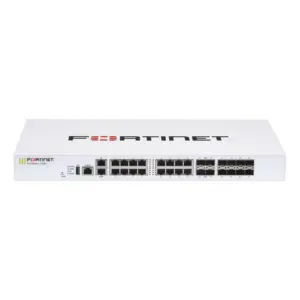
The 400F hardware provides four GE RJ45 ports and four SFP GE ports, a 480 GB SSD, two USB interfaces, software SSL/TLS processing, a single power supply, and a rack-mountable 1U chassis. Fortinet lists up to 500 Mbps throughput and less than 5 ms latency in its current datasheet, while also stating that performance values are up to figures and vary with system configuration. For an IT manager, this means a meaningful sizing exercise should use observed or forecast application traffic and security requirements rather than a simple office headcount.
Deployment design also matters. Fortinet supports active/passive and active/active clustering on this model. Organizations that consider their protected web services business-critical should discuss high availability, upstream and downstream switching, IP addressing, certificates, routing, application ownership, maintenance windows, logging, monitoring, and recovery procedures as part of the project. A WAF can be technically capable yet still be the wrong purchase if the topology, subscription, or traffic assumptions are incomplete.
FourTeck can assist Uganda buyers by translating these requirements into a quote request: appliance model, security bundle, support term, high-availability quantity, transceiver needs, rack and power considerations, and project delivery requirements. This is particularly useful for procurement teams that need a bill of materials that can be reviewed by both technical and commercial stakeholders.
Why a dedicated WAF changes the security conversation
Protect the application layer deliberately
A network firewall and a WAF solve different problems. FortiWeb is built to evaluate web and API requests in application context. For businesses running public portals or transaction systems, this adds a control point specifically designed around application-layer threats and policies.
Apply machine learning to changing application behavior
Fortinet uses machine learning within FortiWeb to model applications and identify malicious patterns. The operational value is the ability to complement conventional signatures and rules with behavior-oriented analysis, particularly as applications evolve and attack methods change.
Address APIs as first-class protected assets
Modern business services increasingly expose APIs to mobile apps, partners, front-end applications, and automation. FortiWeb includes API discovery and protection capabilities, helping security teams extend application protection beyond conventional browser-based pages.
Use flexible copper and fibre connectivity
Four GE RJ45 and four SFP GE interfaces provide practical integration options in a data-centre or server-room network. Buyers should still verify the intended interface map and any SFP modules required, because the physical appliance and transceivers are separate procurement considerations.
Build an availability design around clustered appliances
Support for active/passive and active/active clustering gives architects options for resilient designs. High availability requires more than enabling a setting: the quote, rack space, switching, addressing, licensing, cabling, power, and operating procedure should all reflect the chosen architecture.
Keep security evidence and operational data locally
The appliance includes a 480 GB SSD. Local storage supports appliance operation and data requirements, while longer-term retention and centralized reporting needs should be planned according to the organization’s monitoring architecture and compliance objectives.
A mid-range physical FortiWeb platform with a clear 500 Mbps sizing point
The distinguishing procurement characteristic is not a long list of generic security claims. It is the combination of FortiWeb application and API protection with a 1U appliance platform, eight Gigabit data-interface options across copper and SFP, 480 GB SSD storage, and an officially published throughput ceiling of up to 500 Mbps.
500 Mbps
Published up-to throughput; validate against real traffic and enabled protections.
4 GE RJ45 + 4 SFP GE
Mixed physical connectivity for integration with suitable network infrastructure.
480 GB SSD
Integrated solid-state storage in the appliance.
1U rack-mountable
Designed for standard rack deployment with front-to-back airflow.
HA clustering
Active/passive and active/active clustering are supported.
Unlimited application licenses
Fortinet lists unlimited application licenses for the hardware platform; service subscriptions remain a separate selection consideration.
FortiWeb 400F specification ledger
| Specification | Confirmed detail | Buyer relevance |
|---|---|---|
| Product type | Web Application Firewall appliance | Protects web applications and APIs |
| Throughput | Up to 500 Mbps | Size using peak protected traffic and security functions |
| Latency | Less than 5 ms | Published platform metric; real results depend on deployment |
| Copper interfaces | 4 GE RJ45 | Confirm topology and port allocation |
| Fibre interfaces | 4 SFP GE | Compatible SFP modules may be required |
| USB | 2 interfaces | Local appliance connectivity |
| SSL/TLS processing | Software | Important when evaluating encrypted traffic load |
| Storage | 480 GB SSD | Plan external or centralized retention separately where needed |
| High availability | Active/passive, active/active clustering | Two-appliance design may be appropriate for critical services |
| Administrative domains | 32 | Useful for segmented administration requirements |
| Form factor | 1U rack-mountable | Reserve rack position and front-to-back airflow |
| Dimensions | 44 × 438 × 420 mm | Confirm cabinet depth and service clearance |
| Weight | 5.4 kg | Rack planning |
| Power input | 100–240V AC, 50–60 Hz | Compatible with common data-centre AC feeds |
| Power supply | Single | Important availability consideration |
| Average power consumption | 127.33 W | UPS and power budgeting |
| Heat dissipation | 521.38 BTU/h | Cooling calculation |
| Operating temperature | 0°C to 40°C | Maintain suitable equipment-room conditions |
| Humidity | 5% to 95% non-condensing | Environmental planning |
Three specifications deserve particular attention during purchase. First is throughput. The 500 Mbps figure is an up-to platform value, not a promise that every security profile, traffic mix, TLS workload, and deployment topology will deliver the same application throughput. Measure or estimate peak protected traffic and include growth headroom. Second is SSL/TLS processing: the 400F uses software processing, so encrypted application traffic should be part of the sizing discussion. Third is the single power supply. Although the platform supports appliance clustering, power-path resilience must be designed at the system level. A pair of appliances can provide service resilience, but the rack, UPS, switch connectivity, cabling, and failover design need to support that objective. Buyers should also identify whether copper or SFP links will be used and specify any transceivers rather than assuming they are included.
Five questions to answer before requesting the bill of materials
01 — What application workload will pass through the WAF?
List the websites, portals, APIs, mobile back ends, and business applications to be protected. Record typical and peak traffic, the proportion of HTTPS, upload behavior, large-object traffic, and any seasonal peaks. This determines whether the 400F performance envelope is suitable and helps the security team design policies around actual applications rather than assumptions.
02 — What scale and performance margin is required?
Do not size only for today’s average bandwidth. Consider peak concurrent activity, new digital services, API growth, and expected traffic during the intended service life. If projected demand approaches the appliance ceiling, a higher FortiWeb model or another deployment model may provide more prudent headroom.
03 — How will it connect to the existing environment?
Document switch ports, VLANs, IP addressing, routing, DNS dependencies, server networks, certificates, load balancers, reverse proxies, and upstream firewalls. The 400F offers both GE RJ45 and SFP GE connectivity, but the correct interface choice depends on the existing network. Fibre links may require separately selected SFP modules.
04 — What availability and subscription plan is required?
Decide whether a single appliance is acceptable or whether business impact justifies a cluster. Then identify the security-service bundle and FortiCare term required. Hardware, security services, and support are related procurement decisions. A technically correct appliance without the intended service entitlement can leave the project short of its operational objective.
05 — What delivery, installation, and lifecycle expectations apply?
Share project deadlines, site readiness, rack and UPS availability, implementation responsibility, support expectations, and any internal change-control requirements. Availability can vary, so project planning should separate requested delivery dates from confirmed supply commitments.
Quote Preparation
Send FourTeck the protected application count, peak traffic estimate, HTTPS percentage, API requirements, deployment topology, HA preference, copper or SFP connectivity, desired subscription/support term, quantity, delivery destination, and target project schedule.
Where the 400F can make operational sense
Customer and citizen portals
An organization operating a public portal may need to protect login pages, forms, account functions, and back-end APIs without treating all inbound traffic as generic network sessions. A FortiWeb deployment can add application-aware policy and threat detection in front of these services. The project team should estimate portal peak traffic, authentication behavior, TLS requirements, API calls, and maintenance windows. If service interruption would be costly, clustering and redundant surrounding network paths should be evaluated.
E-commerce and transactional applications
Online commerce and transaction systems face application-layer attacks, automated abuse, credential-related threats, and API exposure. FortiWeb’s application protection, bot mitigation, and machine-learning capabilities are relevant to this risk profile. The buyer should map payment and identity flows, third-party integrations, expected transaction peaks, and application ownership. WAF deployment should complement secure development and patching rather than replace them.
Enterprise web applications published from a data centre
Businesses that host applications in a private server room or data centre may prefer a physical security control that integrates directly with their network. The 1U format, Gigabit copper and SFP connectivity, and clustering options support conventional rack deployments. Validate rack depth, airflow, UPS capacity, interface media, switch design, and operational access before purchase.
API-centric digital services
APIs often connect mobile applications, partner platforms, and internal services. FortiWeb includes API discovery and protection features that can help teams identify and govern exposed API behavior. Buyers should provide known API endpoints, traffic volume, authentication approach, schema or development ownership, and change frequency so the implementation plan can align security policy with the way the APIs actually operate.
Machine learning is useful when it is tied to application context
Web applications change frequently. New URLs appear, APIs evolve, front-end frameworks change, users behave differently during campaigns, and development teams release new functionality. Static rules remain important, but they can struggle to describe every legitimate and malicious pattern. Fortinet positions machine learning as a core part of FortiWeb’s approach, using application modeling to help identify malicious patterns and reduce the administrative burden associated with traditional application learning.
For a buyer, the practical question is not whether a product contains machine learning; it is how the feature fits the operating model. Security teams need a process for onboarding applications, observing behavior, reviewing detections, tuning policy, coordinating with developers, and responding to events. A WAF should be treated as an actively managed security control. Application owners need to communicate planned releases and unusual traffic events so protection can remain effective without unnecessarily interrupting legitimate users.
The 400F provides the physical platform for these FortiWeb capabilities. The selected software release and service entitlements determine the precise feature set available at deployment time. Before quotation, identify which protections are mandatory, which are desirable, and who will administer the platform. This makes the subscription conversation concrete and avoids selecting a bundle simply because its name sounds comprehensive.
API protection belongs in the original design
Many organizations discover that a web application is actually a collection of browser pages, mobile endpoints, partner APIs, and back-end services. Protecting only the visible website can leave important interfaces outside the intended control boundary. FortiWeb includes API discovery and protection capabilities, which makes API inventory and traffic analysis an important part of deployment planning.
Capability 01 — API discovery: use application traffic visibility to improve understanding of exposed interfaces. The operational objective is to reduce unknown or poorly governed API exposure.
Capability 02 — API protection: apply controls to API traffic as part of the broader application security policy. The project should involve developers or API owners so security decisions reflect legitimate request structures and business processes.
Capability 03 — Unified application protection: plan web and API security together where they serve the same business application. This helps procurement size traffic more accurately and helps operations avoid fragmented ownership.
The buyer should document API endpoints, authentication mechanisms, expected clients, request volumes, large payloads, versioning practices, and release frequency. These details influence implementation even when they do not change the hardware SKU. They also help determine whether the 500 Mbps platform is appropriately sized once all protected traffic is considered.
High availability is a system design, not a checkbox
Fortinet supports active/passive and active/active clustering for the 400F. That is important for organizations whose protected applications cannot depend on one appliance. However, clustering does not automatically remove every single point of failure. The 400F itself has a single power supply, so a resilient design needs to consider separate appliances, appropriate UPS feeds, upstream and downstream network redundancy, switch configuration, cabling, monitoring, and tested failover procedures.
A high-availability quote may therefore require two appliances and corresponding subscriptions or support entitlements, plus network accessories. The exact bill of materials depends on Fortinet licensing rules for the selected bundle and the customer’s architecture. Buyers should ask for these items to be shown clearly rather than assuming a single-appliance quote represents a complete resilient solution.
Buyer decision checklist
□ Is application downtime business-critical? □ Is a second appliance required? □ Are both network paths redundant? □ Are rack and UPS resources available? □ Are SFP modules required? □ Has failover behavior been planned? □ Are certificates and configuration backups included in the operating procedure? □ Is monitoring available for both nodes?
What buyers should check before purchase
| Risk | What to confirm | Why it matters | Share with FourTeck |
|---|---|---|---|
| Undersizing | Peak protected traffic, HTTPS share, growth | Security processing and traffic mix affect real performance | Traffic measurements and forecasts |
| Wrong bundle | Required security services and support term | Hardware alone may not provide the intended service entitlement | Required features and 1/3/5-year preference |
| Connectivity gap | RJ45 versus SFP links and optics | SFP modules and fibre type must match the network | Switch model, media, distance, port type |
| Availability gap | Cluster, power, rack, switching, maintenance | HA requires surrounding infrastructure and operational planning | Downtime tolerance and topology |
Also confirm the exact hardware revision or bundle SKU on the final quotation, delivery destination, quantity, required implementation date, and the organization’s warranty/support expectations. Fortinet support services are available in different per-device options, and service availability can have geographic conditions. FourTeck can help structure the request, but the final entitlement should be verified against the quoted SKU and destination. If the workload has outgrown the 400F’s sizing point, it is better to evaluate a higher FortiWeb model before purchase than to depend on optimistic traffic assumptions.
Planning FortiWeb procurement in Uganda
FourTeck can assist organizations in Uganda with product selection, configuration review, quotation preparation, and delivery coordination for Fortinet security projects. Availability can vary by exact appliance SKU, subscription bundle, support term, quantity, and sourcing cycle, so a quotation request should be treated as the point at which current commercial and supply details are confirmed.
For a Kampala deployment, share the technical requirements before the purchase order stage whenever possible. This allows the quote to distinguish the base appliance from FortiWeb security subscriptions, FortiCare support, any second unit required for high availability, SFP modules, and other project accessories. FourTeck can also help buyers compare a 400F requirement with another FortiWeb capacity tier if the measured workload indicates that more performance headroom is appropriate.
Warranty and support expectations should be tied to the exact quoted entitlement. Fortinet offers different support options, and service conditions may vary by geography and contract. FourTeck can provide guidance during quotation without making an unsupported promise about local stock, delivery time, or warranty response. For project quantities, include the required deployment schedule and site count so sourcing and delivery planning can be discussed clearly.
Uganda location coverage
Organizations planning deployments in Kampala, Entebbe, Jinja, Mbarara, and Gulu can use one coordinated FourTeck enquiry to describe the destination, quantity, technical configuration, and required project schedule. This avoids treating each city as a separate product requirement and keeps the focus on the correct appliance and service configuration. Delivery arrangements and timing should be confirmed in the quotation for the specific destination rather than assumed from the product model alone.
East Africa and regional project enquiries
Organizations with security standards spanning more than one country may want a consistent FortiWeb architecture while still handling procurement and delivery requirements by destination. FourTeck can discuss requirements for Uganda, Kenya, selected East Africa markets, selected Africa markets, the UAE, and Kuwait through its relevant regional channels. A multi-country requirement should identify the quantity, destination, support expectations, desired bundle, and implementation schedule for each site.
Regional planning is particularly useful when the same application is delivered from several facilities or when a central security team wants a common platform. The technical standard can be consistent while rack, power, connectivity, licensing, import, and support conditions differ by location. Do not assume that stock, lead time, or service entitlement in one market automatically applies to another. Use the FourTeck Uganda site, FourTeck Kenya, or FourTeck Africa to start the appropriate regional discussion. UAE requirements can be directed through FourTeck UAE, while Kuwait enquiries can use FourTeck Kuwait.
FortiWeb capacity paths and project links
Related-model selection should be driven by protected throughput, interface requirements, SSL/TLS processing needs, availability design, and growth. The links below are catalogue paths for discussion; FourTeck can confirm which exact model and bundle best fits the project.
FortiWeb 100F — for smaller protected workloads where the published 100 Mbps tier is sufficient. Explore FortiWeb 100F options
FortiWeb 600F — a higher hardware tier with published 1 Gbps throughput and hardware SSL/TLS processing. Review FortiWeb 600F options
FortiWeb 1000F — for projects requiring a materially higher published throughput tier. Find FortiWeb 1000F information
Fortinet security portfolio — useful when the project also includes network firewalling, switching, wireless, or broader Security Fabric requirements. Browse Fortinet solutions in Uganda
Project assistance — for model sizing, subscriptions, quantities, and delivery planning. Contact FourTeck Uganda for a project quote
Procurement support around the appliance, not just a model number
01. Product selection guidance. FourTeck can use workload, throughput, interface, and availability requirements to help structure the model-selection discussion instead of assuming the requested model is automatically the best fit.
02. Configuration review. A WAF project may include the appliance, subscriptions, FortiCare, optics, cabling, a second HA unit, and implementation dependencies. Reviewing these elements early reduces the chance of an incomplete bill of materials.
03. Quote assistance. Procurement teams can provide quantity, destination, support term, and project timing so the quotation reflects the actual requirement. Current pricing and availability are confirmed during this process.
04. Business IT context. Application security does not operate in isolation. Rack space, UPS capacity, switches, firewalls, servers, certificates, logging, and operational ownership can affect the deployment. FourTeck can help identify the procurement dependencies that should be discussed with the technical team.
05. Alternative model matching. If the traffic forecast, SSL workload, or growth plan indicates that the 400F is not the right tier, the requirement can be compared with other FortiWeb hardware or deployment options before ordering.
06. Project and quantity coordination. Multi-unit and multi-site requirements benefit from a consolidated schedule and destination list. This gives the commercial team a clearer basis for sourcing and delivery discussions without promising availability before it is confirmed.
Questions Uganda buyers ask about this FortiWeb platform
01. What is the FortiWeb 400F primarily used for?
It is a physical Web Application Firewall designed to protect web applications and APIs. FortiWeb provides application-focused controls including anomaly detection, API discovery and protection, bot mitigation, and other web security capabilities. It is typically positioned between users and protected application services according to the chosen deployment design. It complements, rather than replaces, secure application development, patching, identity controls, and network security.
02. How much throughput does the 400F support?
Fortinet publishes throughput of up to 500 Mbps for the 400F. The vendor also states that performance values are up to figures and can vary with system configuration. Buyers should therefore size using peak protected traffic, HTTPS usage, enabled security functions, application behavior, and growth rather than treating 500 Mbps as guaranteed application throughput in every environment.
03. Which network interfaces are available?
The appliance provides four GE RJ45 ports and four SFP GE ports, giving a mix of copper and fibre-capable Gigabit connectivity. The project design should identify which ports will carry management, protected traffic, HA, or other required connections. If SFP interfaces are used, confirm the correct transceiver type, fibre media, distance, and compatibility as part of the bill of materials.
04. Can the appliance be deployed in high availability?
Yes. Fortinet lists active/passive and active/active clustering for this model. A resilient deployment normally requires planning beyond the cluster configuration itself, including appliance quantity, licensing or support entitlements, switch paths, cabling, rack space, power, monitoring, and failover procedures. Because the 400F has a single power supply, system-level resilience deserves particular attention during design.
05. Does it protect APIs as well as websites?
Yes, API discovery and protection are part of the FortiWeb platform capabilities described by Fortinet. For an API-heavy environment, buyers should document endpoint inventory, authentication, request volume, expected clients, payload characteristics, and release practices. This helps the technical team design policy and ensures API traffic is included in the overall throughput and capacity estimate.
06. What licenses or subscriptions should be quoted?
The correct subscription depends on the security functions and support level required. Fortinet offers FortiWeb service bundles and FortiCare options with different terms. Rather than selecting by bundle name alone, list the capabilities the project requires and the desired support period. FourTeck can then align the quotation request with the appropriate available SKU and confirm the entitlement details.
07. Is the 400F suitable for a rack installation?
Yes. The appliance is a 1U rack-mountable platform measuring approximately 44 × 438 × 420 mm and weighing 5.4 kg. It uses front-to-back forced airflow and accepts 100–240V AC at 50–60 Hz. Buyers should reserve suitable rack depth and ventilation and include the appliance in UPS and cooling calculations for the equipment room.
08. Is FortiWeb 400F available in Uganda?
FourTeck can prepare a Uganda quotation and discuss sourcing for the required configuration. Availability varies by exact SKU, bundle, support term, quantity, and sourcing cycle, so it should be confirmed when the quote is prepared. Share the delivery destination, project schedule, quantity, and technical requirements to obtain a more useful commercial response rather than relying on a generic availability assumption.
09. What information should I send for a quote?
Provide application count, peak traffic, HTTPS percentage, API requirements, expected growth, deployment topology, HA preference, required interface media, desired subscription and support term, quantity, destination, and project schedule. If you already have a network diagram or existing WAF specification, include the relevant details. This helps FourTeck identify missing accessories and distinguish hardware from service entitlements.
10. What if 500 Mbps is not enough for our workload?
Fortinet offers higher FortiWeb hardware tiers. For example, the current vendor model table lists the 600F at up to 1 Gbps and the 1000F at up to 2.5 Gbps. If measured peak traffic, encrypted traffic, future growth, or enabled protections make the 400F sizing tight, compare a higher model before purchase rather than planning to operate continuously near the platform ceiling.
Turn your application-security requirement into a complete quote
Send FourTeck your protected application workload, peak traffic, HTTPS share, API requirements, high-availability preference, interface media, subscription term, quantity, and Uganda delivery destination. The team can use those details to review the requested platform, identify configuration dependencies, and prepare a current quotation without assuming stock or commercial terms.
Useful details: application count • traffic estimate • HA requirement • RJ45/SFP needs • support term • quantity • delivery destination • project date.
Reviews
There are no reviews yet.