
FortiSwitch FS-124F-FPOE Uganda
A 24-port full-PoE+ Gigabit access switch with four 10GbE SFP+ uplinks for secure, centrally managed branch and campus edge networks.
The FS-124F-FPOE is built for wiring closets and business access layers where endpoint connectivity, PoE capacity, uplink headroom, and simplified Fortinet management need to work together. It supports all 24 copper access ports with 802.3af/at PoE and provides a 370W total PoE budget, giving IT teams a practical platform for powering access points, IP telephones, cameras, and other compatible devices without separate electrical adapters at every endpoint.
Fortinet
FS-124F-FPOE
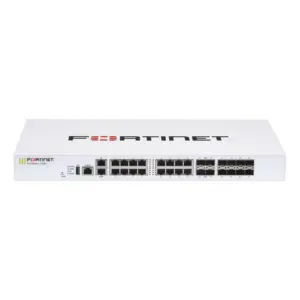
24 × GE RJ45 PoE+
4 × 10GE SFP+
370W
1RU rack mount
A secure access switch for PoE-heavy business edge networks
The FortiSwitch 124F-FPOE is part of Fortinet’s Secure Access family and is designed to sit at the access layer of an organization’s wired network. Its role is straightforward but important: connect user devices and infrastructure endpoints, supply power to compatible devices through Ethernet where required, and provide fast uplink paths toward the rest of the network. The model combines 24 Gigabit Ethernet RJ45 interfaces with four 10 Gigabit SFP+ ports, so it can serve a full office-floor or branch access layer while retaining higher-speed connectivity for uplinks, aggregation, or resilient network design.
Its full-PoE configuration is a major reason to select this variant rather than a non-PoE or partial-PoE model. Every copper access port supports IEEE 802.3af/at power delivery, while the switch provides a total PoE budget of up to 370W. That matters in networks where wireless access points, IP phones, surveillance cameras, door controllers, thin-client peripherals, and other powered endpoints are distributed through ceilings, meeting rooms, corridors, reception areas, or office zones. A single Ethernet run can carry both data and electrical power, simplifying endpoint placement and reducing the number of local power adapters that need to be managed.
For organizations already using FortiGate security appliances, the FS-124F-FPOE can be integrated through FortiLink. This allows the switch to participate in Fortinet’s broader security and management architecture, with network access controls and visibility aligned to the FortiGate environment. The switch can also support non-FortiLink operation using its own management interfaces, so the correct management design should be confirmed during planning rather than assumed.
Performance is sized for a 24-port Gigabit access role. The platform is specified with 128Gbps switching capacity and 190 million packets per second, giving it the forwarding capability needed for wire-speed access switching across its port set under normal supported configurations. It also supports 4K VLANs, 32K MAC address storage, link aggregation, spanning-tree instances, and other features needed in structured enterprise and branch networks.
Selection should be based on more than port count. Buyers need to confirm the total PoE demand, whether 10GbE fibre or copper-adapted uplinks are required, the type and distance of fibre links, FortiGate compatibility, desired support coverage, rack space, airflow, cabling standards, and future endpoint growth. FourTeck can review these inputs for Uganda projects and help build a procurement list that includes the switch, appropriate transceivers, patching, support options, and related network components where needed.
What the design means for day-to-day operations
01
Power more edge devices from one access layer
Full PoE+ capability across 24 ports lets the switch support a dense mix of powered devices. The 370W shared budget gives planners flexibility, but the connected equipment must still be power-budgeted. When correctly designed, this can reduce separate power adapters and simplify wiring around ceilings, desks, corridors, cameras, and wireless access points.
02
Give access traffic room to move upstream
Four 10GbE SFP+ interfaces provide faster uplink options than the individual 1GbE access ports. This is useful when multiple users, access points, cameras, or phones share upstream services and the access switch needs stronger connectivity toward aggregation, a FortiGate, or another switching layer.
03
Align switching with a Fortinet security design
FortiLink integration can bring FortiSwitch configuration and visibility into a FortiGate-managed environment. For businesses standardizing on Fortinet, this reduces the separation between wired access and the security gateway, making policy-oriented operations easier to coordinate.
04
Use a compact rack footprint
The 1RU rack-mount format fits conventional network cabinets and wiring closets without consuming excessive vertical space. Its built-in AC power supply reduces the number of external power components that need to be mounted near the unit.
05
Support structured segmentation
With support for thousands of VLANs and enterprise switching functions, the platform can separate traffic types such as corporate users, voice, wireless infrastructure, surveillance, and guest devices according to the wider network design.
06
Plan for a manageable access-layer lifecycle
A defined 24-port access block helps IT teams document port use, uplinks, PoE allocations, and endpoint groups. This is useful for offices and branches where repeatable switch designs make support, expansion, and troubleshooting more predictable.
The key distinction is the combination of full-port PoE+ and four 10GbE uplinks in a 24-port access platform.
For buyers comparing access switches, the most important question is not simply whether PoE is present. It is how many ports can deliver power, the total power budget available, the speed and number of uplinks, and how the switch will be managed. This model addresses those requirements with full PoE+ coverage across its 24 Gigabit copper ports and a 370W shared budget, while four 10GbE SFP+ interfaces provide flexible upstream connectivity.
FortiSwitch 124F-FPOE specification ledger
| Product type | Secure access managed Ethernet switch |
| Copper access interfaces | 24 × Gigabit Ethernet RJ45 |
| PoE ports | 24 × IEEE 802.3af/at PoE+ |
| PoE power budget | 370W maximum shared budget |
| Uplink interfaces | 4 × 10GE SFP+ |
| Serial console | 1 × RJ45 console port |
| Switching capacity | 128Gbps duplex |
| Packet forwarding | 190 Mpps duplex |
| MAC address storage | 32K |
| VLANs supported | 4K |
| Link aggregation | Up to 8 links per group; 16 groups |
| Packet buffer | 2MB |
| Memory / flash | 512MB DDR3 / 64MB flash |
| Form factor | 1RU rack mount |
| Dimensions | 44 × 260 × 440mm (H × D × W) |
| Weight | 3.82kg |
| Power input | 100–240V AC, 50–60Hz |
| Power supply | Built-in AC; no redundant power supply |
| Average / maximum consumption | 449.8W / 451.3W with PoE loading basis used by vendor specification |
| Operating temperature | 0°C to 45°C |
| Humidity | 10% to 90% non-condensing |
| Airflow / acoustic level | Side-to-back airflow / approximately 45.8dBA |
The specifications that most influence purchasing are the PoE budget, uplink design, management architecture, and power environment. A 370W PoE limit can support many typical phones and moderate-power access points, but a network containing numerous higher-draw wireless devices or cameras can reach the shared budget sooner than port count suggests. Calculate each endpoint’s maximum draw rather than relying on average consumption. The four 10GbE SFP+ ports are another planning point because transceivers are selected according to fibre type, distance, connector standard, and the equipment at the far end. If the switch will be FortiGate-managed, verify the intended FortiGate platform and software release. Finally, the built-in AC supply has no redundant power option, so sites with strict availability targets should consider upstream UPS protection and the broader resilience design.
Five questions that shape the correct bill of materials
01 — What will connect to the 24 access ports?
List the endpoints by type: desktop computers, IP telephones, wireless access points, cameras, printers, door controllers, conference-room devices, and any other Ethernet equipment. This establishes whether the 24-port density is sufficient and whether most connections are simple Gigabit data links or require PoE. It also helps determine whether a second switch, a higher-port model, or a different access architecture is more suitable.
02 — How much PoE power will the connected devices require?
Port count and power budget are separate limits. Although all 24 RJ45 ports support PoE+, the entire switch shares a maximum 370W budget. Add the maximum rated power demand of every powered endpoint and include spare capacity for changes. A design that appears to use only eighteen ports can still exceed its power budget if those ports host relatively high-draw devices.
03 — How will the switch connect upstream?
The four SFP+ interfaces support high-speed uplinks, but the correct transceiver depends on link distance, fibre type, connector, desired speed, and the device at the far end. Buyers should identify whether the switch uplinks to a FortiGate, another FortiSwitch, a core switch, or a fibre distribution frame. Optics should never be selected by connector appearance alone.
04 — How will the switch be managed and secured?
Organizations using FortiGate may prefer FortiLink-based management so access switching can be coordinated with the security fabric. Standalone operation is also possible, but the operational workflow differs. Confirm the existing firewall model, current software, authentication design, VLAN requirements, and whether centralized policy control is a project objective.
05 — What support, rack, power, and delivery conditions apply?
Confirm cabinet depth, ventilation, UPS capacity, power sockets, patch-panel layout, fibre termination, and the support term expected by the organization. Project buyers should also share the delivery location, required quantity, target implementation window, and whether installation services or remote configuration assistance are required.
Where the platform makes practical sense
Branch office with converged voice, wireless, and user access
A regional office may need to connect desktop users, IP phones, printers, meeting-room endpoints, and several wireless access points from one wiring closet. The 24 copper ports provide a practical access block while PoE+ reduces the number of local power supplies. Four 10GbE uplinks give the network designer room to connect upstream without forcing aggregate traffic through a single 1GbE path. The main check is whether the total PoE budget covers the full device mix.
Education building or training facility
Classrooms and training centres often combine wired teacher stations, wireless access points, phones, printers, cameras, and administrative endpoints. A 24-port PoE access switch can consolidate these connections in a rack while VLAN segmentation separates administrative, learning, guest, voice, and surveillance traffic according to the network policy. Fibre uplinks may be useful when the building connects to another block or central network room. The optical path and distance should be documented before ordering transceivers.
Clinic, professional practice, or distributed service site
Smaller healthcare and professional environments commonly depend on reliable wired connectivity for workstations and applications while also needing PoE for phones, wireless infrastructure, cameras, and access-control equipment. The FS-124F-FPOE provides the necessary access density without moving into a 48-port chassis. Where FortiGate is already deployed, FortiLink can help coordinate access switching with the security platform. Device compatibility and network segmentation should be reviewed as part of the design.
Hospitality, retail, and customer-facing facilities
Guest Wi-Fi, point-of-service infrastructure, back-office users, cameras, and IP telephony can create a varied edge network. Full-port PoE+ supports flexible endpoint placement, while the shared 370W budget needs careful accounting when many cameras and modern wireless access points are involved. A resilient upstream design may use more than one SFP+ interface depending on the architecture. Power protection is also important because the switch itself does not contain a redundant power supply.
PoE capacity is a design resource, not merely a feature checkbox
Power over Ethernet becomes valuable when it changes how devices can be placed and supported. A ceiling-mounted access point can receive data and power from the same structured cable. A desk phone can operate without a separate wall adapter. Cameras can be positioned where coverage is needed rather than where an electrical outlet is convenient. These operational advantages depend on the switch having enough PoE-enabled ports and enough total wattage to sustain the installed endpoint mix.
The FS-124F-FPOE supports PoE+ across all 24 Gigabit copper ports, but the total output is capped by a 370W shared power budget. That means planners should create a power worksheet during procurement. Record the maximum power class or wattage requirement of each endpoint, not only its typical consumption. Then add headroom for replacement devices and growth. This prevents a situation where the switch has spare physical ports but insufficient remaining power for a new device.
The distinction is particularly important in wireless and surveillance projects. Newer access points may demand more power than older models, especially when additional radios, USB functions, or higher-performance features are used. Cameras can also vary widely according to infrared illumination, heaters, motors, or other functions. A uniform assumption per port can therefore produce a misleading design. The switch should be assessed against the exact endpoint list.
FourTeck can use that endpoint list to help Uganda buyers decide whether one FS-124F-FPOE is appropriate, whether powered devices should be distributed across multiple switches, or whether a higher-power model is a better fit. This turns PoE planning into a measurable procurement decision instead of an afterthought.
Four 10GbE uplinks give the access layer breathing room
Access switches aggregate many individual endpoint flows. Even when each endpoint uses a 1GbE port, simultaneous traffic from users, wireless clients, cameras, phones, backups, cloud applications, and local services can make upstream design important. The four SFP+ ports allow the switch to connect toward aggregation or security infrastructure at up to 10GbE per supported link, depending on the selected topology and transceivers. They can also support designs that need multiple physical uplinks or link aggregation.
Capability 01
Four SFP+ interfaces provide more uplink choices than a basic two-uplink access switch.
Capability 02
10GbE support helps reduce upstream bottlenecks when many access ports are active.
Capability 03
Optical selection remains configuration dependent and must match fibre, distance, and peer equipment.
The procurement implication is clear: SFP+ ports are only part of the link. Buyers should identify the transceiver standard, fibre type, connector, cable path, and far-end interface before the order is finalized. A correct switch paired with the wrong optics still creates a failed uplink. FourTeck can review these details and include suitable transceivers or direct-attach options where appropriate.
Management architecture affects operations long after installation
FortiSwitch can be deployed in a FortiGate-managed architecture through FortiLink, allowing switching to be integrated into the broader Fortinet environment. For organizations already running FortiGate, this can simplify how administrators view connected devices, build access policies, apply segmentation, and maintain branch or campus network consistency. The value is operational: the access layer does not need to be treated as an isolated platform when the overall design is intentionally built around Fortinet.
However, the presence of FortiLink capability does not remove the need for compatibility checks. The FortiGate model, available FortiLink interfaces, FortiOS release, topology, switch quantity, and intended features should be reviewed. Some businesses may instead operate the switch in standalone mode. That can be appropriate, but management, configuration backups, monitoring, and change procedures need to be defined differently.
Buyer decision checklist
- Confirm whether FortiGate will control the switch through FortiLink.
- Record the FortiGate model and current software release.
- Identify VLAN, authentication, and access-control requirements.
- Determine whether switch management must be centralized across multiple sites.
- Confirm the desired FortiCare support level and term separately from the hardware purchase.
- Document who will perform initial configuration and ongoing administration.
These questions matter because a managed switch is an operational platform, not only a port expander. The correct management model can reduce administrative friction and make troubleshooting more consistent across the life of the installation.
What to check before purchase
Another purchasing consideration is model fit within the wider FortiSwitch range. A non-PoE FS-124F may be sufficient when all attached devices have local power, while the FS-124F-POE covers only part of the access ports with PoE and a lower total budget. Conversely, projects expecting multi-gigabit wireless access, higher power classes, or significantly more endpoints may justify a newer or larger platform. FourTeck can review these trade-offs instead of assuming the most expensive option is automatically the correct one.
Procurement support for Uganda network projects
FourTeck supports organizations planning Fortinet switching deployments in Uganda by helping translate a network requirement into a practical quotation. Availability can vary by procurement cycle, support term, quantity, and accessory requirements, so the recommended approach is to confirm the full configuration before a purchase decision. That includes the exact switch variant, SFP or SFP+ transceivers, fibre or copper patching, rack accessories, UPS protection, FortiCare coverage, and any related firewall or wireless equipment.
For Kampala projects, the quotation process can include a review of switch quantities, cabinet location, endpoint mix, PoE budget, uplink topology, and delivery requirements. FourTeck can also help identify whether the FS-124F-FPOE is the appropriate variant or whether a partial-PoE, non-PoE, higher-density, or multi-gigabit model better fits the requirement. Warranty and support guidance is based on the selected Fortinet service option and applicable vendor terms rather than an assumed blanket coverage statement.
Project and bulk requirements benefit from early planning. Sharing the expected implementation schedule, number of sites, number of switches per site, and preferred support duration allows the quotation to be structured around the real deployment rather than a single hardware line item.
Coverage across key Uganda business locations
FourTeck can coordinate quotations and project supply requirements for customers in Kampala and can also support procurement planning for deployments in Entebbe, Jinja, Mbarara, and Gulu. Delivery arrangements, project quantities, and configuration needs should be confirmed during the quotation process because logistics and availability can vary by location and order scope.
Support for multi-country East Africa and regional projects
Organizations with branches in more than one market often prefer to standardize switch families, support terms, uplink components, and documentation across locations. FourTeck can assist with procurement planning for Uganda and selected East Africa markets where project requirements call for coordinated network hardware sourcing. Regional enquiries can be reviewed through the relevant FourTeck channels for Kenya and Africa, while requirements linked to the Gulf region may also be directed through FourTeck UAE or FourTeck Kuwait where relevant.
The purpose of regional coordination is consistency, not an assumption of local stock or identical delivery conditions. Each market can have different lead times, import requirements, support expectations, and project schedules. A multi-country bill of materials should therefore identify the destination, quantity, desired support term, and local installation dependency for every site. This helps prevent small configuration differences from becoming operational problems after deployment.
For organizations standardizing Fortinet, FourTeck can also compare the required access-port density and PoE profile at each site. A 24-port full-PoE switch may be ideal for one branch while a lower-density, non-PoE, or higher-capacity model may be more appropriate elsewhere. Regional standardization works best when it standardizes design principles as well as part numbers.
Useful comparison paths for a Fortinet access-switch project
Practical assistance around the hardware decision
01Product selection guidance. FourTeck can compare the full-PoE model with related FortiSwitch variants based on port count, endpoint power, uplink requirements, and growth expectations.
02Configuration review. Buyers can submit endpoint lists, PoE requirements, FortiGate information, fibre distances, and rack details for a more accurate bill of materials.
03Quote assistance. Project quantities, desired support term, accessories, and delivery destination can be combined into one commercial request rather than handled as disconnected items.
04Business IT context. Switch procurement can be reviewed alongside firewalls, wireless access points, structured cabling, UPS protection, and other infrastructure dependencies.
05Uganda delivery coordination. Requirements can be planned around destination, quantity, and implementation needs without assuming fixed availability or a universal delivery schedule.
06Alternative product matching. Where endpoint density, multi-gigabit requirements, or PoE demand make this model unsuitable, FourTeck can help identify a better-aligned option.
Buyer questions about the FS-124F-FPOE
01. What is the FortiSwitch FS-124F-FPOE mainly used for?
It is a managed secure access switch for connecting business endpoints at the network edge. It provides 24 Gigabit Ethernet copper ports, all with PoE+ capability, plus four 10GbE SFP+ uplinks. It is well suited to offices, branches, schools, clinics, hospitality sites, and other environments that need wired user access together with powered devices such as wireless access points, IP phones, and cameras.
02. Can all 24 ports provide PoE at the same time?
All 24 RJ45 access ports support IEEE 802.3af/at PoE+, but the entire switch shares a maximum 370W PoE budget. Whether every port can power a device simultaneously therefore depends on the wattage required by those devices. A group of low-power phones may fit comfortably, while numerous higher-draw access points or cameras can consume the budget much faster. Always calculate maximum endpoint demand before deployment.
03. What are the four SFP+ ports used for?
The four SFP+ interfaces provide higher-speed uplink connectivity, supporting 10GbE links where appropriate. They are commonly used to connect the access switch to an aggregation switch, a FortiGate, another FortiSwitch, or a fibre backbone. The required transceiver depends on fibre type, distance, connector, and the interface at the far end, so optics should be selected as part of the network design.
04. Does the switch require a FortiGate?
No, a FortiGate is not required simply for the switch to function as a managed switch. However, FortiSwitch can integrate with compatible FortiGate platforms through FortiLink, which allows centralized management and closer alignment with Fortinet’s security architecture. If FortiLink is part of the project, the FortiGate model, software release, topology, and intended features should be checked for compatibility before ordering.
05. Does FortiSwitch FS-124F-FPOE need a subscription?
The hardware can be purchased separately, while FortiCare and other service entitlements are selected according to the support and management requirement. The appropriate support package and term should be confirmed for the organization’s operational needs. Buyers planning FortiGate-managed switching or cloud-related services should also verify any associated licensing or service dependencies for the complete architecture rather than treating the switch as an isolated line item.
06. Is this model suitable for Wi-Fi access points and IP cameras?
Yes, provided the endpoints use compatible Ethernet speeds and IEEE 802.3af/at PoE within the switch’s total 370W budget. It is frequently a good fit for mixed environments containing wireless access points, phones, and cameras. The important step is to add the maximum power demand of all powered devices. Higher-power or multi-gigabit endpoints may justify a different FortiSwitch model depending on their requirements.
07. What should I send FourTeck to request a quote in Uganda?
Share the number of switches required, the types and quantities of connected devices, expected PoE wattage, uplink speed, fibre type and distance, FortiGate model if applicable, support term preference, rack or cabinet details, and the delivery destination. For project orders, include the target implementation period and whether optics, patch cables, UPS equipment, installation, or related Fortinet products should be included in the quotation.
08. What is the difference between FPOE, POE, and the standard FS-124F?
The standard FS-124F does not provide PoE. The FS-124F-POE supports PoE+ on 12 access ports with a lower total PoE budget, while the FS-124F-FPOE supports PoE+ on all 24 access ports and provides a 370W total budget. The right choice depends on how many devices need switch-supplied power and how much power those devices consume, not only the number of Ethernet ports.
09. What should be checked for rack and power installation?
The switch is a 1RU rack-mount unit with a built-in AC power supply. Confirm cabinet depth, mounting space, airflow, available AC power, grounding, and UPS capacity. The unit uses side-to-back airflow, so ventilation should not be blocked by dense cabling or adjacent equipment. Because the switch does not have a redundant power supply, upstream power protection and the site’s resilience requirements should be considered during design.
10. Is the FS-124F-FPOE the best choice for every 24-port Fortinet deployment?
No. It is particularly strong when a project needs 24 Gigabit access ports, PoE+ on all of them, a 370W shared power budget, and 10GbE uplinks. A non-PoE or partial-PoE model may be more economical for low-power environments, while newer multi-gigabit or higher-power models may be better for advanced wireless and higher-draw endpoints. Selection should follow the endpoint, power, uplink, and management requirements.
Build the switch quote around your actual network
A useful quotation should account for more than the switch itself. Send FourTeck your port count, powered-device list, PoE requirements, uplink design, FortiGate details, fibre distance, desired support term, quantity, and Uganda delivery location. The team can review the model fit and identify related components that need to be included.
- Number of switches and sites
- Powered endpoint types and maximum wattage
- 10GbE uplink and transceiver requirements
- FortiGate model and management design
- Support term, rack, UPS, and delivery needs
Reviews
There are no reviews yet.