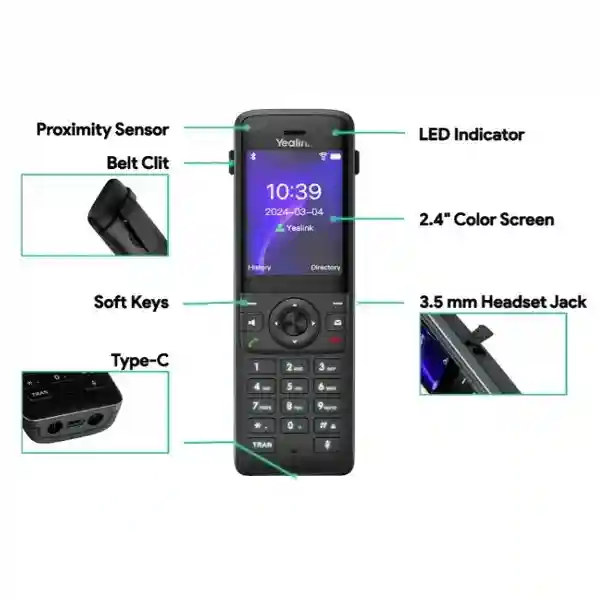
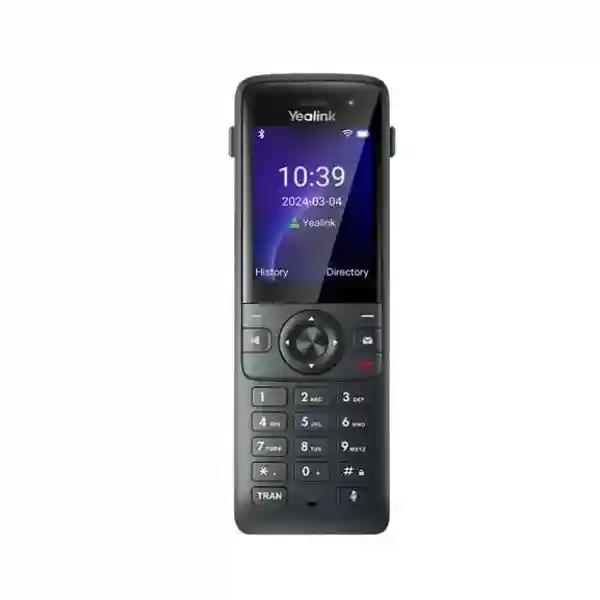
Yealink AX83H Wi-Fi IP Phone – Enterprise Wireless SIP Mobility
The Yealink AX83H is a portable enterprise Wi-Fi IP phone built for teams that need business calling while moving through offices, warehouses, hotels, retail floors and other managed wireless environments. Instead of tying a user to an Ethernet desk position, the handset registers to a SIP service through the organization’s Wi-Fi network. Its dual-band 2.4 GHz and 5 GHz Wi-Fi 6 radio supports IEEE 802.11a/b/g/n/ac/ax, while IEEE 802.11k/r/v capabilities are designed to support faster roaming between compatible access points. That combination makes the AX83H particularly relevant when procurement teams need voice mobility but want to keep communications integrated with an IP-PBX or hosted SIP platform.
The handset supports up to four SIP accounts, a 2.4-inch 240 × 320 TFT color display, Bluetooth 5.0 for compatible headsets, Optima HD audio, smart noise cancellation, a hearing-aid-compatible handset, local five-way conferencing and a 2000mAh battery. Yealink rates battery performance at up to nine hours of talk time and up to 200 hours of standby under laboratory conditions. USB Type-C charging and the supplied charging cradle provide practical charging options for shift-based and mobile teams.
For Ugandan organizations, a successful AX83H project depends on more than handset quantity. WLAN coverage, access-point placement, roaming configuration, authentication method, voice QoS, SIP platform settings, charging arrangements and user movement patterns should all be considered before rollout. FourTeck can help buyers translate those operational requirements into a practical bill of materials and deployment plan.
Instant Specifications & Procurement Fact Rail
Yealink AX83H
Enterprise portable Wi-Fi SIP handset
2.4/5 GHz Wi-Fi 6, 802.11k/r/v
2000mAh battery; 5V/1.2A adapter
Price and availability on request
Confirm regional terms on quotation
The AX83H should be procured as part of a wireless voice solution rather than treated as an isolated handset. The phone relies on suitable Wi-Fi coverage and a compatible SIP service. Buyers should provide the expected number of users, building or site type, existing wireless platform, SIP/PBX platform and delivery location when requesting a quote. Warranty handling, lead time and available stock can vary by supply batch and should therefore be confirmed on the commercial quotation.
Operational Product Architecture & Overview
AX83H architecture combines a SIP endpoint, dual-band Wi-Fi radio, Bluetooth interface, local user interface, audio processing functions and rechargeable battery in a compact handheld format. The principal architectural distinction from a conventional desk IP phone is that network access is wireless. There is no requirement for an Ethernet drop at the user’s working position, but the wireless LAN becomes a critical part of the voice path. Voice packets travel from the handset over the selected access point and through the IP network toward the SIP call server or hosted voice service.
Wi-Fi 6 support provides compatibility with modern wireless deployments while retaining support for earlier IEEE 802.11 generations listed by Yealink. For mobility, 802.11k can assist with neighbor information, 802.11v can support network-assisted roaming decisions and 802.11r is associated with faster transition mechanisms on compatible WLAN infrastructure. These capabilities do not replace correct RF design. A site with dead zones, excessive co-channel interference, overloaded access points or inconsistent security profiles can still produce poor voice behavior. Procurement therefore needs coordination between telephony and WLAN teams.
The audio subsystem includes HD handset and speaker operation, full-duplex hands-free capability with acoustic echo cancellation, and smart noise cancellation. Supported codecs include G.722 and common narrowband codecs such as G.711 variants and G.729 family options. Codec choice ultimately depends on the SIP platform and network policy. A wideband codec can improve perceived clarity when supported end to end, while narrower codecs may be used where interoperability or bandwidth policy requires them.
Four SIP accounts allow one handset to represent multiple lines or identities where the call platform supports that design. Core calling functions include hold, transfer, waiting, forward, DND, auto answer, hotline, voicemail-related functions, call park and pickup, intercom and multicast paging. Local five-way conferencing can support small ad-hoc discussions without requiring users to move to a meeting room.
Security capabilities are important because the endpoint operates on the enterprise WLAN. The specification includes WPA, WPA2 and WPA3, IEEE 802.1X, SRTP for voice, TLS 1.3 support, HTTPS certificate management, AES256 configuration-file encryption, OpenVPN and secure boot. The exact security profile should be tested against the customer’s WLAN and SIP platform before mass deployment, especially where certificate-based authentication or enterprise EAP methods are mandatory.
Enterprise Business Outcomes & Value Analysis
Key Hardware & Software Highlights
| Component | Capability | Operational Value |
|---|---|---|
| Wireless radio | 2.4/5 GHz 802.11a/b/g/n/ac/ax | Works across modern dual-band enterprise WLAN designs. |
| Roaming | IEEE 802.11k/r/v | Supports faster AP transition behavior on compatible networks. |
| Display | 2.4-inch 240×320 TFT | Compact visual interface for contacts, status and call handling. |
| Battery | 2000mAh | Rated up to 9h talk / 200h standby in lab conditions. |
| Bluetooth | Bluetooth 5.0 headset support | Enables compatible wireless headset workflows. |
| Management | Web, phone, auto-provision, TR-069, YDMP/YMCS | Supports standardized deployment and maintenance. |
Technical Specifications Ledger
| SIP accounts | Up to 4 VoIP accounts |
| Display | 2.4-inch 240×320 TFT color |
| Wi-Fi | Dual-band 2.4/5 GHz, IEEE 802.11a/b/g/n/ac/ax |
| Roaming | IEEE 802.11k/r/v |
| Bluetooth | Bluetooth 5.0 for headset connection |
| Audio | HD handset, HD speaker, HAC, full-duplex speakerphone, smart noise cancellation |
| Codecs | G.722, PCMU/G.711μ, PCMA/G.711A, G.729 family, G.726, G.723.1, iLBC |
| Directory | Local phonebook up to 1000 entries; XML/LDAP remote phonebook; Google contacts |
| Interfaces | 1×3.5 mm headset jack; 1×Type-C port |
| Network | IPv4/IPv6, SIP v1/v2, static/DHCP, STUN, HTTP/HTTPS, SNTP, UDP/TCP/DNS-SRV |
| QoS | Layer 3 ToS DSCP, 802.11e/WMM |
| Security | SRTP, TLS 1.3, HTTPS certificate manager, AES256 configuration encryption, OpenVPN, IEEE 802.1X, WPA/WPA2/WPA3, secure boot |
| Power adapter | 100–240V AC input; 5V DC/1.2A output |
| Operating temperature | 0–40°C |
| Operating humidity | 10–95% |
| Handset size | 151.0 × 49.5 × 21 mm |
| Handset weight | 126 g |
Specifications should be reviewed against the exact regional hardware and current firmware at order time. Features exposed to users can also depend on the connected SIP platform, WLAN policy and administrator configuration.
Configuration & Sizing Worksheet
1. Estimate users and movement
Record the number of simultaneous handset users, expected calls per shift, roaming paths and high-density areas. A warehouse may concentrate users around loading zones, while a hotel may require coverage through corridors, service areas and multiple floors. Voice mobility should be validated where users actually walk, not only at fixed test points.
2. Validate the wireless environment
Identify access-point models, WLAN controller or cloud management platform, SSIDs, authentication method and radio plan. Confirm that the intended SSID is consistently available across the required areas and that roaming-related settings are compatible. Review 5 GHz coverage carefully because its propagation differs from 2.4 GHz.
3. Plan charging and shift rotation
The rated nine-hour talk time is laboratory data, not a guaranteed shift duration under every workload. Screen activity, signal conditions, roaming frequency, Bluetooth use and call patterns can affect battery consumption. For intensive operations, establish charging points and a replacement or rotation policy.
4. Confirm SIP and security requirements
Document registrar or proxy details, account quantity, transport requirements, codec policy, SRTP/TLS expectations, directory integration, voicemail and call-control features. If the WLAN uses enterprise authentication, confirm EAP and certificate workflows in a pilot before fleet deployment.
5. Prepare the quote request
Include handset quantity, required delivery city, deployment deadline, PBX or hosted SIP service, Wi-Fi platform, authentication method, Bluetooth or wired headset needs, spare battery expectations, configuration assistance and any requirement for pre-shipment staging. This reduces ambiguity and helps the supplier build an accurate commercial response.
Deployment Scenarios & Industry Use Cases
Large Enterprise and Multi-Site Operations
The AX83H can serve supervisors, facilities teams and roaming employees who need the organization’s SIP identity while away from a desk. In multi-site deployments, standard templates can simplify account, security and directory configuration. Each site should still undergo WLAN validation because RF conditions differ by building materials, floor layout, AP density and interference.
Financial and Banking Environments
Banks and financial organizations often apply strict network segmentation and authentication policies. The AX83H offers WPA3, IEEE 802.1X, SRTP and TLS-related capabilities that can form part of a controlled deployment. Compatibility with the institution’s certificate lifecycle, EAP configuration, SIP platform and logging policy should be validated by the responsible security and network teams.
Educational and Campus Networks
Campus operations teams can use portable SIP phones for maintenance, security, administration and facilities coordination across covered buildings. Large campuses should evaluate roaming across AP groups and buildings, paging requirements, emergency dialing behavior and how voice traffic is prioritized during periods of high student data usage.
Government and Structured Procurement
Government buyers may require documented specifications, formal quotations, approved bill of materials and controlled delivery records. The AX83H specification can be mapped against technical tender requirements covering wireless standards, SIP support, encryption, environmental limits and management. Any mandatory certification or contractual warranty term should be explicitly confirmed in the bid response rather than assumed from general product literature.
Technical Deep Dive: Wireless Processing & Voice Path
A wireless voice endpoint must manage real-time media while maintaining association with the WLAN. The AX83H combines SIP signaling, RTP media handling, codec processing, echo control and radio connectivity in a battery-powered handset. During a call, signaling establishes and manages the session while RTP typically carries the voice stream. QoS mechanisms such as DSCP and 802.11e/WMM can help networks distinguish latency-sensitive voice traffic, provided the WLAN and upstream switches or routers are configured consistently.
Roaming is particularly important. As the user moves away from one AP and toward another, the handset and WLAN need to transition without creating an objectionable interruption. 802.11k/r/v support provides useful mechanisms, but the outcome is determined by the whole WLAN. AP overlap that is too weak can cause delayed handoff; excessive overlap can create sticky-client behavior or contention. A voice-focused survey should therefore assess signal level, interference, channel utilization and transition behavior along realistic walking routes.
Technical Deep Dive: Firmware Security & Operational Control
The handset can be configured through its interface, browser and automated provisioning workflows. For larger estates, standardized provisioning is preferable because it reduces configuration drift. HTTPS-based provisioning can protect configuration delivery in transit, while AES256 configuration-file encryption can add protection for stored configuration payloads. Secure boot provides a platform integrity mechanism, and TLS 1.3 support can be used where the call infrastructure and configuration permit it.
Operational control should include firmware governance. Organizations should define who approves firmware changes, how pilot devices are selected, when updates are deployed and how rollback or incident handling is managed. Yealink management platforms and provisioning services can assist with fleet administration, but administrators should align them with internal access-control, change-management and audit requirements.
Technical Deep Dive: Resilience, Redundancy & Recovery
Yealink lists call-server redundancy support. This can improve resilience when the SIP environment is designed with redundant registrars or proxies. However, handset redundancy cannot compensate for loss of WLAN coverage, site power or upstream connectivity. A resilient design considers access-point power, PoE switch redundancy, controller or cloud dependencies, WAN diversity where hosted calling is used, DNS behavior and call-server architecture.
Disaster recovery planning should define what happens when the normal SIP service is unavailable. Some organizations may rely on redundant call servers, while others use alternate sites or provider-side resilience. Emergency calling requirements deserve special attention because location and routing behavior can differ for mobile Wi-Fi handsets. Validate these workflows with the telephony provider and local operational policy before production use.
Pre-Purchase Buyer Gap Checklist
Licensing: the handset itself supports standard SIP functions, but PBX extensions, hosted seats, advanced call features, directory services or management platforms may have separate commercial terms. Ask for the complete recurring and one-time cost picture.
WLAN readiness: do not assume that strong data Wi-Fi automatically equals good voice Wi-Fi. Request a coverage review or pilot where roaming quality is business-critical. Verify SSID security, 802.1X requirements, AP firmware and radio settings.
Battery planning: rated endurance is laboratory-based. Establish charging behavior around real shifts. High call volume, Bluetooth use, RF conditions and display usage can alter runtime.
Cross-vendor compatibility: SIP is broadly interoperable, but advanced PBX functions vary. Confirm registration, transfer, hold, voicemail indication, paging, directory integration and any required feature codes on the target platform.
Lifecycle: ask the supplier to confirm current availability, regional warranty route, firmware support expectations and replacement procedures at quote time. For large fleets, consider holding spare units to reduce operational downtime.
Physical workflow: assess belt-clip use, headset requirements, charging-cradle placement and whether users need wall- or stand-mounting at charging points. Confirm that environmental temperatures remain within the published 0–40°C operating range.
Security integration: identify whether the WLAN uses WPA2/WPA3 personal or enterprise authentication and whether certificates are required. Test the intended method before volume purchase where possible.
Uganda Procurement & Delivery Logistics
FourTeck Uganda can prepare a commercial quotation around the required AX83H quantity, delivery destination and deployment scope. Buyers should state whether the requirement is a small office rollout, a branch standardization project, a warehouse mobility deployment, a hospitality environment or a multi-site enterprise program. The more complete the technical information supplied at quotation stage, the easier it is to identify configuration dependencies and accessory requirements.
Order processing should include verification of model, quantity, accessories, commercial terms, delivery address and requested services. Stock position and delivery lead time are variable commercial details and should be confirmed on the live quotation. For staged deployments, organizations can request assistance defining a pilot quantity before proceeding to a larger rollout. Pre-configuration may include firmware alignment, provisioning preparation and parameter validation when agreed as part of the project scope.
Local Coverage Matrix
Kampala: suitable for headquarters, offices, retail, hospitality and institutional projects. Entebbe: support for hospitality, logistics and business facilities requiring mobile SIP communication. Jinja: coverage for industrial, education and commercial environments. Mbarara: procurement support for western Uganda branches and institutions. Gulu: project supply for northern Uganda organizations and distributed operations. Delivery timing and service scope depend on order size, destination and confirmed availability.
Cross-Border & Regional Supply Chains
Organizations with regional operations can coordinate product standardization across multiple markets while keeping local delivery and project requirements visible. Explore FourTeck Uganda for Uganda projects, FourTeck Kenya for Kenya requirements, FourTeck Africa for broader African enterprise sourcing, FourTeck UAE for UAE procurement and FourTeck Kuwait for Kuwait requirements. Cross-border projects should account for destination-specific commercial terms, freight, import procedures, warranty handling and lead times. Standardizing the handset model can simplify user training and configuration templates, but regional SIP services and WLAN environments should still be validated individually.
Related Yealink Solutions
A complete voice deployment may combine mobile Wi-Fi handsets with fixed desk phones, touchscreen executive endpoints, reception phones and unified communications equipment. Review Yealink products in Uganda, Wi-Fi IP phone options, business IP phones, Yealink headset options and Yealink conferencing solutions. Mixed endpoint projects should use a consistent extension plan, security policy, firmware governance model and directory strategy. When different user groups have different mobility requirements, procurement can separate fixed-desk, roaming and executive profiles rather than forcing one handset type across every role.
FourTeck Technical Service Capabilities
Technical procurement support can begin with bill-of-materials verification: confirming that the requested AX83H quantity, charging arrangements, headsets and telephony dependencies match the operational use case. For larger projects, engineering validation can cover SIP registration requirements, WLAN authentication, roaming expectations and provisioning methodology. This is especially useful when the phones will be deployed across multiple floors or sites.
Staging can be scoped to reduce work at the destination. Depending on project requirements, this may include approved firmware preparation, baseline configuration, labeling and provisioning-plan validation. Customers should provide authoritative SIP and network parameters through an agreed secure process. Post-sales support can then focus on deployment questions, fault isolation and warranty workflow rather than rebuilding the original configuration assumptions.
Extended Technical FAQ
Does the Yealink AX83H require an Ethernet cable?
No Ethernet interface is listed for the AX83H handset. It is designed to connect through its built-in dual-band Wi-Fi radio. That makes it useful for mobile workers, but it also means the WLAN becomes part of the voice infrastructure. Before deployment, confirm coverage in all intended working zones, authentication compatibility, QoS treatment and roaming behavior. The charging cradle and Type-C interface address charging rather than wired network access.
Can the AX83H roam between access points during a call?
The AX83H supports IEEE 802.11k/r/v roaming-related standards. These capabilities are intended to improve transition behavior across compatible wireless infrastructure. Successful roaming is not determined by the handset alone. Access-point configuration, controller settings, security method, RF overlap, channel utilization and signal conditions all influence results. For voice-critical sites, test actual walking paths while calls are active before approving a large rollout.
How many SIP accounts does the AX83H support?
The handset supports up to four VoIP/SIP accounts. This can allow multiple identities or lines on one device, subject to the capabilities and configuration of the connected SIP platform. Buyers should confirm whether each account requires a separate PBX extension or hosted seat and whether those services have recurring licensing costs. Advanced functions may vary by call server, so a pilot is recommended where the project depends on specific PBX behavior.
What security options are available?
Published capabilities include WPA, WPA2, WPA3, IEEE 802.1X, SRTP for voice, TLS 1.3 support, HTTPS certificate management, AES256 configuration-file encryption, OpenVPN and secure boot. The relevant combination depends on the customer’s WLAN and telephony design. Organizations using certificate-based enterprise Wi-Fi should validate certificate enrollment and renewal procedures, EAP method compatibility and provisioning before deploying the handset fleet.
How long does the AX83H battery last?
Yealink specifies a 2000mAh battery with up to nine hours of talk time and up to 200 hours of standby time based on laboratory data. Real-world runtime varies with call volume, RF conditions, roaming activity, screen use, Bluetooth usage, firmware and other factors. Buyers planning full-shift use should evaluate actual duty cycles during a pilot and place charging cradles where users can conveniently recharge between periods of activity.
Does the AX83H support Bluetooth headsets?
Yes. The handset includes Bluetooth 5.0 for headset connectivity and also provides a 3.5 mm headset jack. Yealink lists basic Bluetooth headset functions including answer, end and mute, with enhanced functions such as redial, call hold and volume synchronization for supported combinations. Because headset feature behavior can vary, confirm the exact headset model where remote call control or synchronization is a procurement requirement.
Can AX83H phones be centrally provisioned?
Yes. Yealink lists configuration through browser, phone and auto-provisioning, with FTP, TFTP, HTTP and HTTPS methods for mass deployment, PnP, TR-069 and support for Yealink management platforms. Centralized provisioning can reduce manual setup and configuration drift. Organizations should establish controlled templates, protect credentials, use secure transport where practical and test firmware or template changes on a pilot group before broad deployment.
Will the AX83H work with any IP-PBX?
The AX83H uses SIP v1/v2 and supports common telephony codecs and functions, which provides a broad interoperability foundation. However, it is not appropriate to promise identical operation with every PBX or hosted provider. Registration, transfer, voicemail indication, paging, directory integration, TLS/SRTP behavior and advanced feature keys should be checked against the target service. FourTeck can use the stated PBX or provider information to guide pre-purchase compatibility review.
What is included in the package?
Yealink’s published package list includes the AX83H phone, charger cradle, rechargeable battery, belt clip, quick start guide and power adapter. Packaging can be subject to regional or revision changes, so buyers placing formal orders should confirm the final package contents on the quotation or order documentation. For larger deployments, also identify whether spare batteries, extra charging arrangements or headsets are needed beyond the standard package.
How is warranty replacement handled in Uganda?
Warranty duration and processing route should be confirmed on the FourTeck quotation for the supplied regional unit. If a fault occurs, customers should retain purchase documentation and provide the device details plus a clear fault description. Troubleshooting may first determine whether the issue relates to configuration, WLAN conditions, firmware, accessories or hardware. Where a hardware warranty process applies, the supplier can advise the required return and replacement procedure under the confirmed commercial terms.
Plan Your Yealink AX83H Deployment
For an accurate Uganda quotation, provide the number of AX83H handsets required, delivery city, existing PBX or hosted SIP platform, Wi-Fi infrastructure, security method, headset requirements and expected deployment date. For larger projects, include building or site information and the user movement pattern so wireless voice readiness can be considered before rollout. FourTeck can assist with bill-of-materials validation, provisioning planning, staging requirements and project supply. Commercial pricing, stock, warranty terms and delivery lead time should be confirmed on the current quotation.

Reviews
There are no reviews yet.