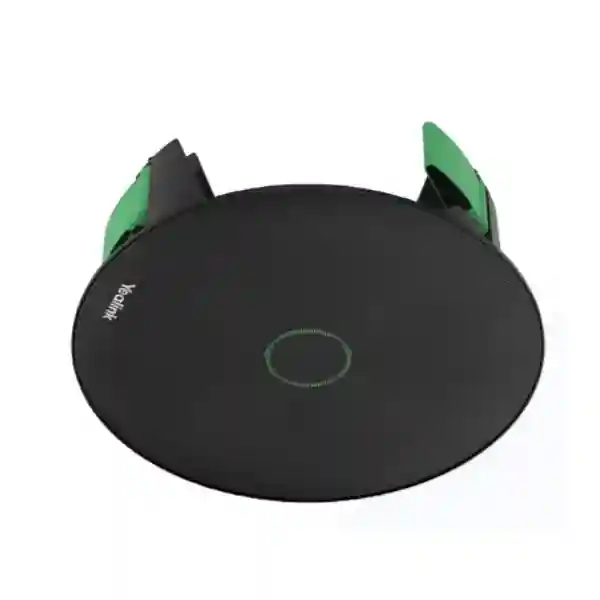
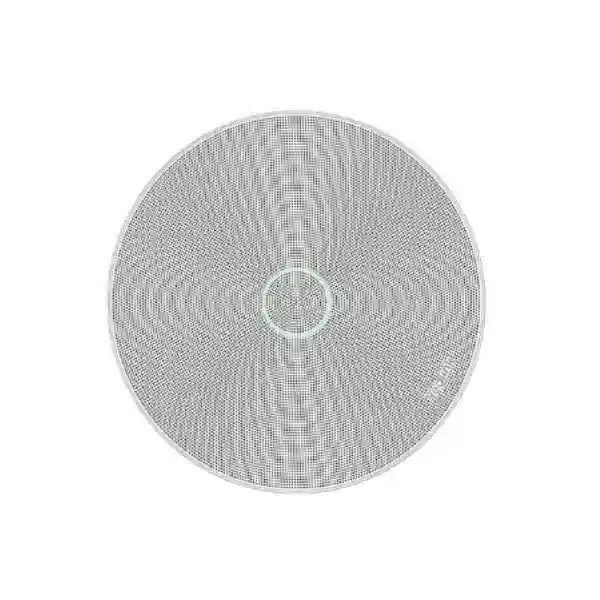
Yealink CM20 Beamforming Ceiling Microphone for Professional Conference Rooms
The Yealink CM20 is a ceiling-mounted beamforming microphone engineered for professional meeting rooms where broad voice pickup, uncluttered tables and predictable conferencing performance matter. Instead of placing microphones between laptops, documents and participants, the CM20 moves the capture layer overhead. Its array of 16 omnidirectional microphone elements operates across eight independent pickup zones and captures voices around the room in 360 degrees. An integrated digital signal processor supports acoustic processing and helps simplify deployment with compatible Yealink meeting-room systems.
For procurement teams, the value of the CM20 is not simply that it is a microphone. It is an architectural component for building a cleaner, more scalable room-audio design. A ceiling microphone can reduce visible cabling, preserve usable table space and create a consistent microphone position that is less likely to be moved between meetings. The CM20 is therefore relevant to boardrooms, executive conference rooms, training spaces, divisible collaboration areas and other medium-to-large rooms where participants may sit at different distances from the display or camera.
Yealink specifies a 120 Hz to 16 kHz frequency response, maximum sound pressure level of 122 dB SPL, 86 dB signal-to-noise ratio at less than 1% THD, sensitivity of 0 dBV/Pa at 94 dB SPL and 1 kHz, and one internal acoustic echo cancellation channel. Published room-performance information describes premium full-duplex capture around a 3.2 m radius and effective coverage around a 4.5 m radius under stated acoustic test conditions. Actual project coverage should always be validated against room reverberation, ceiling height, ambient noise and seating geometry.
FourTeck supplies the Yealink CM20 for Uganda projects with pre-sales bill-of-materials review, compatibility validation and deployment planning. Buyers can provide room dimensions, ceiling type, intended conferencing platform, camera arrangement, network-switch details and installation location so that the quotation reflects the complete requirement rather than a microphone in isolation.
Instant Specifications & Procurement Fact Rail
Yealink CM20
Beamforming ceiling microphone
16 omnidirectional elements
8 independent zones
Ethernet / PoE deployment
Project quotation
The CM20 belongs in a designed room system rather than being selected from one specification alone. Confirm the room plan, mounting height, acoustic treatment, PoE capacity, network topology and compatible Yealink processing or room-system components before ordering. Stock status, lead time, warranty terms and final commercial pricing should be confirmed on the project quotation because they can vary by shipment and supply route.
Operational Product Architecture & Overview
A conference microphone has to solve several problems simultaneously. It must capture a person speaking softly at one end of a room without allowing ventilation noise, reverberation or loudspeaker output to dominate the remote meeting. It must also preserve natural conversational timing so participants can interrupt, respond and speak without the audio system behaving like a one-way radio. The CM20 approaches these requirements through a distributed microphone array, beam-based pickup logic and integrated signal processing.
Sixteen omnidirectional elements provide the raw spatial input. Rather than relying on one capsule to cover an entire room, the array can use multiple elements to form directional pickup behavior. Eight independent pickup zones give the room system useful spatial information and support more precise capture across a seating area. For conferencing designs that use speaker-aware camera behavior, this zoned architecture can also form part of a broader tracking workflow when deployed with supported Yealink components and firmware.
The integrated processing layer is especially important for project design. Traditional ceiling audio systems can require separate microphones, dedicated processors, amplifiers, network interfaces and substantial commissioning. The CM20 integrates processing functions intended to reduce this complexity in compatible Yealink environments. This does not remove the need for proper acoustic planning, but it can reduce the number of independent devices that have to be specified and managed.
PoE deployment is another architectural advantage. A network cable can carry power and connectivity to the ceiling location, reducing dependence on a local mains outlet above the ceiling. For installers, this creates a more structured pathway from the communications rack to the microphone. For IT teams, it means the microphone can be incorporated into planned network-switch capacity, patching and power budgets. Cable category, maximum run length, switch compatibility and PoE budget should still be checked during design.
The physical installation is intended to support different ceiling conditions, including on-ceiling, in-ceiling and pendant-style approaches where supported by the selected mounting accessories and site design. This matters in Uganda projects because boardrooms can range from modern suspended ceilings to high concrete soffits and decorative ceilings. Mounting method should be selected before the bill of materials is finalized, not after equipment arrives on site.
Acoustics remain the decisive variable. Yealink publishes coverage figures under controlled conditions, including specified reverberation, noise level and deployment height. A highly reflective room with glass walls, hard floors and exposed ceilings may require different microphone spacing from an acoustically treated boardroom of the same floor area. FourTeck therefore recommends treating published radius figures as engineering references rather than unconditional guarantees.
Enterprise Business Outcomes & Value Analysis
Overhead placement reduces dependence on where participants place a tabletop microphone. The array architecture is designed to capture speakers around the meeting area while maintaining a permanent, planned microphone position.
Moving the primary microphone to the ceiling preserves table space for laptops, documents and collaboration equipment. This is particularly useful in executive rooms where visual presentation is part of the project brief.
Coverage can be engineered around seating zones, ceiling height and room acoustics. Larger projects can be designed with the required compatible components rather than relying on ad-hoc microphone placement.
PoE allows power and connectivity to follow enterprise cabling practices. Central rack planning can include switch-port allocation, power budget, patching and labeling.
Integrated processing and compatibility with Yealink meeting-room systems can reduce external processing requirements in supported designs, helping simplify commissioning and lifecycle management.
A permanently installed microphone is less exposed to daily movement, cable disconnection and table reconfiguration. Procurement value improves when the device is correctly matched to the room and retained through routine room use.
These outcomes depend on design discipline. The CM20 cannot compensate for every room problem by itself. Excessive reverberation, strong HVAC noise, incorrect loudspeaker placement, inadequate network power or unsupported system combinations can reduce overall performance. A successful project aligns the microphone, loudspeakers, cameras, processing, conferencing platform, network and room acoustics as one system.
Key Hardware & Software Highlights
| Component | Technical Role | Operational Outcome |
|---|---|---|
| 16 microphone elements | Multi-element omnidirectional array | Broad room capture and beamforming input |
| 8 pickup zones | Spatial pickup segmentation | More precise voice-location handling |
| Integrated DSP | On-device audio processing | Simpler supported Yealink room architecture |
| PoE | Network-delivered power | Single structured cabling path to ceiling |
| Magnetic cover | Low-profile finish | Discreet integration and easier access |
Technical Specifications Ledger
| Specification | CM20 Detail | Procurement Note |
|---|---|---|
| Microphone array | 16 omnidirectional microphone units | Designed for ceiling-based 360° room capture |
| Pickup zones | 8 independent zones | Useful for spatial pickup and supported tracking workflows |
| Frequency response | 120 Hz–16 kHz | Voice-focused conferencing range |
| Maximum SPL | 122 dB SPL | Check current regional datasheet during final design |
| Signal-to-noise ratio | 86 dB at <1% THD | Room noise remains an important project variable |
| Sensitivity | 0 dBV/Pa, 94 dB SPL at 1 kHz | Published manufacturer parameter |
| AEC | 1 internal channel | Supports conferencing echo-management architecture |
| Power / connectivity | PoE network deployment | Validate switch standard, budget and cabling |
| Nominal coverage | Approx. 4 m radius stated on current product specifications | Actual performance depends on acoustics and mounting |
| High-quality published reference | 3.2 m pickup radius, STIPA 0.78 under stated conditions | Use as design reference, not unconditional guarantee |
| Extended published reference | 4.5 m pickup radius, STIPA 0.72 under stated conditions | Room survey recommended |
Specification interpretation matters. Coverage numbers are not interchangeable with a guaranteed room diameter because speech intelligibility changes with reverberation time, background noise, ceiling height, loudspeaker behavior and participant position. During procurement, compare the room drawing with the manufacturer deployment guidance and reserve enough design margin for real operating conditions.
Configuration & Sizing Worksheet
1. Estimate the occupied speaking area
Measure the area where people will actually speak, not only the room dimensions. A long boardroom may have unused circulation space behind chairs, while a training room may require coverage across multiple seating rows. Mark the furthest participant positions and compare them with the proposed ceiling location.
2. Record ceiling height and construction
Note finished ceiling height, tile dimensions, ceiling void depth, structural restrictions and whether the surface is suspended tile, gypsum, timber, concrete or another finish. This determines mounting approach, installer access and accessory requirements.
3. Assess acoustic conditions
Identify glass walls, hard floors, exposed concrete, open ceilings, air-conditioning diffusers and other sources of reverberation or noise. Two rooms with identical dimensions can require different microphone strategies. Acoustic treatment may provide greater improvement than adding hardware without addressing reflections.
4. Validate network and power
Reserve suitable Ethernet connectivity from the communications location to the microphone position. Confirm PoE availability, switch capacity, VLAN policy where applicable, cable pathway and patching. For larger room systems, calculate the complete power budget for microphones, speakers and other network-powered endpoints.
5. Confirm room-system compatibility
List the conferencing platform, Yealink room-system model, cameras, speakers, processing devices and control components. Compatibility can depend on the chosen architecture and firmware generation. Avoid assuming that an Ethernet connector means unrestricted cross-vendor interoperability.
6. Prepare the quotation package
Send FourTeck the room dimensions, ceiling height, floor plan where available, conferencing platform, desired camera behavior, speaker arrangement, installation city, required quantity and target completion date. This enables a quotation that includes the right accessories and avoids preventable site delays.
Deployment Scenarios & Industry Use Cases
Large Enterprise and Multi-Site Networks
Enterprises standardizing meeting rooms across several offices benefit from repeatable room templates. The CM20 can form part of a standardized medium- or large-room design in which microphone location, network port, mounting method, compatible speakers and camera configuration are documented. Standardization simplifies support because IT teams encounter a familiar architecture at each location. It also makes spare planning and rollout documentation more predictable.
Financial and Banking Institutions
Banks and financial organizations frequently operate executive rooms, management meeting spaces, training rooms and regional offices. Ceiling audio reduces table clutter and supports permanent installations where equipment should not be moved between meetings. Network segmentation, controlled firmware management and approved installation procedures should be aligned with the institution’s internal security policies.
Educational and Campus Networks
Universities, colleges and training institutions can use ceiling microphone architecture in hybrid classrooms, council rooms and staff collaboration spaces. Educational rooms can be acoustically challenging because they may contain hard walls and flexible furniture layouts. Site assessment is particularly important when users may speak from multiple positions rather than a fixed conference table.
Government and Institutional Procurement
Government meeting rooms often require formal bills of materials, serial-number records, documented installation, warranty clarity and predictable support channels. FourTeck can structure quotations around the complete deployment requirement, including compatible accessories and technical validation. Where tender specifications call for exact standards, the project team should reconcile those requirements against the current manufacturer datasheet before order placement.
Technical Deep Dive: Beamforming, Processing & Array Architecture
A ceiling microphone sits farther from participants than a typical tabletop unit, so array processing is central to its usefulness. The CM20 uses 16 omnidirectional elements to gather acoustic information from around the room. Beamforming combines signals from multiple elements in a way that emphasizes useful speech arriving from selected directions while reducing the influence of unrelated sound. Eight pickup zones provide a structured spatial model rather than treating the room as one undifferentiated acoustic field.
This architecture is valuable when seating is distributed around a boardroom table. A participant near one corner and another at the opposite side do not present identical acoustic conditions. The array provides the processing system with more information than a single microphone capsule could supply. However, beamforming is not a substitute for appropriate placement. If the microphone is installed too high, too far from participants or beside a strong noise source, the ratio of useful speech to room sound deteriorates.
The integrated DSP supports functions intended to improve conferencing intelligibility and reduce the need for a separate processor in compatible Yealink MVC designs. Echo management is important because the microphone inevitably hears audio reproduced by room loudspeakers. Full-duplex conferencing requires the system to distinguish remote-program audio from local speech so both sides can converse naturally. The CM20’s internal processing is part of that signal chain.
Technical Deep Dive: Firmware, Ecosystem & Operational Control
Enterprise conferencing equipment should be managed as an IT endpoint, not as an isolated appliance. Firmware level can affect compatibility, features and behavior with other room components. Before a multi-room rollout, establish a known-good system combination and test it in a representative room. Record device models, firmware versions, network settings and physical mounting positions so that support teams can reproduce the environment.
Yealink ecosystem integration is one of the practical reasons to choose the CM20 when the wider room already uses compatible Yealink conferencing components. Procurement teams should still verify the exact room bundle and current compatibility matrix at the time of purchase. Product families evolve, and features described for a current firmware generation may not behave identically in an older deployed system.
Network governance also matters. Conferencing endpoints may sit on dedicated collaboration VLANs, and PoE switches may be centrally monitored. Document switch ports and cable IDs during installation. If the organization applies firmware approval procedures, include the microphone and associated room components in that process. A repeatable operational model is more valuable than an installation that works on handover day but cannot be easily supported later.
Technical Deep Dive: Availability, Redundancy & Recovery Planning
Meeting-room resilience is different from data-center redundancy. A single room may not require duplicated microphones, but the organization still needs a recovery strategy. Keep configuration records, identify compatible spare equipment for critical facilities and maintain access to replacement cabling and mounting components. For executive or command environments, consider whether an alternate room should be available if any conferencing component fails.
PoE centralizes power, which can improve operational control when the network switch is protected by a UPS. That does not make the room fully redundant: the switch, upstream network, compute appliance, display, camera and loudspeaker chain remain dependencies. During design, identify each dependency and decide what level of resilience matches the business importance of the room.
Recovery procedures should be documented before an incident. Record how to verify network power, inspect link state, check compatible room-system status, confirm firmware and isolate whether a fault follows the microphone, cable or switch port. For multi-site organizations, standardized documentation reduces troubleshooting time because local teams can provide consistent information to central support.
Pre-Purchase Buyer Gap Checklist
Does the microphone require a separate processor? The CM20 includes integrated DSP and is designed to simplify compatible Yealink MVC deployments. The complete architecture still depends on the selected room system, speakers and platform, so confirm the exact bill of materials before ordering.
Will one microphone cover the entire room? Possibly, but floor area alone is not enough to decide. Published coverage is based on defined acoustic conditions. High ceilings, glass, reverberation, HVAC noise and unusual seating layouts can change the practical result. Submit a room plan for sizing.
Are there hidden subscription costs? The microphone’s hardware procurement should be distinguished from conferencing-platform licensing, room-system licensing and any management services used by the wider deployment. Ask for a quotation that separates hardware from recurring platform costs where applicable.
Can it connect to any PoE switch? PoE simplifies deployment, but the switch standard, power budget, network design and supported system architecture must be checked. Do not assume that physical Ethernet compatibility guarantees complete functional interoperability.
What ceiling clearance is needed? Clearance depends on the chosen mounting method and ceiling construction. Review the installation accessories and site structure before ordering. A ceiling survey should identify obstructions, cable pathways and safe fixing points.
What happens if the room is very reflective? Microphone processing can improve intelligibility, but it cannot remove every acoustic limitation. Consider acoustic panels, curtains, soft finishes or other treatment where reverberation is excessive. Correct loudspeaker positioning is also important.
Is camera tracking supported? The CM20 provides eight beam outputs and Yealink describes integration with room cameras for enhanced tracking in supported solutions. Confirm the required cameras, room-system components and firmware before specifying tracking as a project requirement.
What should be included in the purchase order? Include the microphone quantity, required mounting accessories, compatible processing or room-system components, network and PoE considerations, speakers where required, installation services, delivery location and any commissioning requirement. A complete bill of materials reduces change orders.
Uganda Regional Procurement & Delivery Logistics
FourTeck supports Uganda organizations purchasing Yealink conferencing equipment through project-based quotation. The process should begin with technical scope rather than unit price alone. For a CM20 project, provide the number of rooms, room dimensions, ceiling height and type, conferencing platform, existing Yealink equipment, delivery city and required completion schedule. Where drawings are available, include them so the technical team can review microphone positioning and associated components.
After scope confirmation, the commercial quotation can identify the supplied hardware, accessories and applicable services. Stock status and delivery timing should be confirmed at quotation stage because enterprise collaboration products can move through regional distribution channels and lead times can change. Buyers with fixed project dates should state the required on-site date early so logistics can be planned around procurement approvals and installation sequencing.
For deployment projects, staging can include bill-of-materials verification and firmware review before dispatch. This reduces the risk of installers arriving with incompatible or incomplete components. Site installation timing should also account for ceiling works, network cabling, PoE switch readiness, display and camera installation, room furniture and final acoustic conditions.
Local Coverage Matrix
Corporate offices, boardrooms, hotels, institutions and multi-room collaboration deployments.
Hospitality, aviation-related offices, government facilities and executive meeting spaces.
Industrial, education and regional business conferencing requirements.
Regional offices, universities, healthcare administration and institutional meeting rooms.
Public-sector, NGO, education and distributed organization collaboration projects.
Projects outside these hubs can also be quoted. Delivery planning should consider destination, quantity, installation scope and project schedule. For multi-site rollouts, use a standardized room template where practical and identify exceptions before procurement.
Cross-Border & Regional Supply Chains
Organizations operating across East Africa and the Gulf can coordinate related enterprise technology requirements through FourTeck regional channels. Uganda requirements can be reviewed at FourTeck Uganda, Kenya projects through FourTeck Kenya, wider continental requirements through FourTeck Africa, UAE requirements through FourTeck UAE, and Kuwait requirements through FourTeck Kuwait.
Cross-border projects benefit from a common equipment schedule and room standard. Create one approved bill of materials for each room type, then document local differences such as ceiling construction, network switching, installation labor and delivery requirements. This reduces specification drift between offices and makes support easier after rollout. Commercial terms, taxes, duties, warranty routing and lead times should be confirmed for each destination rather than assumed to be identical across countries.
Related Yealink Room Components
A CM20 installation is normally part of a broader room design. Depending on the project, buyers may also need compatible Yealink ceiling speakers, room audio processing, cameras, meeting-room compute systems, touch controllers, PoE switching and BYOD connectivity. Review Yealink conferencing solutions in Uganda and contact the project team for model-specific compatibility rather than selecting accessories only by connector type.
For larger rooms, Yealink AVHub may form part of a multi-device conferencing architecture. The CS10 family provides ceiling-speaker options for designs requiring distributed overhead audio. Camera selection should be based on room depth, participant framing requirements and conferencing platform. Network components should be sized for the total PoE load of the room, not only the CM20. A complete quotation can combine these elements into one reviewed bill of materials.
FourTeck Technical Service Capabilities
FourTeck’s role in a professional room project can extend beyond hardware supply. Pre-sales engineering validation helps confirm whether the CM20 is suitable for the proposed room and identifies complementary components. Bill-of-materials review checks quantities and accessories against the room plan. This is especially useful for ceiling products because missing mounting hardware or incorrect assumptions about network power can delay installation.
Staging can include model verification and firmware review before shipment where agreed as part of the project. For repeat deployments, a reference-room configuration can be documented so subsequent rooms follow the same design. Post-sales troubleshooting is more effective when installation records include cable identifiers, switch ports, device models, firmware versions and room diagrams.
Where installation services are required, coordinate ceiling access, network readiness, electrical work, display mounting and room availability before the engineer visit. Final commissioning should test local and remote speech, echo behavior, speaker levels, participant positions and the actual conferencing platform used by the customer.
Extended Technical FAQ
Is the Yealink CM20 suitable for a medium or large conference room?
Yes, it is designed for professional medium-to-large meeting environments, but suitability must be determined from the occupied speaking area and acoustic conditions rather than room category alone. Yealink publishes reference pickup radii under defined test conditions, while actual rooms differ in ceiling height, reverberation and background noise. A boardroom with acoustic treatment may perform differently from an equally sized glass training room. Provide a floor plan, ceiling height and seating arrangement so the microphone location and quantity can be validated before purchase.
How many microphone elements are built into the CM20?
The CM20 uses 16 omnidirectional microphone elements and provides eight independent pickup zones. This array is the foundation for its beamforming behavior and broad 360-degree room capture. Multiple elements give the processing system spatial information that a single capsule cannot provide. The practical benefit is more consistent pickup across a meeting area and a ceiling installation that does not depend on users repositioning microphones. Performance still depends on correct mounting, room acoustics and integration with the rest of the conferencing system.
Does the CM20 need a separate audio processor?
The CM20 includes integrated DSP and Yealink positions it for simplified plug-and-play use with compatible MVC room systems, reducing the need for an additional external processor in those supported architectures. That statement should not be interpreted as universal compatibility with every conferencing design. Large or specialized rooms may use additional processing or different system components. Before procurement, identify the exact room-system model, cameras, speakers and platform so the complete audio path can be checked against current Yealink guidance.
Can the CM20 be powered through the network?
Yes, the CM20 supports PoE deployment, allowing network power and connectivity to reach the ceiling location through structured Ethernet cabling. This can simplify installation because a separate local power outlet is not normally required at the microphone position. The project must still confirm switch compatibility, available PoE budget, cable quality and the complete load of other network-powered room devices. Where business continuity matters, placing the relevant PoE switch on protected power can also improve room resilience during brief utility interruptions.
What pickup distance should be used for room planning?
Use manufacturer coverage figures as engineering references rather than fixed guarantees. Yealink has published a high-quality reference around a 3.2 m pickup radius with STIPA 0.78 and an extended reference around 4.5 m with STIPA 0.72 under specified reverberation, noise and mounting conditions. Current product material also describes nominal coverage around a 4 m radius. A real room may perform differently. Ceiling height, glass surfaces, HVAC noise, speaker placement and participant orientation should be considered during design.
Does the CM20 support camera tracking workflows?
Yealink describes eight beam outputs for precise speaker tracking and integration with room cameras for enhanced tracking in supported solutions. The important procurement word is supported: camera behavior depends on the wider Yealink room architecture, device models and firmware. If automatic speaker framing or tracking is a mandatory requirement, include it explicitly in the project scope. FourTeck can then review the camera, microphone and room-system combination before quotation rather than assuming the microphone alone enables every tracking function.
What ceiling installation methods should be considered?
The CM20 is designed for versatile ceiling integration, with installation approaches that can include in-ceiling, on-ceiling and pendant-style deployment depending on the site and applicable accessories. The correct choice depends on ceiling construction, available void space, finished height, architectural appearance and safe fixing points. A suspended tile ceiling presents different requirements from concrete or an open industrial ceiling. Confirm the mounting method before ordering so the quotation can include appropriate accessories and the installer can prepare cable pathways and access safely.
What warranty applies to Uganda purchases?
Warranty terms should be confirmed on the FourTeck quotation for the specific shipment and project rather than inferred from another market. Enterprise hardware warranty can depend on supply channel, commercial agreement and manufacturer or distributor policy. Keep the invoice, serial-number records and delivery documentation for warranty administration. For multi-room deployments, maintaining an asset register with model, serial number, room location and installation date makes future support significantly easier. Ask for the applicable warranty baseline and replacement process when requesting the commercial quote.
Can FourTeck help with configuration and deployment planning?
Yes. A useful pre-sales review should cover room dimensions, ceiling height, acoustic conditions, conferencing platform, existing Yealink equipment, cameras, loudspeakers, network switching, PoE availability and installation location. The purpose is to identify a complete bill of materials and avoid treating the microphone as an isolated purchase. For multi-room projects, create standard room types and document exceptions. This approach makes procurement, installation and later support more predictable while reducing the risk of missing accessories or selecting incompatible components.
What information should I send to receive an accurate CM20 quotation?
Send the required quantity, project city, room dimensions, ceiling height and construction, seating layout, conferencing platform, existing room-system model if any, camera and speaker requirements, network-switch details where known, desired installation scope and target completion date. Drawings or photographs of the room can help technical review when available. If the project includes several rooms, provide a room schedule showing which spaces share the same design. This allows the quotation to reflect the complete requirement and makes delivery and installation planning more reliable.
Plan Your Yealink CM20 Deployment in Uganda
A successful ceiling-microphone project begins with the room, not the carton. Share your dimensions, ceiling height, conferencing platform, existing Yealink components and delivery location with FourTeck. The team can review the requirement, identify compatible supporting components and prepare a project quotation for supply and deployment. For boardrooms, training rooms, executive meeting spaces and standardized multi-site rollouts, early technical validation helps prevent incorrect quantities, missing accessories and avoidable installation changes.
Request current Uganda pricing, stock position, applicable warranty terms and expected delivery timing as part of the quotation. If installation or commissioning is required, include it in the initial scope so cabling, ceiling access, PoE readiness and room availability can be coordinated with the equipment schedule.

Reviews
There are no reviews yet.