Yealink CMKit-121 Ceiling Audio Kit for Professional Conference Rooms in Uganda
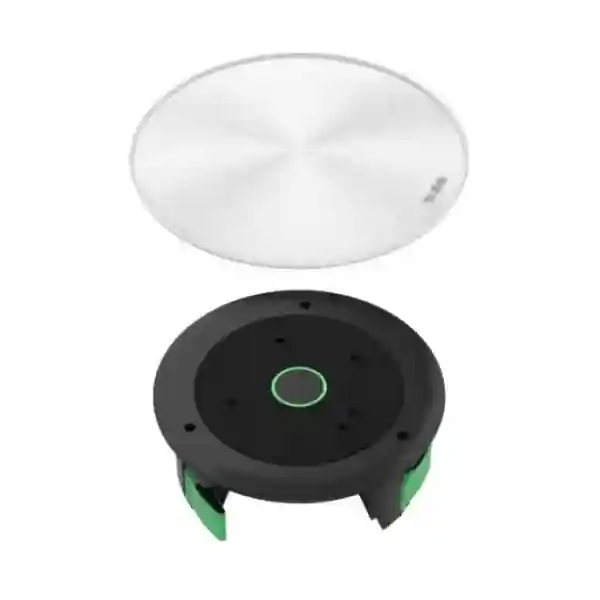
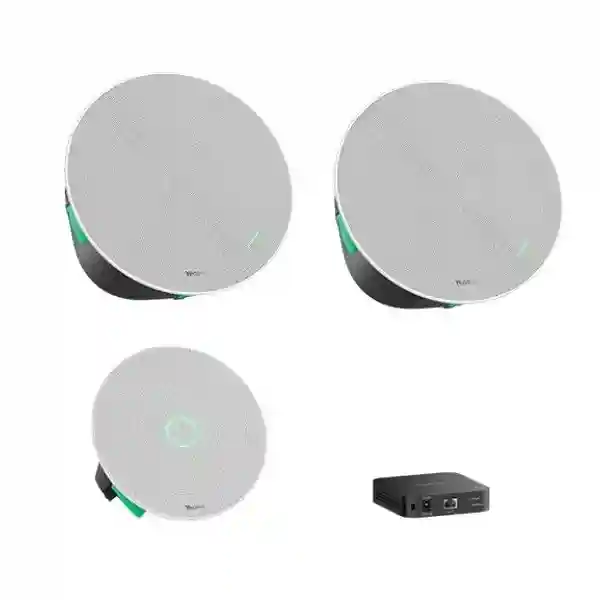
The Yealink CMKit-121 is a coordinated ceiling-audio package built for organizations that want professional meeting-room sound without covering conference tables with microphones and speakerphones. The bundle brings together the CM20 ceiling microphone, two CS10 ceiling speakers and an RCH40 E2 switch as a practical core for a Yealink ceiling-audio deployment. Yealink positions one CMKit-121 for a standard medium-to-large conference room of approximately 5 × 8 metres, while two packages can be combined for an extra-large room around 6 × 10 metres. Actual design should still account for ceiling height, room reverberation, seating geometry, partitions and ambient noise.
For procurement teams, the value is integration. Instead of sourcing a microphone, loudspeakers and network infrastructure independently and then resolving compatibility during installation, CMKit-121 establishes a known Yealink audio building block. The CM20 provides a 16-element omnidirectional microphone array, eight pickup zones and integrated processing. The CS10 is a low-profile two-way coaxial ceiling loudspeaker tuned for speech intelligibility, and the RCH40 E2 provides the network connectivity required for the audio endpoints. This architecture is especially useful for boardrooms, training rooms, management meeting spaces, classrooms and hybrid collaboration environments where visual cleanliness and consistent coverage are priorities.
FourTeck supports Uganda buyers with configuration review, bill-of-materials validation, quotation preparation, deployment planning and post-sales coordination. Share the room dimensions, ceiling height, expected participant count, table layout, conferencing platform and existing Yealink host equipment to obtain a deployment-oriented quotation rather than a component-only price.
Instant Specifications & Procurement Fact Rail
1 × CM20, 2 × CS10, 1 × RCH40 E2
Medium to large; scalable with additional kit
1 × RJ-45, IEEE 802.3af PoE
1 × RJ-45, IEEE 802.3at PoE+
Project quotation recommended
The fact rail should be treated as the starting point for procurement rather than a substitute for room design. Ceiling audio is sensitive to installation height and acoustic conditions. A room with hard glass walls and long reverberation may require different positioning from a similarly sized room with acoustic treatment. Likewise, a U-shaped boardroom and classroom layout place participants differently relative to pickup zones. FourTeck therefore recommends confirming room drawings and compatible Yealink host equipment before purchase.
Operational Product Architecture
At the capture layer, CM20 places sixteen omnidirectional microphone elements in the ceiling and organizes pickup across eight zones. Yealink specifies a frequency response of 120 Hz to 16 kHz, maximum SPL of 122 dBSPL, 86 dB signal-to-noise ratio at less than 1% THD, and one internal acoustic echo-cancellation channel. Integrated processing reduces the need to add a separate processor in supported Yealink room-system designs. The ceiling position also frees the table for laptops, documents and face-to-face interaction.
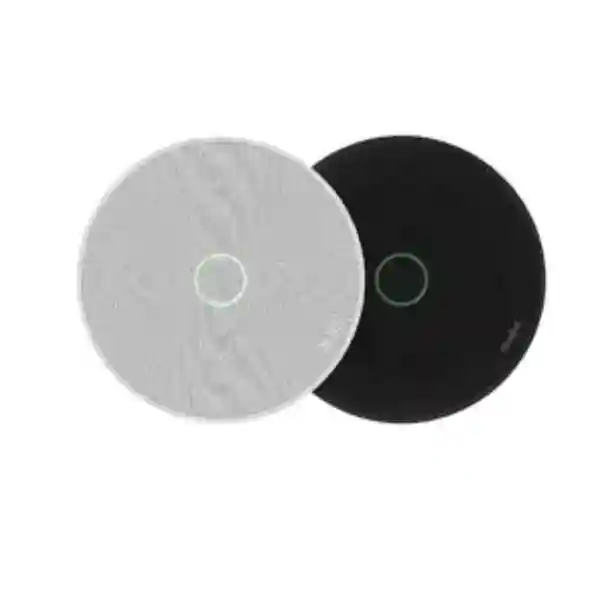
At the playback layer, the pair of CS10 loudspeakers uses a two-way coaxial architecture with a 5.7-inch woofer and 1.1-inch tweeter. Yealink specifies a 100 Hz–20 kHz response at -6 dB, continuous maximum SPL of 99 dB at 20 W and one metre, 88 dB sensitivity at one metre/one watt and a nominal 120-degree coverage angle. These characteristics are oriented toward broad, intelligible voice distribution rather than a narrow point-source experience.
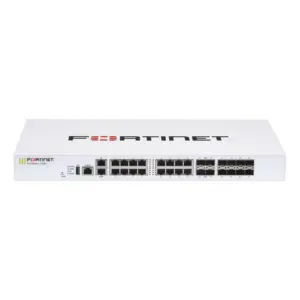
The network layer is handled by RCH40 E2 in the package. Networked audio makes cable planning, PoE budget and switch behaviour part of the audio design. Yealink documentation emphasizes appropriate switching characteristics for professional audio, including avoidance of problematic energy-saving Ethernet behaviour in relevant deployments and support for quality-of-service planning. Buyers should therefore resist treating the network switch as an interchangeable commodity without checking the approved topology.
Enterprise Business Outcomes & Value Analysis
Ceiling placement and a multi-element array provide broad participant coverage while reducing dependence on people leaning toward a tabletop microphone.
Two ceiling speakers distribute remote participant speech through the room and support a more uniform listening experience.
A second CMKit-121 can be considered for larger rooms, allowing designers to scale using repeatable audio units.
Moving primary audio hardware overhead keeps tables clear and supports premium boardroom aesthetics.
A bundled microphone, speaker pair and switch reduces the number of independently selected components requiring compatibility review.
Standardizing on a documented room-audio architecture can make support, replacement and future room replication easier across multiple sites.
For organizations rolling out multiple rooms, repeatability is a major operational advantage. A validated design can become the reference for additional offices, reducing engineering variance. That does not eliminate site surveys: ceiling construction, cable pathways, fire regulations and acoustic conditions still vary. It does, however, give facilities, IT and collaboration teams a common starting architecture and a clearer bill of materials.
Key Hardware & Software Highlights
| Component | Technical Highlight | Operational Outcome |
|---|---|---|
| CM20 | 16 omnidirectional microphones, 8 pickup zones, integrated DSP | Broad ceiling capture with room-system integration |
| CS10 × 2 | Two-way coaxial design, 120° nominal coverage | Distributed speech playback |
| RCH40 E2 | Network switching for meeting-room endpoints | Consolidated connectivity and PoE planning |
Technical Specifications Ledger
| Item | Confirmed Specification |
|---|---|
| CM20 microphone array | 16 omnidirectional microphones; 8 pickup zones |
| CM20 frequency response | 120 Hz–16 kHz |
| CM20 maximum SPL | 122 dBSPL |
| CM20 power | Typical 5.7 W; rated 9 W; IEEE 802.3af Class 3 PoE |
| CM20 dimensions | Ø223 × H83 mm with cover mesh |
| CM20 environment | 0–50°C operating; 5%–90% humidity; UL 2043 plenum rated |
| CS10 frequency response | 100 Hz–20 kHz (-6 dB) |
| CS10 speaker drivers | 5.7-inch woofer; 1.1-inch tweeter |
| CS10 coverage | 120° nominal |
| CS10 power | 24 W rated, 20 W typical; IEEE 802.3at Class 4 PoE+ |
| CS10 dimensions | Ø294 × H125.8 mm with cover mesh |
| CS10 environment | 0–50°C operating; 5%–90% humidity; UL 2043 plenum rated |
Configuration & Sizing Worksheet
Step 1 — Measure the room: record length, width, finished ceiling height and the seated ear height. Do not size solely from floor area; microphone-to-participant distance changes with ceiling height.
Step 2 — Map seating: identify the actual speaking positions, not just the table perimeter. Include presentation areas, lecterns or secondary seating if they must be captured.
Step 3 — Review acoustics: note glass, concrete, hard floors, exposed ceilings, movable partitions, HVAC outlets and other factors that can increase reverberation or background noise.
Step 4 — Validate cabling and power: confirm structured cabling pathways and PoE/PoE+ requirements for each endpoint. Network audio should be planned with appropriate switching and quality-of-service behaviour.
Step 5 — Confirm the host platform: identify the Yealink room-system components and firmware level. Compatibility can vary by host and software release, so validation should precede ordering.
Step 6 — Prepare the quote: provide room drawings, quantities, installation location, platform, required delivery date, mounting constraints and any requirement for staging or pre-configuration.
Deployment Scenarios & Industry Use Cases
Large enterprise and multi-site networks: CMKit-121 is suitable where organizations want standardized conference-room audio across offices. A repeatable kit can simplify documentation, spares strategy and support escalation while keeping local installation tailored to room acoustics.
Financial institutions: boardrooms and management rooms often require clean tables, controlled installation and dependable speech intelligibility. Ceiling endpoints can support a discreet installation while network and access controls remain part of the institution’s wider infrastructure policy.
Education and campus networks: training rooms, hybrid classrooms and faculty meeting spaces can benefit from overhead capture and distributed playback, particularly where table layouts change. Designers should validate coverage for instructors who move around the front of the room.
Government and public-sector procurement: the bundle supports clearly documented component-level procurement. Buyers can request a formal bill of materials, installation scope, warranty terms and configuration assumptions for tender or internal approval processes.
Technical Deep-Dives
Capture, Processing & Audio Architecture
CM20’s sixteen-microphone array gives the system multiple spatial inputs from which its internal processing can build useful pickup behaviour. The practical benefit is not simply microphone count; it is the ability to place the capture system overhead while maintaining useful coverage across participant positions. Yealink documents a four-metre coverage radius under suitable conditions and high-quality full-duplex capture within three metres, with measured examples varying by room conditions. For project design, these figures should be interpreted alongside ceiling height, reverberation and noise rather than treated as unconditional boundaries.
Software Ecosystem, Firmware & Operational Control
A professional room is an ecosystem rather than a collection of isolated endpoints. Firmware compatibility between the audio devices and Yealink host matters, particularly when expanding device counts. Procurement should record the intended host, current firmware branch and planned conferencing platform. This makes commissioning more predictable and gives support teams a reproducible baseline when diagnosing issues.
Availability, Redundancy & Recovery Planning
Meeting-room resilience starts with infrastructure. Use standards-compliant structured cabling, document switch ports, maintain configuration records and keep appropriate replacement components for critical sites. In a two-kit extra-large-room design, each package operates as an independent audio unit, which provides a modular topology. Critical boardrooms may justify spare endpoints or a rapid replacement arrangement even when the system itself is functioning normally.
Pre-Purchase Buyer Gap Checklist
Before issuing a purchase order, confirm what is included in the CMKit-121 bundle and what belongs to the wider room system. The kit covers the core ceiling microphone, speaker pair and RCH40 E2 switch, but cameras, compute, touch consoles, displays, installation labour, structured cabling and room-specific mounting work may be separate. Verify the host-device compatibility for the planned topology and firmware. Confirm ceiling type and clearance above the finished ceiling because both CM20 and CS10 require physical installation space and appropriate support. Check local building requirements before cutting ceiling openings.
Also validate the power budget. The CM20 uses PoE while CS10 uses PoE+, and the project network must be designed accordingly. Confirm whether the room will remain on the supplied meeting-room switch topology or integrate into a managed AV network. If integrating with wider enterprise switching, document quality-of-service, VLAN and energy-saving Ethernet policies. Finally, request warranty terms, lead time, delivery location and replacement procedures in the quotation. These details prevent a technically correct product selection from becoming a delayed deployment because of unplanned infrastructure work.
Uganda Procurement, Delivery & Local Coverage
FourTeck can prepare project quotations for Yealink CMKit-121 deployments in Uganda based on quantity, destination and room requirements. For Kampala projects, procurement teams can coordinate product supply with room-design information and installation scheduling. Entebbe deployments may include corporate offices, hospitality meeting spaces and institutional facilities. Jinja, Mbarara and Gulu projects can be quoted with destination-specific logistics and planned dispatch coordination. For multi-site rollouts, consolidating room types and quantities into one bill of materials can simplify commercial review and reduce configuration variance.
Delivery timing depends on stock position, order quantity and project scope, so buyers should request a current lead-time confirmation at quotation stage rather than relying on a generic estimate. Where pre-deployment validation is requested, FourTeck can review the proposed Yealink host, audio-device quantities, network assumptions and mounting requirements before dispatch. This is particularly useful for installations outside Kampala where avoiding a second site visit has significant operational value.
Cross-Border & Regional Supply
Organizations operating across East Africa and the Gulf can coordinate related requirements through FourTeck regional channels. Visit FourTeck Uganda, FourTeck Kenya, FourTeck Africa, FourTeck UAE or FourTeck Kuwait for location-specific procurement enquiries. Cross-border projects should align model numbers, room standards and approved bills of materials before purchasing so that support teams inherit a consistent environment.
Related Yealink Room Components
A CMKit-121 project often sits within a wider Yealink collaboration environment. Buyers evaluating alternative or complementary components can review Yealink ceiling microphones, ceiling loudspeakers, MVC room systems, AVHub-based professional room designs, UVC-series conferencing cameras and room-control accessories through the FourTeck Uganda catalogue. Related component selection should follow the target room topology rather than brand matching alone. For example, host support and firmware determine how many ceiling-audio devices can be attached in specific architectures. Ask FourTeck to validate the complete bill of materials when combining CM20, CS10 or other Yealink audio endpoints with existing room hardware.
FourTeck Technical Service Capabilities
FourTeck can support the procurement process beyond box supply by reviewing room requirements against the proposed bill of materials. Engineering validation can include model and quantity checks, compatibility review, network and PoE assumptions, mounting considerations and documentation of dependencies. Where appropriate, staging can include device inspection, firmware alignment and basic pre-shipment checks. These services are intended to reduce installation-day uncertainty and help the customer’s AV integrator or IT team begin from a documented configuration.
Post-sales coordination can cover product documentation, configuration guidance and warranty escalation according to the commercial terms supplied with the quotation. For larger deployments, maintaining a room-by-room equipment schedule and serial-number record is recommended. This provides a useful operational reference for support and future expansion.
Extended Technical FAQ
What exactly is included in Yealink CMKit-121?
The core CMKit-121 package combines one CM20 ceiling microphone, two CS10 ceiling speakers and one RCH40 E2 switch. It is intended to establish the primary ceiling-audio layer of a Yealink professional meeting-room design. The wider conference-room solution may require a compatible Yealink host, camera, room compute, touch controller, display, structured cabling and installation materials. Request a complete bill of materials for the specific room rather than assuming every conferencing component is contained in the audio kit.
What room size can one CMKit-121 support?
Yealink presents one CMKit-121 as suitable for a standard medium-to-large conference room around 5 × 8 metres. Two kits can be combined for an extra-large room around 6 × 10 metres. These dimensions are design references, not a substitute for acoustic planning. Ceiling height, table shape, seating positions, background noise and reverberation affect effective pickup and playback. For unusual rooms, provide drawings and ceiling height so coverage can be reviewed before ordering.
How does the CM20 capture voices?
CM20 contains sixteen omnidirectional microphone elements and supports eight pickup zones. Its integrated signal processing is designed for professional conferencing and includes internal echo-cancellation capability. Ceiling placement gives participants a clean table surface and can provide consistent coverage when correctly positioned. The final experience still depends on deployment height and room acoustics, so placement should be based on the actual seating plan rather than simply centering the microphone geometrically in the room.
What are the CS10 speaker characteristics?
CS10 is a two-way coaxial ceiling loudspeaker using a 5.7-inch low-frequency driver and 1.1-inch high-frequency driver. Yealink specifies a 100 Hz to 20 kHz frequency response at -6 dB, continuous maximum SPL of 99 dB at 20 W and one metre, and a nominal 120-degree coverage angle. In CMKit-121, two speakers help distribute conferencing speech through the room. Speaker placement should be coordinated with seating and ceiling geometry for even listening levels.
Does CMKit-121 require Power over Ethernet?
Yes. The networked endpoints rely on Ethernet power. CM20 supports IEEE 802.3af Class 3 PoE with 9 W rated power and approximately 5.7 W typical power. CS10 supports IEEE 802.3at Class 4 PoE+ and is rated at 24 W with 20 W typical power. The project should validate the switch power budget and cabling before installation. Where enterprise switching is involved, network configuration should also consider the requirements of real-time audio traffic.
Can the kit integrate with existing Yealink room systems?
CM20 and CS10 are designed for the Yealink professional room ecosystem, but the supported combination and maximum endpoint count depend on the host device and firmware. Yealink documentation identifies supported configurations involving products such as AVHub and selected UVC hosts. Because compatibility evolves with firmware, the safest procurement method is to provide the exact existing host model and software version for validation before purchase, especially when expanding an installed room.
Is a separate external audio processor required?
CM20 includes integrated signal processing and Yealink describes direct integration into supported MVC environments without the need for an additional DSP device in those designs. That can reduce component count and simplify room architecture. However, a complex divisible room, third-party control environment or specialist acoustic requirement may have additional design considerations. FourTeck can review the intended topology and identify whether the standard CMKit-121 architecture is sufficient for the project.
What ceiling considerations should be checked before purchase?
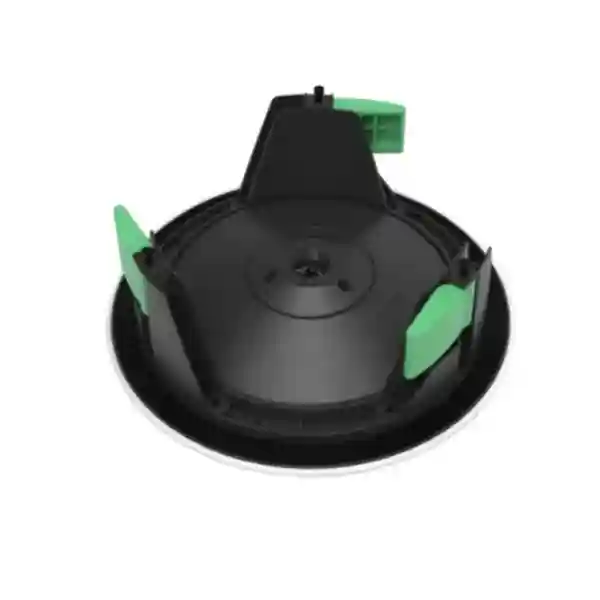
Confirm ceiling height, tile or plasterboard construction, available void depth, structural support, cable routes and applicable fire/building requirements. CM20 measures approximately Ø223 × H83 mm with its cover mesh, while CS10 is approximately Ø294 × H125.8 mm with its cover mesh. Both are UL 2043 plenum rated according to Yealink specifications. Installers should use appropriate supports and follow manufacturer guidance rather than relying solely on the ceiling finish to carry device weight.
How should we prepare a Uganda quotation request?
Provide the number of rooms, each room’s dimensions and ceiling height, seating capacity, table layout, conferencing platform, existing Yealink equipment, delivery city and target completion date. Include drawings or photographs when available. For projects in Kampala, Entebbe, Jinja, Mbarara, Gulu or other Uganda locations, state whether the request is supply-only or requires configuration and installation coordination. This information allows the quotation to reflect the real project rather than only the kit quantity.
What support should be planned after installation?
Document the installed models, serial numbers, switch connections, host firmware and room configuration. Keep copies of room drawings and commissioning records. For business-critical rooms, consider a spare strategy and clear warranty escalation process. Firmware updates should be managed deliberately and tested against the room-system environment rather than applied without change control. FourTeck can assist with documentation, product guidance and warranty coordination according to the agreed project scope.
Request a Yealink CMKit-121 Uganda Project Quote
Send FourTeck your room dimensions, ceiling height, participant capacity, conferencing platform and existing Yealink equipment. We can use those details to prepare a project-focused quotation and help validate the audio kit, compatible host equipment, network requirements and deployment assumptions before order placement. For multi-room projects, include a room schedule so standard configurations can be grouped efficiently.

Reviews
There are no reviews yet.