Yealink CS10-D Network Ceiling Speaker – Dante Audio for Enterprise Meeting Rooms
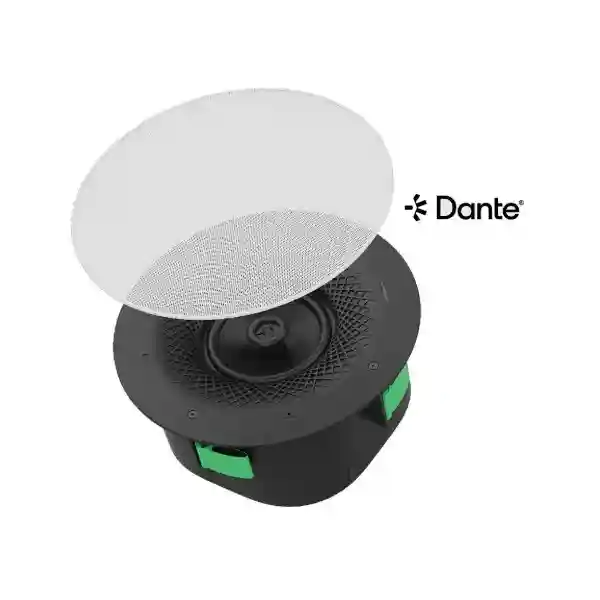
The Yealink CS10-D is a low-profile, 2-way coaxial active ceiling loudspeaker designed for professional meeting spaces where intelligible speech, discreet architecture and network-based audio distribution matter. The CS10-D edition supports Dante audio transmission and combines an integrated digital-to-analogue conversion stage with PoE+ power, allowing enterprise AV teams to deploy loudspeakers through structured Ethernet infrastructure rather than treating every ceiling speaker as an isolated analogue endpoint. For Uganda organisations building Microsoft Teams, Zoom, boardroom, training-room or multipurpose collaboration environments, that architecture can simplify cable planning, reduce visible equipment and create a cleaner path for centrally engineered room audio.
At the acoustic layer, the CS10-D uses a 5.7-inch low-frequency woofer and 1.1-inch high-frequency tweeter in a coaxial arrangement. Yealink specifies a frequency response of 100 Hz to 20 kHz at -6 dB, sensitivity of 88 dB at 1 W/1 m, continuous maximum SPL of 99 dB at 20 W/1 m, and a nominal 120-degree coverage angle. Those characteristics are particularly relevant to speech-led collaboration because a ceiling design must distribute voices evenly across participant positions without forcing excessive output from one point in the room. The unit is also deliberately shallow, measuring approximately 125.8 mm high with the cover mesh, helping integrators work with constrained ceiling voids.
Procurement should begin with the room rather than the speaker count. Ceiling height, listener plane, room length and width, acoustic treatment, ambient noise, ceiling construction, Dante topology and PoE budget all affect a correct bill of materials. FourTeck can help translate these variables into a practical proposal, including speaker quantity, network switching, compatible conferencing components, mounting accessories and deployment preparation.
Instant Specifications & Procurement Fact Rail
Yealink CS10-D, Dante edition
2-way coaxial active ceiling loudspeaker
1 × RJ-45 with Dante transport
PoE+, IEEE 802.3at Class 4
24 W / 20 W
Quote-led enterprise procurement
This fact rail is intended for early project qualification. It confirms that CS10-D is not simply a passive ceiling loudspeaker: it is a networked Dante endpoint requiring compatible Ethernet infrastructure and sufficient PoE+ capacity. Before ordering, the project team should confirm whether the existing switch estate provides IEEE 802.3at Class 4 power on the intended ports, whether Dante traffic is permitted and appropriately designed on the network, and whether ceiling construction supports the planned mounting method. Warranty terms, commercial lead time and stock position should be confirmed on the quotation because these can vary by supply batch, project quantity and regional channel conditions.
Operational Product Architecture & Overview
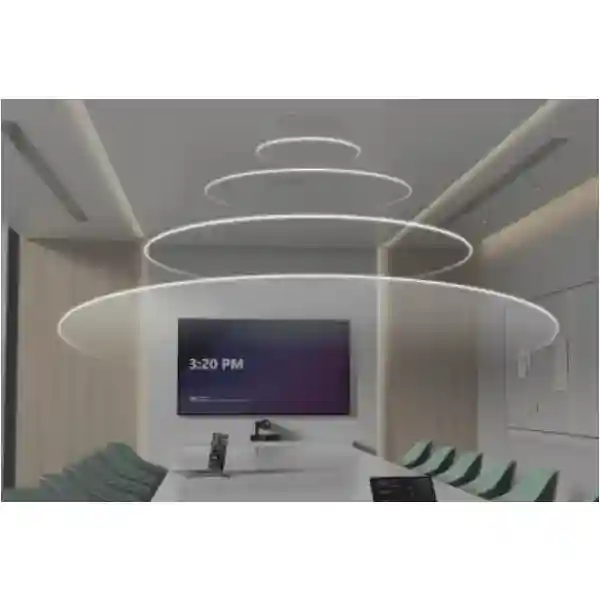
The practical value of the CS10-D comes from the way acoustic reproduction, amplification, conversion, networking and power are combined into a ceiling endpoint. Conventional meeting-room audio often requires an amplifier rack, analogue speaker cabling and careful routing from a central equipment position. A Dante-capable active loudspeaker changes that design logic. Audio can be transported as network traffic to the endpoint, while PoE+ supplies operating power through the same structured-cabling environment. This can be particularly useful where meeting rooms are distributed across multiple floors or where AV teams want a repeatable network-oriented room standard.
The coaxial driver arrangement places the high-frequency and low-frequency elements on a common acoustic axis. In a conferencing context, that supports coherent reproduction over the stated coverage area and helps maintain speech intelligibility for participants seated at different positions. The 120-degree nominal coverage angle gives designers a useful basis for estimating spacing, but it should not be treated as a universal speaker-count formula. Ceiling height, room geometry, listener location and desired overlap determine whether one, two or more units are appropriate.
The 100 Hz to 20 kHz stated response is aligned with conferencing and presentation reproduction rather than sub-bass entertainment applications. Human speech occupies the range where intelligibility and tonal balance are more important than very-low-frequency extension. Yealink describes the system as acoustically tuned for speech, which makes it a logical candidate for boardrooms, training spaces, executive meeting rooms and collaboration suites. The continuous 99 dB maximum SPL at 20 W/1 m provides meaningful headroom for business speech, although real-room sound pressure at listener positions depends on distance, room absorption, speaker quantity and gain structure.
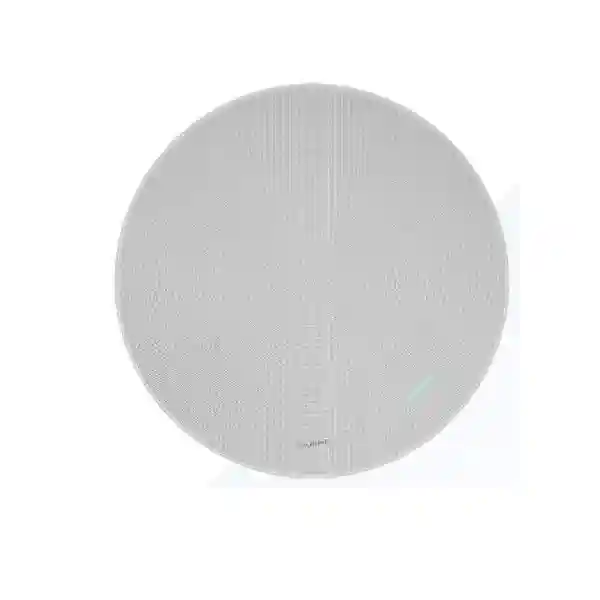
Physical architecture also matters. With a diameter of about 294 mm and height of 125.8 mm with the cover mesh, the CS10-D is intended to remain visually discreet. The detachable magnetic grille supports a clean finish, and Yealink lists white and black colour options. A UL 2043 plenum rating is relevant to projects where equipment is installed in air-handling spaces, although local building rules and project specifications must still be reviewed by the responsible contractor.
The procurement pain points behind this model are usually predictable: teams want to avoid bulky wall speakers, reduce analogue audio cabling, create consistent voice coverage, integrate with professional AV-over-IP infrastructure, or standardise meeting rooms around a networked collaboration architecture. CS10-D addresses those requirements best when it is treated as one element of an engineered system rather than a standalone consumer speaker.
Enterprise Business Outcomes & Value Analysis
The two-way coaxial architecture, 120-degree nominal coverage and speech-focused tuning support even, intelligible reproduction for conferencing. Correctly positioned ceiling speakers can reduce the large level differences that occur when a single front-of-room source must cover listeners at very different distances.
A networked endpoint can simplify signal distribution and reduce dependence on long analogue speaker runs. Reliability still depends on upstream PoE switching, structured cabling, network configuration and the conferencing platform, so these dependencies should be documented in the room design.
Dante provides a standards-based professional audio transport environment that can support modular expansion. Organisations planning multiple rooms can establish repeatable network, VLAN, switching and speaker-placement standards instead of redesigning every room from first principles.
Because audio travels through the network, AV traffic can be incorporated into enterprise network governance. The network team should define switch configuration, segmentation, access policy and change control appropriate to the site rather than connecting AV endpoints without operational ownership.
PoE+ reduces the need for a local AC power outlet at every ceiling speaker. For facilities teams, this can make room builds cleaner and can concentrate power resilience decisions at the network-switch layer, where UPS-backed switching may already exist.
The strongest cost argument is not the speaker price alone. Buyers should compare installation labour, amplifier requirements, cable pathways, switch capacity, mounting hardware, commissioning time and future room-change costs. Network audio can reduce some categories while increasing the importance of correctly sized PoE infrastructure.
The low-profile ceiling format and magnetic grille help meeting spaces maintain a professional appearance. This is valuable in executive boardrooms, customer-facing facilities and modern offices where visible loudspeakers and surface cabling can conflict with interior design requirements.
Key Hardware & Software Highlights
| Component | Confirmed Capability | Operational Outcome |
|---|---|---|
| LF driver | 5.7-inch / 145 mm woofer | Supports body and clarity in spoken content and presentation audio. |
| HF driver | 1.1-inch / 28 mm tweeter | Reproduces upper-frequency detail important to consonants and speech definition. |
| Network audio | Dante protocol | Allows professional digital audio routing over compatible IP infrastructure. |
| Power | IEEE 802.3at Class 4 PoE+ | Enables network and power delivery through Ethernet infrastructure. |
| Coverage | 120° nominal | Supports broad ceiling coverage when correctly positioned and spaced. |
| Grille | Detachable magnetic design | Creates a discreet finish and supports interior integration. |
A useful distinction for technical buyers is that CS10-D is the Dante edition. The related CS10 is the general networked edition, so model suffix validation is important on purchase orders and bills of materials. Where Dante interoperability is a project requirement, the CS10-D designation should be maintained consistently across quotation, ordering, receiving and commissioning documentation.
Technical Specifications Ledger
The following ledger consolidates manufacturer-published CS10-D parameters that matter during design review. Where a project requires a parameter not listed here, it should be confirmed against the current manufacturer documentation before tender submission or final purchase approval.
| Parameter | CS10-D Specification | Procurement Relevance |
|---|---|---|
| Frequency response | 100 Hz–20 kHz (-6 dB) | Suitable for speech-led conferencing and presentation reproduction. |
| Maximum SPL | Continuous 99 dB @ 20 W, 1 m | Use with room distance and ambient-noise assumptions when sizing. |
| Sensitivity | 88 dB @ 1 W, 1 m | Useful acoustic reference for system design. |
| LF / HF | 5.7-inch woofer / 1.1-inch tweeter | Two-way coaxial reproduction architecture. |
| Nominal impedance | 8 Ω | Manufacturer acoustic/electrical reference. |
| Coverage angle | 120° nominal | Supports preliminary placement calculations. |
| Power supply | PoE+ IEEE 802.3at Class 4 | Switch ports and total PoE budget must be checked. |
| Power | 24 W rated; 20 W typical | Important for PoE budget and UPS runtime planning. |
| Interface | 1 × RJ-45 | Plan one compatible structured-cabling run per endpoint. |
| Size with grille | Ø294 × H125.8 mm | Verify ceiling void, cut-out planning and adjacent services. |
| Size without grille | Ø287.2 × H125 mm | Useful during mechanical coordination. |
| Weight | 2808 g without cover mesh; cover mesh 207 g | Ceiling support method must account for installed load. |
| Operating temperature | 0–50°C | Keep installation within rated indoor environment. |
| Operating humidity | 5%–90% | Relevant to HVAC-controlled room planning. |
| Plenum rating | UL 2043 | Supports projects involving air-handling spaces, subject to local compliance review. |
Configuration & Sizing Worksheet
Step 1 — Establish Room Workload and Listening Area
Record room length, width, finished ceiling height and expected seated listener height. Note whether the room is a fixed boardroom, flexible training room, divisible conference suite or multipurpose venue. A nominal 120-degree coverage figure is a starting point, not a final design. Speaker spacing should be engineered so important seating positions remain inside useful coverage with appropriate overlap and without creating excessive level variation.
Step 2 — Inspect Ceiling and Environmental Constraints
Confirm the ceiling construction, available void depth, grid dimensions, obstructions, HVAC routes, lighting positions and structural support requirements. The speaker body is roughly 125.8 mm high with its mesh cover, but installers need working clearance for cable routing, mounting hardware and safe service access. Coordinate the speaker location with sprinklers, lighting, air diffusers and other ceiling services before cutting or ordering accessories.
Step 3 — Calculate PoE and Cabling Capacity
Each CS10-D requires PoE+ compliant with IEEE 802.3at Class 4 and uses one RJ-45 interface. Multiply the intended endpoint count by the planned power allocation and compare it with both per-port capability and the switch’s total PoE budget. Include other PoE endpoints sharing the switch. For critical rooms, consider whether the network switch is protected by UPS power so the audio path does not fail immediately during a short utility interruption.
Step 4 — Validate Dante Network Design
Confirm that the network design can support Dante traffic and that responsibility for AV network configuration is clear. Establish switch configuration standards, addressing, VLAN strategy where applicable, QoS practices where required by the wider design, and change-management ownership. Cross-vendor Dante compatibility is one of the protocol’s strengths, but every endpoint and system role should still be validated in the intended topology.
Step 5 — Review Platform and System Components
A ceiling loudspeaker is only one part of the collaboration chain. Identify the room compute appliance, DSP or audio routing layer, microphones, cameras, touch controllers and conferencing platform. Yealink positions CS10/CS10-D alongside professional meeting-room products such as the CM20 ceiling microphone and pro-AV room systems. Confirm exact compatibility for the proposed system version rather than assuming that shared branding alone guarantees the desired topology.
Step 6 — Prepare the Quote Pack
Provide room drawings, ceiling photos where available, room dimensions, speaker quantity estimate, existing switch make/model, available PoE budget, conferencing platform, microphone choice, required grille colour, target delivery location and installation scope. A complete brief allows FourTeck to validate the bill of materials and identify missing accessories before commercial approval.
Deployment Scenarios & Industry Use Cases
Large Enterprise and Multi-Site Networks
For organisations standardising collaboration rooms across headquarters, branches and regional offices, CS10-D can form part of a repeatable Dante-based room blueprint. The advantage is consistency: network teams can define switching requirements, AV teams can define placement and commissioning practices, and procurement can reuse an approved bill-of-materials pattern. A standard still needs room-specific adjustment because ceiling heights and dimensions vary, but common components reduce support complexity and simplify spares planning.
Financial and Banking Institutions
Banks and financial institutions often require polished boardrooms, training spaces and operational meeting rooms while maintaining strict infrastructure governance. A ceiling speaker removes desktop clutter and can align with centrally managed network infrastructure. The design team should document AV VLAN or network policy, switch access, physical installation standards and configuration ownership. Sensitive institutions should treat the speaker as part of a controlled communications environment and apply their normal network approval process.
Educational and Campus Networks
Universities, training centres and large schools may use network audio in hybrid classrooms, council rooms, seminar spaces and lecture collaboration areas. PoE+ can be attractive where structured cabling is already available in ceiling zones. Designers should account for higher ambient noise, flexible seating and room reconfiguration. Coverage may need to prioritise even speech levels across a broad listener area rather than a single executive table.
Government and Public-Sector Procurement
Government deployments benefit from clearly documented model numbers, technical compliance, power requirements and accessories. The CS10-D’s published UL 2043 plenum rating, PoE+ requirement and dimensional data can be incorporated into technical submittals. Tender teams should distinguish confirmed manufacturer specifications from project-specific assumptions and request written clarification for warranty, delivery, installation and interoperability requirements before contract award.
Hospitality, Healthcare and Corporate Training
Conference centres, hospitals and corporate training facilities can use ceiling audio where visual discretion and distributed speech coverage are priorities. The speaker is designed for indoor professional environments, so projects with unusual moisture, dust, outdoor exposure or specialist hygiene requirements should not assume suitability without additional review. Correct application protects both system performance and procurement confidence.
Technical Deep Dive 1: Processing, Conversion & Acoustic Engine
CS10-D combines an active speaker architecture with integrated conversion and network transport. In practical terms, the endpoint receives digital audio through the network rather than relying solely on a conventional central amplifier feeding long analogue speaker cables. Dante provides the transport layer, while the integrated DAC converts the incoming digital stream for reproduction through the internal active loudspeaker architecture. This reduces the number of discrete components that must be distributed around the room and makes the network switch an important part of the audio system.
The coaxial driver geometry is equally significant. By aligning the 5.7-inch woofer and 1.1-inch tweeter around a common axis, the design is intended to provide consistent full-range coverage from a compact ceiling aperture. In conference spaces, intelligibility depends on more than headline frequency response. Listener distance, direct-to-reverberant ratio, room absorption, competing HVAC noise and microphone echo-control design all contribute to perceived quality. For that reason, the 99 dB continuous maximum SPL and 88 dB sensitivity values should be interpreted as engineering inputs rather than guarantees of identical performance in every room.
Technical Deep Dive 2: Dante Ecosystem, Firmware Governance & Operational Control
Dante support is the defining distinction of the CS10-D variant. Professional AV teams use Dante to route digital audio across Ethernet infrastructure between compatible endpoints. This creates flexibility in system design, but it also introduces operational disciplines that are less important in simple passive-speaker systems. Network topology, switch capability, endpoint naming, addressing, clocking, firmware compatibility and change control become part of AV commissioning. Procurement therefore should involve both the AV integrator and the network owner before equipment arrives on site.
Firmware governance should follow the same controlled approach used for other enterprise endpoints. Before a major rollout, record the approved device version, validate compatibility in a representative room and define how future updates will be tested. Avoid uncontrolled changes immediately before executive events or critical meetings. Where the wider Yealink room system provides management functions, confirm the exact management path for this model and the intended deployment rather than assuming every device exposes identical controls.
Technical Deep Dive 3: Availability, Power Resilience & Recovery Planning
A PoE-powered loudspeaker shifts part of the room’s availability model to the network closet. If the PoE switch loses power, connected speakers lose power. That can be an advantage when the switch is protected by a properly sized UPS because audio endpoints can inherit central power resilience without individual ceiling-mounted power supplies. It can also create a concentration risk if too many critical rooms depend on one unprotected switch. During design, identify the switch, its upstream power source, UPS runtime and maintenance arrangements.
Redundancy should be evaluated at system level. The CS10-D specification describes one RJ-45 interface, so endpoint-level dual-network failover should not be assumed. Instead, resilience planning may involve spare stock, documented replacement procedures, switch redundancy where appropriate, configuration backups, labelled cabling and rapid access to commissioning records. For divisible rooms, map which speakers serve each room state and document how audio routing should behave after a reset or equipment replacement.
Pre-Purchase Buyer Gap Checklist
Enterprise buyers frequently focus on the loudspeaker specification and discover integration questions too late. The first gap to close is licensing. Dante is a protocol capability of the CS10-D, but the complete room may include other products with their own software, platform or management licensing. Request a line-by-line commercial bill of materials so recurring items are visible rather than inferred.
The second gap is lifecycle alignment. Ask whether the quoted unit is current production, confirm the applicable warranty terms on the quotation, and document the expected support route. For a multi-year standardisation programme, discuss likely availability and suitable successor planning. A project can be technically successful but operationally awkward if later sites cannot source the same accessory or finish.
The third gap is physical clearance. The published speaker height does not equal the total working space an installer needs. Ceiling supports, Ethernet bend radius, mounting components, tiles, ducts and lighting can create conflicts. Review reflected ceiling plans before installation. The fourth gap is power. Do not merely confirm that a switch says PoE; verify IEEE 802.3at Class 4 support and total available PoE budget with all ports loaded.
The fifth gap is interoperability. Dante is widely used in professional audio, but system compatibility is still a design exercise. Confirm the source device, routing/control method, sample-rate and clocking expectations where relevant, and the conferencing architecture. Cross-vendor interoperability should be validated in the proposed topology before a large rollout.
The sixth gap is acoustics. A premium network speaker cannot compensate for every untreated reflective room. Glass walls, hard floors and long reverberation times can reduce speech clarity. Where a room is acoustically difficult, combine speaker design with microphone placement, echo-control strategy and suitable acoustic treatment. Finally, clarify who commissions the system. Installation, network configuration and audio tuning may be separate scopes. Assign ownership before delivery to prevent equipment being physically installed but not operationally commissioned.
Uganda Procurement, Delivery & Project Coordination
FourTeck Uganda supports quote-led procurement for organisations that need more than a retail speaker purchase. A useful request for quotation should identify the exact Yealink CS10-D model, required quantity, destination, target project date, room count and whether the requirement includes related network, conferencing or installation components. Where drawings are available, including them early can help expose ceiling and cabling dependencies before the order is finalised.
Order processing and delivery timing depend on quantity, supply position and project scope, so lead times should be confirmed in the formal quotation rather than assumed from a generic product page. For larger deployments, staged delivery may be preferable: pilot one representative room, validate acoustic coverage and network behaviour, then release the remaining rooms. This approach reduces the risk of repeating a room-design error across an entire estate.
Technical pre-configuration can include bill-of-materials verification, compatibility review, firmware preparation where applicable and coordination of network requirements. Customers should nominate both an AV contact and an IT/network contact for Dante-based projects. That simple step often prevents late-stage delays caused by unplanned PoE capacity, VLAN policy or switch configuration questions.
Local Coverage Matrix
Kampala: suitable for corporate headquarters, banks, government offices, hotels and enterprise meeting-room refreshes. Entebbe: procurement can support hospitality, aviation-adjacent offices, conference facilities and institutional sites. Jinja: industrial, education and regional office projects can be scoped with the same room and network validation process. Mbarara: branch offices, universities, healthcare institutions and regional organisations can request project-based supply. Gulu: public-sector, education, NGO and commercial collaboration-room requirements can be quoted with delivery requirements confirmed per project. For every location, site readiness, ceiling conditions, network power and commissioning scope should be clarified before dispatch.
Cross-Border & Regional Supply Chains
Organisations operating across East Africa, the Gulf and wider African markets often need consistent product specifications across multiple offices. FourTeck’s regional web presence can support country-specific engagement while maintaining a common technical bill of materials. Uganda projects can begin at FourTeck Uganda; Kenya requirements can be coordinated through FourTeck Kenya; broader continental requirements can reference FourTeck Africa. Gulf-region teams can use FourTeck UAE and FourTeck Kuwait.
For cross-border standardisation, keep the core model specification separate from country-specific commercial terms. Freight, taxes, warranty handling, delivery windows and installation arrangements may vary by destination. A central technical standard can still define CS10-D, grille colour, compatible room system, PoE requirements and commissioning checklist while local quotations handle commercial and logistics details.
Related Products & System Planning
A complete ceiling-audio meeting room may require microphones, room cameras, compute appliances, touch controllers, PoE switching and mounting accessories in addition to CS10-D. Yealink identifies the CM20 ceiling microphone as a related professional room component and offers accessories such as a black magnetic cover and pendant-mount enclosure for CS10/CS10-D. Large pro-AV rooms may also use Yealink MVC-series room systems. Because related-model compatibility can evolve, ask FourTeck to validate the current bill of materials for the intended platform and room type.
Explore the Uganda enterprise technology catalogue or contact the project team for compatible Yealink conferencing solutions, PoE network infrastructure, structured cabling requirements and meeting-room accessories. When requesting alternatives, state whether Dante support is mandatory; this prevents substitution with a general-edition speaker that does not meet the network-audio requirement.
FourTeck Technical Service Capabilities
Enterprise procurement works best when technical validation occurs before shipment. FourTeck can review the proposed bill of materials against the room requirement, flag obvious omissions and coordinate the commercial offer around the exact CS10-D variant. For multi-component meeting rooms, verification should cover speaker quantity, microphone choice, conferencing platform, network switching, PoE capacity, cable paths and installation accessories.
Staging can also reduce site risk. Where the project scope permits, devices can be checked against the planned system architecture and current firmware requirements before dispatch. Pre-shipment documentation should record model numbers and quantities so the receiving team can reconcile delivered equipment with the approved design. Post-sales support is most effective when the customer retains room drawings, network details, configuration records and serial information, because these shorten troubleshooting and replacement workflows.
For larger estates, consider creating a standard room pack: approved bill of materials, ceiling placement diagram, switch-port requirements, commissioning checklist, acceptance-test procedure and escalation contacts. This turns a one-off installation into a repeatable operational standard and makes future branch deployments easier to budget and support.
Extended Technical FAQ
1. What is the main difference between Yealink CS10-D and CS10?
The key procurement distinction is that CS10-D is the Dante edition. Yealink positions CS10-D for Dante audio transmission and interoperability with standard Dante devices, while CS10 is the general edition. If a project specification explicitly calls for Dante, the suffix matters and should appear on the quotation, purchase order and receiving checklist. Both models share the low-profile two-way coaxial ceiling-speaker concept, but buyers should not assume the two editions are interchangeable for a network-audio design. Confirm the exact model before approval, especially on projects where an AV consultant has specified Dante routing.
2. Does CS10-D need a separate power adapter?
The CS10-D is powered using PoE+ and Yealink specifies IEEE 802.3at Class 4. This means the intended Ethernet switch or PoE infrastructure must provide the required standard and sufficient power budget. The manufacturer lists 24 W rated power and 20 W typical power. For several speakers on one switch, calculate total endpoint demand alongside every other PoE device connected to that switch. A switch may have PoE-capable ports but still have an insufficient total power budget when many endpoints are active. For critical rooms, also consider whether the PoE switch is connected to UPS-backed power.
3. How many CS10-D speakers are required in a meeting room?
There is no responsible universal answer based only on floor area. Yealink specifies a nominal 120-degree coverage angle, but actual quantity and spacing depend on ceiling height, seating layout, listener plane, ambient noise, room absorption, target sound level and acceptable overlap. A small room may need fewer endpoints than a long boardroom or divisible space even if the total area looks similar. Provide room dimensions and a reflected ceiling plan where possible. The design should also coordinate speaker positions with microphones, lights, HVAC diffusers and architectural constraints rather than selecting locations after ceiling work is complete.
4. Can CS10-D work with third-party Dante equipment?
Yealink states that CS10-D supports the Dante audio transmission protocol and can integrate with a wide range of standard Dante devices. That is a strong basis for professional cross-vendor designs, but interoperability should still be validated at system level. The complete design may include DSP, microphones, room systems, network switches and control software, each with its own firmware and configuration requirements. Before a large rollout, test the proposed topology, document clocking and routing behaviour where relevant, and confirm how the conferencing platform interfaces with the Dante audio path. Protocol compatibility does not remove the need for commissioning.
5. Is the CS10-D suitable for plenum ceiling spaces?
Yealink lists the CS10-D as UL 2043 plenum rated and describes it as suitable for air-handling spaces. This is useful for commercial ceiling installations, but it should not be interpreted as a substitute for local code review. Building regulations, consultant specifications, fire requirements and the ceiling system itself can impose additional obligations. The installer should verify mounting, cable type, support method and penetrations against the project’s approved drawings and applicable local requirements. Procurement teams should include any project-specific compliance documents in the submittal process rather than relying on a single product rating.
6. What ceiling clearance should be allowed?
The published size is approximately Ø294 × H125.8 mm with the cover mesh and Ø287.2 × H125 mm without it. However, the minimum usable ceiling void cannot be derived from height alone. Installers require space for mounting hardware, Ethernet routing, connector access, cable bend radius and safe working clearance. Ducts, lighting, sprinklers and structural members may also occupy the same zone. Review the ceiling layout before ordering and before cutting. If a suspended or specialist ceiling is involved, confirm the correct mounting method and any accessory requirements with the project integrator.
7. Is the CS10-D designed primarily for music or conferencing?
Yealink positions the CS10/CS10-D family specifically for modern meeting environments and notes speech-focused acoustic tuning. The published 100 Hz–20 kHz response, two-way coaxial design and 99 dB continuous maximum SPL support professional voice and presentation reproduction. It can reproduce general programme audio within its operating range, but projects centred on high-output music or extended low-frequency performance may have different loudspeaker requirements. For boardrooms, training rooms and video conferencing, speech intelligibility and even coverage usually matter more than deep bass. Match the loudspeaker to the primary room function.
8. Are there recurring licensing costs for the speaker?
The manufacturer information used for this product page confirms Dante capability but does not establish a universal recurring subscription charge for the CS10-D speaker itself. Buyers should nevertheless review the complete solution because conferencing platforms, management services, room-system software or third-party components may carry their own licensing or subscription terms. Ask for a commercial bill of materials that separates hardware, one-time services and recurring items. This is especially important for multi-room projects where a small annual per-room fee elsewhere in the architecture can become material over the life of the deployment.
9. What warranty and replacement process applies in Uganda?
Warranty conditions should be confirmed on the FourTeck quotation for the specific supply because commercial terms can vary by channel, project and batch. Keep purchase documentation, serial information and installation records available. If a fault occurs, first isolate whether the issue follows the speaker, switch port, cable, Dante route or upstream room system. A structured diagnostic process avoids unnecessary hardware replacement. For larger deployments, organisations may also choose to hold an approved spare so a critical boardroom can be restored quickly while the failed unit follows the applicable warranty or service process.
10. What information should be sent to FourTeck before requesting a final quote?
For the most accurate proposal, send the required CS10-D quantity or room count, room dimensions, ceiling height and type, destination in Uganda, conferencing platform, microphone and room-system details, existing network-switch model, available PoE budget and desired installation scope. If Dante interoperability with third-party equipment is required, identify those devices as well. Drawings and ceiling photographs are helpful for complex rooms. Also state the target deployment date and whether the project requires staging, firmware preparation, installation, commissioning or only product supply. A detailed brief reduces revisions and helps expose missing accessories before procurement approval.
Prepare a Complete Yealink CS10-D Procurement Quote
For a dependable CS10-D deployment, submit more than a quantity. Share the room dimensions, ceiling construction, intended conferencing platform, Dante system context, PoE switch details, delivery location and installation expectations. FourTeck can use this information to review the bill of materials and identify practical dependencies before the order is released. This is particularly valuable for multi-room and multi-site deployments, where one validated room standard can reduce variation across later installations.
Request a project quotation for Yealink CS10-D Network Ceiling Speakers in Uganda, including compatible accessories and related conferencing infrastructure where required. Commercial availability, warranty baseline and delivery schedule will be confirmed for the specific project and quantity.
Reviews
There are no reviews yet.