Business Voice Endpoint • Uganda Enterprise Supply
Yealink SIP-T31P Business IP Phone for Office Voice Communications
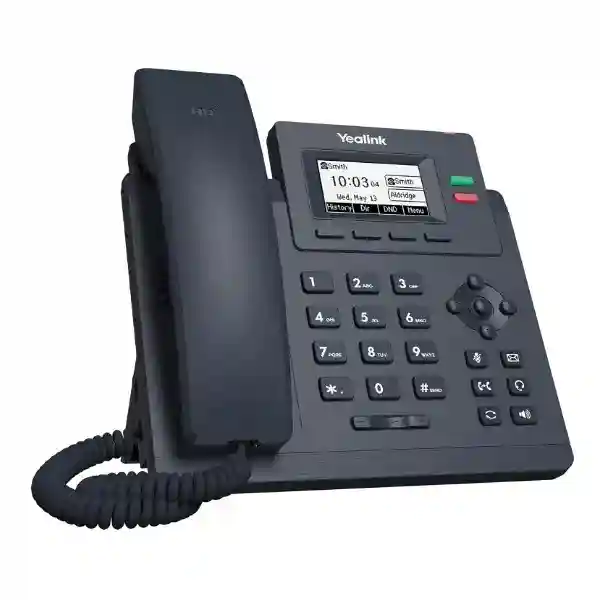
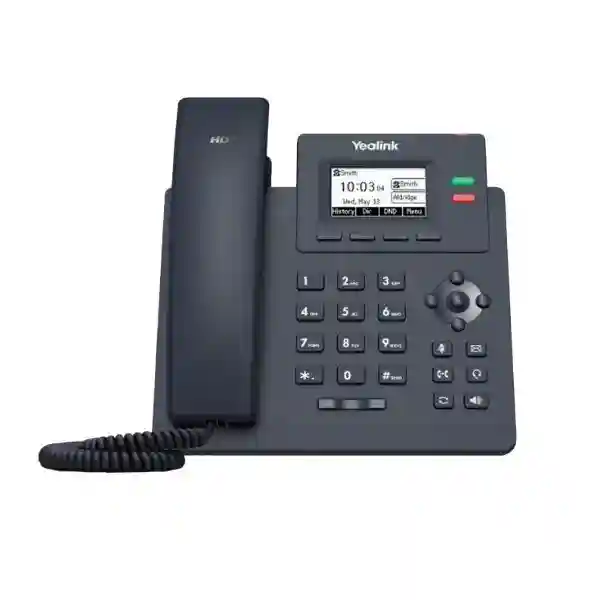
The Yealink SIP-T31P is a two-account SIP desk phone built for organizations that need a straightforward, manageable and PoE-capable voice endpoint for everyday business calling. It combines a 2.3-inch backlit graphical display, two 10/100 Mbps Ethernet ports, IEEE 802.3af PoE, Yealink HD Voice, Smart Noise Filtering, local five-way conferencing and centralized provisioning capabilities in a compact desktop form. In practical procurement terms, it is well suited to users whose daily work depends on reliable extension calling, call transfer, hold, voicemail access, directory use and headset operation rather than a large color screen or high-density programmable key layout.
For Ugandan organizations, the value of selecting the correct desk phone extends beyond the handset itself. The endpoint must match the SIP platform, switching environment, VLAN design, power method, cabling standard, headset requirement and provisioning process already used by the business. A phone that is technically capable but poorly matched to the network can create avoidable deployment delays. The SIP-T31P addresses common entry-level business requirements while retaining features useful to administrators, including web and phone configuration, automated provisioning, VLAN support, secure signaling options, IPv6 support and device-management compatibility.
FourTeck can support procurement teams from initial quantity planning through model validation, bill-of-materials review, staging requirements and delivery coordination. Buyers should provide the intended PBX or hosted voice service, required number of endpoints, site locations, PoE availability and any headset or wall-mounting requirements when requesting a quotation. This allows the proposed supply to reflect the actual deployment rather than treating the phone as an isolated item.
Instant Specifications & Procurement Fact Rail
Yealink SIP-T31P
Up to 2 SIP accounts
2 × 10/100M Ethernet
IEEE 802.3af PoE, Class 1
2.3-inch 132 × 64 backlit LCD
Request current Uganda quotation
The fact rail highlights the elements that usually determine whether the SIP-T31P fits a planned seat. It is an entry-level business endpoint with two line keys and two VoIP accounts, not a high-density attendant console. The dual 10/100M Ethernet interface can support a phone-and-PC desk arrangement where the network design permits it. PoE can simplify installation by carrying power and data over compatible Ethernet infrastructure; an external Yealink AC adapter is an optional alternative. Regional warranty handling should be confirmed on the quotation because coverage depends on supplied channel, project terms and applicable manufacturer or distributor conditions. Stock position and lead time can also change, so procurement teams should request confirmation for the exact quantity and destination before scheduling installation.
Operational Product Architecture & Overview
The SIP-T31P is designed around the needs of a conventional business voice seat. At the user layer, the handset, full-duplex speakerphone, dedicated feature keys, navigation controls and backlit display provide familiar call handling. At the network layer, the device operates as a SIP endpoint using SIP v1 and v2, with static or DHCP addressing, VLAN tagging and Layer 3 QoS marking available for integration into managed business networks. At the management layer, browser configuration, local phone configuration and automated provisioning methods give administrators several ways to establish and maintain device settings.
Audio quality is a central part of the architecture. Yealink specifies HD handset and HD speaker operation, the G.722 wideband codec, common narrowband codecs and Smart Noise Filtering. Acoustic echo cancellation supports hands-free calling, while packet-loss concealment, adaptive jitter buffering, automatic gain control and related voice-processing functions help maintain usable conversations across real IP networks. These features do not remove the need for proper LAN design. Voice quality still depends on adequate bandwidth, low packet loss, sensible QoS configuration and stable upstream connectivity, particularly when calls traverse WAN or internet links.
The two-port 10/100M Ethernet switch is important when planning desks with a single network outlet. One port can connect the phone to the LAN while the second can provide a downstream connection for a workstation, subject to network policy. Because these interfaces are Fast Ethernet rather than Gigabit Ethernet, buyers should evaluate whether a connected workstation requires higher wired throughput. Where gigabit pass-through is a requirement, another model may be more appropriate. This distinction matters in offices moving large files, using bandwidth-intensive local applications or standardizing on gigabit-to-desktop infrastructure.
Power design is equally practical. The SIP-T31P supports IEEE 802.3af PoE on applicable hardware revisions, enabling compatible switches or injectors to power the phone. Yealink lists PoE consumption around 3–4 W and PSU consumption around 2–3 W. Low endpoint power demand can be useful for large seat counts, but the PoE budget should still be calculated at switch level with appropriate engineering margin. Sites without PoE can use the optional 5 V/600 mA Yealink power adapter, which accepts 100–240 V AC input.
The management architecture is particularly relevant for multi-phone rollouts. Auto-provisioning through FTP, TFTP, HTTP or HTTPS, plug-and-play provisioning and TR-069 support can reduce repetitive desk-by-desk configuration. Yealink also positions the T3 family for use with its device management platforms. Administrators should verify the required firmware baseline and management-platform entitlement before deployment. A controlled rollout normally starts with a pilot endpoint, confirms registration, dial plan, time settings, VLAN behavior, directory access and feature codes, then expands through a validated configuration template.
Security controls include SRTP for media, TLS 1.3 capability for protected signaling, HTTPS certificate management, AES-256 configuration-file encryption, digest authentication, IEEE 802.1X, secure boot and VPN-related functions. The correct security profile depends on the PBX, network-access policy and firmware version. Procurement and IT teams should therefore treat endpoint security as an integration task: the strongest mutually supported settings should be validated with the call platform and network rather than assumed from a feature list.
Enterprise Business Outcomes & Value Analysis
HD Voice, G.722, full-duplex speakerphone operation and Smart Noise Filtering support clearer everyday conversations. For organizations, the operational benefit is not merely richer audio: better intelligibility can reduce repetition of names, numbers, instructions and customer details. Network engineering remains important because codec capability cannot compensate for severe packet loss or unstable connectivity.
The SIP-T31P focuses on conventional desk-phone controls and a non-touch graphical interface. Fewer interface layers can be advantageous for users who need dependable calling with minimal training. Call-server redundancy support also allows compatible voice architectures to define alternate service paths, although the actual resilience achieved depends on PBX and network design.
Automated provisioning and centralized management compatibility make the model suitable for repeatable seat rollouts. Templates can standardize account parameters, time settings, VLAN configuration, directories and permitted features. This reduces configuration drift and supports faster replacement when a device must be swapped.
TLS, SRTP, HTTPS, 802.1X, secure boot and encrypted configuration files provide building blocks for a controlled voice endpoint. These capabilities are most valuable when incorporated into an organization-wide policy covering certificate lifecycle, provisioning credentials, switch access, firmware maintenance and administrative passwords.
Two SIP accounts, familiar feature keys, a backlit display and direct call-control functions create a manageable interface for standard users. IT teams can choose local, browser-based or automated provisioning workflows according to project size. The result can be a more consistent endpoint estate without requiring every user to understand complex configuration.
The SIP-T31P targets essential business calling rather than premium-screen features. Its modest stated power consumption also helps keep aggregate endpoint demand manageable. For a true total-cost assessment, include PoE switching, licenses, PBX subscriptions, headsets, installation, spares, support and expected replacement cycle rather than comparing handset prices alone.
Key Hardware & Software Highlights
132 × 64 pixels with icons, soft keys, caller identification and multilingual interface support for clear day-to-day operation.
Supports two VoIP accounts, useful for standard business users who need primary and secondary registrations or service identities.
Two RJ45 10/100M ports support network and optional PC connectivity. Buyers needing gigabit pass-through should account for this model distinction.
IEEE 802.3af Class 1 capability can simplify desk cabling and centralize power protection when deployed with compatible PoE infrastructure.
RJ9 headset connectivity supports users who spend significant time on calls; headset and EHS compatibility should be validated for the selected accessory.
Browser, phone and automated provisioning options allow small installations and larger estates to use an administration method appropriate to scale.
Technical Specifications Ledger
| Category | Confirmed specification | Procurement relevance |
|---|---|---|
| Display | 2.3-inch 132 × 64 graphical LCD with backlight | Suitable for standard call information and menu navigation. |
| Accounts | 2 VoIP accounts | Confirm user registration needs before standardizing. |
| Ethernet | 2 × RJ45 10/100M | Fast Ethernet; not a gigabit pass-through model. |
| PoE | IEEE 802.3af, Class 1 | Check switch PoE budget and hardware revision. |
| Audio | HD handset, HD speaker, Smart Noise Filtering, G.722 and common narrowband codecs | Validate codec policy with PBX or hosted service. |
| Conferencing | Local 5-way audio conferencing | Useful for ad-hoc local multi-party calls. |
| Ports | RJ9 handset and RJ9 headset | Confirm headset model and EHS requirements. |
| Power adapter | Optional 100–240 V AC input, 5 V/600 mA DC output | Needed where PoE is unavailable. |
| Consumption | PSU 2–3 W; PoE 3–4 W | Use for switch power and UPS planning. |
| Dimensions | 188 × 189 × 162 × 50 mm | Review desk footprint and wall-mount location. |
| Operating environment | -10 to +45°C; 10–95% humidity | Keep within manufacturer environmental limits. |
| Provisioning | FTP/TFTP/HTTP/HTTPS, PnP, TR-069 | Supports repeatable multi-seat deployment. |
| Security | TLS 1.3, SRTP, HTTPS, AES-256 config encryption, digest auth, 802.1X, secure boot | Match settings to PBX, certificates and LAN policy. |
Specification tables should be read as an integration reference rather than a substitute for deployment validation. Firmware can affect feature availability, and hosted voice platforms may expose only a subset of endpoint capabilities. The physical network is also part of the solution: VLAN tagging, DHCP options, DNS, NTP/SNTP, QoS and switch access policies should be tested against the intended configuration. When replacing an older fleet, compare not only SIP registration but also headset wiring, wall mounts, provisioning templates, button behavior, directory sources and any platform-specific feature codes.
Configuration & Sizing Worksheet
- Estimate seat count and call workload.
Separate ordinary users from reception, contact-center, executive and conference-room requirements. The T31P is strongest as a standard two-account desk endpoint. Users who need many programmable keys, large color displays, integrated Wi-Fi or gigabit desktop pass-through may require a different model. Record current seats, growth allowance, spare ratio and phased rollout quantities.
- Validate network and desk environment.
Confirm structured cabling, switch port availability, voice VLAN design and whether the phone will share a wall outlet with a PC. Because the integrated switch is 10/100M, determine whether downstream workstation traffic can accept that link speed. Check desk depth, cable routing and wall-mount requirements where relevant.
- Calculate power and resilience.
For PoE deployments, total the expected endpoint load per access switch and leave engineering headroom. If voice service must remain available during utility interruptions, the switch, router, PBX or internet edge also needs suitable UPS or generator support. For non-PoE desks, include the optional AC adapter and appropriate power outlets in the bill of materials.
- Confirm service and licensing.
A SIP phone does not by itself provide a telephone service. Confirm extension or user licenses, hosted voice subscriptions, SIP credentials, DID requirements, voicemail, recording policy and any management-platform subscriptions. Licensing belongs to the selected communications platform and should be quoted separately where applicable.
- Prepare the quotation request.
Provide quantity, delivery city, organization name, target deployment date, PBX or hosted platform, PoE status, headset requirements, preferred support scope and whether pre-configuration is required. For multi-site projects, list quantities by branch so logistics and staging can be planned accurately.
Deployment Scenarios & Industry Use Cases
Large enterprise and multi-site networks
In a large organization, the SIP-T31P can serve standard employees, back-office teams, branch staff and shared operational desks. Central provisioning is important because manually configuring hundreds of endpoints increases labor and inconsistency. A deployment template can establish SIP server addresses, VLAN settings, time configuration, directory sources, security parameters and feature keys. A pilot group should be tested before mass rollout, especially when multiple switch vendors or WAN links are involved.
Financial and banking environments
Banks and financial organizations often prioritize controlled network access, predictable endpoint behavior and secure signaling. The phone’s support for 802.1X, TLS, SRTP, HTTPS and encrypted configuration files can contribute to that architecture when correctly configured. Procurement teams should coordinate with security teams on certificate management, firmware baselines, administrator access and voice VLAN policy. Where call recording is mandated, validate recording at the PBX or service layer and confirm regulatory and internal policy requirements.
Education and campus networks
Schools, universities and training institutions may deploy phones across administration offices, faculty areas, security posts, libraries and service counters. PoE can reduce local power-adapter dependence, while centralized provisioning can help manage endpoints across buildings. Campus designers should map switch capacity and PoE budgets by block, confirm emergency-call routing and maintain an inventory that links each device to its physical location.
Government and public-sector procurement
Public-sector projects typically require clear bills of materials, documented specifications, delivery schedules and acceptance criteria. The SIP-T31P can be evaluated against requirements for SIP compatibility, PoE, security, management and environmental operation. Tender documentation should state required accessories, support terms, warranty expectations and configuration scope explicitly. Where security standards are project-specific, the responsible authority should validate the endpoint and firmware against its own controls before production use.
Technical Deep Dive 1: Processing, Audio & Endpoint Architecture
The T3 family is positioned by Yealink around a stronger processing platform intended to provide responsive operation and support an expanded feature set. For the SIP-T31P, the practical outcome is an endpoint that can combine SIP signaling, voice codec processing, display interaction, local conferencing, directory handling, network services and security functions in a compact device. Buyers should avoid interpreting processing claims like server benchmarks; an IP phone is an embedded appliance whose relevant performance is consistent call handling, interface responsiveness and protocol support.
Voice processing includes G.722 wideband audio plus established narrowband codecs such as G.711 variants, G.729 families, G.726, iLBC and G.723.1. The phone also provides acoustic echo cancellation and other speech-processing mechanisms. Codec selection is negotiated with the call platform and can influence bandwidth and perceived quality. G.722 is attractive for internal wideband calling when supported end to end, while other codecs may be used for interoperability or bandwidth policies. Network engineers should confirm which codecs are permitted by the PBX, SBC and carrier path.
Local five-way conferencing is useful for quick collaborative calls without requiring the user to operate a separate meeting device. However, organizations with frequent large meetings should rely on an appropriate conferencing service or dedicated room system. Similarly, the built-in speakerphone is appropriate for personal desk use, not a substitute for an acoustically designed conference-room endpoint.
Technical Deep Dive 2: Firmware Security & Operational Control
Endpoint firmware is part of the security boundary. The SIP-T31P supports secure boot and modern transport-security capabilities, but effective protection depends on disciplined administration. Organizations should establish an approved firmware version, controlled update source, strong administrator credentials and secure provisioning path. HTTPS provisioning is generally preferable where infrastructure supports it because configuration files can contain sensitive service parameters. AES-256 configuration-file encryption provides another mechanism for protecting configuration material.
TLS 1.3 capability can protect signaling when supported by the server side, while SRTP can protect media. Certificate trust and lifecycle management are essential: enabling a protocol without validating certificates or maintaining trust stores can undermine the intended security model. IEEE 802.1X can integrate the endpoint into authenticated network access, and VLAN functions can help segregate voice traffic. These controls should be implemented in coordination with switching, DHCP, DNS, firewall and PBX policies.
For operations teams, automated provisioning is a major control point. Templates should be versioned and tested. Changes should be piloted before being pushed across a large fleet. Configuration backups, device inventories and documented rollback procedures reduce risk. Yealink management services may provide additional centralized capabilities; verify platform support, firmware prerequisites and commercial terms for the intended environment.
Technical Deep Dive 3: Availability, Redundancy & Recovery
The phone supports call-server redundancy, but endpoint support is only one component of a resilient voice design. True availability requires redundant or recoverable call control, DNS or server discovery, switching, routing, internet or WAN connectivity and power. A phone connected to a PoE switch can remain powered during a local utility failure only if that switch and the upstream voice path are also backed by UPS, generator or another resilient source.
Branch offices should document what happens if the primary PBX or WAN path fails. Depending on the communications architecture, endpoints may register to alternate servers, use local survivability services or lose external calling until connectivity returns. Test these behaviors before accepting a deployment. Recovery testing should include inbound and outbound calls, emergency routing where applicable, voicemail access, directory availability and re-registration after service restoration.
Hardware replacement is another aspect of recovery. Keeping a small pool of pre-approved spares can shorten restoration time. With standardized provisioning, a replacement device can receive the required configuration after identification and network connection rather than being rebuilt manually. Organizations should maintain serial-number and location records so replacement, warranty processing and asset control remain traceable.
Pre-Purchase Buyer Gap Checklist
Does the phone include service? No. The endpoint requires a compatible SIP PBX, hosted voice platform or other supported call-control service. Confirm user licenses, SIP credentials and any carrier services separately.
Is a power adapter always included? Yealink documentation lists the power adapter as optional. If your access switch provides compatible PoE, a local adapter may not be necessary. For non-PoE sites, include the correct adapter in the quote.
Will it provide gigabit connectivity to a PC? No. The SIP-T31P uses two 10/100M Ethernet ports. If a workstation needs gigabit wired access through the phone, select a model with gigabit interfaces or provide a separate network connection.
Are all PBX features automatically available? Not necessarily. SIP interoperability is broad, but advanced functions can depend on the PBX, firmware and provisioning profile. Validate BLF, recording, directories, transfer behavior, voicemail integration and platform-specific features during a pilot.
What about lifecycle and firmware? Ask for the current supplied hardware revision and confirm the firmware baseline approved for your call platform. Maintain a lifecycle record so replacements remain compatible with configuration templates and security policy.
What physical checks matter? Confirm desk footprint, stand angle, cable path, wall-mount accessory requirements and headset connection. In constrained counters or wall installations, physical fit can matter as much as protocol compatibility.
Are there hidden project costs? Budget for voice licenses, PoE switching or adapters, headsets, patch cables where needed, installation labor, provisioning, spares, support and any centralized management service. A complete project budget should reflect the operational system rather than the handset unit price alone.
Can existing network infrastructure support voice quality? Verify VLANs, QoS, DHCP, DNS, SNTP and WAN quality. Voice is sensitive to latency, jitter and packet loss. A site readiness check can prevent endpoint troubleshooting that is actually caused by the network.
Uganda Procurement & Delivery Logistics
FourTeck Uganda can structure quotations around single-site requirements or larger phased deployments. A useful request includes product model, quantity, delivery location, target date, company details and any required accessories or configuration services. For multi-branch projects, provide a location schedule so stock allocation, staging and dispatch can be planned by site. Current availability and delivery lead time should be confirmed at quotation stage because they can vary with quantity and supply conditions.
Before dispatch, technical teams can align the bill of materials with the intended environment. This can include checking whether PoE is available, whether optional power adapters are needed, whether selected headsets are compatible and whether the PBX supports the desired features. Where pre-configuration is part of the project, the required provisioning data should be exchanged through an agreed secure process. Organizations should avoid sending production credentials through informal channels.
Acceptance planning is recommended for larger deliveries. Define what constitutes a successful endpoint test: power-up, network address acquisition, SIP registration, inbound and outbound calling, transfer, voicemail access, directory behavior and any security controls required by the project. This creates a repeatable handover process and makes it easier to distinguish device issues from network or service configuration problems.
Local Coverage Matrix
Head-office, branch, hospitality, retail and professional-office deployments.
Business, hospitality, logistics and administrative voice requirements.
Commercial, education and distributed branch communications.
Regional office and multi-site enterprise endpoint projects.
Institutional, NGO, education and branch communications planning.
For every location, delivery planning should account for quantity, site readiness and whether configuration will be completed centrally or at the destination. Larger projects benefit from labeling endpoints by branch or user group before dispatch, particularly when each site uses different extension ranges or VLAN settings.
Cross-Border & Regional Supply Chains
Organizations operating across East Africa, the Gulf and broader African markets may need consistent endpoint standards across multiple legal entities and sites. FourTeck regional portals can support planning through Uganda, Kenya, Africa, UAE and Kuwait. Cross-border projects should keep a common technical standard while allowing for local quotation, taxation, import requirements, delivery conditions and warranty handling.
A centralized bill of materials can specify the endpoint model, firmware policy, headset family, provisioning template and spare ratio. Each regional deployment can then validate local power, cabling, call platform and logistics. This approach helps multinational IT teams reduce model fragmentation without assuming that every country has identical commercial conditions.
Related Products & Deployment Options
A complete voice project may include more than one desk-phone class. Standard users can be evaluated around the SIP-T31P, while receptionists, executives or users requiring higher port speed may need another Yealink model. Explore FourTeck Uganda for related business communications options and use the contact team to request model matching. When preparing the bill of materials, consider compatible headsets, EHS accessories, PoE switching, network patching, UPS capacity, wall-mount accessories and PBX licensing.
Yealink’s T3 family also includes models positioned around different line counts and network interfaces. The T31P itself is the PoE-capable Fast Ethernet option in its immediate family. Where a project needs gigabit pass-through, validate a gigabit-capable alternative rather than assuming all visually similar models share the same ports. Where users need more programmable keys or a color display, compare a higher-tier endpoint. Matching endpoint class to user role is often more economical than deploying one premium model to every seat.
FourTeck Technical Service Capabilities
Enterprise endpoint procurement is most successful when the supply process includes technical validation. FourTeck can help review the requested model against the stated call platform, network power method and user profile. Bill-of-materials verification can identify missing adapters, headsets, wall-mount requirements or switching dependencies before equipment reaches the site. This is particularly useful when a quotation covers many branches or several endpoint classes.
Staging can be planned around customer requirements, including labeling, firmware alignment and configuration preparation where agreed. Firmware updates should follow a controlled version approved for the communications platform rather than simply applying an arbitrary release. For auto-provisioned estates, configuration templates can be validated on a small test group before scale deployment. Post-sales technical support can then focus on clearly defined issues such as registration, provisioning behavior, endpoint configuration or hardware fault isolation.
For warranty or replacement cases, maintaining purchase records, serial numbers, firmware versions and fault descriptions improves processing. Administrators should capture logs and reproduce the issue where practical before resetting a device, because diagnostic information can be lost during a factory reset. A disciplined support process shortens resolution time and helps determine whether the cause sits with the endpoint, LAN, PBX, carrier or configuration.
Extended Technical FAQ
1. Is the Yealink SIP-T31P suitable for a normal office user?
Yes, it is designed as an entry-level business IP phone for standard voice users. It supports two SIP accounts, a backlit graphical display, HD audio, speakerphone operation, call transfer, hold, call waiting, voicemail-related functions and local five-way conferencing. The key question is whether the user’s role needs features beyond that baseline. Receptionists may require more line or programmable keys, while users who pass a gigabit workstation connection through the phone may need a model with gigabit Ethernet. For ordinary office extensions, branch desks, service counters and shared administrative positions, the SIP-T31P can be a practical fit when the PBX and network are compatible.
2. Does the SIP-T31P work with Power over Ethernet?
The SIP-T31P supports IEEE 802.3af PoE Class 1 on applicable hardware revisions, allowing compatible Ethernet infrastructure to provide power and data over the network cable. This can reduce local adapters and centralize power resilience through the switching environment. Yealink lists PoE consumption around 3–4 W. Before deployment, confirm the access switch supports the required PoE standard and has enough aggregate power budget for all attached devices. If PoE is not available, the phone can use an optional Yealink AC adapter with 100–240 V input and 5 V/600 mA output. Include adapters explicitly in the quotation when required.
3. Can I connect a computer through the phone?
The phone provides two RJ45 10/100M Ethernet ports, enabling a common topology where one cable connects the phone to the network and another connects a workstation through the phone. The important limitation is speed: these are Fast Ethernet interfaces, not gigabit interfaces. If the connected PC requires more than 100 Mbps wired throughput for large file transfers, local applications or other workloads, this pass-through arrangement may become a constraint. In that case, provide a separate gigabit network connection to the workstation or select a phone model with gigabit Ethernet. Check VLAN design and switch configuration before deployment.
4. What PBX or hosted voice licensing is required?
The handset itself does not replace the need for a voice service or call-control platform. Licensing depends on the PBX, unified communications service or hosted SIP provider selected by the organization. A deployment may require user or extension licenses, SIP registrations, direct inward dialing numbers, voicemail, recording, contact-center features or management subscriptions. Those commercial terms are platform-specific and should be confirmed before ordering endpoints. During a proof of concept, validate basic registration as well as transfer, hold, voicemail access, directory integration, BLF where needed and any organization-specific dial plan. This prevents an endpoint purchase from being separated from the service licensing required to make it operational.
5. What security capabilities does the phone provide?
Yealink documents TLS 1.3 support, SRTP, HTTPS certificate management, AES-256 configuration-file encryption, digest authentication, IEEE 802.1X, secure boot and additional network security mechanisms. These capabilities provide useful building blocks, but security depends on the complete architecture. The PBX must support compatible secure signaling and media, certificates must be managed correctly, provisioning credentials should be protected, firmware should be maintained and switch access controls should be configured. For regulated environments, the security team should validate the exact firmware and settings against organizational standards. A feature being supported by the phone does not automatically mean it is enabled or supported by every voice platform.
6. How is a large fleet configured and maintained?
The SIP-T31P supports configuration through the phone, a web interface and automated provisioning. Yealink lists FTP, TFTP, HTTP and HTTPS provisioning, plug-and-play provisioning and TR-069. For a large fleet, administrators normally create a controlled template containing server addresses, account parameters, VLAN settings, time configuration, security options and user-facing preferences. That template should be tested on a pilot group before mass deployment. Yealink also supports centralized device-management approaches for the T3 family, subject to firmware and service requirements. Maintain version-controlled templates and an asset inventory so replacements and branch expansions can follow the same approved configuration.
7. What should be checked before ordering headsets?
The SIP-T31P includes an RJ9 headset port and supports headset-oriented operation. Yealink also identifies EHS wireless-headset support in the product family. Compatibility should still be confirmed for the exact headset and any required electronic hook-switch adapter because connector type alone does not guarantee full remote call-control functionality. Define whether users need wired or wireless headsets, answer/end control from the headset, range requirements, wearing style and acoustic protection. Contact-center users may have different needs from occasional office callers. Including the exact headset model in the pilot avoids discovering after a bulk purchase that answer controls, cabling or audio levels do not behave as expected.
8. How should warranty and hardware replacement be handled?
Warranty conditions should be confirmed on the commercial quotation because they depend on supply channel and applicable project terms. For efficient support, keep purchase records, serial numbers, site location, firmware version and a concise fault description. Before declaring hardware failure, test power source, network cable, switch port, configuration and account registration where relevant. If a replacement is required, standardized auto-provisioning can reduce downtime because the spare can be connected and assigned the approved configuration rather than manually rebuilt. Organizations with many endpoints should consider holding an appropriate spare pool so a desk can be restored while a warranty case is processed.
9. Can FourTeck assist with configuration before delivery?
Configuration and staging requirements can be discussed as part of the project scope. Useful pre-deployment work may include bill-of-materials verification, firmware alignment, labeling, configuration-template validation and basic staging according to agreed customer parameters. The exact scope depends on quantity, voice platform, security policy and information available before shipment. For security, production credentials should be handled through an agreed protected process. A good staging plan also defines what will be completed by FourTeck, what remains the customer’s responsibility and what acceptance tests will be performed at site. This avoids ambiguity when equipment is delivered to multiple branches or handed to different installation teams.
10. What information should I provide to get an accurate quote?
Provide the model name Yealink SIP-T31P, required quantity, delivery city or cities, target delivery date and organization details. Add the PBX or hosted voice platform, whether the network supplies PoE, whether power adapters are required, headset requirements and whether wall mounting or pre-configuration is needed. For multi-site projects, provide quantities by Kampala, Entebbe, Jinja, Mbarara, Gulu or other locations as applicable. If you are replacing an existing phone estate, include the current model and any critical features users rely on. These details help ensure the quotation covers the operational bill of materials rather than only the handset.
Plan Your Yealink SIP-T31P Deployment in Uganda
A reliable business phone rollout starts with the right endpoint, but it succeeds through correct network, power, service and provisioning choices. Share your required quantity, deployment locations, PBX or hosted voice platform, PoE status, headset needs and target schedule with FourTeck. The team can help align the proposed supply with your user roles and infrastructure, identify required accessories and structure the quotation for a single office or multi-site project. For larger deployments, ask about staging, firmware alignment, configuration preparation and branch-by-branch delivery planning. Current stock, lead time, commercial terms and warranty conditions can be confirmed with the quotation.

Reviews
There are no reviews yet.