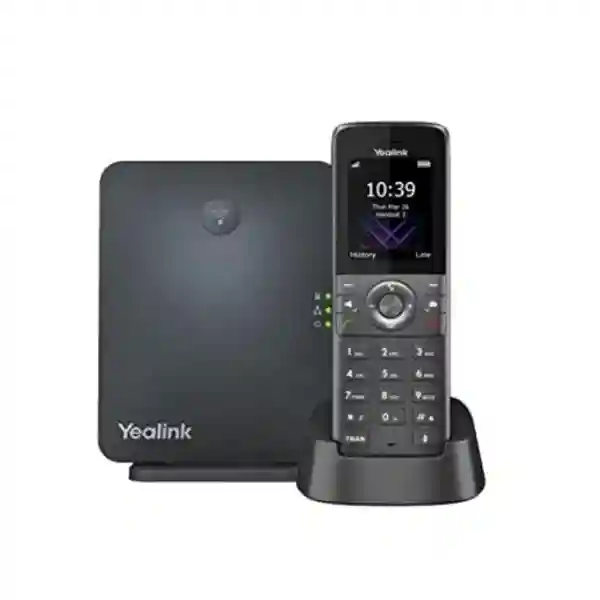
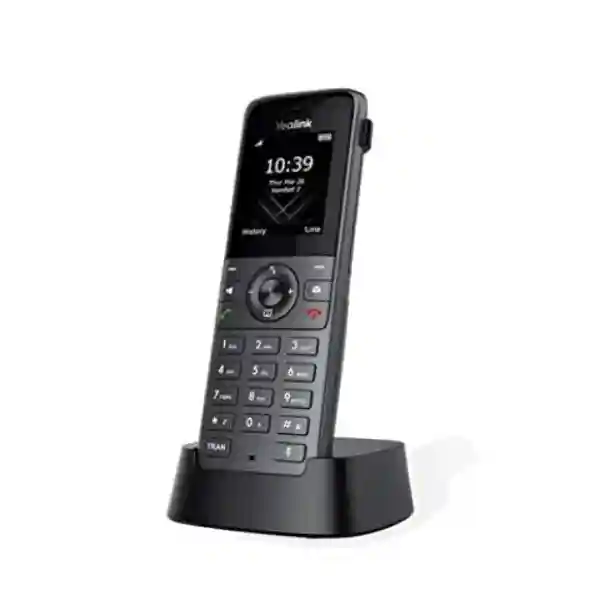
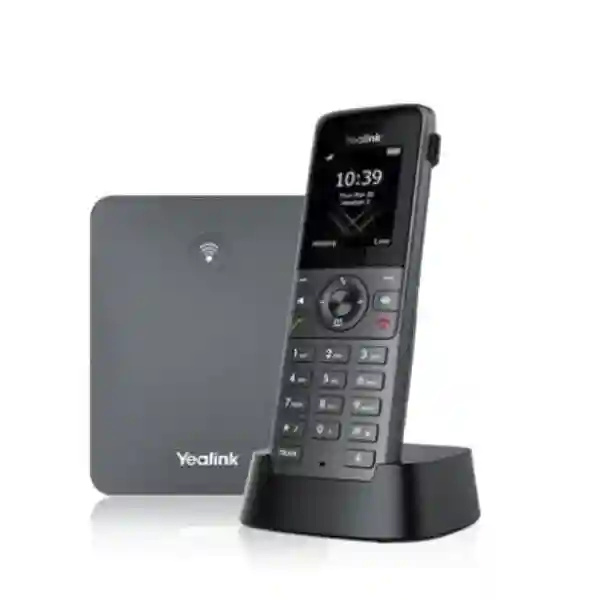
Yealink W73P DECT Phone System for Business Cordless VoIP
The Yealink W73P is a business DECT IP phone system designed for organisations that need employees to move freely while remaining reachable through managed SIP voice services. It pairs the compact W70B IP base station with the W73H cordless handset, creating a single-cell wireless voice platform suited to offices, shops, clinics, service desks, warehouses and other workplaces where a fixed desk telephone can restrict productivity. The architecture separates the network connection from the user handset: the W70B attaches to the LAN and SIP environment while compatible DECT endpoints communicate wirelessly with the base. This reduces the need to extend Ethernet cabling to every roaming user and provides a controlled way to expand cordless extensions as staffing requirements grow.
For procurement teams, the W73P is particularly useful when the requirement is larger than a domestic cordless phone but does not yet justify a multi-cell deployment. A single W70B can register up to 10 compatible DECT handsets or endpoints, support up to 10 SIP accounts and handle up to 20 simultaneous calls. Each W73H can handle up to two simultaneous calls. Coverage is specified by Yealink at up to 50 metres indoors and 300 metres outdoors under ideal conditions; real buildings can reduce those distances because walls, reinforced concrete, shelving, machinery and radio interference affect propagation. Coverage planning should therefore be based on the actual site rather than the theoretical maximum.
FourTeck supplies the Yealink W73P for Uganda with procurement guidance covering handset quantities, SIP platform compatibility, LAN connection, PoE availability, repeater planning and deployment accessories. Organisations can request a configuration-aligned quotation rather than purchasing an incomplete bill of materials.
Instant Specifications & Procurement Fact Rail
W70B base + W73H handset
Up to 10 handsets and 10 SIP accounts
Up to 20 simultaneous calls
10/100 Ethernet; IEEE 802.3af Class 1 PoE
The procurement baseline should include the required number of users, expected concurrent calls, voice platform, building dimensions, wall construction, available network ports and power method. The W70B can use PoE or the supported external power arrangement, giving installers flexibility where PoE switching is not present. Uganda stock position, lead time and warranty terms should be confirmed on the issued quotation because commercial conditions can vary by shipment and project.
Operational Product Architecture & Overview
The W73P uses a straightforward IP-to-DECT architecture. The W70B is the network-facing component and provides the bridge between the organisation’s Ethernet/SIP environment and registered Yealink DECT endpoints. The W73H is the mobile user endpoint. This arrangement is valuable because voice mobility no longer requires an Ethernet drop at every employee position. Instead, the base station is installed at a network-accessible point selected for useful radio coverage, while handsets remain with staff as they move through the covered area.
The W70B provides one RJ45 10/100M Ethernet port and supports IEEE 802.3af Class 1 PoE. Network functions include SIP, static or DHCP addressing, VLAN support, LLDP, STUN and transport choices including UDP, TCP and TLS. Security capabilities include TLS, HTTPS, SRTP, digest authentication and encrypted configuration files. These functions allow the system to fit into structured business voice networks where segmentation, protected signalling and controlled provisioning are important.
Capacity is one of the central reasons organisations investigate the W73P. A base supports up to 10 SIP accounts and up to 20 simultaneous calls, while a W73H supports up to two simultaneous calls. This makes the platform suitable for departments where multiple cordless users may be active at once. It is important, however, to size concurrent calls independently from the number of registered handsets. Ten registered users do not automatically mean twenty external calls will be available: SIP trunk channels, PBX licensing, internet bandwidth and provider policy can impose separate limits.
The radio layer is DECT rather than Wi-Fi. This gives voice traffic a purpose-oriented cordless environment and can simplify mobility for users who need a familiar telephone experience. Yealink specifies up to 50 metres indoor and 300 metres outdoor range under ideal conditions. Those figures are planning ceilings rather than guaranteed site coverage. Dense masonry, metal racks, lift shafts, server rooms, electrical plant and floor-to-floor attenuation can substantially change results. Where a single base cannot cover the required area, compatible repeaters may extend suitable deployments, while larger or more complex sites should be evaluated for a multi-cell architecture.
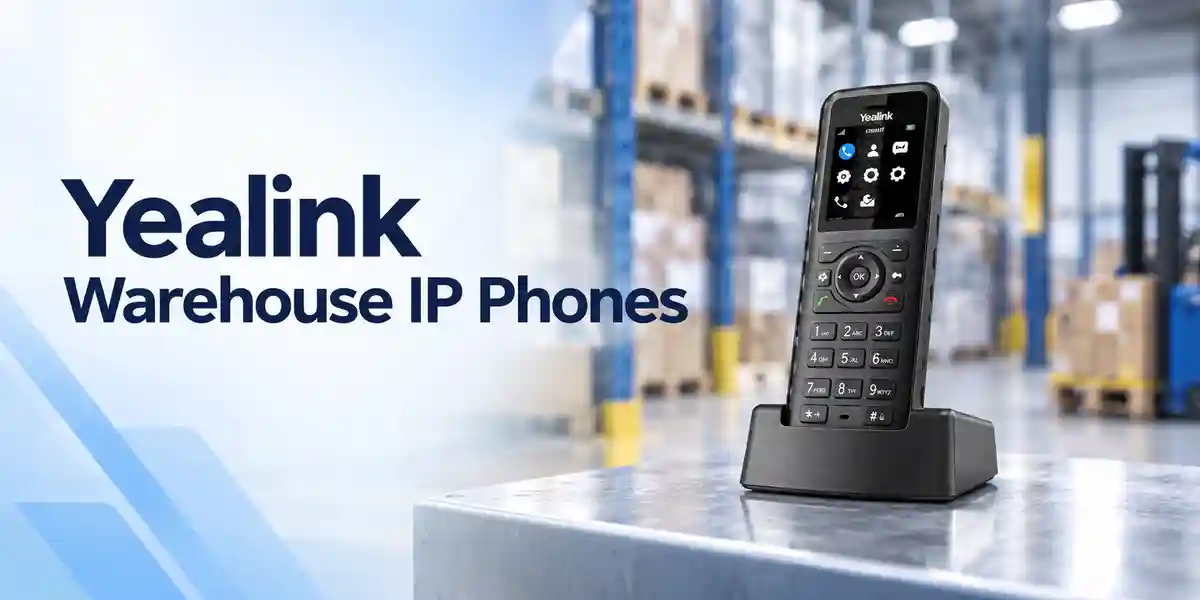
The W73H combines a 1.8-inch 128 × 160 colour display, backlit controls, HD voice, full-duplex speakerphone and noise reduction. A 3.5 mm headset jack supports suitable wired headsets. The lithium battery is rated for up to 35 hours of talk time and up to 400 hours standby under ideal conditions. These figures support long shifts, but actual endurance varies with call duration, signal conditions, display use, battery age and operating environment.
Enterprise Business Outcomes & Value Analysis
The system supports up to 20 simultaneous calls at base level, helping busy small and medium business teams avoid a one-call-per-base bottleneck. Procurement should still validate SIP trunk and PBX capacity.
DECT mobility lets staff carry a business handset through the covered workspace. This is useful for supervisors, reception overflow, retail teams, clinic staff and warehouse coordinators who cannot remain at a desk.
Up to 10 compatible endpoints can be registered to one W70B, allowing a deployment to begin with the included handset and expand as the department grows.
TLS, HTTPS, SRTP and secure configuration options provide tools for a properly designed protected voice deployment. Security depends on compatible PBX/provider settings and correct configuration.
RPS and supported provisioning methods can reduce repetitive manual configuration across deployments. IT teams can standardise parameters, firmware and account settings according to platform policy.
Only the base needs the LAN connection for the cordless users it serves, which can reduce endpoint cabling compared with installing a wired IP phone at every roaming position.
PoE support can centralise base power through a compatible switch. ECO features are available, while external power remains useful where PoE is unavailable.
Long handset battery endurance and optional expansion components help teams plan around shifts and coverage. Spare handsets or batteries may be appropriate for high-dependency operations.
Key Hardware & Software Highlights
The hardware design is intentionally compact. The W70B measures approximately 130 × 100 × 25.1 mm and can be placed on a desktop or wall mounted, allowing the installer to choose a position based on radio coverage and cabling. Three base indicators show registration, network and power status. The W73H measures approximately 144.5 × 48 × 21 mm and uses a compact handset form suited to mobile business users. Its colour screen provides access to calling functions and status information without the bulk of a desktop terminal.
Audio capabilities include HD voice, G.722 wideband audio, supported narrowband codecs, full-duplex speakerphone and noise-reduction features. These capabilities help maintain intelligible conversations, although end-to-end wideband quality depends on the PBX, SIP carrier, remote endpoint and network path. The platform also supports familiar business calling functions including hold, transfer, call waiting, forwarding, three-way conference, intercom, paging, voicemail indication, redial, DND and caller identification where supported by the connected service.
Directory features include a base-stored local phonebook of up to 1,000 entries plus supported remote directory methods. For organisations with central directories, compatibility and authentication should be checked against the actual PBX or directory service. Provisioning can use TFTP, FTP, HTTP, HTTPS and Yealink RPS mechanisms, providing administrators with several ways to deploy settings according to their operational standards.
Technical Specifications Ledger
| Specification | Confirmed Detail |
|---|---|
| System composition | W70B IP base station and W73H DECT handset package |
| Handsets | Up to 10 compatible DECT endpoints |
| SIP accounts | Up to 10 |
| Simultaneous calls | Up to 20 at base level; up to 2 per W73H |
| Display | 1.8-inch 128 × 160 TFT colour display |
| Ethernet | 1 × RJ45 10/100M |
| PoE | IEEE 802.3af, Class 1 |
| Base power adapter | AC 100–240V input; DC 5V/600mA output |
| Headset | 3.5 mm jack on handset |
| Talk / standby | Up to 35 hours talk / 400 hours standby in ideal conditions |
| Radio range | Up to 50 m indoor / 300 m outdoor in ideal conditions |
| Repeaters | Up to 6 RT30 repeaters per base |
| Audio | HD voice, full-duplex speakerphone, G.722 and supported narrowband codecs |
| Security | TLS, HTTPS, SRTP, digest authentication, AES-encrypted configuration support |
| W73H operating temperature | -10°C to +50°C |
| Operating humidity | 10–95% |
Specification values describe the platform capability and do not replace site validation. Network QoS, SIP service capacity, radio conditions and configuration determine real deployment results. Uganda buyers should also confirm the correct regional DECT frequency variant before ordering; radio products must match the intended regulatory market.
Configuration & Sizing Worksheet
1. Estimate users and call concurrency
Count every person or shared role that needs a cordless endpoint, then estimate peak concurrent calls. A six-handset installation may need only three or four concurrent calls, while a customer-service operation can have much higher concurrency. Compare the result with W70B capacity and with the SIP trunk or hosted service allowance.
2. Map the radio environment
Mark the intended base position, working rooms, corridors, floors, outdoor areas and known barriers. Treat the published 50 m indoor and 300 m outdoor values as ideal-condition references. Reinforced walls, metal storage, elevators and machinery justify a conservative design. If the required footprint is large or spread across multiple buildings, request a topology review rather than assuming one base will cover it.
3. Confirm LAN and power
Reserve a switched Ethernet port with suitable voice VLAN and QoS policy where used. Decide whether the W70B will receive IEEE 802.3af PoE or local adapter power. For PoE installations, confirm switch power budget and UPS strategy. A PoE base attached to a UPS-backed access switch can remain powered during short mains interruptions, but the wider voice platform and internet connection must also remain available.
4. Validate SIP platform and licensing
Confirm SIP credentials, extension count, codec policy, transport/security requirements, NAT method and any PBX device templates. The W73P itself supports SIP functionality, but commercial PBX extensions, hosted seats, trunks, call recording, contact-centre functions or advanced features can have separate subscriptions. Request these costs independently so the telephone hardware quote is not mistaken for a complete voice-service budget.
5. Prepare the quotation brief
Provide handset quantity, site location, floor plan or approximate dimensions, PBX/provider, existing PoE switch details, expected simultaneous calls, headset needs, repeater requirement, desired delivery location and any staging request. This information helps FourTeck prepare a more accurate bill of materials and avoids missing accessories.
Deployment Scenarios & Industry Use Cases
Large Enterprise / Multi-Site Networks
Within a large enterprise, W73P can serve contained departments, reception overflow points, workshops or branch offices where a single-cell footprint is appropriate. A multi-site company can standardise handsets and configuration practices while deploying independent bases at smaller branches. Very large continuous roaming environments should be assessed for Yealink multi-cell alternatives rather than stretching a single-cell design beyond its intended role.
Financial & Banking Institutions
Branch operations can use cordless extensions for supervisors, back-office teams or controlled service areas. Network administrators can align voice VLANs, protected signalling and provisioning with institutional policy. Security capabilities on the endpoint are only one layer; firewall policy, PBX hardening, credential management, logging and physical controls remain essential.
Educational & Campus Networks
Schools and training centres can use W73P in administrative blocks, libraries, laboratories or maintenance teams where staff need to leave desks. Campus-wide roaming across multiple buildings generally requires a broader radio architecture, so the W73P is best treated as a departmental single-cell system unless a survey confirms otherwise.
Government & Institutional Procurement
Government buyers often need a clear bill of materials, documented specifications, delivery terms and compatibility validation. The W73P provides standard SIP integration and documented security mechanisms, but the purchasing organisation should specify required approvals, network standards, regional radio requirements and warranty documentation in the request for quotation.
Retail, Hospitality, Healthcare and Warehousing
Mobile staff can receive and transfer business calls without returning to a fixed desk. Retail supervisors can move between sales and stock areas; hospitality teams can coordinate service areas; clinics can equip appropriate administrative personnel; warehouses can provide mobile voice to coordinators. For harsh industrial environments, evaluate rugged Yealink handset options compatible with the selected base rather than assuming the standard W73H is suitable for impact, dust or moisture exposure.
Technical Deep Dive 1: Processing, Radio & Voice Architecture
The W73P’s processing architecture is designed around call handling, SIP signalling, audio processing and DECT endpoint coordination rather than general-purpose computing. The W70B maintains network-side SIP relationships and coordinates registered cordless endpoints. Capacity of up to 20 simultaneous calls gives the base enough headroom for a small or medium department where several users may be active at once. The distinction between registered endpoints and active calls is important: registration represents addressable devices, while concurrency represents live sessions.
DECT provides the wireless leg between base and handset. It should not be confused with Wi-Fi voice. The dedicated cordless architecture can simplify endpoint behaviour and mobility, but radio planning remains physical. Base placement affects usable coverage, and repeaters can be considered where appropriate. Yealink documents support for up to six RT30 repeaters per base. A repeater is not a substitute for unlimited scaling; organisations requiring broad seamless coverage should compare a multi-cell system.
On the audio side, W73H supports HD voice and G.722, plus narrowband codecs. Noise-reduction processing helps in everyday business environments. Voice quality ultimately follows the complete chain: microphone, radio link, base, LAN, WAN, SIP platform, carrier and remote endpoint. Packet loss, jitter, congestion or incorrect QoS can degrade a high-quality handset, which is why voice-network preparation remains part of a professional deployment.
Technical Deep Dive 2: Firmware Security & Operational Control
The W70B includes business-oriented security and management mechanisms such as TLS, HTTPS, SRTP, digest authentication, AES-protected configuration files and role-based configuration levels. Administrators can use these capabilities to build a more controlled deployment, but each feature must be supported and correctly configured at the opposite end. Enabling secure transport on a phone cannot compensate for an incompatible or incorrectly configured PBX.
Provisioning support is valuable in repeated deployments. Rather than typing account details into every system, administrators can use supported provisioning services and protocols to distribute configuration. Yealink RPS and boot mechanisms are intended to streamline deployment and maintenance. Organisations should protect provisioning servers, limit administrative access, rotate credentials and maintain an approved firmware process. Firmware changes should be validated against the PBX/provider before broad rollout where voice service is operationally critical.
Technical Deep Dive 3: Availability, Power & Recovery Planning
A single W70B is a central component for the endpoints registered to it. Availability planning therefore starts by recognising the consequences of base, switch, PBX, internet or power failure. PoE can simplify resilience because the base may be powered from a centrally protected switch. Where continuity is important, place the access switch, router and on-premise PBX on correctly sized UPS protection and ensure the upstream service has an appropriate resilience plan.
The W70B supports outbound proxy backup, which can form part of a supported SIP design. This should not be interpreted as complete system redundancy. Organisations with strict uptime targets should define failure scenarios, recovery objectives and spare-hardware strategy. Keeping a pre-approved spare base or handset can shorten hardware replacement time, but restoration still requires configuration and registration procedures. Documenting those steps before an incident is more valuable than improvising during an outage.
Pre-Purchase Buyer Gap Checklist
Are there hidden licences? The handset/base hardware should be separated from PBX, SIP trunk and hosted-service charges. Many advanced voice services are licensed by the platform rather than the telephone. Ask for a line-item commercial breakdown.
Will any DECT handset work? No assumption should be made. Yealink states its DECT technology is not compatible with third-party DECT base stations or handsets. Select supported Yealink endpoints and verify the current compatibility list for the W70B.
Will one base cover the whole building? Not necessarily. Published range is measured under ideal conditions. Provide a floor plan for challenging sites and consider repeaters or a multi-cell system where appropriate.
Does PoE power the handset charger? PoE applies to the network-connected W70B base. The handset charging cradle requires its appropriate power arrangement. Plan power outlets where handsets will charge.
Can it connect to an existing PBX? W73P uses SIP and supports common network features, but exact interoperability depends on the PBX/provider configuration and supported feature set. Confirm the platform and firmware combination before bulk procurement.
What happens when more than ten users are required? A single W70B reaches its endpoint scale at ten supported registrations. Additional independent single-cell systems or a Yealink multi-cell design may be more appropriate depending on roaming and coverage requirements.
What regional variant should Uganda receive? DECT frequency bands vary by market. Procurement must ensure the supplied radio variant is appropriate for the intended country and applicable regulatory requirements. Do not import an arbitrary regional SKU solely because it is cheaper.
What should be ordered as spares? High-dependency sites can consider spare handsets, charging accessories and other approved components. The right spare level depends on user count, replacement lead time and operational impact.
Uganda Regional Procurement & Delivery Logistics
Uganda procurement begins with a configuration brief rather than a model number alone. FourTeck can prepare a quotation around the number of W73H users, required base stations, repeaters where suitable, headset needs and the existing SIP environment. This reduces the risk of receiving hardware that is technically capable but incomplete for the intended site.
Order processing can include bill-of-materials validation, regional variant checks and pre-shipment coordination. Delivery timing depends on confirmed stock, quantity, project location and supply route, so the formal quotation should be treated as the source for current lead time. Organisations with installation deadlines should provide the target commissioning date during enquiry so availability and logistics can be assessed early.
For pre-configuration, buyers can share approved SIP parameters and deployment standards through the agreed secure process. Staging requirements should define firmware version, provisioning method, VLAN expectations, naming conventions and acceptance tests. Sensitive credentials should never be placed in public purchase documentation.
Local Coverage Matrix
Kampala: suitable for headquarters, offices, retail, hospitality and institutional deployments requiring cordless SIP mobility. Entebbe: useful for service businesses, hospitality operations and branch communications. Jinja: supports commercial, industrial and administrative procurement where mobile extensions improve staff reachability. Mbarara: appropriate for regional offices, healthcare administration, education and growing enterprises. Gulu: enables organisations in northern Uganda to source a standardised business DECT platform through project-based supply. Delivery, stock and service arrangements are confirmed against the specific quotation rather than assumed from city coverage alone.
Cross-Border & Regional Supply Chains
FourTeck supports regional enterprise procurement through market-specific operations. Uganda buyers can use FourTeck Uganda, while projects involving Kenya can reference FourTeck Kenya. Broader continental requirements can be coordinated through FourTeck Africa. UAE requirements can be directed through FourTeck UAE, and Kuwait projects through FourTeck Kuwait. Cross-border supply should always account for regional radio variants, import requirements, warranty route, lead time and destination-specific commercial terms.
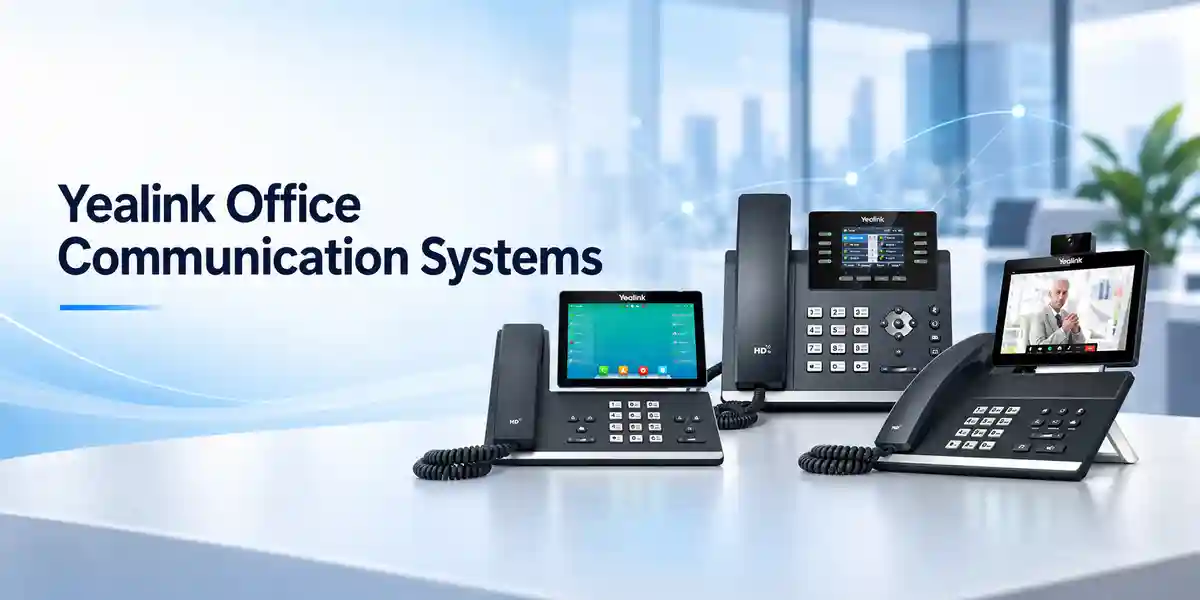
Related Yealink Solutions & Expansion Paths
A W73P deployment can be expanded with compatible Yealink DECT endpoints according to role. Rugged handset requirements should be evaluated separately for industrial or demanding environments. Large roaming footprints may be better served by Yealink multi-cell DECT architecture. Fixed workers can use suitable Yealink SIP desk phones while mobile teams use DECT. Browse Yealink solutions in Uganda or contact the team for W73H handset additions, compatible rugged endpoints, DECT repeaters, PoE switching, SIP desk phones and voice-network accessories. Internal category and model availability changes over time, so a project quotation is the safest way to obtain a current matched bill of materials.
FourTeck Technical Service Capabilities
FourTeck can support engineering validation before supply by checking the requested endpoint count, base capacity, PBX environment, network power method and expected coverage. Bill-of-materials verification helps identify whether additional handsets, repeaters, PoE infrastructure or accessories are required. For staged projects, configuration requirements can be documented before dispatch so devices arrive aligned with the agreed deployment method where service scope permits.
Pre-shipment firmware review can help align a batch to an approved release policy, subject to platform compatibility and project requirements. Post-sales support can assist with hardware identification, configuration guidance and warranty coordination under the applicable commercial terms. Complex radio coverage, PBX integration or network troubleshooting may require additional engineering scope; defining that scope during procurement creates clearer responsibility and faster commissioning.
Extended Technical FAQ
How many handsets can the Yealink W73P support?
The W70B base used by the W73P supports up to 10 compatible Yealink DECT handsets or supported DECT endpoints and up to 10 SIP accounts. This makes it practical for small and medium departments that want to begin with one handset and add users later. Capacity planning should also include simultaneous calls, because endpoint registration and call concurrency are different resources. The base supports up to 20 simultaneous calls, while the W73H can handle up to two simultaneous calls. Your SIP provider, PBX licences and trunk channels may impose separate limits.
What is the practical wireless range?
Yealink specifies up to 50 metres indoors and 300 metres outdoors under ideal conditions. These numbers should not be interpreted as a guaranteed radius in a real Ugandan building. Concrete walls, steel shelving, electrical equipment, lifts, multiple floors and other radio obstacles can reduce usable coverage. For a small open office, a central base position may provide strong results. For warehouses, hotels or multi-floor buildings, provide a floor plan and identify critical call zones. Compatible repeaters can extend suitable single-cell deployments, while larger sites may justify a multi-cell system.
Does W73P require PoE?
No. The W70B supports IEEE 802.3af Class 1 PoE, which is convenient when the network switch can provide power over the Ethernet cable. Yealink also specifies an external power arrangement for the base. PoE can simplify installation and can improve resilience when the PoE switch is protected by UPS power. Remember that the W73H charging cradle is a separate powered component; base PoE does not wirelessly power the charger. During quotation, identify whether the site has PoE and where handsets will be charged.
Can W73P work with any SIP provider or PBX?
W73P is a SIP-based business system and supports standard SIP/network functions, but no responsible procurement process should claim universal feature compatibility with every platform. Registration may be straightforward while advanced functions such as directory integration, transfer behaviour, secure transport, voicemail indicators or provider-specific features can depend on the PBX template and firmware. Share the exact PBX or hosted voice provider during enquiry. FourTeck can use that information to identify configuration considerations and, where appropriate, recommend a validation step before a large rollout.
Can third-party DECT handsets register to the W70B?
Do not plan the system around third-party DECT interoperability. Yealink explicitly states that its DECT technology is not compatible with third-party DECT devices such as base stations and handsets. The correct procurement approach is to select from the Yealink endpoints documented as compatible with W70B and confirm the current compatibility list for the firmware generation being deployed. This is especially important when organisations already own cordless devices from another manufacturer; sharing the DECT label does not guarantee that those products will register or deliver supported business features.
Does the W73P have licensing costs?
The hardware capability and the commercial voice service are separate considerations. The W73P provides SIP endpoint functionality, but your PBX, cloud calling platform or SIP carrier may charge for extensions, user seats, trunks, numbers, recording, contact-centre features or other services. Some directory, security or management functions can also depend on the wider platform. Ask for a quotation that separates physical hardware from third-party recurring services. This gives procurement a more accurate total-cost view and prevents an endpoint purchase from being mistaken for a complete telephone-service subscription.
What happens if the base station fails?
Handsets registered to a single W70B depend on that base for their network-side voice service, so a base failure affects those users. Availability planning should consider spare hardware, documented configuration, protected switch power and the resilience of the PBX or hosted service. For operations where voice downtime has a high business impact, keeping an approved spare and maintaining current configuration records can reduce recovery time. A spare alone does not provide automatic high availability; the replacement still needs to be powered, connected, configured and have endpoints restored according to the deployment procedure.
Can the system be used in a warehouse?
Yes, the architecture can suit warehouse communications when the radio environment and handset durability are appropriate, but warehouses are challenging RF spaces. Metal racks, stored goods, machinery and large distances can create coverage variation. A W73H is a standard business handset; environments requiring impact, dust or moisture resistance should evaluate a compatible rugged Yealink handset. For large facilities, test or survey coverage and consider whether repeaters or a multi-cell architecture is more suitable. Procurement should define both coverage and physical durability requirements rather than choosing solely on handset count.
How should warranty and replacement be handled in Uganda?
Warranty processing should follow the terms stated on the FourTeck quotation or invoice for the supplied unit. Keep serial numbers, purchase documentation and fault details available. If a problem occurs, first distinguish configuration or network issues from a hardware fault because SIP registration, LAN policy, power and radio conditions can produce symptoms that resemble device failure. Where hardware replacement is required, the applicable warranty route and availability determine the next step. Organisations with strict recovery targets should consider operational spares instead of relying solely on warranty turnaround.
What information should I send for a complete W73P quotation?
Send the number of cordless users, expected peak simultaneous calls, site city, approximate building size or floor plan, PBX or hosted SIP provider, existing PoE switch model if relevant, required headset types, coverage zones, repeater expectations and desired delivery date. Also mention whether you require staging, firmware alignment or configuration assistance. If the project spans Kampala, Entebbe, Jinja, Mbarara, Gulu or multiple regional sites, list quantities per location. This allows the quotation to address the actual deployment rather than simply pricing one base-and-handset package without necessary expansion components.
Plan Your Yealink W73P Deployment in Uganda
A successful cordless business phone project depends on more than choosing a handset. Confirm user count, concurrent calls, SIP platform, radio coverage, power, accessories and regional variant before purchase. FourTeck can prepare a project-aligned quotation for a single W73P starter system or a larger deployment with additional compatible endpoints. Share your site and voice requirements so the proposed bill of materials reflects how your team actually works. For larger buildings, include a floor plan or coverage description so the architecture can be assessed before equipment is committed.

Reviews
There are no reviews yet.