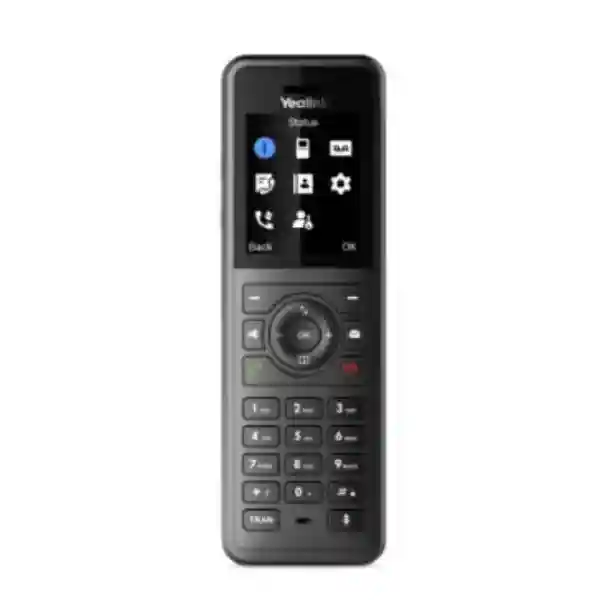
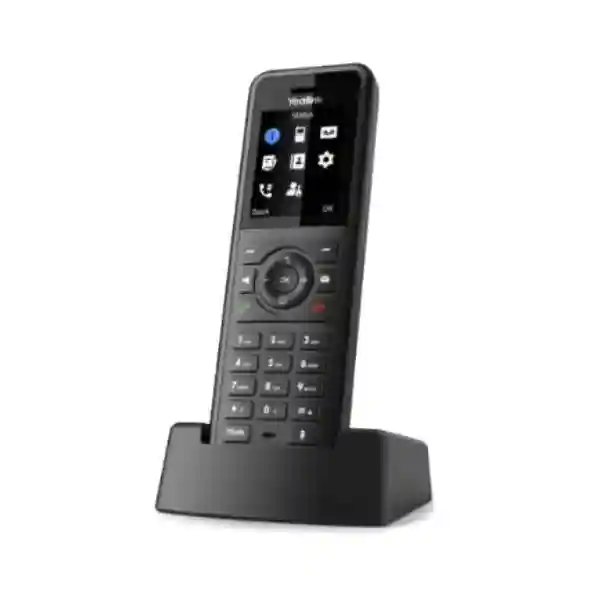
Yealink W77P Rugged DECT Phone System for Business Mobility
The Yealink W77P is a professional SIP cordless communication system combining the W70B DECT IP base station with the W57R rugged handset. It is designed for organizations whose staff must remain reachable while moving between work areas where ordinary desk phones are impractical. Warehouses, workshops, service counters, clinics, hotels, schools, production floors and distributed office environments can use the system to extend business telephony beyond fixed desks while retaining SIP calling, centralized configuration and enterprise security controls.
The W77P supports up to 10 compatible Yealink DECT handsets, up to 10 SIP accounts and up to 20 simultaneous calls at system level. The W57R handset adds IP54 protection, vibration alerting, HD audio and flexible noise reduction for challenging workplaces. The W70B connects to the LAN through a 10/100M Ethernet interface and supports IEEE 802.3af PoE Class 1. This architecture gives procurement teams a straightforward way to add cordless voice without treating every user location as a new cabling point.
For Uganda projects, FourTeck can assist with bill-of-materials validation, handset counts, SIP/PBX compatibility, coverage planning, repeaters, charging positions and staging requirements before dispatch. This is particularly useful where a buyer needs to determine whether one W70B cell is sufficient or whether a larger Yealink multi-cell design is more appropriate.
Instant Specifications & Procurement Fact Rail
W70B base + W57R rugged handset
Up to 10 handsets / 10 SIP accounts
Up to 20 simultaneous calls
1 × RJ45 10/100M Ethernet
IEEE 802.3af PoE Class 1 or adapter
Project quotation and regional support
A W77P purchase should be sized as a system rather than as a single cordless telephone. The base determines system capacity and LAN integration, while handset count, radio coverage, charging locations and PBX registration requirements determine the practical deployment. A standard package includes one W70B base and one W57R handset, with charger, battery, Ethernet cable and related package accessories. Additional compatible endpoints and RT30 repeaters should be quoted according to the actual floor plan and user count.
Operational Product Architecture & Overview
The W77P separates the IP network edge from the mobile user. The W70B base station terminates the Ethernet connection, registers SIP services and provides the DECT radio cell, while the W57R handset communicates wirelessly with that base. This design can reduce the need to run Ethernet to every mobile worker. It also allows an administrator to manage account registration and provisioning centrally rather than configuring isolated consumer cordless devices.
At the call-control layer, the platform supports SIP v1 and SIP v2, UDP, TCP and TLS transport, static or DHCP addressing, VLAN tagging, LLDP, 802.1X and STUN client functionality. The base can support outbound proxy backup, which is relevant when the connected telephony platform has resilient proxy arrangements. Media protection includes SRTP, while HTTPS, digest authentication and encrypted configuration files support safer administration and provisioning.
Capacity is a key differentiator. One W70B can register up to 10 supported Yealink DECT handsets or endpoints and up to 10 SIP accounts, with up to 20 simultaneous calls. Each handset can support up to two simultaneous calls. For many small and medium business sites, this allows a compact radio footprint to serve supervisors, warehouse personnel, technicians or hospitality staff without dedicating one base to every handset.
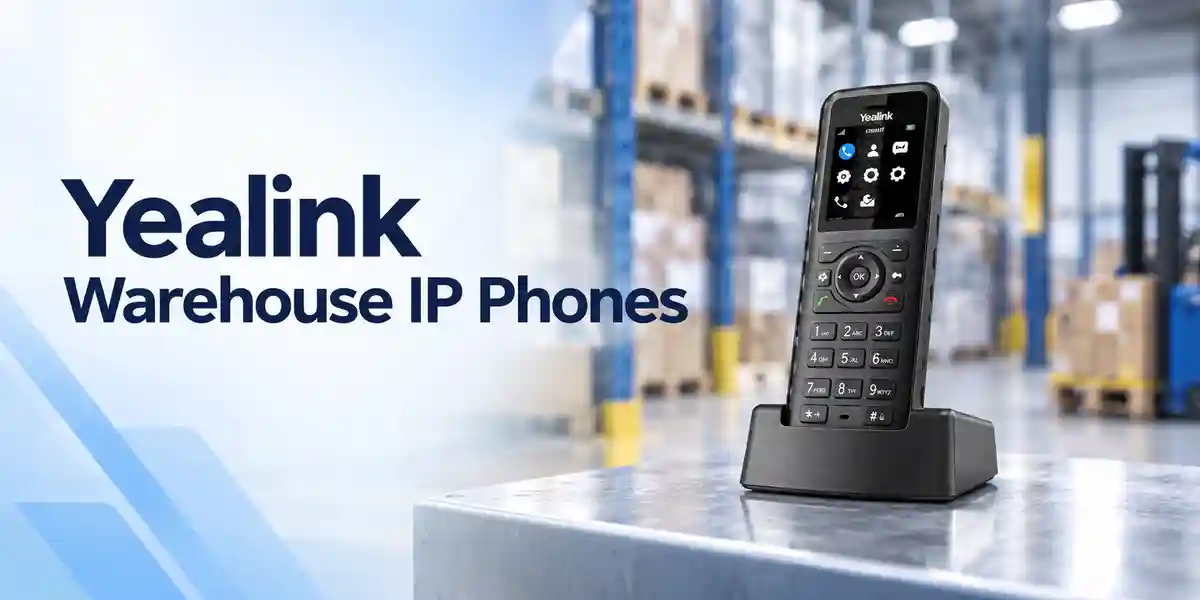
Radio design remains important. Yealink specifies maximum DECT coverage of up to 50 metres indoors and 300 metres outdoors under ideal conditions. Real buildings can reduce those distances through reinforced concrete, metal shelving, machinery, lift shafts, dense walls and electromagnetic interference. Up to six RT30 repeaters can be used per base station, but larger sites should be evaluated for multi-cell architecture rather than assuming repeaters will solve every coverage challenge.
The W57R is purpose-built for tougher handling than a conventional office handset. Its IP54 rating provides protection against dust ingress and water splashes, while its rugged housing is intended for demanding work. The handset includes vibration alerting for noisy environments and a dedicated alarm key. Audio capabilities include full-duplex speakerphone operation, G.722 wideband codec support, Flexible Noise Reduction and Noise Cancellation, plus common narrowband codecs for interoperability with business voice systems.
Battery capability depends on hardware revision. Earlier W57R versions are specified for up to 40 hours talk time and up to 575 hours standby under ideal conditions, while V4 specifications state up to 28 hours talk time and up to 320 hours standby. Quick charging can provide approximately two hours of talk time from ten minutes of charging. Buyers should therefore confirm the hardware revision supplied when battery endurance is a contractual requirement.
Enterprise Business Outcomes & Value Analysis
The financial value is often found in avoided complexity rather than simply handset price. A correctly designed cordless voice layer can reduce cabling changes, allow users to share radio infrastructure and provide consistent provisioning. TCO analysis should include base stations, handsets, repeaters, PoE capacity, chargers, replacement batteries, PBX licenses where applicable, staging effort and support arrangements. Buyers should also distinguish between Yealink device capacity and the concurrent-call or extension limits imposed by their SIP service or PBX.
Key Hardware & Software Highlights
W70B Base
10/100M Ethernet, IEEE 802.3af PoE Class 1, up to 10 SIP accounts, up to 20 simultaneous calls, LED status indicators and centralized network integration.
W57R Handset
1.8-inch 128 × 160 TFT display, IP54 rating, backlit keypad, vibration alarm, full-duplex speakerphone, belt clip and rugged mobile form factor.
Voice
G.722 wideband audio, optional AMR-WB, PCMU, PCMA, G.726, G.729/G.729A and iLBC, plus AEC, PLC, AGC and jitter-buffer functions.
Security
TLS, SRTP, HTTPS, OpenVPN, digest authentication, AES-protected configuration and SHA family support.
Provisioning
Web, handset and automated provisioning, RPS support, PnP and over-the-air handset upgrade mechanisms.
Directories
Local phonebook up to 1,000 entries stored in the base plus remote, LDAP and XML directory capabilities.
Technical Specifications Ledger
| Category | Specification |
|---|---|
| System capacity | Up to 10 handsets/endpoints, 10 SIP accounts, 20 simultaneous calls; up to 2 simultaneous calls per handset. |
| Repeater support | Up to 6 RT30 repeaters per W70B base. |
| Ethernet | 1 × RJ45 10/100M. |
| Power | IEEE 802.3af PoE Class 1; external adapter input AC 100–240 V, output DC 5 V/600 mA. |
| Display | 1.8-inch 128 × 160 pixel TFT colour screen. |
| Protection | W57R IP54 rugged handset. |
| Coverage | Up to 50 m indoors and 300 m outdoors under ideal conditions. |
| DECT band | 1880–1900 MHz Europe-region variant; 1920–1930 MHz US variant. Confirm regional SKU before ordering. |
| Handset size | 157 × 51 × 24 mm. |
| Base size | 130 × 100 × 25.1 mm. |
| Humidity | 10–95% operating humidity. |
| Handset temperature | 0 to 40°C operating. |
| Base temperature | -10 to +45°C operating. |
| Storage | -30 to 70°C. |
| Security | TLS, SRTP, HTTPS, OpenVPN, digest authentication, AES encrypted configuration. |
Specifications should be matched to the exact regional hardware revision and current firmware. In particular, battery figures vary between W57R revisions. Network and security feature availability may also depend on firmware, PBX support and deployment policy. Procurement documents should therefore identify the required region, firmware baseline and any mandatory interoperability criteria rather than relying only on the commercial model name.
Configuration & Sizing Worksheet
1. Estimate users and concurrent calls
Count the people who require a cordless extension and separately estimate peak simultaneous calls. The W70B ceiling is ten supported endpoints, ten SIP accounts and twenty simultaneous calls. If the user population exceeds that figure, do not simply add handsets; evaluate whether multiple independent bases or a Yealink multi-cell platform better matches roaming requirements.
2. Map the radio environment
Mark walls, floors, metal racks, cold rooms, machinery and outdoor zones. The published 50 m indoor and 300 m outdoor figures are ideal-condition maximums, not guaranteed design radii. A physical or predictive coverage assessment is preferable for warehouses and complex buildings.
3. Plan base power and LAN access
Choose a central W70B location with suitable Ethernet connectivity. If PoE is used, verify IEEE 802.3af availability and switch power budget. If an adapter is used, confirm a protected AC outlet and cable route. Keep the base away from obvious RF obstructions where practical.
4. Check PBX and SIP compatibility
Confirm SIP registration details, extension licensing, codecs, VLAN settings, provisioning method, certificate requirements and firewall/NAT design. Yealink DECT radio components are intended for the Yealink ecosystem; third-party DECT handsets or bases should not be assumed compatible.
5. Prepare the quote checklist
State W77P quantity, additional W57R handset quantity, RT30 repeater quantity if validated, spare batteries or chargers, PBX platform, delivery city, installation requirement, staging requirement, warranty expectation and any deadline. This produces a more useful quote than requesting only a unit price.
Deployment Scenarios & Industry Use Cases
Large Enterprise and Multi-Site Operations
A W77P can serve a department, branch, service area or operational zone where up to ten mobile endpoints fit the single-cell capacity. Enterprises with many branches can standardize handset profiles and provisioning practices while maintaining separate local radio cells. For larger continuous campuses where users must roam between cells, procurement teams should compare the single-cell W70B architecture with Yealink multi-cell platforms before finalizing the bill of materials.
Financial and Banking Environments
Back-office operations, facilities teams and controlled service areas may need mobile voice while preserving enterprise network controls. TLS, SRTP, HTTPS, 802.1X and VLAN support can contribute to a managed deployment, but these functions must be aligned with the institution’s own security architecture. Device security does not replace network segmentation, certificate governance, PBX hardening or access policy.
Education and Campus Facilities
Maintenance teams, stores, laboratories and administrative operations can use rugged cordless handsets where staff move between rooms. Coverage planning should account for reinforced structures and multiple floors. Schools and universities with broad campuses may require multi-cell designs rather than independent single-cell islands if seamless roaming is mandatory.
Government and Public-Sector Procurement
Public-sector buyers often require explicit model identification, compliance documents, warranty terms, delivery schedules and acceptance criteria. FourTeck can structure quotations around stated quantities and deployment requirements. Buyers should document the exact security, frequency, power and interoperability requirements applicable to their organization and jurisdiction.
Technical Deep Dive: Radio, Voice and Processing Architecture
The W77P uses DECT for the wireless link between handset and base and SIP for integration with IP telephony. This separation is valuable because voice mobility does not depend on the same Wi-Fi client behavior as a smartphone. The base provides the bridge between the Ethernet network and the DECT radio domain. Call capacity is designed around multiple concurrent sessions, with up to twenty simultaneous calls at the W70B system level and up to two simultaneous calls per handset.
Voice quality depends on codec negotiation, network latency, packet loss, radio conditions and endpoint acoustics. The platform supports G.722 wideband audio as well as common narrowband codecs, and includes acoustic echo cancellation, packet-loss concealment, automatic gain control and adaptive jitter buffering. Flexible Noise Reduction and Noise Cancellation are particularly relevant to industrial or service environments where background sound can interfere with conversations.
DECT range should never be treated as a guaranteed straight-line radius. Radio propagation is shaped by building materials, shelf density, door states, floor slabs and interference. The engineering objective is not maximum theoretical distance but stable call quality across the required work zone. Where one base cannot provide sufficient coverage, repeaters or a multi-cell system should be evaluated according to roaming, handover and capacity needs.
Technical Deep Dive: Software, Firmware Security & Operational Control
The W77P supports several enterprise provisioning methods, including TFTP, FTP, HTTP, HTTPS, Yealink RPS and plug-and-play mechanisms. This matters when deploying multiple systems because standardized templates can reduce configuration variance. Administrators can configure through the web interface, handset or automated provisioning process, and can export trace packages and system logs for troubleshooting.
Security capabilities include TLS for SIP signaling, SRTP for protected media, HTTPS for management, digest authentication, OpenVPN and encrypted configuration files. The practical security posture still depends on how these functions are configured. Organizations should disable unused services where policy allows, use strong administrator credentials, control provisioning endpoints, maintain firmware, segment voice traffic appropriately and validate certificates.
Over-the-air handset upgrade capability can reduce disruption during fleet maintenance. Yealink also describes a no-perception upgrade approach intended to reduce service interruption. For controlled environments, firmware changes should still follow change-management procedures, compatibility testing and rollback planning. A production rollout should not assume that the newest firmware is automatically appropriate for every PBX integration without validation.
Technical Deep Dive: Availability, Redundancy & Recovery
A single W70B is a single radio base for its registered users, so high-availability expectations need to be defined realistically. The system supports outbound proxy server backup, which can help when the SIP infrastructure presents resilient proxy services, but that does not make the physical base redundant. If the base loses power, Ethernet connectivity or hardware function, handsets registered only to that base can lose service.
Resilience planning therefore starts with infrastructure. Use reliable PoE switching or protected AC power, appropriate UPS capacity, resilient LAN design and redundant PBX/SIP services where required. Keep configuration backups and document handset registration. Organizations with critical voice operations may hold a spare base or handset according to internal recovery objectives.
For larger sites, resilience and roaming should be evaluated together. A multi-cell architecture may provide a more appropriate operational model than stretching one single-cell system with repeaters. The correct choice depends on floor area, user count, concurrent call demand, handover expectations and recovery requirements. FourTeck can use these parameters to help define a more defensible bill of materials before purchase.
Pre-Purchase Buyer Gap Checklist
Licensing: The handset and base do not by themselves grant PBX extensions, SIP trunks or hosted-voice subscriptions. Confirm whether your telephony platform charges per extension, concurrent call, feature or device. Hardware lifecycle: Record the exact W57R revision because published battery endurance differs between earlier revisions and V4. Physical placement: The base is compact, but radio placement matters more than rack space; it should be positioned for coverage rather than hidden inside a metal cabinet. Power: Confirm PoE Class 1 support or plan the supplied/approved adapter arrangement. Compatibility: SIP interoperability is broad, but Yealink states that its DECT technology is not compatible with third-party DECT base stations or handsets. Do not confuse SIP interoperability with DECT radio interoperability.
Coverage: Published indoor and outdoor distances are ideal-condition figures. A warehouse with steel racking can behave very differently from an open office. Repeaters: Up to six RT30 repeaters are supported per base, but repeaters should be engineered rather than automatically added. Security: Verify whether your PBX and provisioning service support the TLS/SRTP and certificate policies you require. Directories: If LDAP, XML or remote directories are mandatory, confirm schema and authentication details during staging. Charging: Decide where each handset will be charged and whether shift patterns justify spare batteries or chargers.
Accessories: Quote belt clips, chargers, repeaters and spare power components explicitly where needed. Regional radio variant: Ensure the supplied DECT frequency variant is appropriate for the destination. Environmental limits: IP54 does not mean waterproof or suitable for every hazardous environment. Review temperature, humidity, dust, liquid and impact conditions against site requirements. Support: Define who owns PBX configuration, LAN/VLAN setup, handset provisioning and post-installation troubleshooting. These responsibilities often span different teams and should be clear before deployment.
Uganda Procurement & Delivery Logistics
FourTeck Uganda can prepare project quotations for W77P systems based on quantity, destination and configuration scope. A useful request identifies the number of mobile users, expected call concurrency, PBX or hosted SIP platform, approximate coverage area and delivery location. This enables the quotation to include the correct balance of W77P starter systems, additional W57R handsets, RT30 repeaters where appropriate, charging accessories and technical services.
Order processing can include bill-of-materials verification before dispatch, particularly where multiple handset and accessory quantities are involved. Delivery timing depends on stock position, project quantity, import or transfer requirements and destination. For deployments with configuration support, staging details such as extension credentials, VLAN parameters, provisioning URLs and firmware requirements should be supplied through an agreed secure process.
For projects outside central Kampala, logistics planning should consider final-mile delivery and the availability of local technical staff. Where installation is required, site information should be shared early so radio coverage assumptions and network readiness can be reviewed before equipment arrives.
Uganda Coverage Matrix
Kampala: suitable for corporate offices, hotels, warehouses, retail operations and service facilities requiring mobile SIP voice. Entebbe: applicable to hospitality, logistics, administration and operational teams around commercial and institutional sites. Jinja: useful for industrial, education, warehousing and business deployments where staff move across defined work zones. Mbarara: supports regional offices, healthcare, education, hospitality and commercial operations. Gulu: can be specified for institutional, NGO, education, service and enterprise deployments requiring rugged cordless communication. Delivery and project support scope should be confirmed during quotation for each destination.
Cross-Border & Regional Supply
Organizations operating across East Africa and the Gulf can coordinate related procurement through FourTeck regional channels. Visit FourTeck Uganda, FourTeck Kenya, FourTeck Africa, FourTeck UAE and FourTeck Kuwait. Cross-border projects should identify the destination country for each unit because radio regulations, plug types, warranty routing, taxes, freight and lead times can differ. Standardizing the commercial model is useful, but regional SKU and compliance requirements should still be checked for each destination.
Related Yealink Solutions
A W77P deployment often forms part of a wider voice environment. Explore Yealink solutions in Uganda for desk phones, conference endpoints and complementary communications hardware. Buyers planning larger cordless footprints should compare single-cell DECT with multi-cell Yealink options. Office users who do not require rugged mobility may be better served by fixed SIP desk phones, while warehouse or maintenance teams can benefit from rugged handsets. Contact FourTeck for compatible DECT endpoints, RT30 repeater options, PoE switching, SIP phones, headsets and network accessories appropriate to the final design.
FourTeck Technical Service Capabilities
Technical procurement support can begin before the purchase order. FourTeck can review user counts, call concurrency, site layout, PBX platform and network readiness to help validate the proposed bill of materials. For multi-unit deployments, staging can include agreed firmware checks, baseline configuration and labeling requirements. Pre-shipment review helps reduce common errors such as ordering too few handsets, assuming unsupported third-party DECT interoperability or overlooking PoE and coverage requirements.
Post-sales support can focus on device configuration, registration troubleshooting, firmware guidance and coordination around warranty processing subject to the supplied product and service terms. Complex PBX, firewall, switching or structured-cabling work may require a defined project scope. The goal is to make responsibilities explicit so the customer knows which elements are device configuration and which belong to the wider voice or network environment.
Extended Technical FAQ
How many handsets can the Yealink W77P support?
The W70B base supplied with the W77P can register up to ten supported Yealink DECT handsets or endpoints and up to ten SIP accounts. The system supports up to twenty simultaneous calls, with up to two simultaneous calls per handset. These are device-side maximums; the connected PBX, SIP trunk or hosted service may impose lower limits. A buyer should therefore check both W70B capacity and the telephony service entitlement before deciding how many users to place on one system.
Is the W57R waterproof?
The W57R carries an IP54 protection rating. That means it is designed to resist limited dust ingress and water splashes, but it should not be treated as waterproof or suitable for immersion. IP54 is useful for many warehouses, workshops and service environments, yet the actual site may have chemicals, heavy wash-down, extreme dust or hazardous-area requirements that need a different device class. Procurement teams should compare the environmental specification with the real operating conditions before purchase.
What range should I expect?
Yealink specifies maximum DECT radio coverage of up to 50 metres indoors and 300 metres outdoors under ideal conditions. Actual coverage can be substantially lower because of reinforced concrete, metal racks, machinery, multiple floors and other obstacles. Treat these figures as planning references rather than guarantees. For operational sites, map the required calling zones and test coverage where possible. The W70B supports up to six RT30 repeaters, while larger roaming environments may justify a Yealink multi-cell design.
Does W77P work with third-party DECT handsets?
Buyers should not assume that it does. Yealink states that its DECT technology is focused on its own high-quality voice and data applications and is not compatible with third-party DECT base stations or handsets. This is separate from SIP interoperability: the W70B can integrate with SIP-based telephony platforms, but the radio-side endpoint ecosystem remains a compatibility consideration. If you have existing cordless handsets, provide their exact models before ordering so the migration plan can be assessed.
Does the W70B support PoE?
Yes. The W70B includes one 10/100M RJ45 Ethernet interface and supports IEEE 802.3af PoE Class 1. This can simplify installation because the network cable can provide both connectivity and power when connected to a compatible PoE switch or injector. An external power adapter specification is also available. For business deployments, verify switch PoE budget, UPS protection and VLAN configuration before mounting the base, especially if voice availability is expected during short utility interruptions.
What security features are available?
The W77P platform supports TLS, SRTP, HTTPS, digest authentication, OpenVPN, AES-encrypted configuration files and SHA-family mechanisms, along with 802.1X network access capability. Security depends on configuration and on support from the PBX, provisioning server and network. A secure rollout should use strong administrator credentials, protected provisioning, current validated firmware, appropriate VLAN policy and controlled management access. Device capabilities should be integrated into the organization’s broader voice-security standard rather than considered a standalone security solution.
What battery life does the W57R provide?
Battery endurance depends on the handset hardware revision. Yealink documentation lists W57R V0–V3 at up to 40 hours of talk time and up to 575 hours standby under ideal conditions. W57R V4 documentation lists up to 28 hours talk time and up to 320 hours standby. Quick charging can provide about two hours of talk time from ten minutes of charging. If a tender or shift plan depends on a specific endurance figure, request confirmation of the supplied hardware revision.
Can the W77P be centrally provisioned?
Yes. Provisioning options include TFTP, FTP, HTTP, HTTPS, Yealink RPS and plug-and-play mechanisms, and configuration can also be performed through web or handset interfaces. This makes the platform suitable for repeatable business deployments where multiple bases need consistent settings. The correct method depends on the customer’s PBX and device-management process. For larger rollouts, create and test a standard configuration template before mass deployment and keep credentials and provisioning URLs protected.
What should be included in a quotation request?
Provide the number of cordless users, PBX or SIP service, site type, approximate floor area, number of floors, expected simultaneous calls and delivery city. Mention whether the site has PoE switching, whether roaming across a large building is required and whether configuration support is needed. Also identify any requirement for additional W57R handsets, RT30 repeaters, spare batteries, chargers or staging. These details allow the quote to address the complete deployment rather than only the starter package.
How are warranty and replacement issues handled?
Warranty processing depends on the supplied unit, applicable manufacturer or distributor terms, region and the nature of the fault. Keep serial numbers, purchase documentation and a clear fault description. Before replacement, support may request basic diagnostics such as firmware version, registration status, logs, power checks or a factory-reset test where appropriate. Physical damage, liquid exposure beyond the rated protection or unsupported accessories may be treated differently from a manufacturing fault. Confirm the warranty baseline and service route on the project quotation.
Request a Yealink W77P Uganda Project Quote
Send FourTeck your handset quantity, delivery location, PBX platform and approximate coverage area. We can help validate whether a single W77P system, additional W57R handsets, RT30 repeaters or a larger DECT architecture is the appropriate fit. Include any staging, firmware, VLAN, SIP registration or installation requirements so the quotation reflects the complete project scope rather than only hardware.

Reviews
There are no reviews yet.