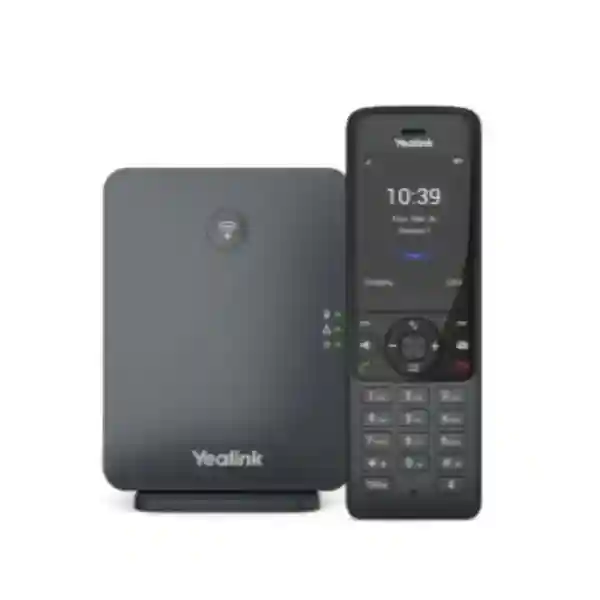
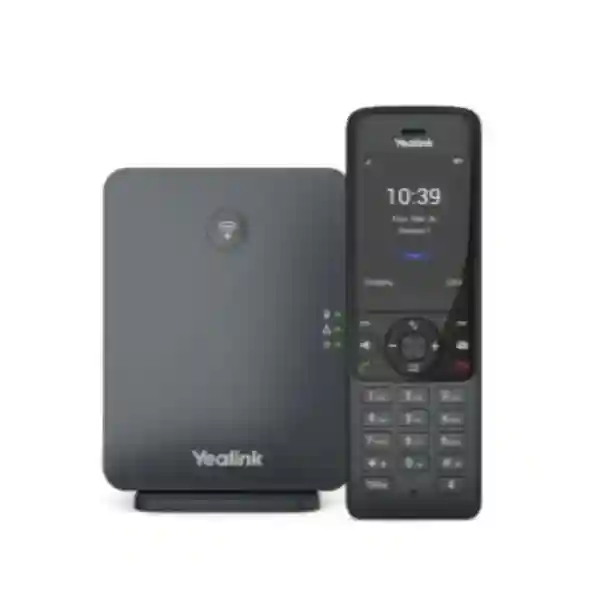
Yealink W78P DECT Phone System for Business Voice Mobility
The Yealink W78P is a business cordless SIP communications platform built around the W70B DECT IP base station and W78H professional handset. It gives teams the freedom to move through offices, workshops, reception areas, warehouses and service environments while remaining connected to an IP telephony platform. Rather than treating cordless calling as an isolated consumer-phone function, the W78P integrates SIP accounts, enterprise call handling, secure network transport, centralized provisioning and DECT radio mobility into one manageable system. A single W70B supports up to 10 compatible DECT handsets, up to 10 SIP accounts and as many as 20 simultaneous calls, with a maximum of two simultaneous calls per handset. This makes the system particularly practical for small and medium organizations that need several mobile users but want to avoid deploying a separate base station for every handset.
For procurement teams, the central question is not simply whether the phone is cordless. The more important issues are whether radio coverage suits the building, whether the existing PBX or hosted SIP service can provision the required accounts, whether the LAN provides suitable Ethernet and PoE connectivity, and whether handset quantities can grow within the capacity of the base. The W78P addresses these requirements with 10/100 Ethernet, IEEE 802.3af Class 1 PoE support on the base, configurable SIP networking, encrypted signaling and media options, and compatibility with a broad Yealink DECT endpoint ecosystem. The W78H handset provides a 2.4-inch 240 x 320 colour screen, noise cancellation, full-duplex speakerphone, Bluetooth headset support, 3.5 mm headset connectivity, vibration alert and quick charging.
Coverage is specified at up to 50 metres indoors and 300 metres outdoors in ideal conditions. Actual performance depends on walls, reinforced concrete, metal shelving, interference and building geometry, so a site assessment remains important for larger or difficult premises. Up to six RT30 repeaters can be associated with the base where compatible extension is appropriate. Organizations planning broader roaming across large campuses should also evaluate Yealink multi-cell architecture rather than assuming repeaters are the right design for every site.
Instant Specifications & Procurement Fact Rail
W70B base + W78H handset
10 handsets / 10 SIP accounts
Up to 20 system-wide
1 x RJ45 10/100M Ethernet
IEEE 802.3af PoE Class 1 or adapter
Contact FourTeck Uganda for current supply and warranty terms
The W78P should be specified as a system rather than only as a handset. The standard package includes the W70B base station and W78H handset, together with charging and installation accessories. When preparing a purchase request, distinguish complete W78P kits from additional W78H handsets because expansion handsets do not require a new base until system capacity or coverage design requires another architecture. Confirm the regional DECT frequency version before ordering, because Yealink publishes different frequency bands for different markets. For Uganda deployments, the supplied regional version and local regulatory suitability should be confirmed on the commercial quotation. Warranty duration, lead time and stock status should likewise be confirmed at order stage rather than assumed from a generic international listing.
Operational Product Architecture & Overview
The architecture separates IP network connectivity from user mobility. The W70B acts as the bridge between the Ethernet/SIP environment and the DECT radio domain. SIP registration, call routing interaction and network services are handled through the base, while paired W78H handsets communicate wirelessly over DECT. This topology reduces the number of wired endpoints required for mobile personnel and allows several handsets to share one strategically positioned network-connected base. It is well suited to organizations where employees move between desks, stock rooms, counters, corridors or operational zones during a call.
At the voice layer, the system supports wideband G.722 and optional AMR-WB alongside established narrowband codecs including PCMU, PCMA, G.726, G.729, G.729A and iLBC. Voice processing functions include acoustic echo cancellation, packet-loss concealment, adaptive jitter buffering, voice activity detection, comfort-noise generation and automatic gain control. These functions matter when the handset is deployed on real business networks where bandwidth, jitter and ambient noise can vary. The W78H also includes Flexible Noise Reduction/Noise Cancellation to improve intelligibility in busy environments.
The base supports SIP v1 and v2, static or DHCP addressing, VLAN tagging and priority through 802.1Q/802.1P, LLDP, 802.1X, STUN for NAT traversal, and UDP, TCP or TLS transport. Outbound proxy backup can support designs where the telephony provider offers redundant proxy infrastructure. Security capabilities include TLS, SRTP, HTTPS, digest authentication, encrypted configuration files, OpenVPN and modern SHA hash options. These capabilities do not automatically make every deployment secure; administrators must configure the PBX, certificates, credentials, VLANs and provisioning process appropriately.
Provisioning is designed for both individual installation and fleet deployment. Administrators can configure through a browser, handset or automated provisioning, with TFTP, FTP, HTTP, HTTPS, Plug and Play and Yealink RPS mechanisms supported. Handset firmware can be updated over the air. This reduces the operational burden when several cordless users need consistent configuration. Directory support includes a local base-stored phonebook, remote phonebook, LDAP and XML options, allowing organizations to align handset contact access with the capabilities of their communications platform.
The common procurement pain point is radio planning. Published ideal range figures are useful for initial sizing but cannot predict every building. Dense masonry, elevator shafts, server-room shielding, metal racks and long corridors can change propagation significantly. A good deployment therefore positions the base centrally relative to expected movement, keeps it away from major sources of interference and validates coverage before committing to a large handset count. Repeaters can extend a single-cell design, but very large premises or roaming requirements across multiple radio cells may justify a Yealink multi-cell system.
Enterprise Business Outcomes & Value Analysis
Up to 20 simultaneous system calls and two simultaneous calls per handset give a properly sized small or medium business meaningful concurrency without dedicating a wired phone to every mobile worker. Capacity should be compared with real peak call patterns, not merely employee count.
DECT provides a purpose-built cordless voice layer independent of office Wi-Fi client traffic. Outbound proxy backup, configurable transport, established voice codecs and local call functions help administrators build predictable communications, subject to PBX and network design.
A base can register up to 10 handsets, allowing an organization to begin with a W78P kit and add compatible endpoints as staffing grows. Up to six RT30 repeaters provide an option for extending suitable single-cell environments.
TLS, SRTP, HTTPS, 802.1X, digest authentication, encrypted configuration files and role-based configuration modes give administrators tools for protecting signaling, media and management. Security results depend on compatible server settings and disciplined credential management.
Automated provisioning, RPS support, browser configuration, logs and over-the-air handset updates can reduce repetitive configuration effort across multiple units. Standard templates can help keep account, codec, directory and network settings consistent.
A shared base reduces the need for a network cable and switch port at every mobile user’s working position. PoE can consolidate base power onto the LAN infrastructure, while ECO modes are designed to reduce unnecessary energy use.
Key Hardware & Software Highlights
W70B Base Station
The network anchor provides one 10/100M RJ45 Ethernet interface and IEEE 802.3af Class 1 PoE. It handles registrations for up to 10 SIP accounts and up to 10 compatible handsets, while supporting up to 20 simultaneous calls.
W78H Handset
A compact cordless handset with a 2.4-inch 240 x 320 TFT colour display, full-duplex speakerphone, vibration alert, illuminated keypad and belt clip. Bluetooth and a 3.5 mm jack allow headset selection for hands-free work.
Voice Processing
Noise cancellation, G.722 wideband voice, echo cancellation, jitter buffering and packet-loss concealment help maintain clear conversations across varying acoustic and network conditions.
Business Call Control
Hold, transfer, three-way conference, call waiting, forwarding, DND, caller identification, voicemail indication, paging, intercom and speed dial support common office calling workflows.
Directories
Local phonebook storage, remote phonebook, LDAP and XML directory options make the system adaptable to different PBX and organizational contact-directory strategies.
Provisioning
Browser configuration, automatic provisioning, RPS, PnP and OTA handset updates simplify repeatable deployment and maintenance where administrators manage several endpoints.
Technical Specifications Ledger
| Category | Specification | Procurement Relevance |
|---|---|---|
| System capacity | Up to 10 handsets, 10 SIP accounts, 20 simultaneous calls; up to 2 calls per handset | Size against peak concurrent calls and mobile-user count. |
| Repeaters | Up to 6 RT30 repeaters per base | Useful where a validated single-cell extension is appropriate. |
| Ethernet | 1 x RJ45 10/100M | Requires one LAN switch connection for the base. |
| PoE | IEEE 802.3af, Class 1 | Can simplify power and UPS-backed installation. |
| Display | 2.4-inch, 240 x 320 TFT colour | Provides clear handset navigation and caller information. |
| Headsets | Bluetooth 5.1 and 3.5 mm jack | Supports wireless or wired headset workflows. |
| Range | Up to 50 m indoors / 300 m outdoors in ideal conditions | Actual coverage requires site validation. |
| Talk time | Up to 21 hours in ideal conditions | Supports long working shifts subject to battery condition and usage. |
| Quick charge | 10 minutes charging for up to 2 hours talk time | Helps recover from an unexpectedly low battery. |
| Voice codecs | G.722, optional AMR-WB; PCMU, PCMA, G.726, G.729/G.729A, iLBC | Confirm codec policy with the PBX/provider. |
| Network | SIP v1/v2, VLAN, LLDP, 802.1X, STUN, DHCP/static, UDP/TCP/TLS | Supports common managed voice-network designs. |
| Security | TLS, SRTP, HTTPS, OpenVPN, digest authentication, AES-encrypted configuration | Coordinate with PBX certificates and security policy. |
| Base temperature | -10 to +45°C operating | Keep within manufacturer environmental limits. |
| Handset temperature | 0 to 40°C operating | Important for warehouses and non-air-conditioned spaces. |
| Humidity | 10–95% | Deployment must remain within published limits. |
DECT frequency varies by regional product version. Yealink publishes 1880–1900 MHz for Europe and 1920–1930 MHz for the United States, with other variants documented for selected markets. Procurement teams should therefore request the correct region-specific unit rather than importing an arbitrary frequency version. Battery standby specifications can also vary by W78H hardware revision; the current Yealink documentation lists up to 21 hours talk time, while later handset revisions can provide substantially longer ideal standby time than early revisions. Commercial quotations should identify the actual supplied revision where this detail is operationally important.
Configuration & Sizing Worksheet
1. Estimate Users and Concurrent Calls
Count personnel who genuinely require cordless mobility, then estimate peak simultaneous calls. A W70B supports up to 10 registered handsets and 20 simultaneous calls, but each handset supports up to two simultaneous calls. If the project exceeds these limits, do not simply add handsets to the bill of materials; redesign the deployment using additional or multi-cell infrastructure appropriate to the site.
2. Map the Radio Environment
Mark expected walking paths, call-critical rooms, stairwells, loading areas and outdoor zones. Note concrete walls, metal partitions and shelving. The ideal 50 m indoor figure is not a guarantee through every obstruction. Position the base so the highest-priority work zones receive strong coverage and validate before final acceptance.
3. Confirm Network and Power
Reserve a switch port and voice VLAN where required. The base has a 10/100M Ethernet interface and can receive IEEE 802.3af Class 1 PoE. If PoE is used, verify switch PoE budget and UPS strategy. If adapter power is used, ensure a suitable outlet and power protection are available near the selected base location.
4. Validate SIP/PBX Compatibility
Record the PBX or hosted voice platform, SIP registrar, authentication model, transport protocol, codecs, VLAN settings, directory integration and certificate requirements. The W78P is standards-based, but individual provider features and provisioning templates differ. Features such as shared call appearance, directories and server-based music on hold depend on compatible server implementation.
5. Plan Headsets and Accessories
Decide whether users require Bluetooth headsets, wired 3.5 mm headsets, belt clips, additional charging cradles or repeaters. Headset choice should consider wearing style, shift duration and acoustic environment. For extended coverage, document exactly where repeaters would be placed and how the resulting radio path will be tested.
6. Prepare the Quote
Provide the number of complete W78P kits, extra W78H handsets, repeater requirements, PBX platform, preferred headset options, delivery city and any pre-configuration requirement. Ask the supplier to confirm regional DECT version, warranty baseline, current lead time, included accessories and whether configuration services are included or quoted separately.
Deployment Scenarios & Industry Use Cases
Multi-Site Enterprises
A distributed organization can standardize W78P systems at smaller branches where each site requires no more than the supported handset and concurrency capacity. Central administrators can maintain common provisioning rules while each branch retains local DECT coverage. This is especially useful for reception, facilities, stock control and support personnel who move around a branch during calls. Larger headquarters should be assessed separately for multi-cell architecture.
Financial and Banking Environments
Branches can use cordless handsets for operational roles that require controlled movement away from a fixed desk. Network teams can place the base on a managed voice VLAN and use supported encrypted signaling and media where compatible with the call platform. Procurement should align device deployment with internal security standards, certificate management and physical handset-control procedures.
Education and Campus Departments
Administrative offices, libraries, maintenance teams and smaller departmental buildings can benefit from cordless voice access. A campus is not automatically a single-cell use case: separate buildings, outdoor paths and thick structural materials may require a more sophisticated radio design. The W78H can also participate in compatible Yealink multi-cell environments, providing an upgrade path for organizations whose mobility requirements grow.
Government and Institutional Procurement
Public-sector projects often require clear bills of materials, documented interfaces, regional product conformity and predictable support arrangements. The W78P’s defined SIP, network, security and provisioning capabilities can be mapped against a technical schedule. Buyers should request formal confirmation of warranty, regional frequency, firmware baseline, included accessories and delivery terms as part of tender evaluation.
Retail, Warehouse and Service Operations
Supervisors and service personnel can remain reachable while moving between counters, back offices and storage areas. Vibration alert can be useful where audible ringing may be missed. Warehouses with tall metal racking require careful radio testing because reflective and obstructive materials can produce coverage patterns that differ substantially from an open office.
Technical Deep Dive: Processing, Voice & Radio Architecture
The W78P is designed around separation of functions. Ethernet terminates at the W70B, which communicates with the SIP infrastructure and serves the associated DECT endpoints. This arrangement means mobile handsets do not contend as ordinary Wi-Fi clients for voice access. The base can maintain up to 10 SIP accounts and coordinate up to 20 simultaneous calls, while each handset handles up to two simultaneous calls. This architecture is efficient for organizations where many mobile users share a compact physical area.
Voice quality is not based on one feature alone. Wideband G.722 can provide richer speech when the PBX and remote path support it, while narrowband codecs maintain compatibility with established SIP services. Acoustic echo cancellation is important for speakerphone operation; jitter buffering and packet-loss concealment address imperfections on the IP side; noise reduction addresses the acoustic side. The W78H’s full-duplex speakerphone and receiver controls give users several ways to adapt calls to their environment.
Radio capacity and radio coverage must be treated separately. A base may have sufficient account capacity while a building still has dead zones. Conversely, a small office may have excellent coverage but exceed the base’s handset capacity if too many users are assigned. A sound design checks both dimensions. Repeaters are a coverage tool, not a method of increasing the base’s registered handset or SIP-account limits.
Technical Deep Dive: Firmware Security & Operational Control
The system provides controls that fit managed enterprise networks: TLS for SIP transport, SRTP for encrypted media, HTTPS for management, digest authentication, encrypted configuration files and 802.1X network access control. These mechanisms are building blocks. For example, selecting TLS on the handset is useful only when the SIP server is configured to accept and correctly authenticate secure transport. Similarly, SRTP requires compatible media policy across the call path.
Provisioning can be automated through supported protocols and Yealink’s redirection service. This matters operationally because manually typing credentials into every handset is slow and increases configuration inconsistency. A controlled provisioning server can distribute account, network, directory and feature settings from standardized templates. Administrators should protect provisioning credentials and configuration files, restrict management access and maintain a tested firmware lifecycle.
Over-the-air handset upgrades allow endpoint firmware maintenance without physically connecting each handset to a computer. Before fleet-wide updates, organizations should test firmware against their PBX features and any specialized call flows. Configuration exports, logs and change records should form part of normal operational documentation, especially in regulated environments.
Technical Deep Dive: Availability, Redundancy & Recovery
A single W70B remains a single radio and network termination point for its associated handsets, so continuity planning should reflect that fact. PoE from a UPS-backed switch can keep the base powered during short utility interruptions, while resilient LAN switching and redundant SIP services can protect upstream communications. The device supports outbound proxy server backup where the telephony design provides it.
For organizations where voice is operationally critical, maintain configuration backups and document replacement procedures. A spare base or handset strategy may reduce recovery time, but replacement devices still need correct regional compatibility, firmware and provisioning. The system’s automatic provisioning features can accelerate restoration when templates are maintained properly.
Large facilities should not confuse repeater coverage with full infrastructure redundancy. Repeaters extend compatible radio coverage but do not transform one base into a redundant multi-cell core. Sites requiring seamless large-area mobility and higher resilience should evaluate Yealink W80/W90 multi-cell designs and map availability requirements to the appropriate architecture.
Pre-Purchase Buyer Gap Checklist
Licensing: The handset and base do not eliminate any licensing that your PBX or hosted SIP provider requires. Confirm extension, user, SIP trunk, call-recording and advanced-feature subscriptions separately. The exact commercial licensing model belongs to the communications platform, not the DECT handset itself.
Third-party DECT: Do not assume a generic DECT handset will pair with the Yealink base. Yealink explicitly notes that its DECT technology is not compatible with third-party DECT devices. Specify supported Yealink endpoints when expanding the system.
Coverage: Published range is measured under ideal conditions. Ask for a coverage review when the site has reinforced concrete, metal storage systems, several floors or outdoor transition zones. Buying repeaters before understanding the radio problem can create an unnecessarily complicated deployment.
Battery revision: Yealink documentation lists different standby performance across W78H hardware revisions while maintaining up to 21 hours of ideal talk time. If very long standby is a contractual requirement, request confirmation of the supplied hardware revision.
Frequency region: DECT frequencies differ internationally. The correct regional variant should be confirmed for Uganda supply and regulatory use. Avoid informal cross-region imports merely because the model name appears identical.
PBX features: SIP registration alone does not guarantee every vendor-specific telephony feature. Confirm shared-line behavior, corporate directories, call recording, BLF-related workflows and provider-specific provisioning with the intended platform.
Power: The base supports PoE, while the handset charger uses its own power arrangement. Plan both elements. In sites with generator or UPS-backed communications, include the switch and charging points in the resilience assessment.
Expansion path: Ten handsets is the single-base registration ceiling. If staffing is likely to exceed that number or if roaming must cover a large campus, compare a multi-cell system at the design stage instead of creating an overextended single-cell installation.
Uganda Procurement & Delivery Logistics
FourTeck Uganda can prepare a commercial quotation around the complete deployment rather than only the headline device. For the fastest bill-of-materials validation, provide the number of cordless users, expected concurrent calls, PBX or hosted SIP platform, delivery location, PoE availability, approximate building layout and any headset or repeater requirement. This allows the quotation to distinguish complete W78P kits from additional W78H handsets and supporting accessories.
Before order confirmation, buyers should request current stock or lead time, warranty terms, regional DECT version and exact package contents. Where pre-configuration is required, provide extension data and network parameters through an agreed secure process. Configuration scope can include firmware baseline checks, account templates, VLAN parameters, codec policy and directory settings where sufficient platform information is available.
Delivery timing varies with stock position, order quantity, project staging and destination. A formal quotation is therefore the correct source for current commercial commitments. For projects with phased branch rollouts, consider staging equipment in logical batches and maintaining a consistent configuration template so later locations can be deployed with the same documented baseline.
Local Coverage Matrix
Kampala: suitable for corporate offices, retail operations, hospitality administration and service businesses requiring mobile SIP extensions. Entebbe: deployments can support offices, logistics and service teams where cordless movement is needed within defined premises. Jinja: commercial and industrial sites can evaluate W78P for supervisors, stores and administrative teams. Mbarara: branch offices, institutions and service operations can standardize cordless communications around a managed SIP platform. Gulu: organizations can procure systems for branch and institutional deployments, with project quantities and delivery arrangements confirmed on quotation. In every city, building construction and network design matter more than a generic distance claim, so coverage should be validated against the actual site.
Cross-Border & Regional Supply
Organizations operating across East Africa, the Gulf and wider African markets can coordinate model standardization while still respecting country-specific DECT frequency, commercial and warranty requirements. For Uganda visit FourTeck Uganda; for Kenyan requirements visit FourTeck Kenya; broader regional projects can reference FourTeck Africa. UAE procurement can be coordinated through FourTeck UAE, while Kuwait requirements can use FourTeck Kuwait.
For multinational rollouts, keep a country-by-country bill of materials rather than assuming one regional radio version, power accessory or warranty process fits every destination. Standardize configuration templates where possible, but verify local SIP-provider parameters, import requirements, power standards and support routing before shipment. This reduces the risk of deploying technically similar but regionally unsuitable hardware.
Related Yealink Products & Expansion Options
The W78P belongs within a wider Yealink business communications portfolio. Buyers comparing cordless architectures can browse Yealink DECT solutions and evaluate W70B base station options or W78H expansion handsets. Sites needing wider radio coverage can review RT30 repeater options. Larger environments should compare Yealink W80 multi-cell systems and Yealink W90 multi-cell systems. For users who remain desk-based, Yealink IP desk phones may provide a more suitable endpoint. Headset-dependent teams can also review Yealink business headsets.
FourTeck Technical Service Capabilities
A successful cordless voice project depends on more than shipping boxes. FourTeck can assist with engineering validation of the proposed handset count, base placement assumptions, PBX environment and accessory requirements. Bill-of-materials review helps identify whether the request contains the right balance of complete kits, additional handsets, repeaters, headsets and network power components.
For staged projects, equipment can be checked against an agreed firmware baseline before shipment and configuration parameters can be prepared where the customer supplies the required SIP and network information. This reduces onsite repetitive work and creates a clearer handover baseline. Where firmware updates are appropriate, they should be tested against the customer’s telephony environment before broad deployment.
Post-sales assistance can cover device configuration, registration troubleshooting, network parameter review and warranty coordination according to the purchased support and warranty terms. Customers should retain device serial records, configuration backups and deployment documentation so replacement or expansion work can be completed efficiently.
Extended Technical FAQ
How many handsets can the Yealink W78P support?
The W70B base supplied as part of the W78P supports registration of up to 10 compatible Yealink DECT handsets or supported endpoints. The system also supports up to 10 SIP accounts and up to 20 simultaneous calls, with up to two simultaneous calls per handset. These limits should be considered separately: a project might stay below 10 users but still have unusual concurrency requirements, or it might need more than 10 mobile users even when call volume is low. If the design exceeds the single-base limits, assess a multi-cell architecture instead of trying to overpopulate one W70B.
What is the practical wireless range?
Yealink specifies a maximum range of up to 50 metres indoors and 300 metres outdoors under ideal conditions. Real buildings can produce shorter or irregular coverage because concrete, metal, glazing, shelving, equipment rooms and interference affect radio propagation. Treat the published figures as planning references rather than guaranteed wall-to-wall distances. For an office with several floors, a warehouse with metal racks or a compound with separated structures, map the required call areas and validate coverage. Up to six RT30 repeaters can be used per base where a repeater-based single-cell extension is appropriate.
Does the W78P work with third-party DECT handsets?
Procurement should not assume so. Yealink states that its DECT technology is incompatible with third-party DECT devices such as other manufacturers’ base stations and handsets. Use supported Yealink DECT endpoints when building or expanding the solution. The W70B supports a range of Yealink handsets, headsets and selected DECT devices, but the exact endpoint compatibility list can change with firmware and product lifecycle. Confirm the planned handset or headset model against current Yealink compatibility documentation before placing a mixed-endpoint order.
Can the base be powered by PoE?
Yes. The W70B provides one 10/100M Ethernet port and supports IEEE 802.3af Class 1 Power over Ethernet. PoE can simplify installation because the base can receive network connectivity and operating power through the same Ethernet run, and a UPS-backed PoE switch can improve resilience during short power interruptions. The handset charging cradle remains a separate consideration, so user charging locations still need suitable power. When planning multiple bases, check the PoE switch’s total power budget and reserve the required switch ports and voice VLAN configuration.
Which security functions are available?
The W78P platform supports TLS, SRTP, HTTPS, digest authentication, OpenVPN, AES-encrypted configuration files and SHA256/SHA384/SHA512 options, along with 802.1X at the network layer. These functions provide tools for securing signaling, media, provisioning and access, but they must be configured with compatible server infrastructure. A secure deployment should also use strong SIP credentials, protected provisioning services, restricted management access, current tested firmware and appropriate network segmentation. Security policy should be validated end-to-end with the PBX or hosted voice provider rather than evaluated only from the handset feature list.
Does the W78P require a separate Yealink license?
The physical W78P system should be distinguished from the licensing model of the PBX or hosted communications service. SIP extensions, trunks, call recording, contact-center functions or other advanced services may require licenses or subscriptions from the voice-platform provider. Those charges are not determined simply by purchasing a W78P. Before ordering, list the required users and features and ask the PBX administrator or service provider to confirm the necessary entitlements. This avoids a common procurement gap where endpoints arrive before sufficient server-side user licenses have been assigned.
Can the W78H use Bluetooth headsets?
Yes. The W78H includes Bluetooth 5.1 and also provides a 3.5 mm headset jack, giving users wireless and wired headset options. This is useful for supervisors, service staff and mobile office users who need their hands free while remaining reachable. Headset compatibility and feature behavior should still be checked for the exact headset model, especially where call-control buttons, range or long-shift battery life are important. Yealink highlights compatibility with selected Yealink Bluetooth headsets, and FourTeck can help align headset quantities with the handset bill of materials.
How long does the handset battery last?
Yealink specifies up to 21 hours of talk time in ideal conditions. Standby duration differs by W78H hardware revision: early documentation lists up to 166 hours for the V0 battery configuration, while later revisions can be specified at up to 320 hours under ideal conditions. The handset also supports quick charging, with 10 minutes of charging providing up to two hours of talk time under stated conditions. Actual endurance varies with battery age, radio conditions, display use, call patterns and Bluetooth use, so organizations with long shifts should establish a charging routine rather than relying only on maximum laboratory figures.
Can FourTeck pre-configure the W78P?
Pre-configuration can be scoped when the customer provides the necessary PBX, SIP and network parameters through an agreed secure process. Typical preparation may include firmware-baseline validation, SIP account templates, VLAN settings, transport selection, codec preferences and directory parameters. Exact work depends on the communications platform and project support scope. For larger rollouts, automated provisioning is generally preferable to manually configuring every handset because it improves consistency and makes future replacement easier. Customers should maintain authoritative configuration records and avoid sending live credentials through insecure channels.
What information is needed for warranty or replacement processing?
Keep the purchase record, device model, serial number, deployment date and a concise description of the fault. Before requesting replacement, basic diagnostics may include confirming power, Ethernet link, registration state, firmware version and whether the issue follows the handset, base or network environment. Warranty duration and replacement procedure depend on the commercial terms supplied with the order, so buyers should confirm these details on the quotation. Maintaining serial-number records by site is especially valuable for multi-branch projects because it allows support teams to identify the affected unit quickly.
Plan Your Yealink W78P Deployment in Uganda
For an accurate procurement proposal, send FourTeck the number of cordless users, expected concurrent calls, PBX or SIP-provider name, delivery location and a simple description of the building. Include whether the LAN provides PoE and whether users require Bluetooth headsets, repeaters or additional W78H handsets. The project can then be checked against single-base capacity, coverage assumptions, network requirements and regional product suitability before commercial confirmation.
A well-prepared quote should identify the complete system kits, expansion endpoints and accessories separately, along with current lead time, warranty terms and any requested staging or configuration service. This approach gives procurement, IT and operations teams a common technical baseline and reduces avoidable changes during installation.
Reviews
There are no reviews yet.